
Oilseed Crop Protection Chemicals Market Report 2026
Global Outlook – By Product Type (Herbicides, Insecticides, Fungicides, Seed Treatment Chemicals, Other Product Types), By Crop Type (Soybean, Canola (Rapeseed), Sunflower, Peanut (Groundnut), Mustard, Cottonseed, Sesame, Other Crop Types), By Mode of Application (Foliar Spray, Seed Treatment, Soil Treatment, Chemigation), By Distribution Channel (Direct Sales, Agricultural Retailers And Dealers, Cooperatives, Online Sales) – Market Size, Trends, Strategies, and Forecast to 2030
Oilseed Crop Protection Chemicals Market Overview
• Oilseed Crop Protection Chemicals market size has reached to $5.25 billion in 2025 • Expected to grow to $7.54 billion in 2030 at a compound annual growth rate (CAGR) of 7.4% • Growth Driver: Rising Oilseed Crop Cultivation Fueling The Growth Of The Market Due To Increasing Demand For Crop Protection Solutions • Market Trend: Development Of Advanced Fungicide Co-Formulations Strengthens Disease Protection In Oilseed Crops • Asia-Pacific was the largest region and fastest growing region.What Is Covered Under Oilseed Crop Protection Chemicals Market?
The oilseed crop protection chemicals are agricultural inputs designed to protect oilseed crops from harmful pests, diseases, weeds, and other biological threats that can reduce crop health and productivity. These chemicals help minimize yield losses, improve crop quality, and support consistent agricultural output throughout the growing season. The oilseed crop protection chemicals play a vital role in enhancing farming efficiency, ensuring stable oilseed production, and contributing to global food and industrial oil supply chains. The main product types of oilseed crop protection chemicals include herbicides, insecticides, fungicides, seed treatment chemicals, and others. Herbicides refer to chemical crop protection products used to control or eliminate unwanted weeds that compete with oilseed crops for nutrients, water, sunlight, and growing space. These chemicals are used for crop types such as soybean, canola (rapeseed), sunflower, peanut (groundnut), mustard, cottonseed, sesame, and others, and are applied through methods such as foliar spray, seed treatment, soil treatment, and chemigation, and sold through distribution channels such as direct sales, agricultural retailers and dealers, cooperatives, and online sales.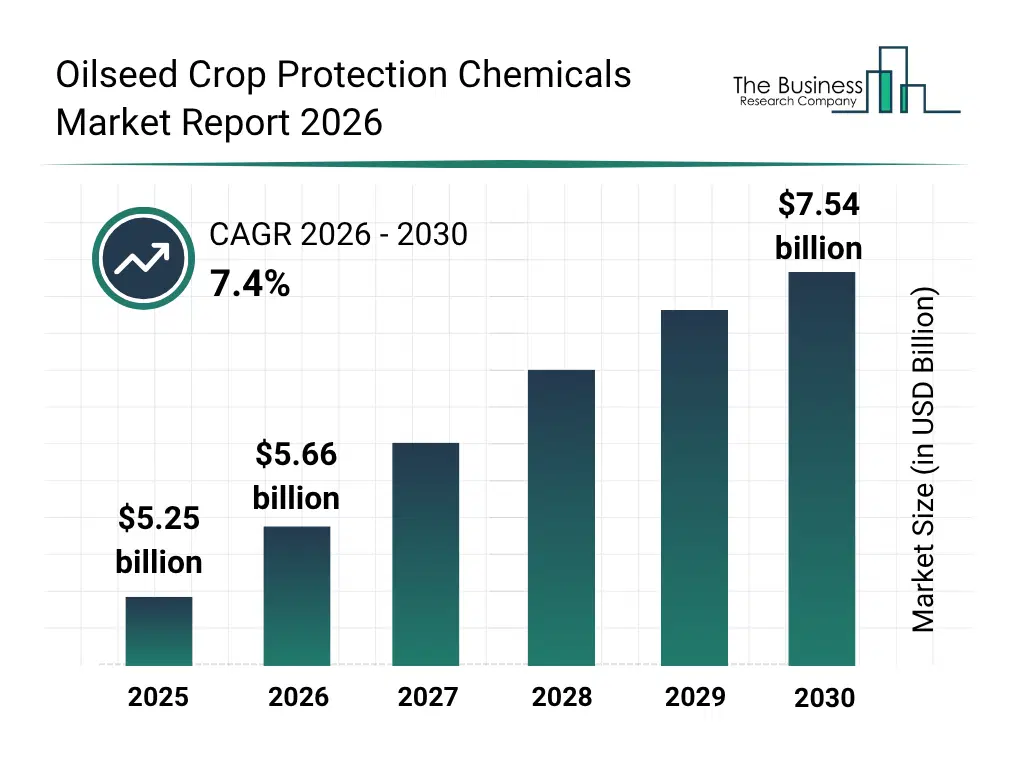
What Is The Oilseed Crop Protection Chemicals Market Size and Share 2026?
The oilseed crop protection chemicals market size has grown strongly in recent years. It will grow from $5.25 billion in 2025 to $5.66 billion in 2026 at a compound annual growth rate (CAGR) of 7.8%. The growth in the historic period can be attributed to rising oilseed cultivation, increasing pest and disease pressure, growing demand for soybean and canola production, expansion of commercial farming, need to minimize crop yield losses.What Is The Oilseed Crop Protection Chemicals Market Growth Forecast?
The oilseed crop protection chemicals market size is expected to see strong growth in the next few years. It will grow to $7.54 billion in 2030 at a compound annual growth rate (CAGR) of 7.4%. The growth in the forecast period can be attributed to increasing global demand for vegetable oils, rising adoption of high-yielding oilseed varieties, increasing frequency of crop pest outbreaks, expansion of oilseed cultivation in emerging economies, growing demand for consistent oilseed crop quality. Major trends in the forecast period include expansion of herbicide-resistant weed management solutions, increasing adoption of combination crop protection products, growing demand for advanced seed treatment chemicals, development of low-application-rate crop protection formulations, increasing use of integrated pest management practices.Tariff Impact On Oilseed Crop Protection Chemicals Market
Tariffs are impacting the oilseed crop protection chemicals market by increasing the cost of imported active ingredients, formulated pesticides, and specialty chemical inputs required for crop protection. This is raising input costs for herbicides, insecticides, fungicides, and seed treatment chemicals, particularly in regions dependent on imported agrochemical raw materials such as Asia-Pacific, North America, and Latin America. Product-intensive segments such as herbicides, insecticides, fungicides, and seed treatment chemicals are most affected due to their dependence on imported chemical inputs and formulations. However, tariffs are also encouraging domestic agrochemical production, regional supplier diversification, and increased investment in local manufacturing capacity, creating long-term resilience in the market.
Global Oilseed Crop Protection Chemicals Market Segmentation
1) By Product Type: Herbicides, Insecticides, Fungicides, Seed Treatment Chemicals, Other Product Types 2) By Crop Type: Soybean, Canola (Rapeseed), Sunflower, Peanut (Groundnut), Mustard, Cottonseed, Sesame, Other Crop Types 3) By Mode of Application: Foliar Spray, Seed Treatment, Soil Treatment, Chemigation 4) By Distribution Channel: Direct Sales, Agricultural Retailers And Dealers, Cooperatives, Online Sales Subsegments: 1) By Herbicides: Selective Herbicides, Non-Selective Herbicides, Pre-Emergence Herbicides, Post-Emergence Herbicides 2) By Insecticides: Organophosphate Insecticides, Pyrethroid Insecticides, Neonicotinoid Insecticides, Diamide Insecticides, Carbamate Insecticides, Biological Insecticides 3) By Fungicides: Triazole Fungicides, Strobilurin Fungicides, Dithiocarbamate Fungicides, Succinate Dehydrogenase Inhibitor Fungicides, Copper-Based Fungicides, Biological Fungicides 4) By Seed Treatment Chemicals: Insecticidal Seed Treatments, Fungicidal Seed Treatments, Nematicidal Seed Treatments, Combination Seed Treatments 5) By Other Product Types: Nematicides, Acaricides, Molluscicides, Plant Growth Regulators, AdjuvantsWhat Is The Driver Of The Oilseed Crop Protection Chemicals Market?
The rising oilseed crop cultivation worldwide is expected to propel the growth of the oilseed crop protection chemicals market going forward. Oilseed crop cultivation refers to the agricultural production of crops such as soybean, rapeseed, sunflower, groundnut, canola, and other oil-bearing crops for edible oil, animal feed, and industrial applications. The rise in oilseed crop cultivation is increasing due to growing global demand for edible oils and bio-based products, encouraging farmers to expand oilseed planting areas and improve production. Oilseed crop cultivation supports the oilseed crop protection chemicals by increasing the demand for products that protect crops from weeds, insects, diseases, nematodes, mites, and other pests, helping improve yield and crop quality. For instance, in September 2025, according to the Agriculture and Horticulture Development Board (AHDB), a UK-based statutory levy board, UK oilseed rape (OSR) production could have increased by 9% to 896 kilotonnes (Kt) in 2025, compared to 2024. Therefore, the rising oilseed crop cultivation worldwide is driving the growth of the oilseed crop protection chemicals industry.Key Players In The Global Oilseed Crop Protection Chemicals Market
Major companies operating in the oilseed crop protection chemicals market are Bayer AG, BASF SE, Syngenta AG, Corteva Inc, UPL Limited, Sumitomo Chemical Co. Ltd., FMC Corporation, ADAMA Ltd., Nufarm Limited, Nutrien Ltd., Nissan Chemical Corporation, Mitsui Chemicals Crop & Life Solutions Inc., Albaugh LLC, Kumiai Chemical Industry Co. Ltd., PI Industries Limited, Sharda Cropchem Limited, Croda International Plc, Rallis India Limited, Nihon Nohyaku Co. Ltd., American Vanguard Corporation, Dhanuka Agritech Limited, Indofil Industries Limited, Sipcam Oxon S.p.A., Gowan Company LLC
This chart is for illustrative purposes; the full report includes a detailed competitor analysis and comprehensive overview of the top 10 companies in the market.
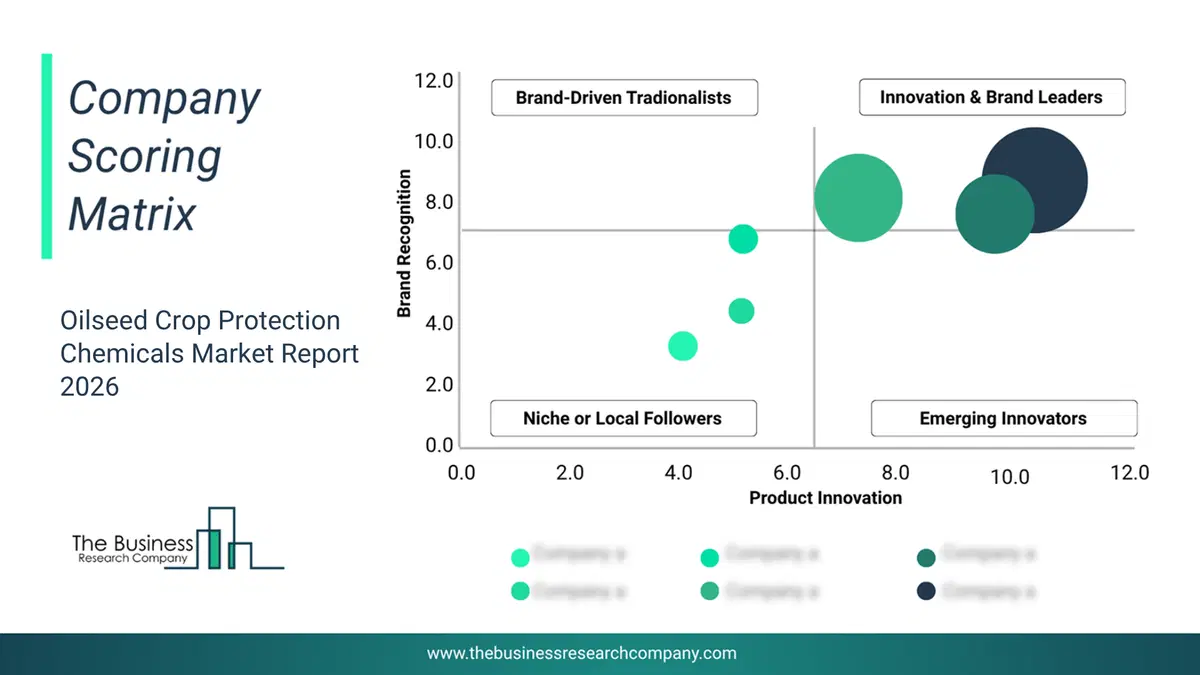
This chart maps companies by product innovation and brand strength, with bubble size indicating relative revenue, helping identify market leaders, challengers, and niche players. This is an illustrative chart; the full report provides a complete and accurate competitive analysis.
Global Oilseed Crop Protection Chemicals Market Trends and Insights
Major companies operating in the oilseed crop protection chemicals market are focusing on developing advanced fungicide co-formulations, such as combinations of complementary active ingredients, to improve disease control, enhance crop protection, and support yield preservation in oilseed crops. Fungicide co-formulations combine multiple active ingredients with different modes of action to provide broad-spectrum protection against fungal diseases affecting oilseed crops. For instance, in February 2025, ADAMA Ltd., an Israel-based crop protection company, launched three new fungicide co-formulations in the UK, including MAXENTIS, a combination of azoxystrobin and prothioconazole. MAXENTIS provides protection against key diseases in oilseed rape, including Sclerotinia and Alternaria, and is formulated for application during flowering and pod development stages. The launch demonstrates the increasing development and commercialization of advanced fungicide co-formulations designed specifically to address disease-control requirements in oilseed crops.What Are Latest Mergers And Acquisitions In The Oilseed Crop Protection Chemicals Market?
In March 2025, FMC Corporation, a US-based manufacturer and marketer of oilseed crop protection chemicals, entered into a strategic collaboration with Bayer AG to bring Isoflex active herbicide technology to European markets. Through this collaboration, FMC aims to expand the commercialization of its IsoflexActive herbicide technology across Europe by leveraging Bayer's established market presence and distribution network while strengthening weed management solutions for European growers. Bayer AG is a Germany-based life sciences company that develops and markets crop protection products, including herbicides for oilseed crops.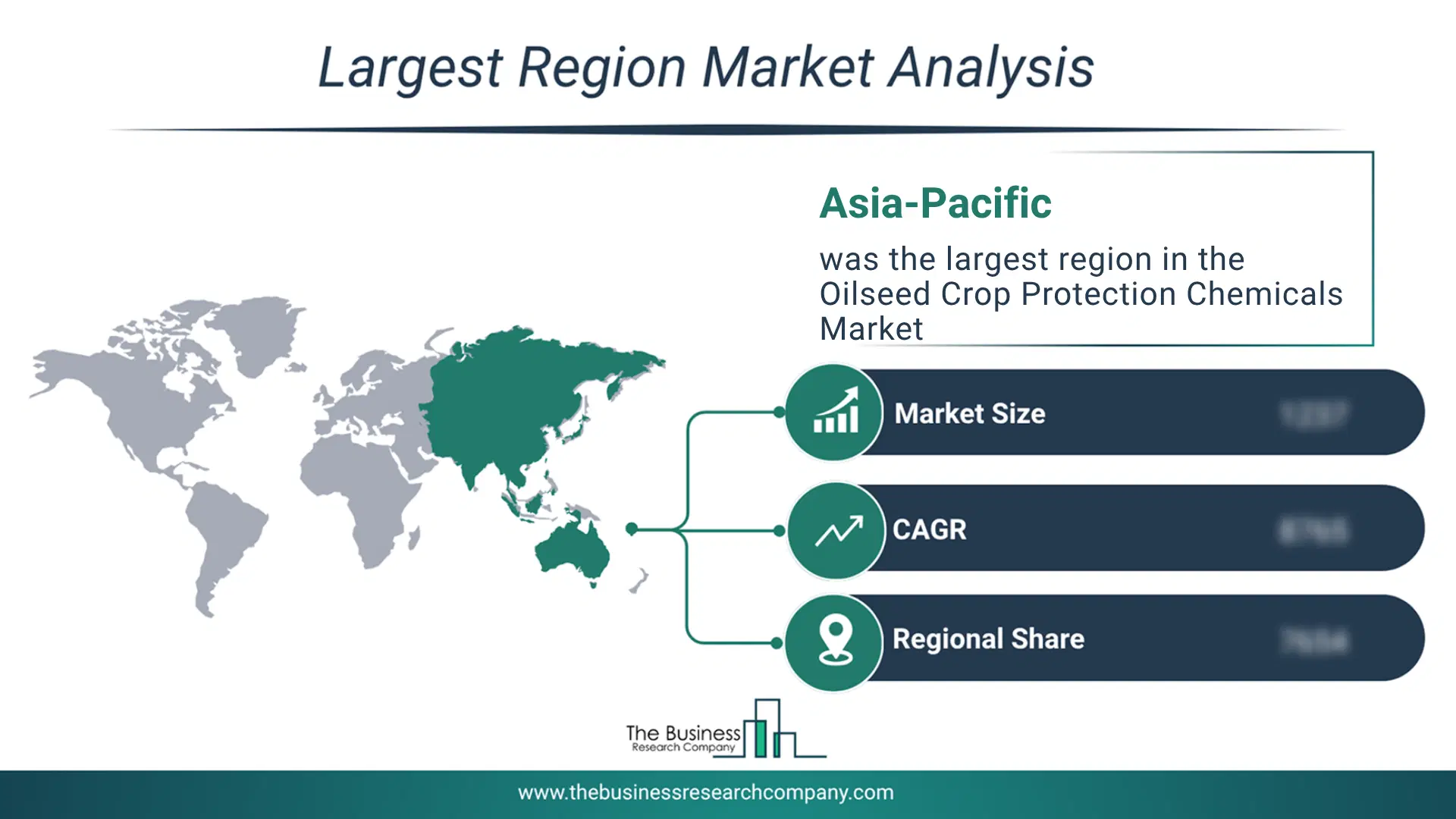
Regional Outlook
Asia-Pacific was the largest region in the oilseed crop protection chemicals market in 2025. Asia-Pacific is expected to be the fastest-growing region in the forecast period. The regions covered in this market report are Asia-Pacific, South East Asia, Western Europe, Eastern Europe, North America, South America, Middle East, Africa. The countries covered in this market report are Australia, Brazil, China, France, Germany, India, Indonesia, Japan, Taiwan, Russia, South Korea, UK, USA, Canada, Italy, Spain.What Defines the Oilseed Crop Protection Chemicals Market?
The oilseed crop protection chemicals market consists of sales of plant growth regulators, nematicides, molluscicides, rodenticides, and acaricides (miticides). Values in this market are ‘factory gate’ values, that is the value of goods sold by the manufacturers or creators of the goods, whether to other entities (including downstream manufacturers, wholesalers, distributors and retailers) or directly to end customers. The value of goods in this market includes related services sold by the creators of the goods.How is Market Value Defined and Measured?
The market value is defined as the revenues that enterprises gain from the sale of goods and/or services within the specified market and geography through sales, grants, or donations in terms of the currency (in USD unless otherwise specified). The revenues for a specified geography are consumption values that are revenues generated by organizations in the specified geography within the market, irrespective of where they are produced. It does not include revenues from resales along the supply chain, either further along the supply chain or as part of other products.
This chart presents market attractiveness based on a quantitative evaluation of growth, competition, strategic alignment, and risk, offering a clear view of opportunity areas for decision-making. This chart is for illustrative purposes; the full report contains the complete analysis.

This chart highlights the Total Addressable Market (TAM) by estimating the maximum revenue opportunity using an assumption-driven approach, supporting strategic planning and opportunity sizing across markets. The chart is illustrative; the full report provides a more comprehensive analysis.
What Key Data and Analysis Are Included in the Oilseed Crop Protection Chemicals Market Report 2026?
The oilseed crop protection chemicals market research report is one of a series of new reports from The Business Research Company that provides market statistics, including industry global market size, regional shares, competitors with the market share, detailed market segments, market trends and opportunities, and any further data you may need to thrive in the oilseed crop protection chemicals industry. The market research report delivers a complete perspective of everything you need, with an in-depth analysis of the current and future state of the industry.Oilseed Crop Protection Chemicals Market Report Forecast Analysis
| Report Attribute | Details |
|---|---|
| Market Size Value In 2026 | $5.66 billion |
| Revenue Forecast In 2030 | $7.54 billion |
| Growth Rate | CAGR of 7.4% from 2026 to 2030 |
| Base Year For Estimation | 2025 |
| Actual Estimates/Historical Data | 2020-2025 |
| Forecast Period | 2026 - 2030 |
| Market Representation | Revenue in USD Billion and CAGR from 2026 to 2030 |
| Segments Covered | Product Type, Crop Type, Mode of Application, Distribution Channel |
| Regional Scope | Asia-Pacific, Western Europe, Eastern Europe, North America, South America, Middle East, Africa |
| Country Scope | The countries covered in the report are Australia, Brazil, China, France, Germany, India, Indonesia, Japan, Taiwan, Russia, South Korea, UK, USA, Canada, Italy, Spain. |
| Key Companies Profiled | Bayer AG, BASF SE, Syngenta AG, Corteva Inc, UPL Limited, Sumitomo Chemical Co. Ltd., FMC Corporation, ADAMA Ltd., Nufarm Limited, Nutrien Ltd., Nissan Chemical Corporation, Mitsui Chemicals Crop & Life Solutions Inc., Albaugh LLC, Kumiai Chemical Industry Co. Ltd., PI Industries Limited, Sharda Cropchem Limited, Croda International Plc, Rallis India Limited, Nihon Nohyaku Co. Ltd., American Vanguard Corporation, Dhanuka Agritech Limited, Indofil Industries Limited, Sipcam Oxon S.p.A., Gowan Company LLC |
| Customization Scope | Request for Customization |
| Pricing And Purchase Options | Explore Purchase Options |