
Oleochemical-Based Food Additive Market Report 2026
Global Outlook – By Product Type (Emulsifiers, Release Agents, Anti-Caking Agents, Other Product Types), By Source (Plant-Based, Animal-Based), By Function (Texture Enhancement, Shelf-Life Extension, Moisture Retention, Anti-Foaming, Flavor Carrier, Other Functions), By Form (Liquid, Powder, Paste), By Distribution Channel (Direct Sales, Distributors And Wholesalers, Online Sales) – Market Size, Trends, Strategies, and Forecast to 2030
Oleochemical-Based Food Additive Market Overview
• Oleochemical-Based Food Additive market size has reached to $1.55 billion in 2025 • Expected to grow to $2.3 billion in 2030 at a compound annual growth rate (CAGR) of 8.2% • Growth Driver: Rising Demand For Clean-Label And Natural Food Ingredients Supports Market Growth Through Increasing Consumer Preference For Transparent Food Products • Market Trend: Expansion Of Plant-Based Fatty Acid Emulsifier Production Enhances Sustainable Food Ingredient Supply • Asia-Pacific was the largest region and fastest growing region.What Is Covered Under Oleochemical-Based Food Additive Market?
Oleochemical-based food additives are ingredients derived from natural oils and fats through oleochemical processing to enhance the functional performance of food products. They improve texture, stability, consistency, processing efficiency, and shelf life while ensuring compatibility with a wide range of food formulations. Oleochemical-based food additives offer a sustainable alternative to petroleum-based ingredients across diverse food manufacturing applications. The main product types in the oleochemical-based food additive market include emulsifiers, release agents, anti-caking agents, and other product types. Emulsifiers refer to ingredients that help stabilize mixtures of ingredients that would otherwise separate, improving consistency, texture, and processing performance. These products are sourced from plant-based and animal-based sources and perform functions including texture enhancement, shelf-life extension, moisture retention, anti-foaming, flavor carrier, and other functions. They are available in liquid, powder, and paste forms and distributed through direct sales, distributors and wholesalers, and online sales.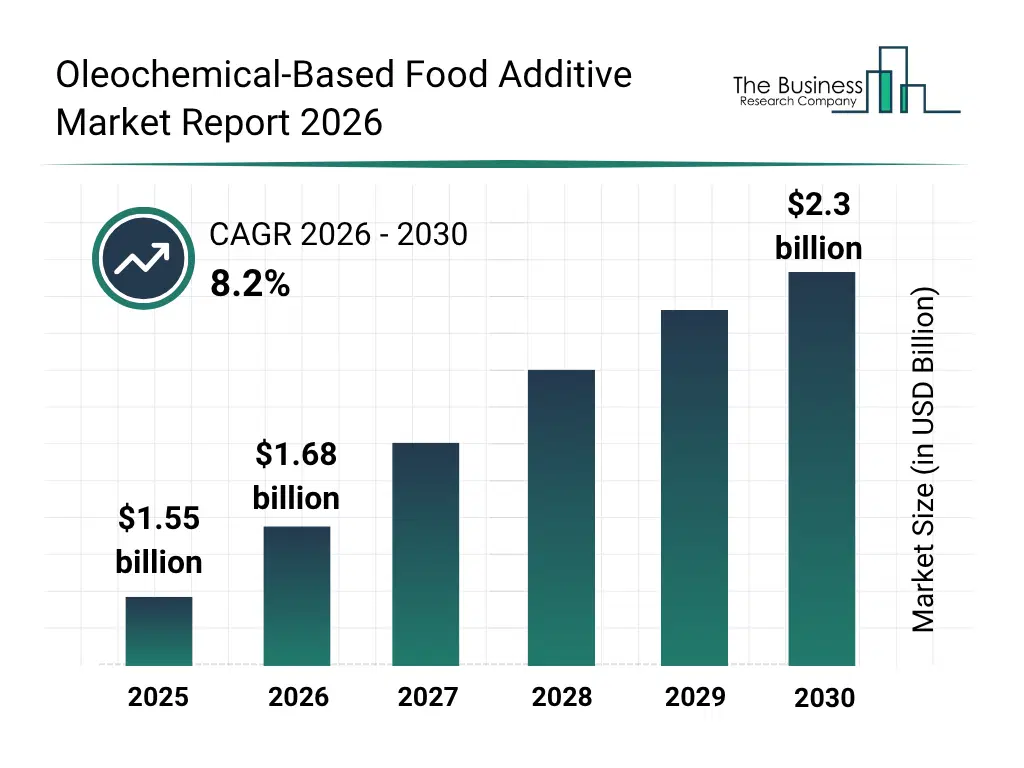
What Is The Oleochemical-Based Food Additive Market Size and Share 2026?
The oleochemical-based food additive market size has grown strongly in recent years. It will grow from $1.55 billion in 2025 to $1.68 billion in 2026 at a compound annual growth rate (CAGR) of 8.6%. The growth in the historic period can be attributed to increasing processed food consumption, growing demand for food texture improvement, expansion of bakery and confectionery production, rising demand for extended food shelf life, increasing use of functional food additives.What Is The Oleochemical-Based Food Additive Market Growth Forecast?
The oleochemical-based food additive market size is expected to see strong growth in the next few years. It will grow to $2.3 billion in 2030 at a compound annual growth rate (CAGR) of 8.2%. The growth in the forecast period can be attributed to growing demand for clean-label ingredients, rising adoption of plant-based food additives, increasing consumption of convenience foods, expansion of food processing industries in emerging economies, growing demand for sustainable food ingredients. Major trends in the forecast period include increasing use of plant-based emulsifiers in food formulations, growing demand for clean-label food additives, rising adoption of natural release agents in food processing, increasing use of oleochemical-based anti-caking agents, growing demand for functional fatty acid esters in food products.Tariff Impact On Oleochemical-Based Food Additive Market
Tariffs are impacting the oleochemical-based food additives market by increasing the cost of imported vegetable oils, animal fats, fatty acid derivatives, processing equipment, and specialty ingredients required for additive production. This is raising procurement and manufacturing costs for emulsifiers, release agents, anti-caking agents, and other oleochemical-based additives, particularly in regions dependent on imported feedstocks such as Asia-Pacific, Europe, and North America. Feedstock-intensive segments such as mono and diglycerides, fatty acid esters, and stearates are most affected due to their reliance on global oil and fat supply chains. However, tariffs are also encouraging local sourcing, regional production, supplier diversification, and investment in domestic oleochemical processing capacity, creating long-term resilience in the market.
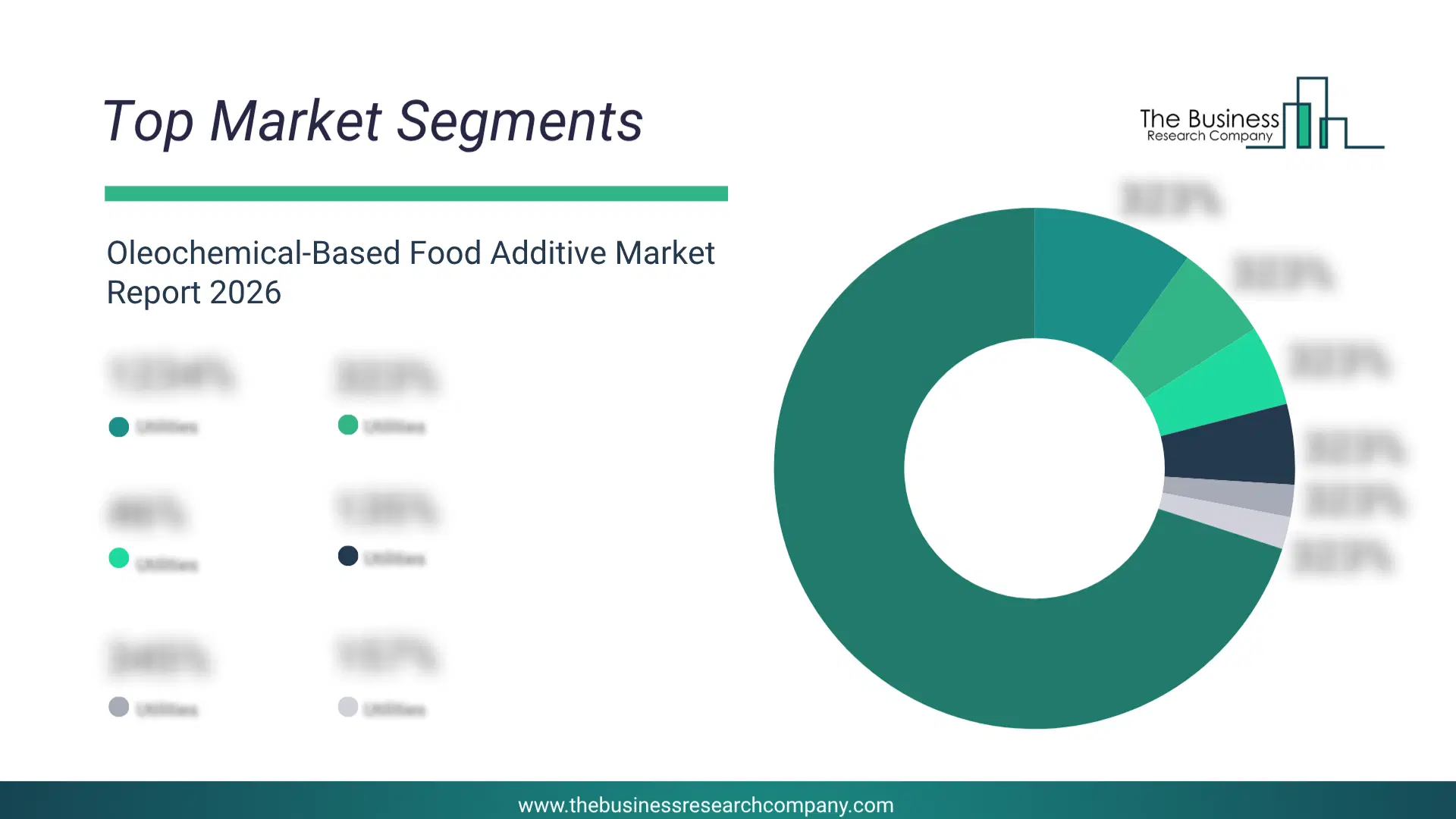
Global Oleochemical Based Food Additive Market Segmentation
1) By Product Type: Emulsifiers, Release Agents, Anti-Caking Agents, Other Product Types 2) By Source: Plant-Based, Animal-Based 3) By Function: Texture Enhancement, Shelf-Life Extension, Moisture Retention, Anti-Foaming, Flavor Carrier, Other Functions 4) By Form: Liquid, Powder, Paste 5) By Distribution Channel: Direct Sales, Distributors And Wholesalers, Online Sales Subsegments: 1) By Emulsifiers: Mono And Diglycerides, Sorbitan Esters, Sucrose Esters, Polyglycerol Esters, Lecithin 2) By Release Agents: Fatty Acid Esters, Glycerol Monostearate, Calcium Stearate 3) By Anti-Caking Agents: Calcium Stearate, Magnesium Stearate, Sodium Stearate 4) By Other Product Types: Citric Acid Esters, Medium Chain Triglycerides, Propylene Glycol EstersWhat Is The Driver Of The Oleochemical-Based Food Additive Market?
The rising demand for clean-label and natural food ingredients is expected to propel the growth of the oleochemical-based food additive market going forward. Clean-label and natural food ingredients refer to food components derived from natural sources with simple and recognizable compositions that meet consumer expectations for transparency, sustainability, and healthier food choices. The rising demand for clean-label and natural food ingredients is driven by consumer preference for minimally processed foods with recognizable ingredients, accelerating the adoption of naturally sourced additives. The growing demand for clean label and natural food ingredients supports oleochemical-based food additives by increasing the need for plant-derived, sustainable ingredients that improve food functionality while meeting consumer preference for cleaner formulations. For instance, in April 2026, according to the National Association of Convenience Stores, a US-based non-profit trade association, a growing share of consumers is prioritizing cleaner products, with about 25% actively choosing snacks that contain no artificial ingredients. Around 68% of consumers support eliminating artificial colors from food and beverages, while 64% prefer the removal of artificial ingredients overall. Therefore, the rising demand for clean-label and natural food ingredients is driving the growth of the oleochemical-based food additive industry.Key Players In The Global Oleochemical-Based Food Additive Market
Major companies operating in the oleochemical-based food additive market are Cargill Incorporated, Archer Daniels Midland Company, Wilmar International Limited, BASF SE, DSM-Firmenich AG, International Flavors & Fragrances Inc, Kerry Group plc, Evonik Industries AG, Kao Corporation, Croda International Plc, Corbion NV, Kuala Lumpur Kepong Berhad, Palsgaard AS, Riken Vitamin Co Ltd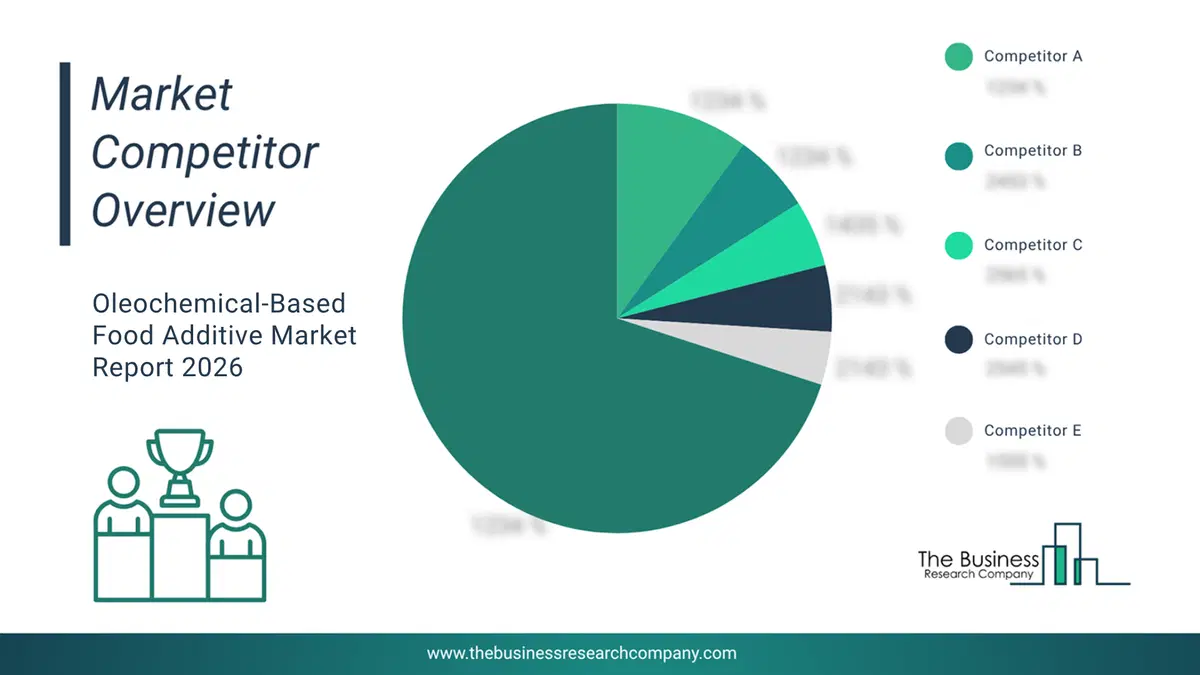
This chart is for illustrative purposes; the full report includes a detailed competitor analysis and comprehensive overview of the top 10 companies in the market.
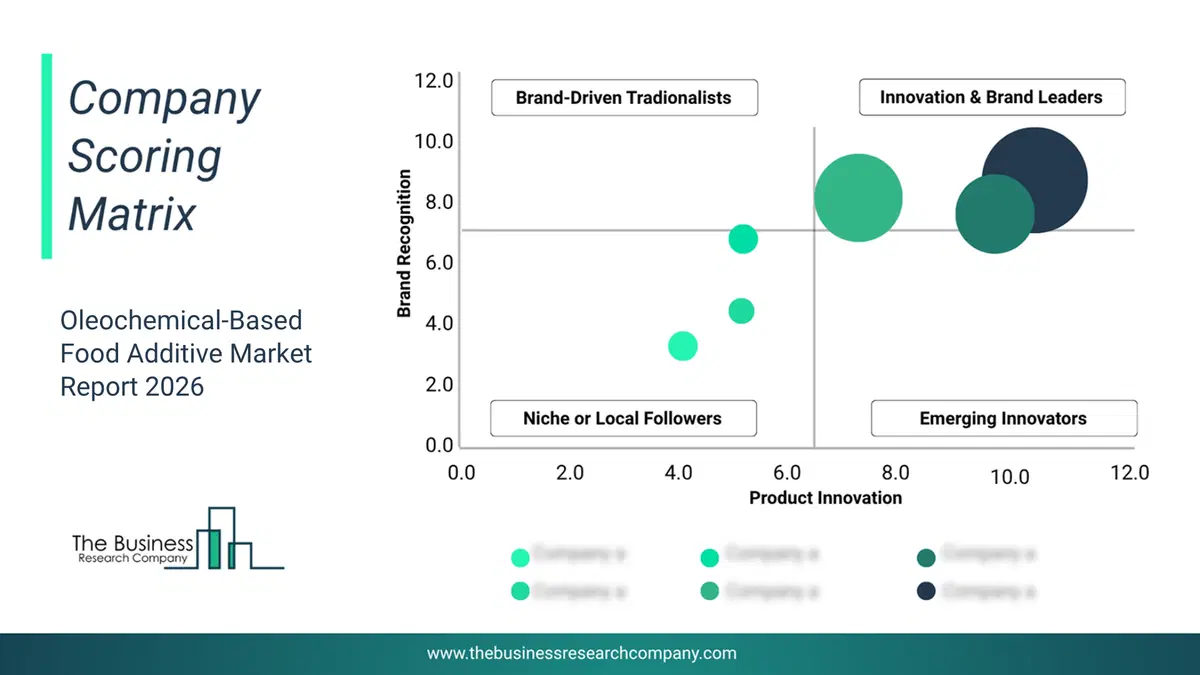
This chart maps companies by product innovation and brand strength, with bubble size indicating relative revenue, helping identify market leaders, challengers, and niche players. This is an illustrative chart; the full report provides a complete and accurate competitive analysis.
Global Oleochemical-Based Food Additive Market Trends and Insights
Major companies operating in the oleochemical-based food additive market are focusing on expanding the production of plant-derived fatty acid emulsifiers, such as polyglycerol esters of fatty acids derived from vegetable oils, to improve food texture, aeration, softness, and formulation performance while enabling the replacement of saturated and trans fats with unsaturated oils. These emulsifiers provide functional properties in bakery formulations by improving batter aeration, maintaining softness, and supporting the use of liquid unsaturated oils as alternatives to solid fats. For instance, in October 2025, Palsgaard A/S, a Denmark-based manufacturer of plant-based food emulsifiers and stabilisers, began producing Emulpals powdered cake emulsifiers at its manufacturing facility in Brazil for the first time. Emulpals comprises plant-based emulsifiers for bakery premixes that improve aeration and softness in cake mixes and enable the replacement of saturated or trans fats with unsaturated liquid oils, while Palsgaard's activated cake emulsifiers include polyglycerol esters of fatty acids.What Are Latest Mergers And Acquisitions In The Oleochemical-Based Food Additive Market?
In March 2026, Bunge Global SA, a Switzerland-based agribusiness and food ingredients company, acquired the soy protein concentrate, lecithin, and soy crush businesses of International Flavors and Fragrances Inc. (IFF) for an undisclosed amount. Through this acquisition, Bunge aims to strengthen its oleochemical-based food additive portfolio by expanding its range of soy lecithin emulsifiers and plant-based protein ingredients for bakery, confectionery, snacks, meat, and alternative protein applications. International Flavors and Fragrances Inc. (IFF) is a US-based provider of oleochemical-based food additives, primarily through its emulsifier product portfolio derived from renewable vegetable oil-based oleochemicals.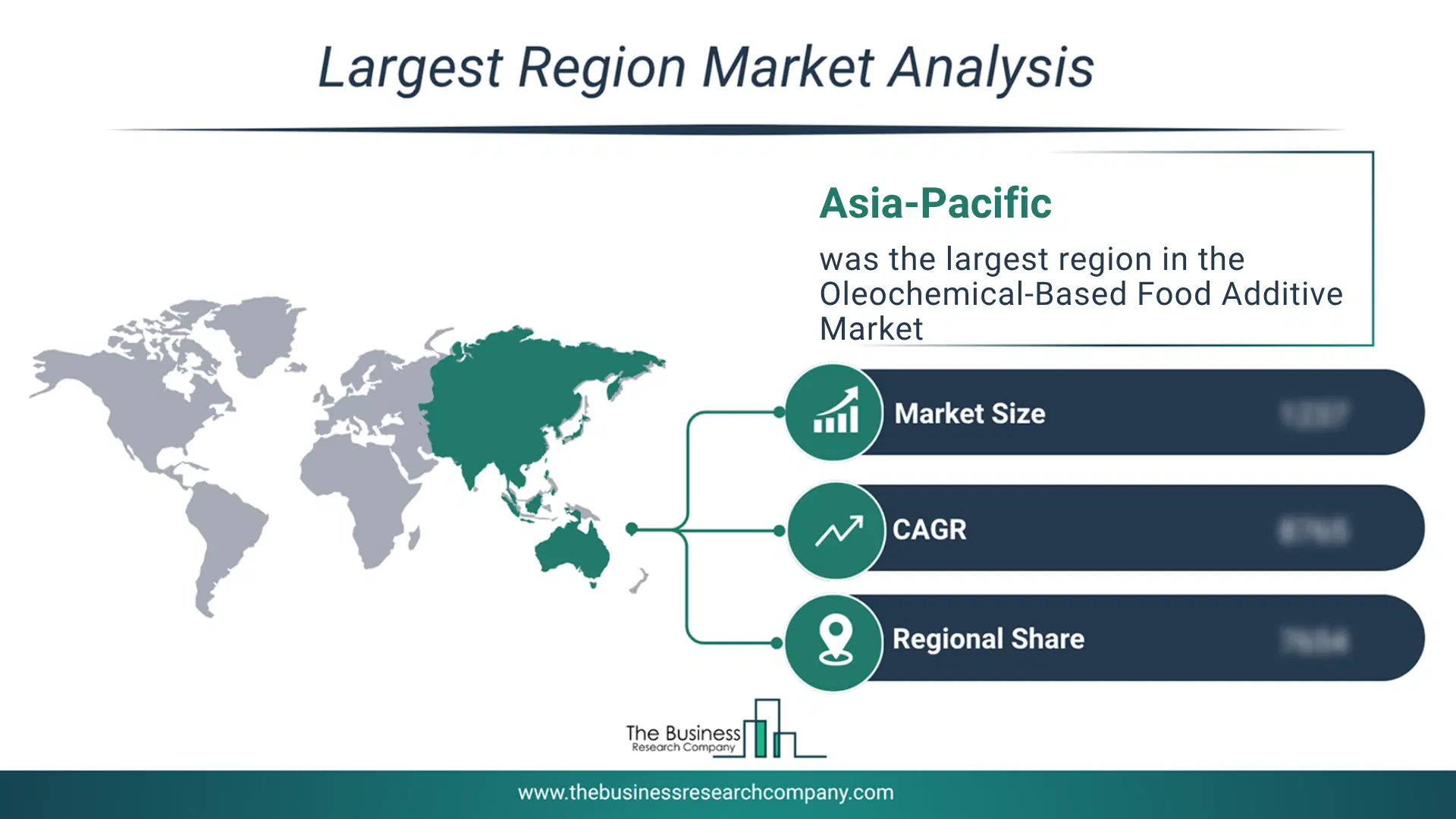
Regional Outlook
Asia-Pacific was the largest region in the oleochemical-based food additive market in 2025. Asia-Pacific is expected to be the fastest-growing region in the forecast period. The regions covered in this market report are Asia-Pacific, South East Asia, Western Europe, Eastern Europe, North America, South America, Middle East, Africa. The countries covered in this market report are Australia, Brazil, China, France, Germany, India, Indonesia, Japan, Taiwan, Russia, South Korea, UK, USA, Canada, Italy, Spain.What Defines the Oleochemical-Based Food Additive Market?
The oleochemical-based food additive market consists of sales of sorbitan esters, sucrose esters, polyglycerol esters, citric acid esters, and stearates, Values in this market are ‘factory gate’ values, that is the value of goods sold by the manufacturers or creators of the goods, whether to other entities (including downstream manufacturers, wholesalers, distributors and retailers) or directly to end customers. The value of goods in this market includes related services sold by the creators of the goods.How is Market Value Defined and Measured?
The market value is defined as the revenues that enterprises gain from the sale of goods and/or services within the specified market and geography through sales, grants, or donations in terms of the currency (in USD unless otherwise specified). The revenues for a specified geography are consumption values that are revenues generated by organizations in the specified geography within the market, irrespective of where they are produced. It does not include revenues from resales along the supply chain, either further along the supply chain or as part of other products.
This chart presents market attractiveness based on a quantitative evaluation of growth, competition, strategic alignment, and risk, offering a clear view of opportunity areas for decision-making. This chart is for illustrative purposes; the full report contains the complete analysis.

This chart highlights the Total Addressable Market (TAM) by estimating the maximum revenue opportunity using an assumption-driven approach, supporting strategic planning and opportunity sizing across markets. The chart is illustrative; the full report provides a more comprehensive analysis.
What Key Data and Analysis Are Included in the Oleochemical-Based Food Additive Market Report 2026?
The oleochemical-based food additive market research report is one of a series of new reports from The Business Research Company that provides market statistics, including industry global market size, regional shares, competitors with the market share, detailed market segments, market trends and opportunities, and any further data you may need to thrive in the oleochemical-based food additive industry. The market research report delivers a complete perspective of everything you need, with an in-depth analysis of the current and future state of the industry.Oleochemical-Based Food Additive Market Report Forecast Analysis
| Report Attribute | Details |
|---|---|
| Market Size Value In 2026 | $1.68 billion |
| Revenue Forecast In 2030 | $2.3 billion |
| Growth Rate | CAGR of 8.2% from 2026 to 2030 |
| Base Year For Estimation | 2025 |
| Actual Estimates/Historical Data | 2020-2025 |
| Forecast Period | 2026 - 2030 |
| Market Representation | Revenue in USD Billion and CAGR from 2026 to 2030 |
| Segments Covered | Product Type, Source, Function, Form, Distribution Channel |
| Regional Scope | Asia-Pacific, Western Europe, Eastern Europe, North America, South America, Middle East, Africa |
| Country Scope | The countries covered in the report are Australia, Brazil, China, France, Germany, India, Indonesia, Japan, Taiwan, Russia, South Korea, UK, USA, Canada, Italy, Spain. |
| Key Companies Profiled | Cargill Incorporated, Archer Daniels Midland Company, Wilmar International Limited, BASF SE, DSM-Firmenich AG, International Flavors & Fragrances Inc, Kerry Group plc, Evonik Industries AG, Kao Corporation, Croda International Plc, Corbion NV, Kuala Lumpur Kepong Berhad, Palsgaard AS, Riken Vitamin Co Ltd |
| Customization Scope | Request for Customization |
| Pricing And Purchase Options | Explore Purchase Options |