

On-Device Intelligence Market Report 2026
Global Outlook – By Technology (Machine Learning, Internet Of Things, Other Technologies), By Application (Smartphones And Tablets, Wearables, Personal Computers (PCs) And Laptops, Other Applications), By End-User (Consumers, Healthcare, Retail And E-commerce, Industrial Sector, Other End-Users) – Market Size, Trends, Strategies, and Forecast to 2030
On-Device Intelligence Market Overview
• On-Device Intelligence market size has reached to $60.01 billion in 2025 • Expected to grow to $148.54 billion in 2030 at a compound annual growth rate (CAGR) of 19.8% • Growth Driver: Growing Adoption Of Internet Of Things (IoT) Devices Propels Market Growth Due To Need For Real-Time Data Processing And Improved Security • Market Trend: Apple Unveils iPhone 16 With Apple Intelligence For Enhanced User Experience • North America was the largest region in 2025.Market Gains By 2030 – Top Opportunities By Segment
Market Gain identifies the most promising market opportunities by highlighting the segments or products expected to generate the highest incremental revenue growth over the next five years.
What Is Covered Under On-Device Intelligence Market?
On-device intelligence refers to the ability of a device to process and analyze data locally using built-in AI and machine learning models rather than relying on cloud computing. This approach enhances privacy, speed, and efficiency by reducing the need for data transmission to external servers. It enables real-time language translation, facial recognition, predictive text, and personalized recommendations while maintaining user data security. The main technologies of on-device intelligence include machine learning, the Internet of Things, and others. Machine learning refers to a branch of artificial intelligence (AI) that enables computers to learn from data and improve their performance on tasks without being explicitly programmed. The various applications include smartphones and tablets, wearables, personal computers (PCs) and laptops, and others. They are used by several end-users, such as consumers, healthcare, retail and e-commerce, industrial sector and others.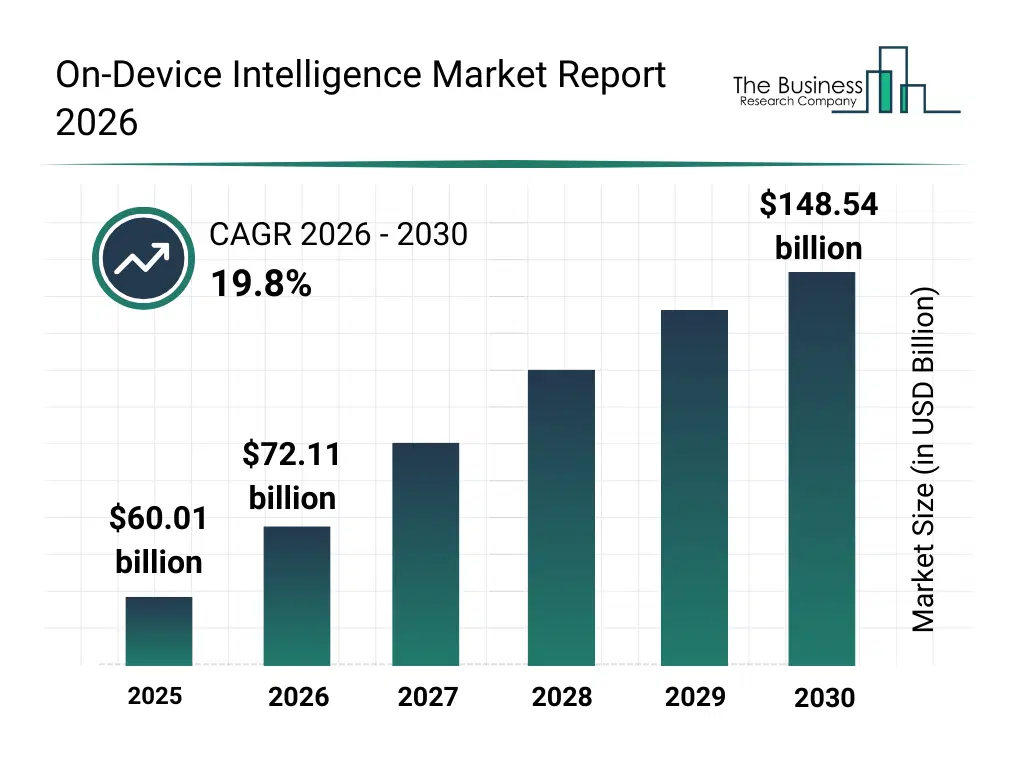
What Is The On-Device Intelligence Market Size and Share 2026?
The on-device intelligence market size has grown exponentially in recent years. It will grow from $60.01 billion in 2025 to $72.11 billion in 2026 at a compound annual growth rate (CAGR) of 20.2%. The growth in the historic period can be attributed to growth of smartphone computing power, early adoption of edge computing, demand for real-time analytics, concerns over data privacy, advancements in semiconductor design.What Is The On-Device Intelligence Market Growth Forecast?
The on-device intelligence market size is expected to see rapid growth in the next few years. It will grow to $148.54 billion in 2030 at a compound annual growth rate (CAGR) of 19.8%. The growth in the forecast period can be attributed to increasing demand for privacy-preserving ai, expansion of wearable and smart devices, growth of autonomous systems, advancements in edge AI chips, reduced reliance on cloud connectivity. Major trends in the forecast period include edge AI processing adoption, privacy-centric data processing, low-latency intelligent applications, AI-optimized hardware integration, energy-efficient on-device AI models.
Global On-Device Intelligence Market Segmentation
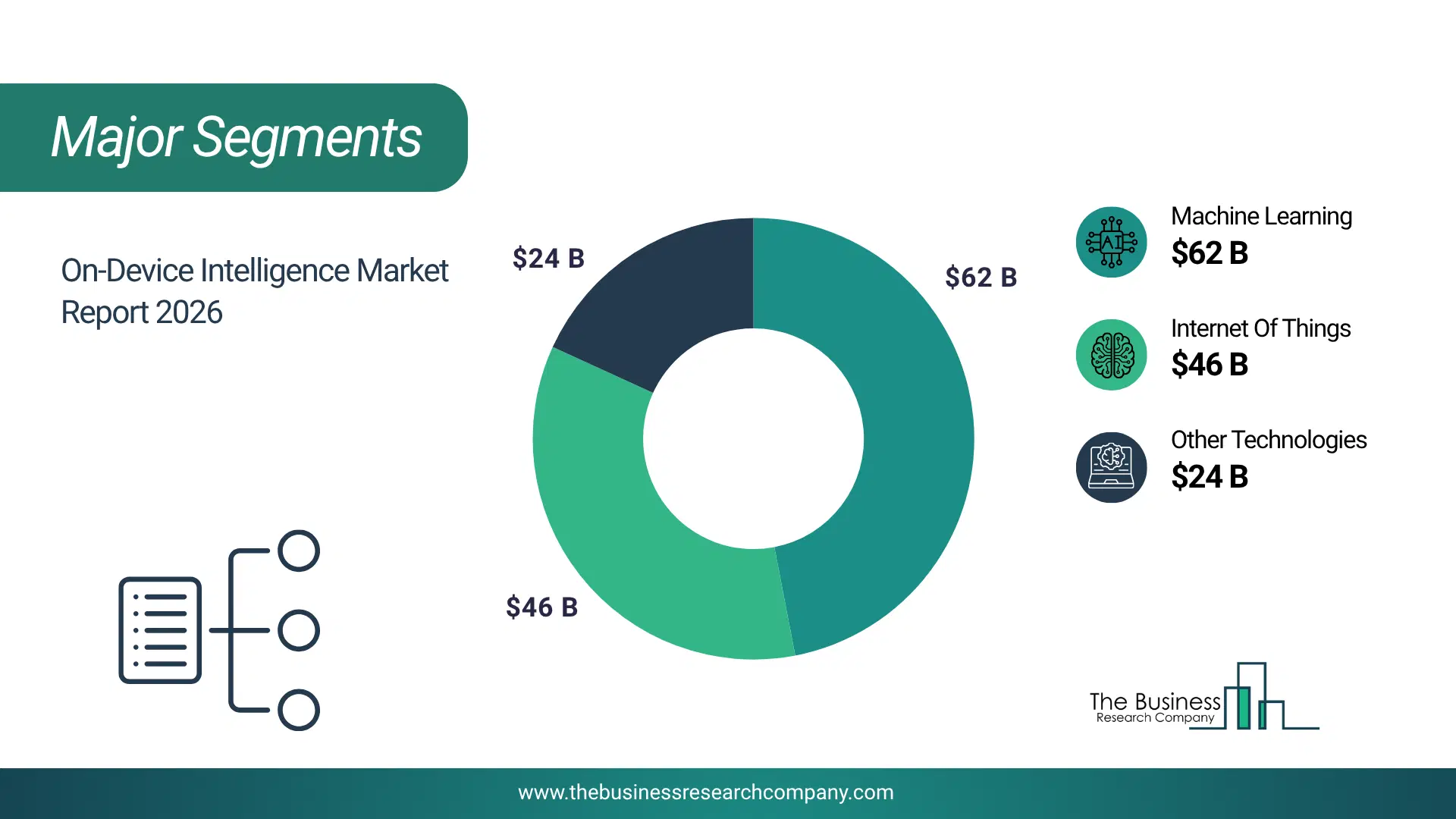
1) By Technology: Machine Learning, Internet Of Things, Other Technologies 2) By Application: Smartphones And Tablets, Wearables, Personal Computers (PCs) And Laptops, Other Applications 3) By End-User: Consumers, Healthcare, Retail And E-commerce, Industrial Sector, Other End-Users Subsegments: 1) By Machine Learning: Supervised Learning, Unsupervised Learning, Reinforcement Learning 2) By Internet Of Things: Smart Home, Industrial IoT, Automotive IoT, Healthcare IoT 3) By Other Technologies: Edge Computing, Natural Language Processing (NLP), Computer Vision The top segments in the construction waste recycling market will be: • Concrete will reach $10.46 Billion by 2030. • Bricks will reach $5.6 Billion by 2030. • Metal will reach $4.7 Billion by 2030. • Wood will reach $2.77 Billion by 2030. • Other Materials will reach $1.68 Billion by 2030. The top segments in the on-device intelligence market will be: • Machine Learning will reach $62.28 Billion by 2030. • Internet Of Things will reach $46.47 Billion by 2030. • Other Technologies will reach $23.92 Billion by 2030.What Is The Driver Of The On-Device Intelligence Market?
The growing adoption of Internet of Things (IoT) devices is expected to propel the growth of the on-device intelligence market going forward. IoT devices refer to physical objects embedded with sensors, software, and connectivity features that enable them to collect, transmit, and exchange data over the internet. The adoption of IoT devices is due to advancements in connectivity, declining sensor costs, and growing adoption across industries for automation and real-time data insights. On-device intelligence enhances IoT devices by enabling real-time data processing, reducing latency, improving security, and minimizing reliance on cloud connectivity for faster and more efficient decision-making. For instance, in October 2025, according to the IoT Analytics, a Germany-based, a leading global provider of market insights, the number of connected IoT devices is projected to grow by 14% in 2025, reaching 39 billion by 2030. Therefore, the growing adoption of IoT devices drives the growth of the on-device intelligence industry.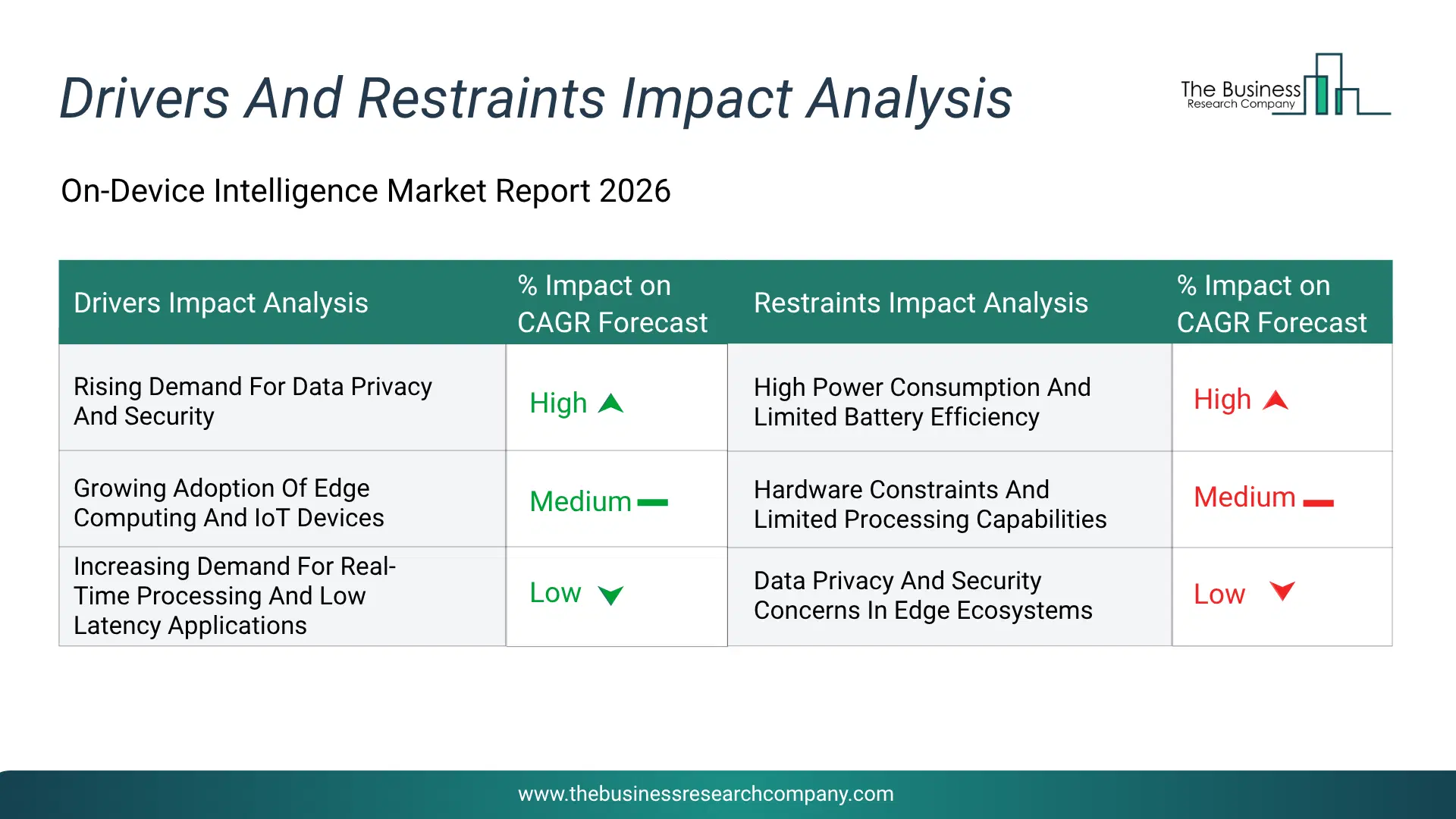
Infographic Chart Showing Key Market Drivers Analysis And Restraints For On-Device Intelligence Market
The chart presents an impact analysis of key drivers and restraints, quantifying their relative influence on the market's growth rate and helping assess the balance between growth enablers and limiting factors. This chart offers a high-level perspective; the full report contains more detailed insights.
How Will The Drivers Impact Growth In The Global On-Device Intelligence Market?
• Rising Demand For Data Privacy And Security (High) – During the forecast period, the rising demand for data privacy and security is expected to become a key growth driver for the on-device intelligence market by 2030. Users and regulators increasingly prefer data processing to occur locally rather than being transmitted to cloud servers. This reduces the risk of data breaches, unauthorized access, and compliance issues related to data protection laws. Organizations adopt on-device AI solutions to ensure sensitive information such as biometric and personal data remains secure within the device. This shift strengthens consumer trust and encourages wider adoption across smartphones, healthcare devices, and financial applications. • Growing Adoption Of Edge Computing And IoT Devices (Medium) – During the forecast period, the growing adoption of edge computing and IoT devices is expected to emerge as a major factor driving the expansion of the on-device intelligence market by 2030. These devices require real-time data processing with minimal latency. On-device AI enables faster decision-making without relying on continuous cloud connectivity, which is critical for applications like autonomous systems, smart homes, and industrial automation. The rapid expansion of connected devices increases the demand for embedded intelligence to handle large volumes of data locally. This reduces bandwidth usage and operational costs while improving system efficiency. Enterprises are increasingly integrating on-device intelligence into edge ecosystems, fueling market expansion. • Increasing Demand For Real-Time Processing And Low Latency Applications (Low) – During the forecast period, the increasing demand for real-time processing and low latency applications is expected to act as a key growth catalyst for the on-device intelligence market by 2030. Increasing demand for real-time processing and low latency applications acts as a major driver for the on-device intelligence market because many modern use cases, such as voice assistants, augmented reality, and predictive analytics, require instant responses. Cloud-based processing often introduces delays due to network dependency, which limits performance in time-sensitive applications. On-device intelligence eliminates this latency by enabling immediate data analysis and response directly on the device. This enhances user experience and operational reliability across consumer electronics and enterprise solutions.How Will The Restraints Impact Growth In The Global On-Device Intelligence Market?
• High Power Consumption And Limited Battery Efficiency (High) – During the forecast period, the high power consumption and limited battery efficiency act as significant restraints in the on-device intelligence market by restricting continuous processing capabilities on edge devices. Advanced AI models require substantial computational resources, which quickly drain battery life in smartphones, wearables, and IoT devices. This limits the deployment of complex real-time applications such as video analytics and continuous speech recognition. Manufacturers must balance performance with energy efficiency, often leading to compromised model accuracy or functionality. As a result, user experience and large-scale adoption of on-device intelligence solutions are constrained. • Hardware Constraints And Limited Processing Capabilities (Medium) – During the forecast period, the hardware constraints and limited processing capabilities pose a major challenge to the growth of the on-device intelligence market. Many edge devices lack the necessary high-performance processors, memory, and specialized AI chips required to run sophisticated machine learning models locally. This restricts the complexity and size of models that can be deployed on-device, limiting advanced analytics and deep learning applications. Additionally, upgrading hardware increases device costs, making it less accessible for price-sensitive markets. Consequently, these limitations slow down innovation and hinder widespread adoption across diverse consumer and industrial segments. • Data Privacy And Security Concerns In Edge Ecosystems (Low) – During the forecast period, the data privacy and security concerns in edge ecosystems act as a restraint despite on-device intelligence being designed to enhance data protection. Devices processing sensitive personal data locally still face risks such as unauthorized access, device hacking, and data leakage. Ensuring robust encryption, secure storage, and regular software updates increases development complexity and costs for manufacturers. Moreover, lack of standardized security frameworks across devices creates inconsistencies in protection levels. These concerns reduce consumer trust and slow the adoption of on-device AI solutions, especially in highly regulated industries.Key Players In The Global On-Device Intelligence Market
Major companies operating in the on-device intelligence market are Amazon.com Inc., Apple Inc., Google LLC, Samsung Electronics Co. Ltd., Microsoft Corporation, Sony Corporation, Huawei Technologies Co. Ltd., Intel Corporation, International Business Machines Corporation, Qualcomm Incorporated, Broadcom Inc., Micron Technology Inc., NVIDIA Corporation, Texas Instruments Incorporated, MediaTek Inc., Rockwell Automation Inc., Xilinx Inc., ARM Holdings plc, Cypress Semiconductor Corporation, Robert Bosch GmbH, Vuzix Corporation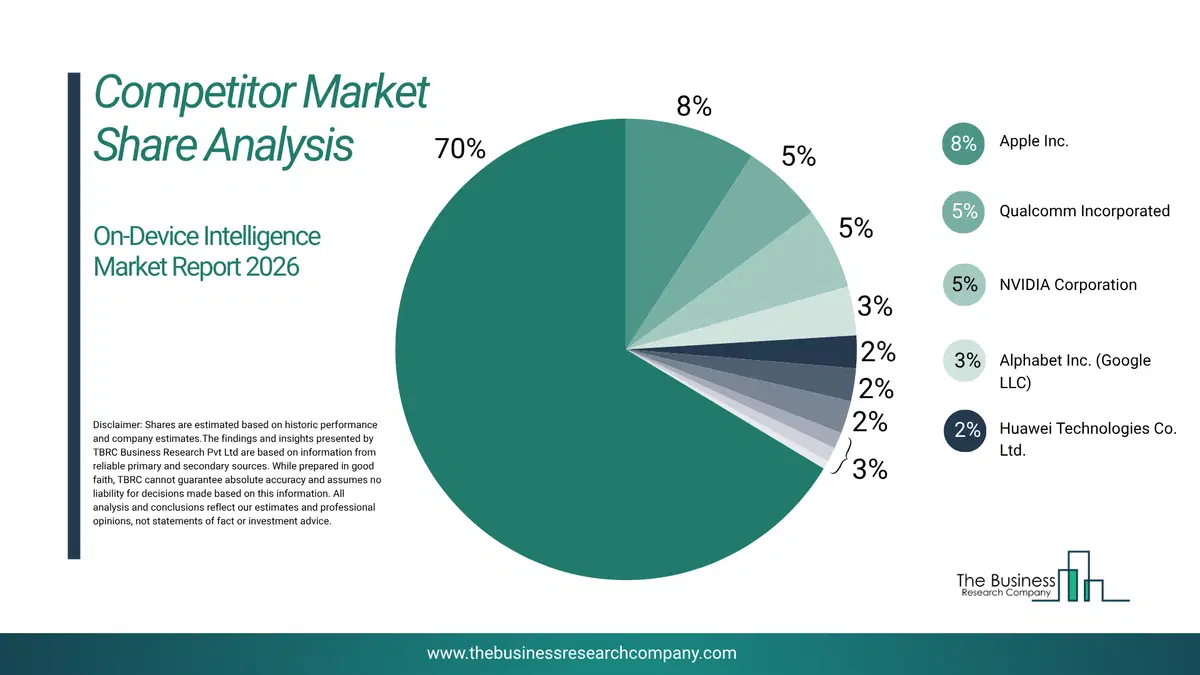
This chart is for illustrative purposes; the full report includes a detailed competitor analysis and comprehensive overview of the top 10 companies in the market.
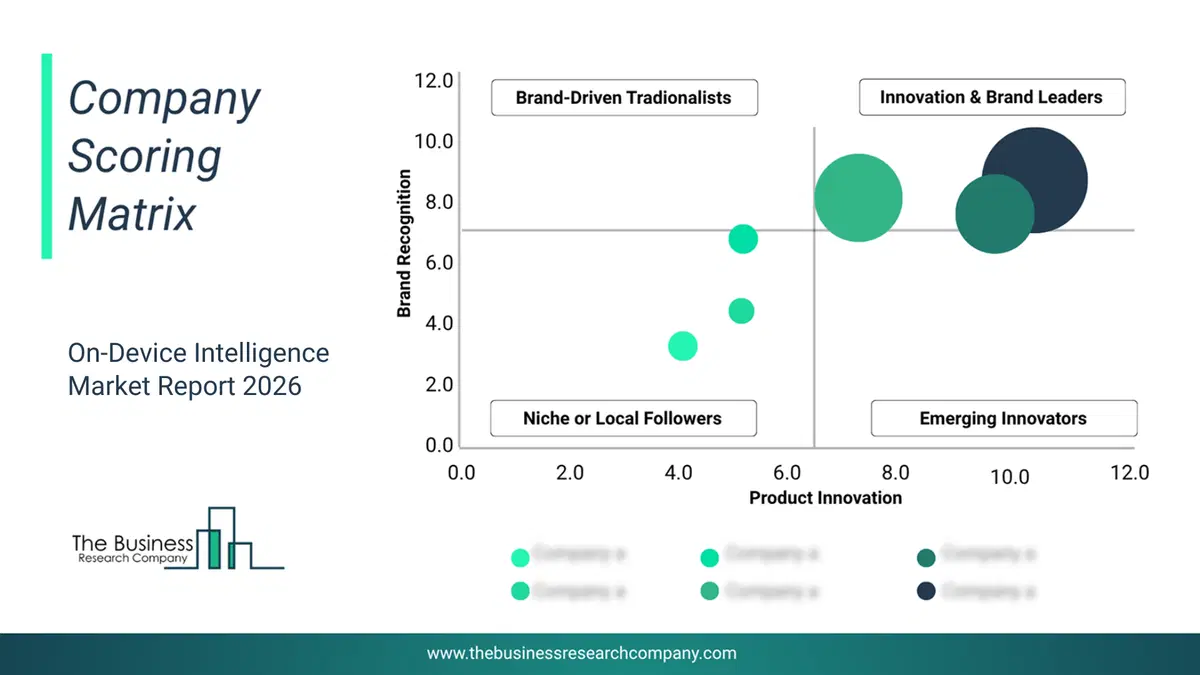
This chart maps companies by product innovation and brand strength, with bubble size indicating relative revenue, helping identify market leaders, challengers, and niche players. This is an illustrative chart; the full report provides a complete and accurate competitive analysis.
Global On-Device Intelligence Market Trends and Insights
Major companies operating in the on-device intelligence market are focusing on developing innovative technologies, such as GenAI features, to enhance real-time processing, improve user personalization, strengthen data security, and reduce dependence on cloud computing for faster and more efficient AI-driven experiences. GenAI features refer to advanced artificial intelligence capabilities that enable machines to generate human-like content, such as text, images, audio, and code, based on learned patterns from vast datasets. For instance, in September 2024, Apple Inc., a US-based technology company, launched the iPhone 16 series, powered by the new A18 Bionic chip based on the Arm V9 architecture. The A18 Bionic chip in the iPhone 16 series is designed to enhance on-device intelligence by enabling more sophisticated, faster, and power-efficient AI-driven features. This chip allows for the integration of Apple Intelligence, a suite of advanced AI features that enhance the user experience by providing smart functionalities like text rewriting, proofreading, and summarizing content across apps such as mail, notes, and pages, as well as audio transcription and summarization in the Phone and Notes apps.What Are Latest Mergers And Acquisitions In The On-Device Intelligence Market?
In April 2024, Apple Inc., a US-based technology company, acquired Datakalab for an undisclosed amount. With this acquisition, Apple aims to enhance its on-device AI capabilities, improve real-time processing efficiency, and strengthen privacy-focused AI solutions by integrating Datakalab’s low-power deep learning algorithms into its ecosystem. Datakalab is a France-based company that develops efficient AI algorithms for on-device processing.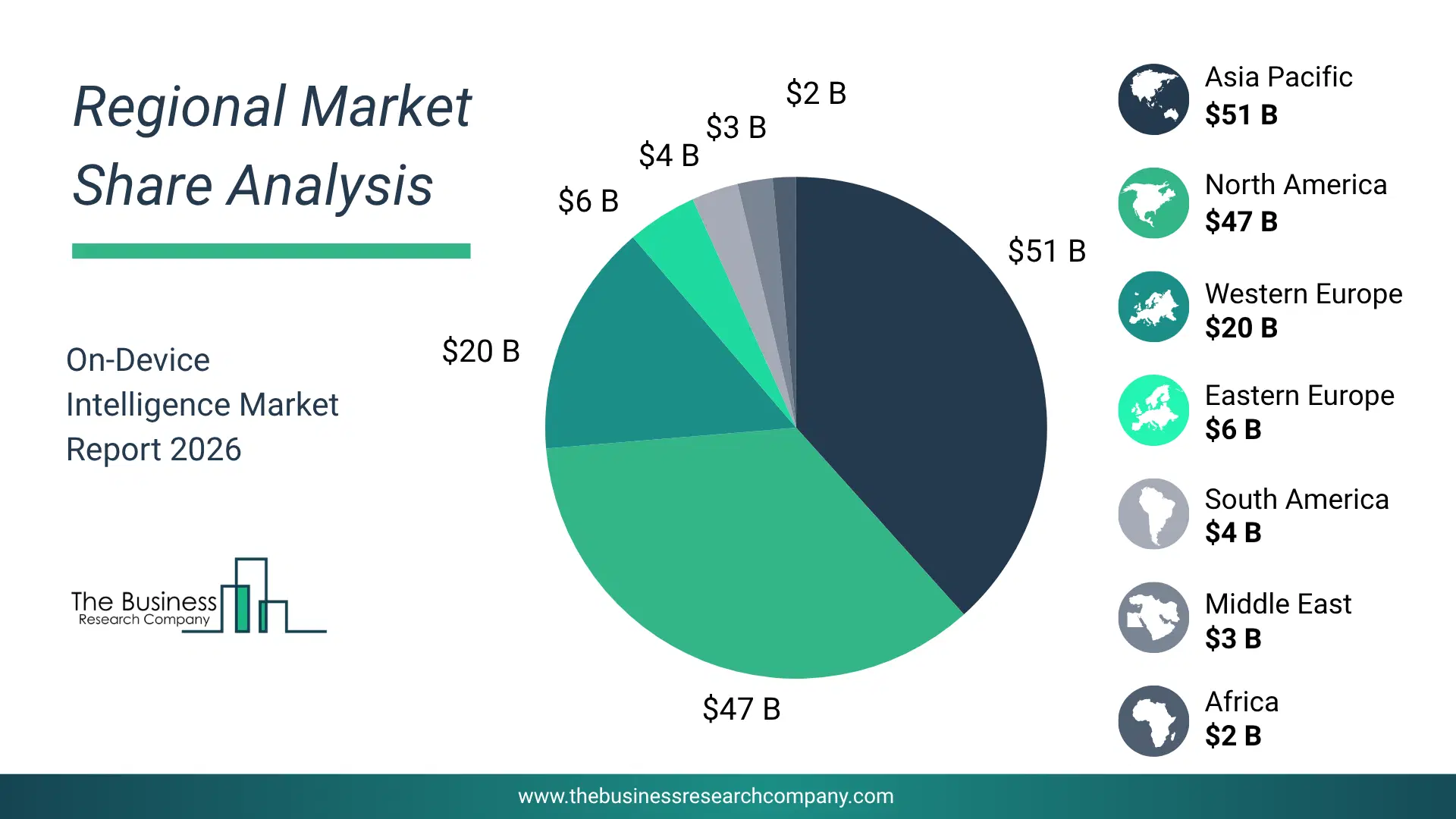
Regional Insights
North America was the largest region in the on device intelligence market in 2025. The regions covered in this market report are Asia-Pacific, South East Asia, Western Europe, Eastern Europe, North America, South America, Middle East, Africa. The countries covered in this market report are Australia, Brazil, China, France, Germany, India, Indonesia, Japan, Taiwan, Russia, South Korea, UK, USA, Canada, Italy, Spain.What Defines the On-Device Intelligence Market?
The on-device intelligence market consists of revenues earned by entities providing services such as speech recognition, image and video recognition, natural language processing (NLP), and predictive analytics. The market value includes the value of related goods sold by the service provider or included within the service offering. The on-device intelligence market also includes sales of smart home devices, autonomous vehicles and drones, edge computing devices, and biometric devices. Values in this market are ‘factory gate’ values, that is the value of goods sold by the manufacturers or creators of the goods, whether to other entities (including downstream manufacturers, wholesalers, distributors and retailers) or directly to end customers. The value of goods in this market includes related services sold by the creators of the goods.How is Market Value Defined and Measured?
The market value is defined as the revenues that enterprises gain from the sale of goods and/or services within the specified market and geography through sales, grants, or donations in terms of the currency (in USD unless otherwise specified). The revenues for a specified geography are consumption values that are revenues generated by organizations in the specified geography within the market, irrespective of where they are produced. It does not include revenues from resales along the supply chain, either further along the supply chain or as part of other products.
This chart presents market attractiveness based on a quantitative evaluation of growth, competition, strategic alignment, and risk, offering a clear view of opportunity areas for decision-making. This chart is for illustrative purposes; the full report contains the complete analysis.

This chart highlights the Total Addressable Market (TAM) by estimating the maximum revenue opportunity using an assumption-driven approach, supporting strategic planning and opportunity sizing across markets. The chart is illustrative; the full report provides a more comprehensive analysis.
What Key Data and Analysis Are Included in the On-Device Intelligence Market Report 2026?
The on-device intelligence market research report is one of a series of new reports from The Business Research Company that provides market statistics, including industry global market size, regional shares, competitors with the market share, detailed market segments, market trends and opportunities, and any further data you may need to thrive in the on-device intelligence industry. The market research report delivers a complete perspective of everything you need, with an in-depth analysis of the current and future state of the industry.On-Device Intelligence Market Report Forecast Analysis
| Report Attribute | Details |
|---|---|
| Market Size Value In 2026 | $72.11 billion |
| Revenue Forecast In 2030 | $148.54 billion |
| Growth Rate | CAGR of 20.2% from 2026 to 2030 |
| Base Year For Estimation | 2025 |
| Actual Estimates/Historical Data | 2020-2025 |
| Forecast Period | 2026 - 2030 |
| Market Representation | Revenue in USD Billion and CAGR from 2026 to 2030 |
| Segments Covered | Technology, Application, End-User |
| Regional Scope | Asia-Pacific, Western Europe, Eastern Europe, North America, South America, Middle East, Africa |
| Country Scope | The countries covered in the report are Australia, Brazil, China, France, Germany, India, Indonesia, Japan, Taiwan, Russia, South Korea, UK, USA, Canada, Italy, Spain. |
| Key Companies Profiled | Amazon.com Inc., Apple Inc., Google LLC, Samsung Electronics Co. Ltd., Microsoft Corporation, Sony Corporation, Huawei Technologies Co. Ltd., Intel Corporation, International Business Machines Corporation, Qualcomm Incorporated, Broadcom Inc., Micron Technology Inc., NVIDIA Corporation, Texas Instruments Incorporated, MediaTek Inc., Rockwell Automation Inc., Xilinx Inc., ARM Holdings plc, Cypress Semiconductor Corporation, Robert Bosch GmbH, Vuzix Corporation |
| Customization Scope | Request for Customization |
| Pricing And Purchase Options | Explore Purchase Options |