
On-Orbit Propellant Depot Market Report 2026
Global Outlook – By Depot Type (Permanent, Temporary), By Propellant Type (Cryogenic, Non-Cryogenic), By Application (Satellite Refueling, Deep Space Missions, Spacecraft Servicing, Other Applications), By End-User (Commercial, Government And Defense, Research Organizations) – Market Size, Trends, Strategies, and Forecast to 2030
On-Orbit Propellant Depot Market Overview
• On-Orbit Propellant Depot market size has reached to $1.88 billion in 2025 • Expected to grow to $4.48 billion in 2030 at a compound annual growth rate (CAGR) of 18.9% • Growth Driver: Increasing Prioritization Of Lunar And Martian Exploration Fueling The Growth Of The Market Due To Geopolitical Competition And Long-Duration Mission Needs • Market Trend: Standardized Refueling Interfaces Support Sustainable Space Operations • North America was the largest region in 2025.What Is Covered Under On-Orbit Propellant Depot Market?
An on-orbit propellant depot is a space-based facility that stores and supplies fuel to satellites, spacecraft, or space stations while in orbit. Its primary purpose is to extend the operational life of satellites, support deep-space missions, and enable refueling of spacecraft without returning to Earth. This infrastructure allows spacecraft to launch with less fuel, reduces mission costs, supports reusable space vehicles, and facilitates long-duration missions such as lunar or interplanetary exploration by providing a refueling waypoint in space. The main depot types of on-orbit propellant depot are permanent and temporary. Permanent depots are in-space storage facilities designed to hold propellants or supplies in orbit for long-term use, supporting sustained space operations. It includes various propellant types, such as cryogenic and non-cryogenic, and us sed for applications such as satellite refueling, deep space missions, spacecraft servicing, and others. The kiey end users include commercial, government and defense, and research organizations.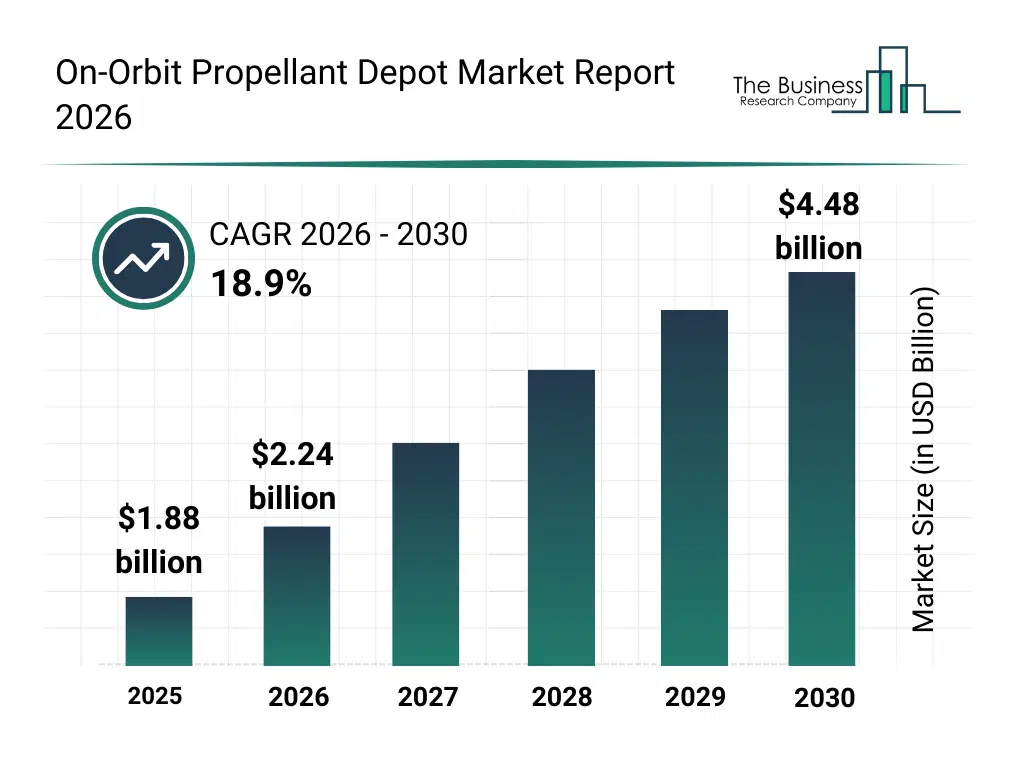
What Is The On-Orbit Propellant Depot Market Size and Share 2026?
The on-orbit propellant depot market size has grown rapidly in recent years. It will grow from $1.88 billion in 2025 to $2.24 billion in 2026 at a compound annual growth rate (CAGR) of 19.1%. The growth in the historic period can be attributed to growing number of long-duration satellite missions, rising interest in reusable spacecraft, development of in-orbit refueling technologies, government and commercial space agency investments, increasing need to extend satellite operational life.What Is The On-Orbit Propellant Depot Market Growth Forecast?
The on-orbit propellant depot market size is expected to see rapid growth in the next few years. It will grow to $4.48 billion in 2030 at a compound annual growth rate (CAGR) of 18.9%. The growth in the forecast period can be attributed to expansion of modular refueling interface kits, adoption of autonomous docking and fuel transfer systems, growth in deep-space mission support, rising use of miniature propellant tanks for small satellites, development of international in-orbit fuel supply infrastructure. Major trends in the forecast period include modular refueling interfaces and docking adaptors, miniaturized propellant storage solutions, autonomous fuel transfer systems, support for reusable space vehicles, in-orbit refueling for lunar and deep-space missions.
Global On-Orbit Propellant Depot Market Segmentation
1) By Depot Type: Permanent, Temporary 2) By Propellant Type: Cryogenic, Non-Cryogenic 3) By Application: Satellite Refueling, Deep Space Missions, Spacecraft Servicing, Other Applications 4) By End-User: Commercial, Government And Defense, Research Organizations Subsegments: 1) By Permanent: Government Operated, Commercial Operated, International Collaborative 2) By Temporary: Mission Specific, Experimental, Emergency SupportWhat Is Driver Of The On-Orbit Propellant Depot Market?
The increasing prioritization of lunar and Martian exploration is expected to propel the growth of the on-orbit propellant depot market going forward. Lunar and martian exploration refers to the development of human and robotic missions aimed at exploring, establishing presence, and conducting research on the Moon and Mars. The increasing prioritization of lunar and Martian exploration is due to geopolitical competition, as nations aim to assert leadership in space to gain strategic, scientific, and economic advantages. On-orbit propellant depots support lunar and Martian exploration by providing in-space refueling capabilities, making long-duration missions feasible. They reduce the need for multiple Earth launches by enabling spacecraft to replenish fuel in orbit, improving mission efficiency and sustainability. For instance, in July 2023, according to the National Aeronautics and Space Administration, a US-based government agency, the U.S. government allocated $7.478 billion for Moon-to-Mars exploration under the Artemis program, representing a $687 million increase compared to 2022. Therefore, the increasing prioritization of lunar and Martian exploration is driving the growth of the on-orbit propellant depot industry.Key Players In The Global On-Orbit Propellant Depot Market
Major companies operating in the on-orbit propellant depot market are The Boeing Company, Northrop Grumman Corporation, Thales Group, SpaceX Corp., Moog Inc., Argo Space Corp, MT Aerospace AG, Gateway Galactic Inc., Sierra Space Corporation, Redwire Corporation, Axiom Space Inc., Astroscale U.S. Inc., Firefly Aerospace Inc., D-Orbit S.p.A., Nanoracks LLC, Orbit Fab Inc., Eta Space LLC, SAB Aerospace Inc., Altius Space Machines Inc., Momentus Inc., Kosmok Inc.
This chart is for illustrative purposes; the full report includes a detailed competitor analysis and comprehensive overview of the top 10 companies in the market.
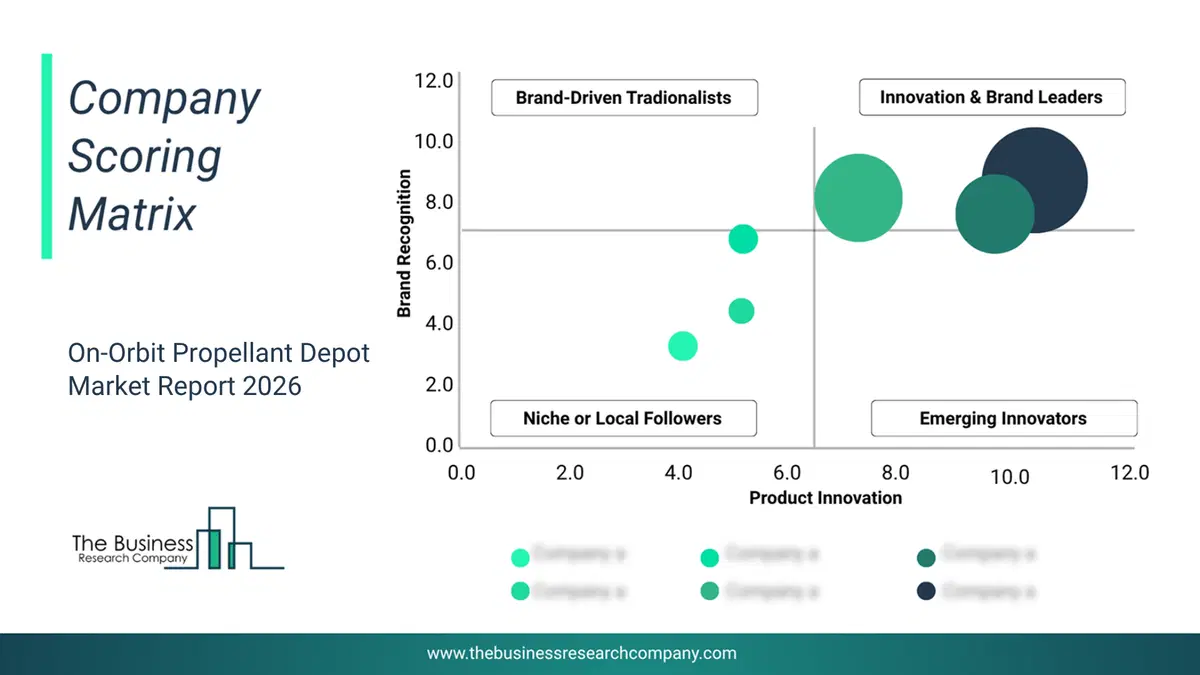
This chart maps companies by product innovation and brand strength, with bubble size indicating relative revenue, helping identify market leaders, challengers, and niche players. This is an illustrative chart; the full report provides a complete and accurate competitive analysis.
Global On-Orbit Propellant Depot Market Trends and Insights
Major companies operating in the on-orbit propellant depot market are focusing on advanced technologies, such as zero-loss cryogenic propellant storage and transfer systems, to gain a competitive advantage. This technology systems designed to store, manage and transfer super-cold rocket fuels in space with minimal boil-off and precise fluid handling enables spacecraft to refuel in orbit and extend mission capabilities. For instance, in October 2025, Rocket Lab, a US-based space systems company, completed its Photon spacecraft build for the LOXSAT mission, which features zero-loss liquid oxygen storage, automated docking interfaces, and integrated fluid-transfer hardware for deployment in 2026. The benefits include lower launch mass, reduced dependence on heavy lift systems, and longer mission durations; however, the technology demands high-precision thermal control, introduces complexity in spacecraft docking operations, and requires regulatory frameworks that are still evolving.What Are Latest Mergers And Acquisitions In The On-Orbit Propellant Depot Market? Clearspace S.A. And Orbit Fab Partner To Advance In-Space Refueling Services
In January 2024, ClearSpace S.A., a Switzerland-based space debris removal company, partnered with Orbit Fab Inc. to develop an in-space refueling service. This collaboration aims to develop an integrated refueling service architecture combining Orbit Fab’s fuel depot and RAFTI refueling interface with ClearSpace’s shuttle platform to accelerate the commercialization of in-space propellant transfer and depot capabilities. Orbit Fab Inc. is a US-based company developing in-space fuel depots, providing on-orbit refueling services for satellites and spacecraft.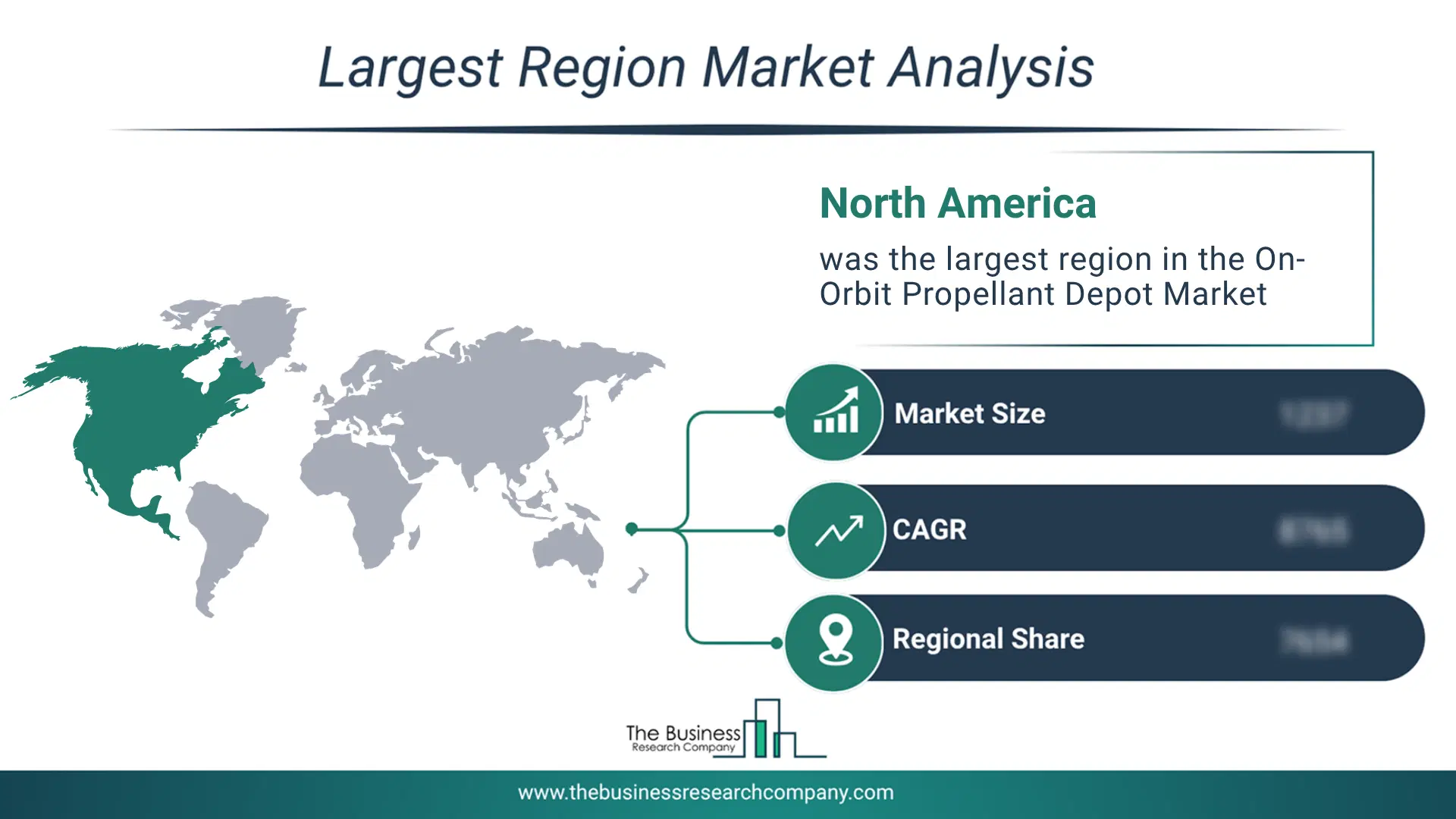
Regional Insights
North America was the largest region in the on-orbit propellant depot market in 2025. The regions covered in this market report are Asia-Pacific, South East Asia, Western Europe, Eastern Europe, North America, South America, Middle East, Africa. The countries covered in this market report are Australia, Brazil, China, France, Germany, India, Indonesia, Japan, Taiwan, Russia, South Korea, UK, USA, Canada, Italy, SpainWhat Defines the On-Orbit Propellant Depot Market?
The on-orbit propellant depot market consists of sales of modular refueling interface kits, autonomous docking adapters, fuel transfer subsystems, miniature propellant tanks, and in-orbit propellant storage modules. Values in this market are ‘factory gate’ values, that is, the value of goods sold by the manufacturers or creators of the goods, whether to other entities (including downstream manufacturers, wholesalers, distributors, and retailers) or directly to end customers. The value of goods in this market includes related services sold by the creators of the goods.How is Market Value Defined and Measured?
The market value is defined as the revenues that enterprises gain from the sale of goods and/or services within the specified market and geography through sales, grants, or donations in terms of the currency (in USD unless otherwise specified). The revenues for a specified geography are consumption values that are revenues generated by organizations in the specified geography within the market, irrespective of where they are produced. It does not include revenues from resales along the supply chain, either further along the supply chain or as part of other products.
This chart presents market attractiveness based on a quantitative evaluation of growth, competition, strategic alignment, and risk, offering a clear view of opportunity areas for decision-making. This chart is for illustrative purposes; the full report contains the complete analysis.

This chart highlights the Total Addressable Market (TAM) by estimating the maximum revenue opportunity using an assumption-driven approach, supporting strategic planning and opportunity sizing across markets. The chart is illustrative; the full report provides a more comprehensive analysis.
What Key Data and Analysis Are Included in the On-Orbit Propellant Depot Market Report 2026?
The on-orbit propellant depot market research report is one of a series of new reports from The Business Research Company that provides market statistics, including industry global market size, regional shares, competitors with the market share, detailed market segments, market trends and opportunities, and any further data you may need to thrive in the on-orbit propellant depot industry. The market research report delivers a complete perspective of everything you need, with an in-depth analysis of the current and future state of the industry.On-Orbit Propellant Depot Market Report Forecast Analysis
| Report Attribute | Details |
|---|---|
| Market Size Value In 2026 | $2.24 billion |
| Revenue Forecast In 2030 | $4.48 billion |
| Growth Rate | CAGR of 18.9% from 2026 to 2030 |
| Base Year For Estimation | 2025 |
| Actual Estimates/Historical Data | 2020-2025 |
| Forecast Period | 2026 - 2030 |
| Market Representation | Revenue in USD Billion and CAGR from 2026 to 2030 |
| Segments Covered | Depot Type, Propellant Type, Application, End-User |
| Regional Scope | Asia-Pacific, Western Europe, Eastern Europe, North America, South America, Middle East, Africa |
| Country Scope | The countries covered in the on-orbit propellant depot market report are Australia, Brazil, China, France, Germany, India, Indonesia, Japan, Taiwan, Russia, South Korea, UK, USA, Canada, Italy, Spain |
| Key Companies Profiled | The Boeing Company, Northrop Grumman Corporation, Thales Group, SpaceX Corp., Moog Inc., Argo Space Corp, MT Aerospace AG, Gateway Galactic Inc., Sierra Space Corporation, Redwire Corporation, Axiom Space Inc., Astroscale U.S. Inc., Firefly Aerospace Inc., D-Orbit S.p.A., Nanoracks LLC, Orbit Fab Inc., Eta Space LLC, SAB Aerospace Inc., Altius Space Machines Inc., Momentus Inc., Kosmok Inc. |
| Customization Scope | Request for Customization |
| Pricing And Purchase Options | Explore Purchase Options |