
On-Site Medical Waste-To-Energy Systems Market Report 2026
Global Outlook – By Technology (Incineration, Autoclaving, Microwave, Pyrolysis, Other Technologies), By Waste Type (Infectious Waste, Pathological Waste, Sharps, Chemical Waste, Other Wastes), By Capacity (Small, Medium, Large), By Installation Type (New Installations, Retrofit Installations), By Application (Hospitals, Clinics, Laboratories, Pharmaceutical Companies, Other Applications) – Market Size, Trends, Strategies, and Forecast to 2030
On-Site Medical Waste-To-Energy Systems Market Overview
• On-Site Medical Waste-To-Energy Systems market size has reached to $1.93 billion in 2025 • Expected to grow to $3.03 billion in 2030 at a compound annual growth rate (CAGR) of 9.5% • Growth Driver: Increasing Number Of Healthcare Facilities Driving The Market Growth Due To Rising Demand For Efficient Medical Waste Management And Sustainable Energy Recovery Solutions • Market Trend: Decentralized Hybrid Microwave-Steam Sterilization Systems For On-Site Medical Waste Treatment • North America was the largest region in 2025 and Asia-Pacific is the fastest growing region.What Is Covered Under On-Site Medical Waste-To-Energy Systems Market?
On-site medical waste-to-energy systems are integrated technological and engineering solutions that process biomedical and healthcare waste at the point of generation to convert it into usable energy forms such as heat or electricity. These systems combine advanced waste treatment technologies such as incineration, gasification, pyrolysis, and emission control mechanisms to ensure safe, efficient, and environmentally compliant disposal of hazardous medical waste. The main technologies of on-site medical waste-to-energy systems include incineration, autoclaving, microwave, pyrolysis, and other technologies. Incineration refers to high-temperature thermal treatment processes used to convert medical waste into energy while ensuring volume reduction and sterilization. These systems are categorized by waste type including infectious waste, pathological waste, sharps, chemical waste, and other wastes and by capacity including small, medium, and large systems. They are also classified by installation type such as new installations and retrofit installations and the various applications involved are hospitals, clinics, laboratories, pharmaceutical companies, and others.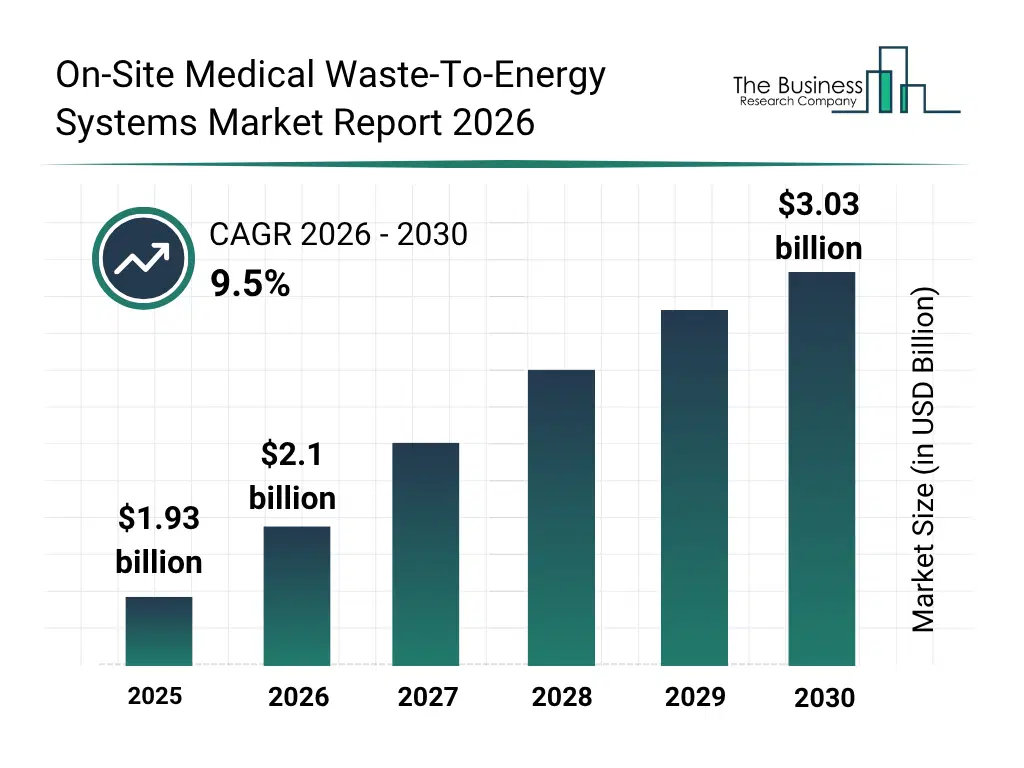
What Is The On-Site Medical Waste-To-Energy Systems Market Size and Share 2026?
The on-site medical waste-to-energy systems market size has grown strongly in recent years. It will grow from $1.93 billion in 2025 to $2.1 billion in 2026 at a compound annual growth rate (CAGR) of 9.3%. The growth in the historic period can be attributed to rising biomedical waste generation from expanding healthcare infrastructure, increasing regulatory enforcement on hazardous medical waste disposal, growing adoption of incineration and autoclave systems in hospitals, limited centralized waste treatment capacity in developing regions, increasing awareness of infection control and hygiene standards.What Is The On-Site Medical Waste-To-Energy Systems Market Growth Forecast?
The on-site medical waste-to-energy systems market size is expected to see strong growth in the next few years. It will grow to $3.03 billion in 2030 at a compound annual growth rate (CAGR) of 9.5%. The growth in the forecast period can be attributed to expansion of decentralized healthcare facilities and clinics, stricter global emission and sustainability regulations, rising demand for on-site waste-to-energy recovery systems, advancements in plasma gasification and pyrolysis technologies, increasing investment in circular healthcare infrastructure and green hospital initiatives. Major trends in the forecast period include advanced on-site medical waste-to-energy conversion systems, integration of real-time emissions monitoring and control systems in healthcare waste treatment, modular decentralized biomedical waste processing and energy recovery units, hybrid gasification and pyrolysis based medical waste valorization technologies, AI enabled automated waste segregation and feedstock optimization systems.
Global On-Site Medical Waste-To-Energy Systems Market Segmentation
1) By Technology: Incineration, Autoclaving, Microwave, Pyrolysis, Other Technologies 2) By Waste Type: Infectious Waste, Pathological Waste, Sharps, Chemical Waste, Other Wastes 3) By Capacity: Small, Medium, Large 4) By Installation Type: New Installations, Retrofit Installations 5) By Application: Hospitals, Clinics, Laboratories, Pharmaceutical Companies, Other Applications Subsegments: 1) By Incineration: Rotary Kiln Incineration Systems, Controlled Air Incineration Systems, Fluidized Bed Incineration Systems, Modular Incineration Systems 2) By Autoclaving: Gravity Displacement Autoclaving Systems, Pre Vacuum Autoclaving Systems, Steam Sterilization Systems, Continuous Autoclaving Systems 3) By Microwave: Batch Microwave Treatment Systems, Continuous Microwave Treatment Systems, Microwave Disinfection Systems, Microwave Shredding Systems 4) By Pyrolysis: Slow Pyrolysis Systems, Fast Pyrolysis Systems, Vacuum Pyrolysis Systems, Catalytic Pyrolysis Systems 5) By Other Technologies: Chemical Disinfection Systems, Plasma Gasification Systems, Irradiation Treatment Systems, Encapsulation SystemsWhat Are The Drivers Of The On-Site Medical Waste-To-Energy Systems Market?
The increasing number of healthcare facilities is expected to propel the growth of the on-site medical waste-to-energy systems market going forward. Healthcare facilities refer to institutions such as hospitals, clinics, and diagnostic centers that provide medical services, treatment, and care to patients. The number of healthcare facilities is rising due to increasing population, as more people require access to medical services, treatment, and healthcare infrastructure to meet growing healthcare needs. On-site medical waste-to-energy systems help healthcare facilities by safely treating and converting medical waste into usable energy, reducing disposal costs, minimizing environmental impact, and improving on-site waste management efficiency. For instance, in May 2023, according to the Department of Health and Social Care, a UK-based government department, the government reaffirms its commitment to building 40 new hospitals by 2030, while confirming for the first time that the new hospital programme will be backed by over $27.2 billion (£20 billion) in infrastructure investment. Therefore, the increasing number of healthcare facilities is driving the growth of the on-site medical waste-to-energy systems industry. The increasing volume of medical waste is expected to propel the growth of the on-site medical waste-to-energy systems market going forward. Medical waste refers to hazardous and non-hazardous waste generated from healthcare activities that require safe handling, treatment, and disposal to prevent environmental and health risks. The volume of medical waste is growing due to the increasing number of hospital admissions, as more patients require medical care, diagnostic procedures, and treatments that generate significant quantities of disposable materials and contaminated waste. On-site medical waste-to-energy systems manage the increasing volume of medical waste by safely treating, reducing, and converting hazardous and non-hazardous waste into usable energy at the source, while minimizing storage challenges and transportation requirements. For instance, in March 2023, according to NHS Digital, a UK government health data and statistical authority, providers generate around 156,000 tonnes of clinical waste annually, which is either processed through high-temperature incineration (HTI) or alternative treatment (AT), a quantity equivalent to more than 400 fully loaded jumbo jets of waste. Therefore, the increasing volume of medical waste is driving the growth of the on-site medical waste-to-energy systems industry.Key Players In The Global On-Site Medical Waste-To-Energy Systems Market
Major companies operating in the on-site medical waste-to-energy systems market are Veolia Environnement S.A., Waste Management Inc., Tuttnauer, Bondtech Corporation, Bertin Medical Waste, San-I-Pak Pacific Inc., Ecosteryl S.A., Newster Group S.r.l., Gient Heating Industry Co. Ltd., Daniels Health, HAAT Incinerators India Private Limited, Bionics Consortium, Indotech Industries Private Limited, Scientico Incinerators, B. L. Engineering, Medayil Incinerators, Ylem Energy LimitedGlobal On-Site Medical Waste-To-Energy Systems Market Trends and Insights
Major companies operating in the on-site medical waste-to-energy systems market are focusing on developing innovative products, such as decentralized hybrid microwave-steam sterilization systems to enhance on-site treatment efficiency, reduce infectious waste volume, and generate energy. Decentralized hybrid microwave-steam sterilization systems are on-site medical waste treatment technologies that use microwave energy and steam to disinfect and reduce infectious waste at the source, helping eliminate pathogens, lower disposal costs, and improve environmental safety through efficient localized processing. For instance, in November 2024, Neo San, an India-based clean-tech environmental technology company, launched the Neo-AX, an innovative decentralized high-efficiency on-site incineration system designed for hospitals, clinics, and other healthcare facilities. It targets biomedical waste streams through automated handling, controlled combustion, and integrated safety mechanisms. The system is engineered for flexible deployment at point-of-generation sites, includes advanced process controls and safety interlocks, and is designed to minimize hazardous waste transportation while enabling efficient destruction of non-recyclable medical and sanitary waste, thereby supporting on-site waste-to-energy conversion and regulatory compliance for healthcare operators.Regional Outlook
North America was the largest region in the on-site medical waste-to-energy systems market in 2025. Asia-Pacific is expected to be the fastest-growing region in the forecast period. The regions covered in this market report are Australia, Brazil, China, France, Germany, India, Indonesia, Japan, Taiwan, Russia, South Korea, UK, USA, Canada, Italy, Spain. The countries covered in this market report are Australia, Brazil, China, France, Germany, India, Indonesia, Japan, Taiwan, Russia, South Korea, UK, USA, Canada, Italy, Spain.What Defines the On-Site Medical Waste-To-Energy Systems Market?
The on-site medical waste-to-energy systems market consists of revenues earned by entities by providing services such as system design and engineering, installation and commissioning, operation and maintenance, waste processing and energy recovery services, emission monitoring, regulatory compliance management, and performance optimization. The market value includes the value of related goods sold by the service provider or included within the service offering. The on-site medical waste-to-energy systems market also includes sales of incinerators, gasification units, pyrolysis reactors, autoclaves, shredders, emission control systems, and waste handling equipment. Values in this market are ‘factory gate’ values, that is, the value of goods sold by the manufacturers or creators of the goods, whether to other entities (including downstream manufacturers, wholesalers, distributors, and retailers) or directly to end customers. The value of goods in this market includes related services sold by the creators of the goods.How is Market Value Defined and Measured?
The market value is defined as the revenues that enterprises gain from the sale of goods and/or services within the specified market and geography through sales, grants, or donations in terms of the currency (in USD unless otherwise specified). The revenues for a specified geography are consumption values that are revenues generated by organizations in the specified geography within the market, irrespective of where they are produced. It does not include revenues from resales along the supply chain, either further along the supply chain or as part of other products.What Key Data and Analysis Are Included in the On-Site Medical Waste-To-Energy Systems Market Report 2026?
The on-site medical waste-to-energy systems market research report is one of a series of new reports from The Business Research Company that provides on-site medical waste-to-energy systems market statistics, including on-site medical waste-to-energy systems industry global market size, regional shares, competitors with a on-site medical waste-to-energy systems market share, detailed on-site medical waste-to-energy systems market segments, market trends and opportunities, and any further data you may need to thrive in the on-site medical waste-to-energy systems industry. This on-site medical waste-to-energy systems market research report delivers a complete perspective of everything you need, with an in-depth analysis of the current and future scenario of the industry.On-Site Medical Waste-To-Energy Systems Market Report Forecast Analysis
| Report Attribute | Details |
|---|---|
| Market Size Value In 2026 | $2.1 billion |
| Revenue Forecast In 2030 | $3.03 billion |
| Growth Rate | CAGR of 9.5% from 2026 to 2030 |
| Base Year For Estimation | 2025 |
| Actual Estimates/Historical Data | 2020-2025 |
| Forecast Period | 2026 - 2030 |
| Market Representation | Revenue in USD Billion and CAGR from 2026 to 2030 |
| Segments Covered | Technology, Waste Type, Capacity, Installation Type, Application |
| Regional Scope | Asia-Pacific, Western Europe, Eastern Europe, North America, South America, Middle East, Africa |
| Country Scope | The countries covered in the on-site medical waste-to-energy systems market report are Australia, Brazil, China, France, Germany, India, Indonesia, Japan, Taiwan, Russia, South Korea, UK, USA, Canada, Italy, Spain. |
| Key Companies Profiled | Veolia Environnement S.A., Waste Management Inc., Tuttnauer, Bondtech Corporation, Bertin Medical Waste, San-I-Pak Pacific Inc., Ecosteryl S.A., Newster Group S.r.l., Gient Heating Industry Co. Ltd., Daniels Health, HAAT Incinerators India Private Limited, Bionics Consortium, Indotech Industries Private Limited, Scientico Incinerators, B. L. Engineering, Medayil Incinerators, Ylem Energy Limited |
| Customization Scope | Request for Customization |
| Pricing And Purchase Options | Explore Purchase Options |