
On-Site Medical Waste Treatment Systems Market Report 2026
Global Outlook – By Technology (Friction Heat Treatment Systems, Autoclave Treatment Systems, Microwave Treatment Systems, Chemical Disinfection Systems, Steam Sterilization Systems, Incineration Systems), By Waste Type (Infectious Waste, Pathological Waste, Sharps Waste, Pharmaceutical Waste, Laboratory Waste, Plastic Medical Waste, General Healthcare Waste), By Installation Type (Fixed Systems, Mobile Systems), By Capacity (Small Capacity Systems, Medium Capacity Systems, Large Capacity Systems), By End User (Hospitals, Clinics, Ambulatory Surgical Centers, Diagnostic Laboratories, Blood Banks, Pharmaceutical And Biotechnology Companies, Research And Academic Institutes, Veterinary Hospitals And Clinics) – Market Size, Trends, Strategies, and Forecast to 2030
On-Site Medical Waste Treatment Systems Market Report 2026 Market Overview
• On-Site Medical Waste Treatment Systems Market Report 2026 market size has reached to $0.41 billion in 2025 • Expected to grow to $0.71 billion in 2030 at a compound annual growth rate (CAGR) of 11.6% • Growth Driver: Rising Generation Of Biomedical Waste Fueling The Growth Of The Market Due To Increasing Healthcare Activities And Infection Control Requirements • Market Trend: Advancing Non-Incineration Friction Heat Treatment Technologies For Sustainable And Efficient On-Site Biomedical Waste Management • Asia-Pacific was the largest region and fastest growing region.What Is Covered Under On-Site Medical Waste Treatment Systems Market?
On-site medical waste treatment systems are localized waste processing solutions that use friction-generated heat to disinfect, sterilize, shred, and reduce the volume of infectious medical waste at the point of generation. These systems convert hazardous healthcare waste into non-infectious waste suitable for disposal while minimizing transportation risks, enhancing infection control, and reducing environmental impact. The main technologies of on-site medical waste treatment systems include friction heat treatment systems, autoclave treatment systems, microwave treatment systems, chemical disinfection systems, steam sterilization systems, and incineration systems. Friction heat treatment systems refer to advanced waste processing technologies that generate heat through mechanical friction to disinfect and reduce medical waste volume while minimizing environmental impact. These systems are designed to treat infectious waste, pathological waste, sharps waste, pharmaceutical waste, laboratory waste, plastic medical waste, and general healthcare waste and are available as fixed systems and mobile systems. They are offered in small capacity systems, medium capacity systems, and large capacity systems and are utilized by end users such as hospitals, clinics, ambulatory surgical centers, diagnostic laboratories, blood banks, pharmaceutical and biotechnology companies, research and academic institutes, and veterinary hospitals and clinics.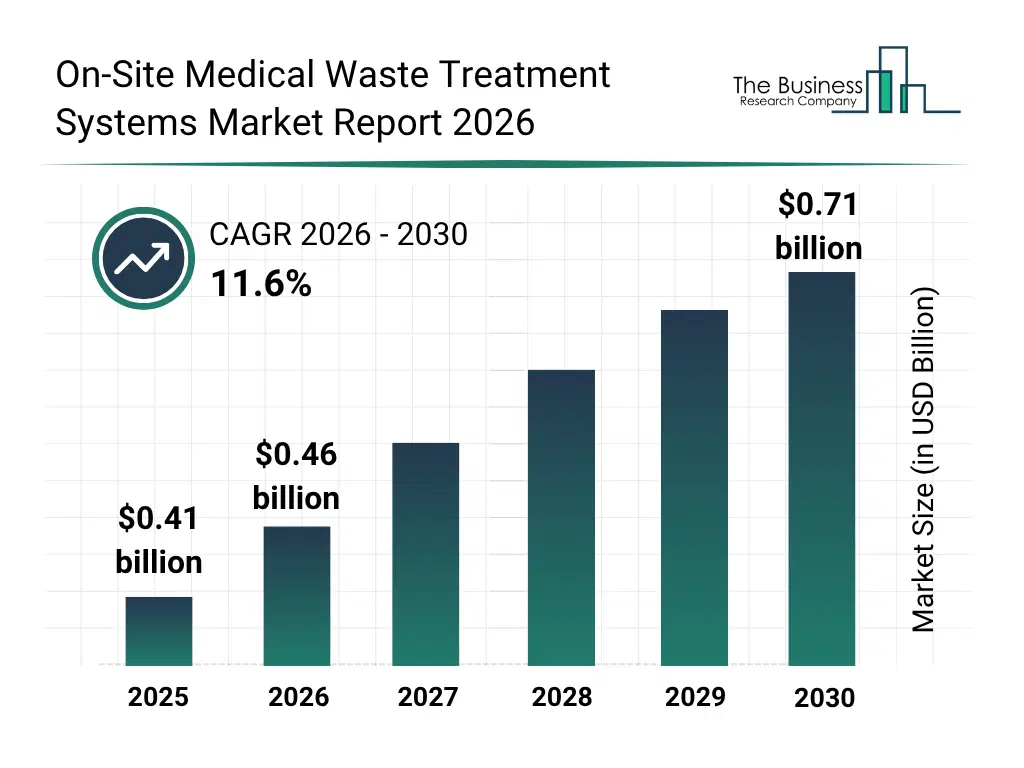
What Is The On-Site Medical Waste Treatment Systems Market Size and Share 2026?
The on-site medical waste treatment systems market size has grown rapidly in recent years. It will grow from $0.41 billion in 2025 to $0.46 billion in 2026 at a compound annual growth rate (CAGR) of 11.4%. The growth in the historic period can be attributed to increasing healthcare waste generation, rising hospital infrastructure expansion, growing awareness of infection prevention, stricter biomedical waste disposal regulations, increasing adoption of on-site waste treatment practices.What Is The On-Site Medical Waste Treatment Systems Market Growth Forecast?
The on-site medical waste treatment systems market size is expected to see rapid growth in the next few years. It will grow to $0.71 billion in 2030 at a compound annual growth rate (CAGR) of 11.6%. The growth in the forecast period can be attributed to growing demand for decentralized waste treatment, rising investments in sustainable healthcare infrastructure, increasing focus on reducing medical waste transportation, expanding healthcare facilities in emerging economies, growing adoption of high-capacity waste treatment systems. Major trends in the forecast period include growing adoption of on-site waste volume reduction technologies, increasing preference for non-incineration medical waste treatment, expansion of point-of-generation waste processing solutions, rising integration of multi-stage waste disinfection and shredding systems, growing focus on high-capacity on-site waste processing equipment.
Global On-Site Medical Waste Treatment Systems Market Segmentation
1) By Technology: Friction Heat Treatment Systems, Autoclave Treatment Systems, Microwave Treatment Systems, Chemical Disinfection Systems, Steam Sterilization Systems, Incineration Systems 2) By Waste Type: Infectious Waste, Pathological Waste, Sharps Waste, Pharmaceutical Waste, Laboratory Waste, Plastic Medical Waste, General Healthcare Waste 3) By Installation Type: Fixed Systems, Mobile Systems 4) By Capacity: Small Capacity Systems, Medium Capacity Systems, Large Capacity Systems 5) By End User: Hospitals, Clinics, Ambulatory Surgical Centers, Diagnostic Laboratories, Blood Banks, Pharmaceutical And Biotechnology Companies, Research And Academic Institutes, Veterinary Hospitals And Clinics Subsegments: 1) By Friction Heat Treatment Systems: Batch Processing Systems, Continuous Processing Systems, Integrated Shredding Systems, Automated Control Systems 2) By Autoclave Treatment Systems: Gravity Displacement Autoclaves, Pre Vacuum Autoclaves, Steam Flush Pressure Pulse Autoclaves, Integrated Shredding Autoclaves 3) By Microwave Treatment Systems: Batch Microwave Systems, Continuous Microwave Systems, Shredding Integrated Microwave Systems, High Capacity Microwave Systems 4) By Chemical Disinfection Systems: Chlorine Based Disinfection Systems, Ozone Based Disinfection Systems, Peracetic Acid Disinfection Systems, Hydrogen Peroxide Disinfection Systems 5) By Steam Sterilization Systems: Saturated Steam Systems, High Pressure Steam Systems, Continuous Steam Sterilization Systems, Integrated Steam And Shredding Systems 6) By Incineration Systems: Rotary Kiln Incinerators, Dual Chamber Incinerators, Controlled Air Incinerators, Modular IncineratorsWhat Are The Drivers Of The On-Site Medical Waste Treatment Systems Market?
The rising generation of biomedical waste is expected to propel the growth of the on-site medical waste treatment systems market going forward. Biomedical waste refers to waste generated during the diagnosis, treatment, or immunization of humans or animals, as well as from medical research and healthcare-related activities. The growing generation of biomedical waste is driven by increasing healthcare services, expanding hospital infrastructure, rising surgical procedures, and heightened infection prevention measures. On-site medical waste treatment systems enable healthcare facilities to safely treat infectious waste at the point of generation, reducing transportation risks, ensuring regulatory compliance, and minimizing environmental impact. For instance, in October 2024, according to World Health Organization (WHO), a Switzerland-based specialized agency, approximately 15% of all waste generated by healthcare activities worldwide is hazardous, including infectious, toxic, and radioactive waste, while the remaining 85% is non-hazardous. Therefore, the rising generation of biomedical waste is driving the growth of the on-site medical waste treatment systems industry. The growing investments in healthcare infrastructure is expected to propel the growth of the on-site medical waste treatment systems market going forward. Healthcare infrastructure refers to the physical facilities, medical equipment, healthcare workforce, and supporting systems that enable the delivery of healthcare services to patients. Investments in healthcare infrastructure are rising due to increasing patient volumes, expanding healthcare facilities, technological advancements, and government efforts to strengthen healthcare systems. Expanding healthcare infrastructure increases the volume of infectious medical waste, boosting the need for on-site friction heat treatment systems for safe, compliant, and sustainable waste disposal. For instance, in January 2024, according to the American Hospital Association (AHA), a US-based non-profit organization, the total number of hospitals in the United States reached 6,120 in 2024, up from 6,093 in 2022. Therefore, the growing investments in healthcare infrastructure is driving the growth of the on-site medical waste treatment systems industry.Key Players In The Global On-Site Medical Waste Treatment Systems Market
Major companies operating in the on-site medical waste treatment systems market report are Getinge AB, Matthews Environmental Solutions, BioSAFE Engineering LLC, Antonio Matachana S.A., Fedegari Autoclavi S.p.A., Tuttnauer Europe B.V., Santes Incinerator, Systec GmbH, MMM Münchener Medizin Mechanik GmbH, Astell Scientific Ltd, The Mark-Costello Co., San-Ipak Pacific Corporation, METEKA GmbH, Tesalys SAS, Dutch Incinerators B.V., Priorclave Ltd, ARVS Equipment Private Limited, Celitron Medical Technologies Kft., Bondtech Corporation, Addfield Environmental Systems Limited, Inciner8 Limited, ECODAS, Haat Incinerators India Private Limited
This chart is for illustrative purposes; the full report includes a detailed competitor analysis and comprehensive overview of the top 10 companies in the market.
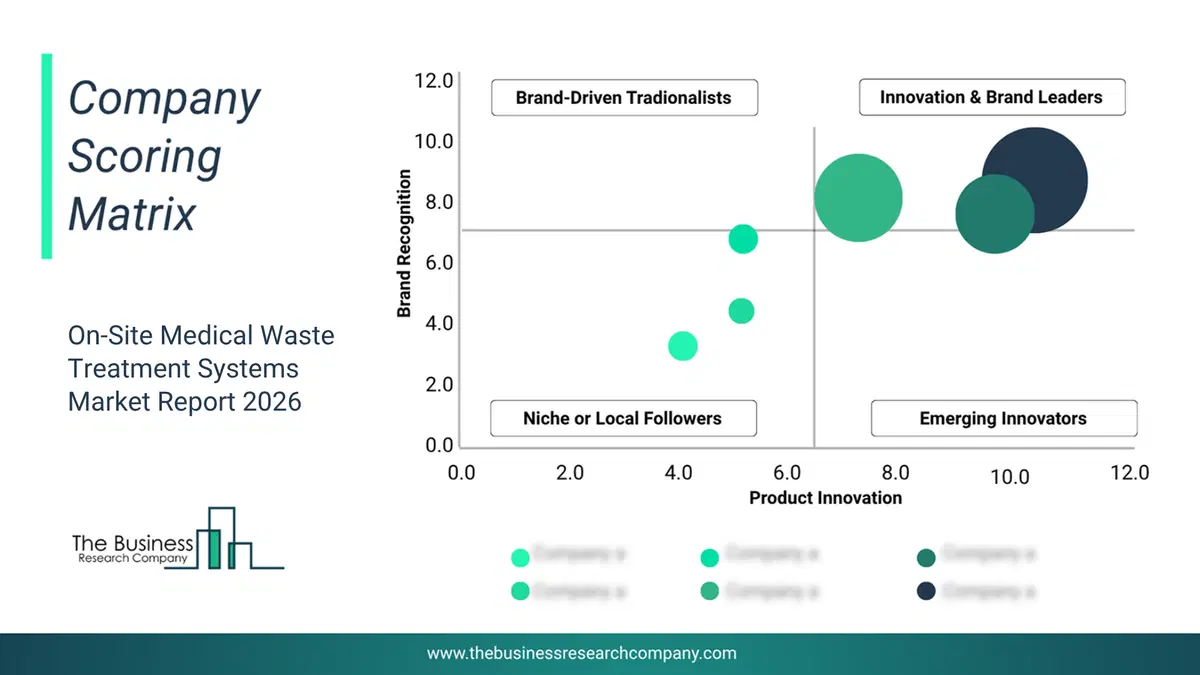
This chart maps companies by product innovation and brand strength, with bubble size indicating relative revenue, helping identify market leaders, challengers, and niche players. This is an illustrative chart; the full report provides a complete and accurate competitive analysis.
Global On-Site Medical Waste Treatment Systems Market Trends and Insights
Major companies operating in the on-site medical waste treatment systems market are focusing on developing advanced solutions, such as non-incineration friction heat treatment technologies to improve on-site sterilization efficiency, reduce environmental emissions, and enhance healthcare waste management. Non-incineration friction heat treatment technologies are on-site medical waste treatment systems that use friction-generated heat to shred, disinfect, and sterilize infectious healthcare waste without combustion, converting it into non-infectious waste while minimizing harmful emissions and environmental impact. For instance, in November 2023, Newster System S.r.l., an Italy-based manufacturer of medical waste treatment systems, showcased its NW50 frictional heat treatment system at MEDICA 2023. The on-site sterilizer uses patented frictional heat technology to shred and sterilize infectious healthcare waste in a single process, enabling hospitals to treat medical waste at the point of generation while reducing transportation risks and waste volume. The system operates without incineration or chemical disinfectants, helping minimize environmental impact while ensuring effective sterilization. It produces dry, inert waste that can be managed as non-infectious waste in accordance with applicable local regulations, reducing disposal costs. Its compact, automated design is intended for installation within healthcare facilities, allowing continuous, on-site processing and improving operational efficiency in medical waste management.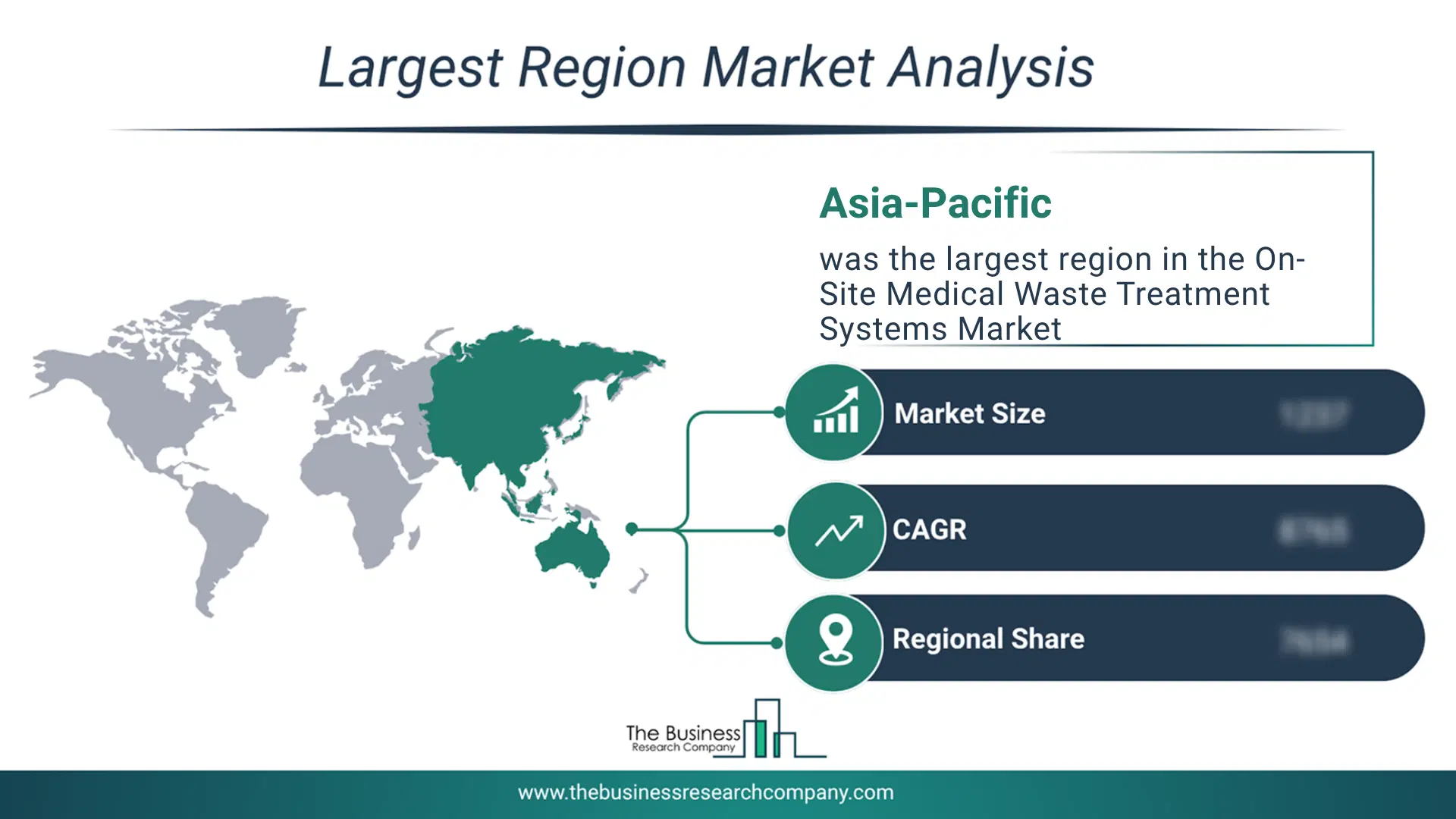
Regional Outlook
Asia-Pacific was the largest region in the on-site medical waste treatment systems market in 2025. Asia-Pacific is expected to be the fastest-growing region in the forecast period. The regions covered in this market report are Asia-Pacific, South East Asia, Western Europe, Eastern Europe, North America, South America, Middle East, Africa. The countries covered in this market report are Australia, Brazil, China, France, Germany, India, Indonesia, Japan, Taiwan, Russia, South Korea, UK, USA, Canada, Italy, Spain.What Defines the On-Site Medical Waste Treatment Systems Market?
The on-site medical waste treatment systems market consists of sales of friction heat-based medical waste treatment systems, integrated waste treatment units, shredding and sterilization modules, waste loading and unloading systems and monitoring and control systems.Values in this market are ‘factory gate’ values, that is, the value of goods sold by the manufacturers or creators of the goods, whether to other entities (including downstream manufacturers, wholesalers, distributors, and retailers) or directly to end customers. The value of goods in this market includes related services sold by the creators of the goods.How is Market Value Defined and Measured?
The market value is defined as the revenues that enterprises gain from the sale of goods and/or services within the specified market and geography through sales, grants, or donations in terms of the currency (in USD unless otherwise specified). The revenues for a specified geography are consumption values that are revenues generated by organizations in the specified geography within the market, irrespective of where they are produced. It does not include revenues from resales along the supply chain, either further along the supply chain or as part of other products.
This chart presents market attractiveness based on a quantitative evaluation of growth, competition, strategic alignment, and risk, offering a clear view of opportunity areas for decision-making. This chart is for illustrative purposes; the full report contains the complete analysis.

This chart highlights the Total Addressable Market (TAM) by estimating the maximum revenue opportunity using an assumption-driven approach, supporting strategic planning and opportunity sizing across markets. The chart is illustrative; the full report provides a more comprehensive analysis.
What Key Data and Analysis Are Included in the On-Site Medical Waste Treatment Systems Market Report 2026?
The on-site medical waste treatment systems market research report is one of a series of new reports from The Business Research Company that provides market statistics, including industry global market size, regional shares, competitors with the market share, detailed market segments, market trends and opportunities, and any further data you may need to thrive in the on-site medical waste treatment systems industry. The market research report delivers a complete perspective of everything you need, with an in-depth analysis of the current and future state of the industry.On-Site Medical Waste Treatment Systems Market Report Forecast Analysis
| Report Attribute | Details |
|---|---|
| Market Size Value In 2026 | $0.46 billion |
| Revenue Forecast In 2030 | $0.71 billion |
| Growth Rate | CAGR of 11.6% from 2026 to 2030 |
| Base Year For Estimation | 2025 |
| Actual Estimates/Historical Data | 2020-2025 |
| Forecast Period | 2026 - 2030 |
| Market Representation | Revenue in USD Billion and CAGR from 2026 to 2030 |
| Segments Covered | Technology, Waste Type, Installation Type, Capacity, End User |
| Regional Scope | Asia-Pacific, Western Europe, Eastern Europe, North America, South America, Middle East, Africa |
| Country Scope | The countries covered in the report are Australia, Brazil, China, France, Germany, India, Indonesia, Japan, Taiwan, Russia, South Korea, UK, USA, Canada, Italy, Spain. |
| Key Companies Profiled | Getinge AB, Matthews Environmental Solutions, BioSAFE Engineering LLC, Antonio Matachana S.A., Fedegari Autoclavi S.p.A., Tuttnauer Europe B.V., Santes Incinerator, Systec GmbH, MMM Münchener Medizin Mechanik GmbH, Astell Scientific Ltd, The Mark-Costello Co., San-Ipak Pacific Corporation, METEKA GmbH, Tesalys SAS, Dutch Incinerators B.V., Priorclave Ltd, ARVS Equipment Private Limited, Celitron Medical Technologies Kft., Bondtech Corporation, Addfield Environmental Systems Limited, Inciner8 Limited, ECODAS, Haat Incinerators India Private Limited |
| Customization Scope | Request for Customization |
| Pricing And Purchase Options | Explore Purchase Options |