
Onboard Carbon Capture System Market Report 2026
Global Outlook – By Component And System (Capture Units, Compressors And Liquefaction Units, Storage Cylinders, Filtration Systems), By Service (Installation, Maintenance, Retrofitting, Monitoring, Engineering Consulting, System Integration, Testing And Inspection), By Vessel Type (Commercial Cargo Ships, Passenger Ships, Tankers, Offshore Support Vessels), By End-User Industry (Shipping And Maritime, Aviation, Freight And Logistics, Energy And Utilities, Oil And Gas) – Market Size, Trends, Strategies, and Forecast to 2030
Onboard Carbon Capture System Market Overview
• Onboard Carbon Capture System market size has reached to $1.30 billion in 2025 • Expected to grow to $2.41 billion in 2030 at a compound annual growth rate (CAGR) of 13% • Growth Driver: Surge In Adoption Of Carbon Capture Technologies In Transport Fueling The Growth Of The Market Due To Rising Demand For Emission Reduction In Mobile Sources • Market Trend: Developing Commercial Onboard Carbon Capture Systems To Reduce Maritime Emissions And Accelerate Decarbonization • North America was the largest region in 2025 and Asia-Pacific is the fastest growing region.What Is Covered Under Onboard Carbon Capture System Market?
An onboard carbon capture system refers to an integrated technology installed directly on ships or marine vessels to capture carbon dioxide emissions produced during fuel combustion. It operates by extracting carbon dioxide from engine exhaust streams, compressing it, and storing it safely onboard for later offloading at port facilities. These systems help the maritime industry reduce greenhouse gas emissions without requiring immediate changes to existing vessel engines or fuels. The main component and system of onboard carbon capture systems include capture units, compressors and liquefaction units, storage cylinders, and filtration systems. Capture units refer to components of a system designed to extract and isolate carbon dioxide from emission sources for storage or utilization. The services such as installation, maintenance, retrofitting, monitoring, engineering consulting, system integration, and testing and inspection. The vessel types including commercial cargo ships, passenger ships, tankers, and offshore support vessels, and they serve key end-user industries such as shipping and maritime, aviation, freight and logistics, energy and utilities, and oil and gas.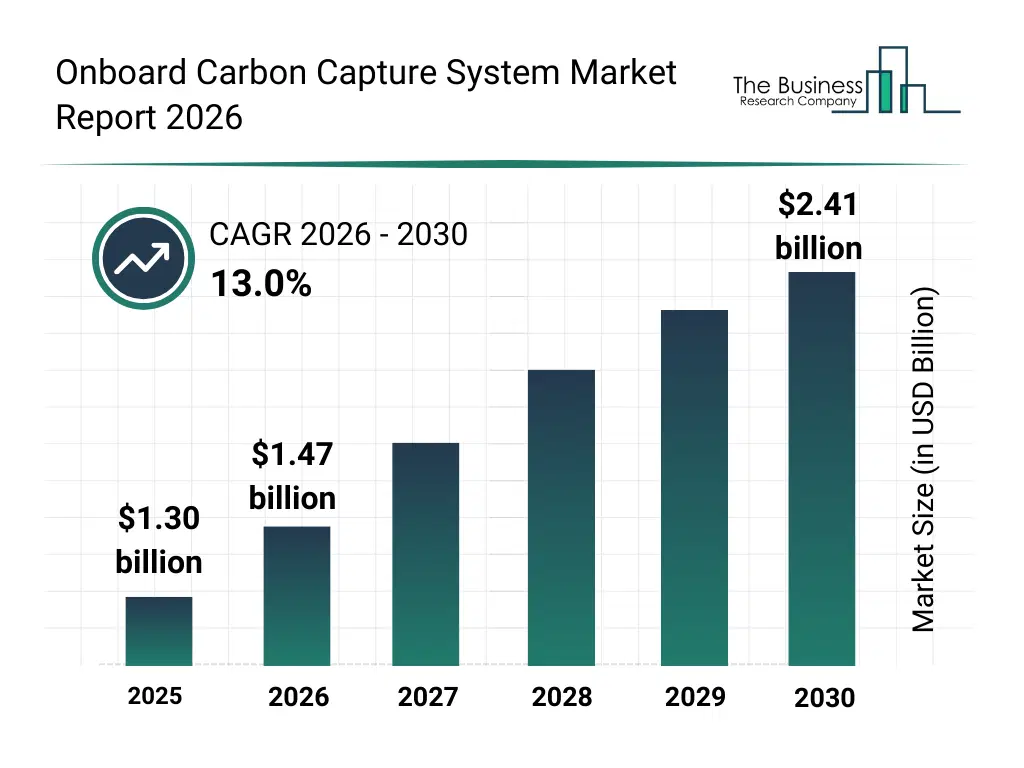
What Is The Onboard Carbon Capture System Market Size and Share 2026?
The onboard carbon capture system market size has grown rapidly in recent years. It will grow from $1.30 billion in 2025 to $1.47 billion in 2026 at a compound annual growth rate (CAGR) of 13.3%. The growth in the historic period can be attributed to growing maritime emission regulations, increasing pressure to decarbonize shipping fleets, rising adoption of exhaust treatment systems, expanding focus on low-carbon maritime operations, increasing awareness of environmental compliance.What Is The Onboard Carbon Capture System Market Growth Forecast?
The onboard carbon capture system market size is expected to see rapid growth in the next few years. It will grow to $2.41 billion in 2030 at a compound annual growth rate (CAGR) of 13.0%. The growth in the forecast period can be attributed to increasing global carbon reduction mandates, rising investment in onboard decarbonization technologies, growing adoption of retrofittable carbon capture solutions, expanding deployment of large vessel carbon capture pilots, increasing focus on carbon intensity reduction targets. Major trends in the forecast period include advancements in compact capture technologies, innovations in marine carbon dioxide storage systems, developments in energy-efficient absorption materials, research and development in solvent and sorbent chemistry, progress in modular onboard capture designs.
Global Onboard Carbon Capture System Market Segmentation
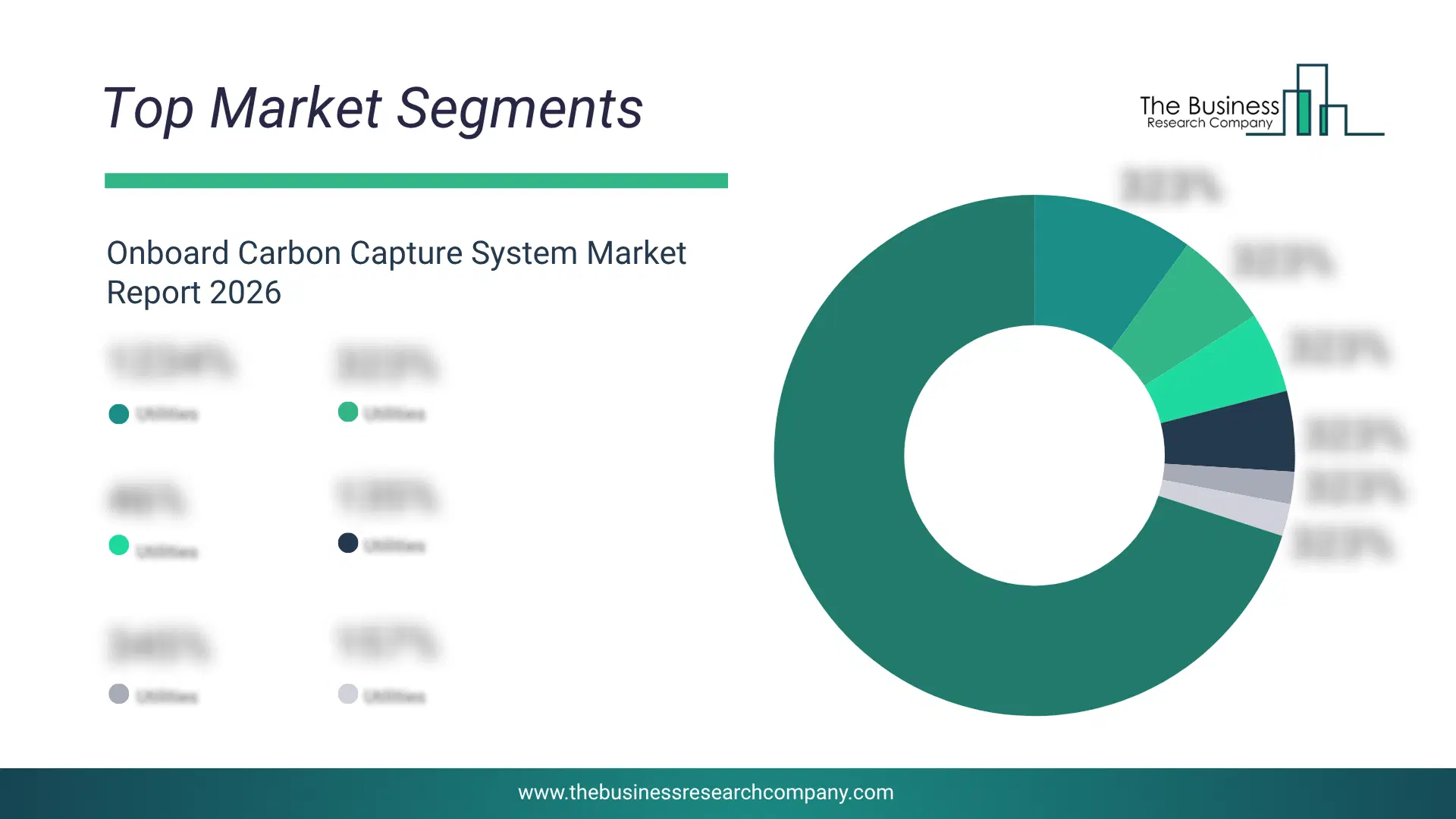
1) By Component And System: Capture Units, Compressors And Liquefaction Units, Storage Cylinders, Filtration Systems 2) By Service: Installation, Maintenance, Retrofitting, Monitoring, Engineering Consulting, System Integration, Testing And Inspection 3) By Vessel Type: Commercial Cargo Ships, Passenger Ships, Tankers, Offshore Support Vessels 4) By End-User Industry: Shipping And Maritime, Aviation, Freight And Logistics, Energy And Utilities, Oil And Gas Subsegments: 1) By Capture Units: Chemical Absorption Capture Units, Physical Adsorption Capture Units, Membrane Separation Capture Units, Cryogenic Capture Units 2) By Compressors And Liquefaction Units: High Pressure Gas Compressors, Low Temperature Liquefaction Units, Integrated Compression And Cooling Units, Modular Compressor Skid Units 3) By Storage Cylinders: High Pressure Gas Storage Cylinders, Liquefied Carbon Dioxide Storage Tanks, Insulated Cryogenic Storage Cylinders, Modular Onboard Storage Modules 4) By Filtration Systems: Particulate Filtration Systems, Gas Purification Filter Systems, Moisture Removal Filter Systems, Multi Stage Filtration SystemsWhat Are The Drivers Of The Onboard Carbon Capture System Market?
The increasing adoption of carbon capture technologies in transport and mobile sources is expected to propel the growth of the onboard carbon capture system market going forward. Transport carbon capture adoption refers to the uptake of systems and protocols that capture CO₂ emissions directly from vehicles, ships, or mobile power units at the point of generation to reduce greenhouse gas emissions. The rise in adoption of carbon capture technologies in transport and mobile sources is due to tightening global emission norms and decarbonization targets that push operators to cut tailpipe CO₂ while keeping existing vehicle fleets in service The onboard carbon capture system supports carbon capture technologies in transport and mobile sources by developing and deploying CO₂ capture technologies that can be integrated into mobile emission sources to meet emissions targets and regulatory expectations. For instance, in March 2024, according to the International Energy Agency, a France-based intergovernmental organization, carbon dioxide capture capacity for 2030 increased by 35% in 2023 and storage capacity rose by 70%, bringing total capture potential to over 430 million tonnes per year and storage capacity to around 620 million tonnes of carbon dioxide per year. Therefore, the increasing adoption of transport carbon capture technologies is driving the growth of the onboard carbon capture system industry. The rising demand for emissions reduction in shipping and aviation is expected to propel the growth of the onboard carbon capture system market going forward. Emissions reduction demand refers to the increasing global focus on reducing greenhouse gas emissions from sectors that contribute significantly to climate change, including transport sectors such as shipping and aviation. Demand for emissions reduction in shipping and aviation is rising as international regulations and climate targets increasingly require operators to cut greenhouse gases while customers and investors push for demonstrably cleaner transport options. The onboard carbon capture system support emissions reduction in shipping and aviation by offering technologies that capture CO₂ at the point of emission from vessels and aircraft, allowing operators to comply with stricter emissions targets. For instance, in July 2023, according to the International Maritime Organization (IMO), a UK-based United Nations specialized agency, the 2023 IMO Strategy on Reduction of GHG Emissions from ships set targets to reduce carbon intensity by at least 40 % by 2030, compared with 35 % in 2022, and net-zero greenhouse gas emissions by around 2050, demonstrating a clear year-over-year increase in ambition for shipping sector decarbonization. Therefore, the rising demand for emissions reduction in shipping and aviation is driving the growth of the Onboard Carbon Capture System industry.Key Players In The Global Onboard Carbon Capture System Market
Major companies operating in the onboard carbon capture system market are Shell Plc, TotalEnergies, Equinor ASA, Mitsubishi Heavy Industries Ltd., Baker Hughes Co., Mitsui O.S.K. Lines, Wartsila Corporation, Samsung Heavy Industries Co. Ltd., Hanwha Ocean Co. Ltd., Chart Industries Inc., Kawasaki Heavy Industries Ltd., Carbon Clean Solutions Ltd., DESMI, Linde Engineering, Alfa Laval Inc., Panasia Japan Corp., MAN Energy Solutions, Langh Tech, Capsol Technologies ASA, EverLoNG Project Consortium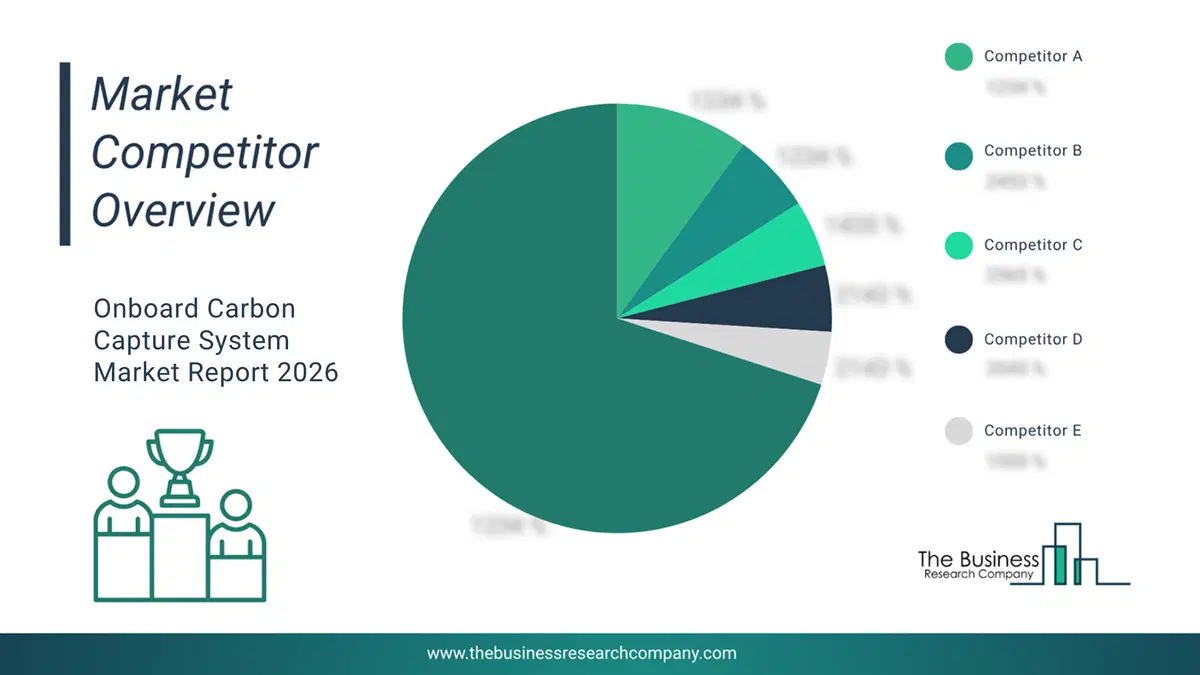
This chart is for illustrative purposes; the full report includes a detailed competitor analysis and comprehensive overview of the top 10 companies in the market.
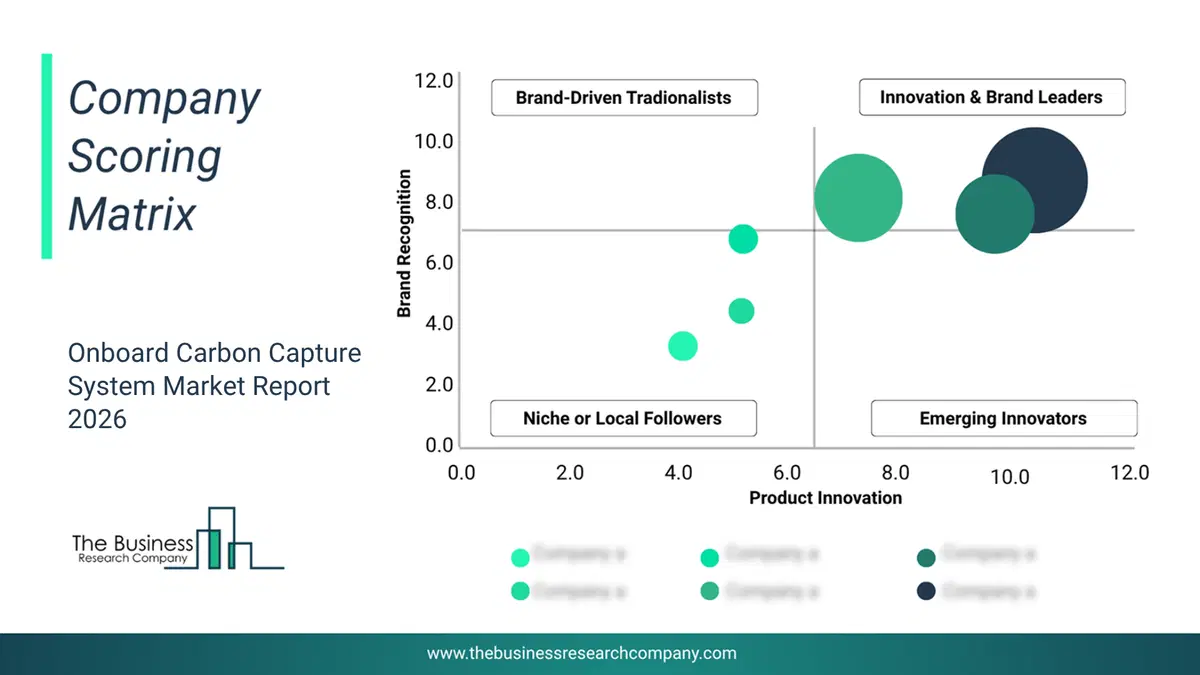
This chart maps companies by product innovation and brand strength, with bubble size indicating relative revenue, helping identify market leaders, challengers, and niche players. This is an illustrative chart; the full report provides a complete and accurate competitive analysis.
Global Onboard Carbon Capture System Market Trends and Insights
Major companies operating in the onboard carbon capture system market are focusing on developing innovative solutions, such as commercially available onboard carbon capture and storage (CCS) systems for ships, to reduce CO₂ emissions at the point of combustion, support regulatory compliance, and advance maritime decarbonization. Commercial onboard CCS systems are technologies that capture CO₂ directly from vessel exhaust, store it onboard for later offloading or utilization, and enable shipowners to lower emissions without immediately switching to alternative fuels. For instance, in May 2025, Wärtsilä, a Finland-based marine technology company, launched its commercially available onboard carbon capture solution. This system was validated through a full-scale installation trial onboard the Clipper Eris ethylene carrier and is designed to reduce vessel CO₂ emissions by up to 70 percent while integrating seamlessly with conventional fuel engines and existing exhaust treatment systems. This launch represents a significant technological advancement by bringing operational CCS capability to commercial vessels, bridging trial-scale demonstrations with real-world deployment, and offering a scalable, efficient solution for maritime emissions reduction.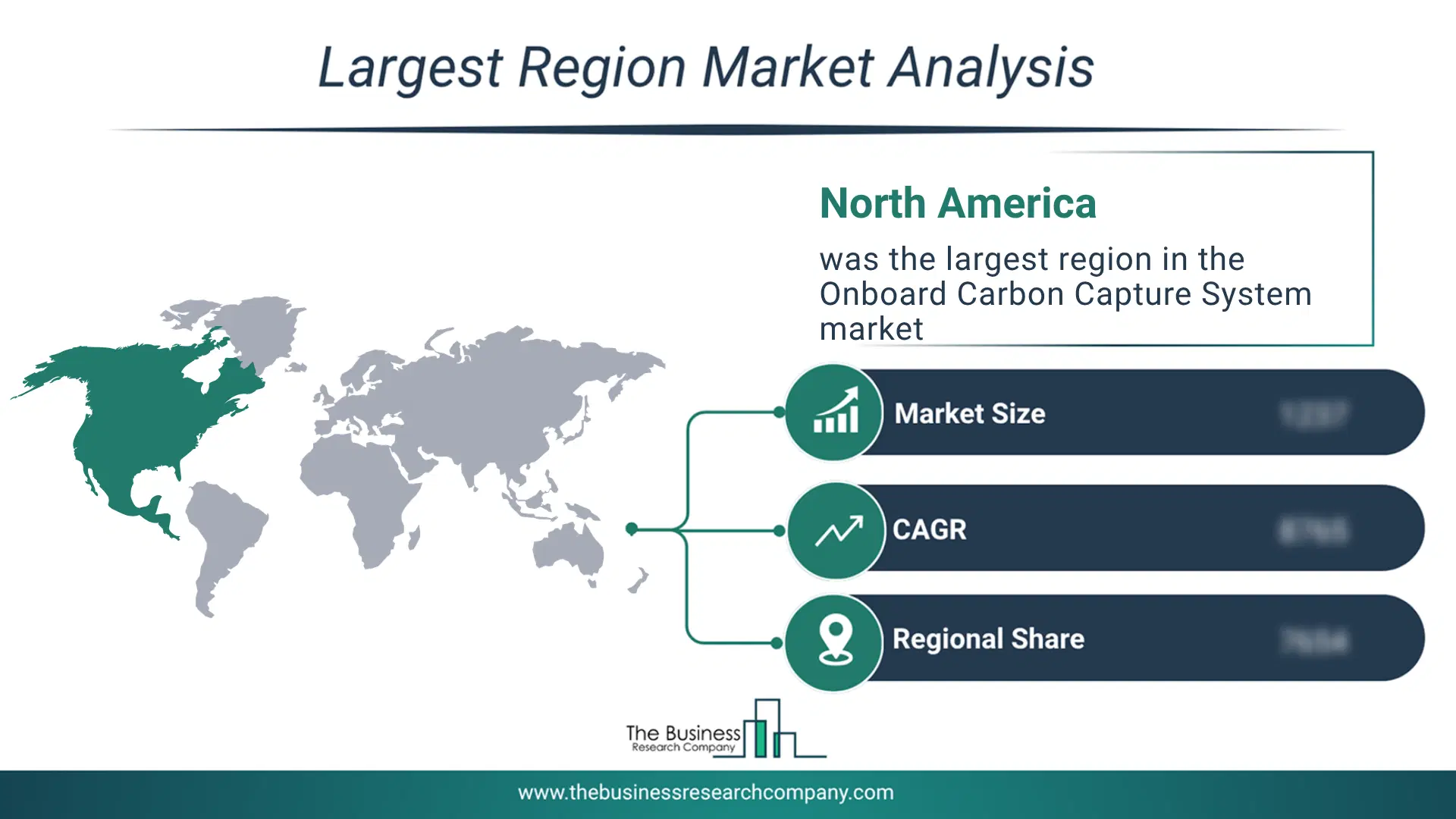
Regional Insights
North America was the largest region in the onboard carbon capture system market in 2025. Asia-Pacific is expected to be the fastest-growing region in the forecast period. The regions covered in this market report are Asia-Pacific, South East Asia, Western Europe, Eastern Europe, North America, South America, Middle East, Africa. The countries covered in this market report are Australia, Brazil, China, France, Germany, India, Indonesia, Japan, Taiwan, Russia, South Korea, UK, USA, Canada, Italy, Spain.What Defines the Onboard Carbon Capture System Market?
The onboard carbon capture system market consists of revenues earned by entities by providing services such as installation services, maintenance services, engineering consulting, retrofit integration services, and carbon dioxide handling services. The market value includes the value of related goods sold by the service provider or included within the service offering. The onboard carbon capture system market also includes sales of carbon capture units, absorption modules, exhaust gas scrubbers, carbon dioxide compression units, and onboard storage tanks. Values in this market are ‘factory gate’ values, that is the value of goods sold by the manufacturers or creators of the goods, whether to other entities (including downstream manufacturers, wholesalers, distributors and retailers) or directly to end customers. The value of goods in this market includes related services sold by the creators of the goods.How is Market Value Defined and Measured?
The market value is defined as the revenues that enterprises gain from the sale of goods and/or services within the specified market and geography through sales, grants, or donations in terms of the currency (in USD unless otherwise specified). The revenues for a specified geography are consumption values that are revenues generated by organizations in the specified geography within the market, irrespective of where they are produced. It does not include revenues from resales along the supply chain, either further along the supply chain or as part of other products.
This chart presents market attractiveness based on a quantitative evaluation of growth, competition, strategic alignment, and risk, offering a clear view of opportunity areas for decision-making. This chart is for illustrative purposes; the full report contains the complete analysis.

This chart highlights the Total Addressable Market (TAM) by estimating the maximum revenue opportunity using an assumption-driven approach, supporting strategic planning and opportunity sizing across markets. The chart is illustrative; the full report provides a more comprehensive analysis.
What Key Data and Analysis Are Included in the Onboard Carbon Capture System Market Report 2026?
The onboard carbon capture system market research report is one of a series of new reports from The Business Research Company that provides market statistics, including industry global market size, regional shares, competitors with the market share, detailed market segments, market trends and opportunities, and any further data you may need to thrive in the onboard carbon capture system industry. The market research report delivers a complete perspective of everything you need, with an in-depth analysis of the current and future state of the industry.Onboard Carbon Capture System Market Report Forecast Analysis
| Report Attribute | Details |
|---|---|
| Market Size Value In 2026 | $1.47 billion |
| Revenue Forecast In 2030 | $2.41 billion |
| Growth Rate | CAGR of 13% from 2026 to 2030 |
| Base Year For Estimation | 2025 |
| Actual Estimates/Historical Data | 2020-2025 |
| Forecast Period | 2026 - 2030 |
| Market Representation | Revenue in USD Billion and CAGR from 2026 to 2030 |
| Segments Covered | Component And System, Service, Vessel Type, End-User Industry |
| Regional Scope | Asia-Pacific, Western Europe, Eastern Europe, North America, South America, Middle East, Africa |
| Key Companies Profiled | Shell Plc, TotalEnergies, Equinor ASA, Mitsubishi Heavy Industries Ltd., Baker Hughes Co., Mitsui O.S.K. Lines, Wartsila Corporation, Samsung Heavy Industries Co. Ltd., Hanwha Ocean Co. Ltd., Chart Industries Inc., Kawasaki Heavy Industries Ltd., Carbon Clean Solutions Ltd., DESMI, Linde Engineering, Alfa Laval Inc., Panasia Japan Corp., MAN Energy Solutions, Langh Tech, Capsol Technologies ASA, EverLoNG Project Consortium |
| Customization Scope | Request for Customization |
| Pricing And Purchase Options | Explore Purchase Options |