
Open Source Big Data Tool Market Report 2026
Global Outlook – By Tool Type (Data Processing Tools, Data Storage Solutions, Data Analytics Frameworks, Data Visualization Tools, Machine Learning Libraries), By Deployment Model (On-Premises Solutions, Cloud-Based Tools, Hybrid Deployment Models), By Data Source (Social Media Data, Machine-Generated Data, Transactional Data, Sensor Data, Publicly Available Datasets), By User Type (Small And Medium Enterprises (SMEs), Large Enterprises, Individual Developers And Data Scientists, Research Institutions, Non-Profit Organizations), By Industry Vertical (Healthcare, Finance And Banking, Retail And E-Commerce, Telecommunications, Manufacturing, Government And Public Sector) – Market Size, Trends, Strategies, and Forecast to 2030
Open Source Big Data Tool Market Overview
• Open Source Big Data Tool market size has reached to $78.52 billion in 2025 • Expected to grow to $147.23 billion in 2030 at a compound annual growth rate (CAGR) of 13.4% • Growth Driver: Increasing Shift Toward Cloud Computing And Hybrid Deployment Adoption Is Fueling The Growth Of The Market Due To Demand For Scalable, Flexible, And Cost-efficient Data Processing Solutions • Market Trend: Advancements In Next-generation Stream Processing Architectures For Scalable And Cost-efficient Real-time Analytics • North America was the largest region in 2025 and Asia-Pacific is the fastest growing region.What Is Covered Under Open Source Big Data Tool Market?
An open-source big data tool is a software application or framework whose source code is publicly available and used to store, process, analyze, or visualize very large datasets without proprietary restrictions. These tools support distributed computing and scalable data operations across clusters of machines to handle high-volume, high-velocity, and high-variety data. They are widely adopted for big data workflows because they are customizable, cost-effective, and backed by active developer communities. The main tool types of open source big data tools include data processing tools, data storage solutions, data analytics frameworks, data visualization tools, and machine learning libraries. Data processing tools refer to platforms that enable organizations to efficiently collect, clean, transform, and process large volumes of structured and unstructured data for analytics and decision-making. The systems are deployed through on-premises solutions, cloud-based tools, and hybrid deployment models and work with data sources such as social media data, machine-generated data, transactional data, sensor data, and publicly available datasets. The systems are adopted by user types including small and medium enterprises, large enterprises, individual developers and data scientists, research institutions, and non-profit organizations and are used across industry verticals such as healthcare, finance and banking, retail and electronic commerce, telecommunications, manufacturing, and government and public sector.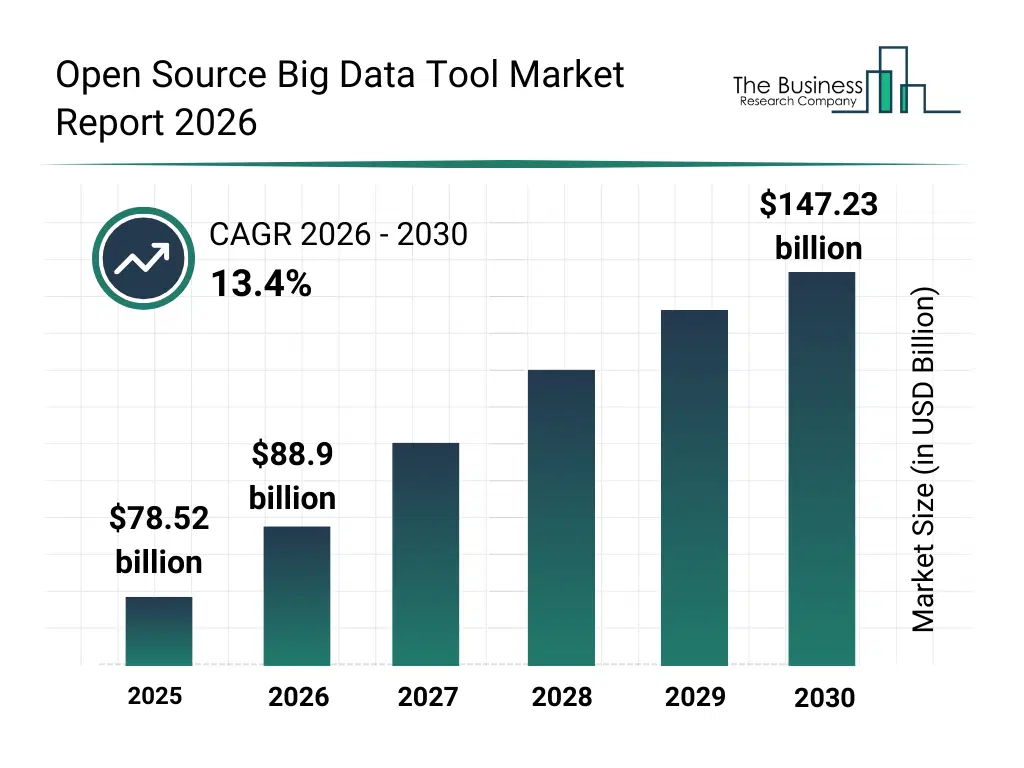
What Is The Open Source Big Data Tool Market Size and Share 2026?
The open source big data tool market size has grown rapidly in recent years. It will grow from $78.52 billion in 2025 to $88.9 billion in 2026 at a compound annual growth rate (CAGR) of 13.2%. The growth in the historic period can be attributed to growth of internet data traffic, expansion of cloud infrastructure adoption, rising enterprise data volumes, demand for cost effective data platforms, growth of open source developer communities.What Is The Open Source Big Data Tool Market Growth Forecast?
The open source big data tool market size is expected to see rapid growth in the next few years. It will grow to $147.23 billion in 2030 at a compound annual growth rate (CAGR) of 13.4%. The growth in the forecast period can be attributed to increase in real time data generation from iot devices, rising adoption of AI and ML workloads, growth of data driven decision making culture, expansion of edge computing environments, increasing need for scalable data governance. Major trends in the forecast period include rise of distributed data architectures across hybrid environments, growing adoption of stream processing for real time decision making, expansion of open source data lakehouse and query engine adoption, increasing community driven innovation and plugin ecosystems, democratization of advanced analytics for smes and research bodies.
Global Open Source Big Data Tool Market Segmentation
1) By Tool Type: Data Processing Tools, Data Storage Solutions, Data Analytics Frameworks, Data Visualization Tools, Machine Learning Libraries 2) By Deployment Model: On-Premises Solutions, Cloud-Based Tools, Hybrid Deployment Models 3) By Data Source: Social Media Data, Machine-Generated Data, Transactional Data, Sensor Data, Publicly Available Datasets 4) By User Type: Small And Medium Enterprises (SMEs), Large Enterprises, Individual Developers And Data Scientists, Research Institutions, Non-Profit Organizations 5) By Industry Vertical: Healthcare, Finance And Banking, Retail And E-Commerce, Telecommunications, Manufacturing, Government And Public Sector Subsegments: 1) By Data Processing Tools: Batch Processing Tools, Stream Processing Tools, Distributed Computing Frameworks, Workflow Scheduling Tools, Data Integration Tools 2) By Data Storage Solutions: Distributed File Systems, No Structured Query Language Databases, In Memory Data Stores, Data Warehousing Solutions, Object Storage Systems 3) By Data Analytics Frameworks: Statistical Analysis Frameworks, Predictive Analytics Platforms, Real Time Analytics Frameworks, Big Data Query Engines, Data Mining Frameworks 4) By Data Visualization Tools: Interactive Dashboards, Reporting And Charting Tools, Geospatial Visualization Tools, Real Time Data Visualization Platforms, Business Intelligence Visualization Tools 5) By Machine Learning Libraries: Supervised Learning Libraries, Unsupervised Learning Libraries, Deep Learning Frameworks, Natural Language Processing Libraries, Recommendation System LibrariesWhat Is The Driver Of The Open Source Big Data Tool Market?
The increasing shift towards cloud computing and hybrid deployment adoption is expected to propel the growth of the open-source big data tool market going forward. Cloud computing is the delivery of computing services such as servers, storage, databases, networking, software, and analytics over the internet, allowing on-demand access without local infrastructure. The rise of cloud computing and hybrid deployment adoption is due to organizations seeking flexible, scalable, and cost-efficient IT solutions that enable seamless integration of on-premises and cloud resources with minimal infrastructure management. Open-source big data tools are useful for cloud computing because they enable organizations to efficiently process, store, and analyze massive volumes of data on scalable cloud infrastructure, while reducing costs, avoiding vendor lock-in, and supporting flexible, distributed computing environments. For instance in December 2023, according to The European Commission, a Belgium-based government agency, node deployment a type of cloud service increased from 498 in 2022 to nearly 1,836 in 2024. Therefore, the increasing shift toward cloud computing and hybrid deployment adoption is driving the growth of the open-source big data tool market.Key Players In The Global Open Source Big Data Tool Market
Major companies operating in the open source big data tool market are Google LLC, Microsoft Corporation, International Business Machines Corporation (IBM), Oracle Corporation, Databricks Inc., Elastic N.V., Qualtrics International Inc., MongoDB Inc., Aiven Oy, Dremio Corporation, ClickHouse Inc., Yugabyte Inc., Redpanda Data Inc., Pinecone Systems Inc., MinIO Inc., Tessell Inc., Snowplow Analytics Ltd., MotherDuck Inc., HPCC Systems Inc., and TDengine Inc.
This chart is for illustrative purposes; the full report includes a detailed competitor analysis and comprehensive overview of the top 10 companies in the market.
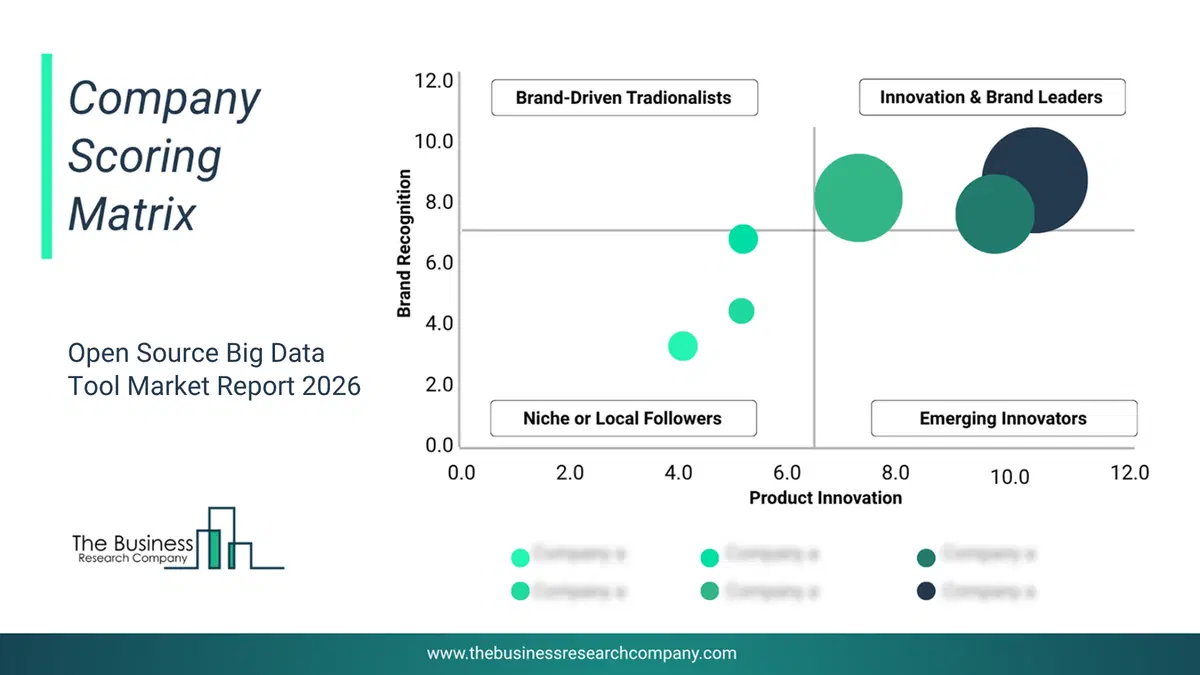
This chart maps companies by product innovation and brand strength, with bubble size indicating relative revenue, helping identify market leaders, challengers, and niche players. This is an illustrative chart; the full report provides a complete and accurate competitive analysis.
Global Open Source Big Data Tool Market Trends and Insights
Major companies operating in the open source big data tools are focusing on advancing real-time and batch data processing capabilities, such as next-generation stream processing architectures, to improve scalability, reduce operational complexity, and lower the cost of real-time analytics across modern data environments. Next-generation stream processing architectures refer to enhancements in distributed data processing engines that simplify stream–batch unification, optimize resource utilization in cloud-native deployments, and enable efficient handling of large-scale, stateful data workloads. For instance, in March 2025, the Apache Flink, a Germany-based open-source, distributed processing framework and engine, launched Apache Flink 2.0.0, the first major release in the Flink 2.x series. This is designed to address long-standing challenges in real-time computing, that disaggregated state management, materialized tables, and optimized batch execution modes, while strengthening integration with streaming lakehouse architectures. These advancements enable more accessible, cost-efficient, and scalable real-time data processing, supporting a broader range of big data and AI-driven applications.What Are Latest Mergers And Acquisitions In The Open Source Big Data Tool Market?
In January 2023, Confluent Inc., a US-based technology company, acquired Immerok for an undisclosed amount. With this acquisition, Confluent aimed to strengthen its real-time data streaming and analytics capabilities by deepening Apache Flink expertise, accelerating innovation in open source stream processing, and expanding enterprise adoption of scalable big data pipelines. Immerok GmbH is a Germany-based technology company that specializes in providing open source big data tools.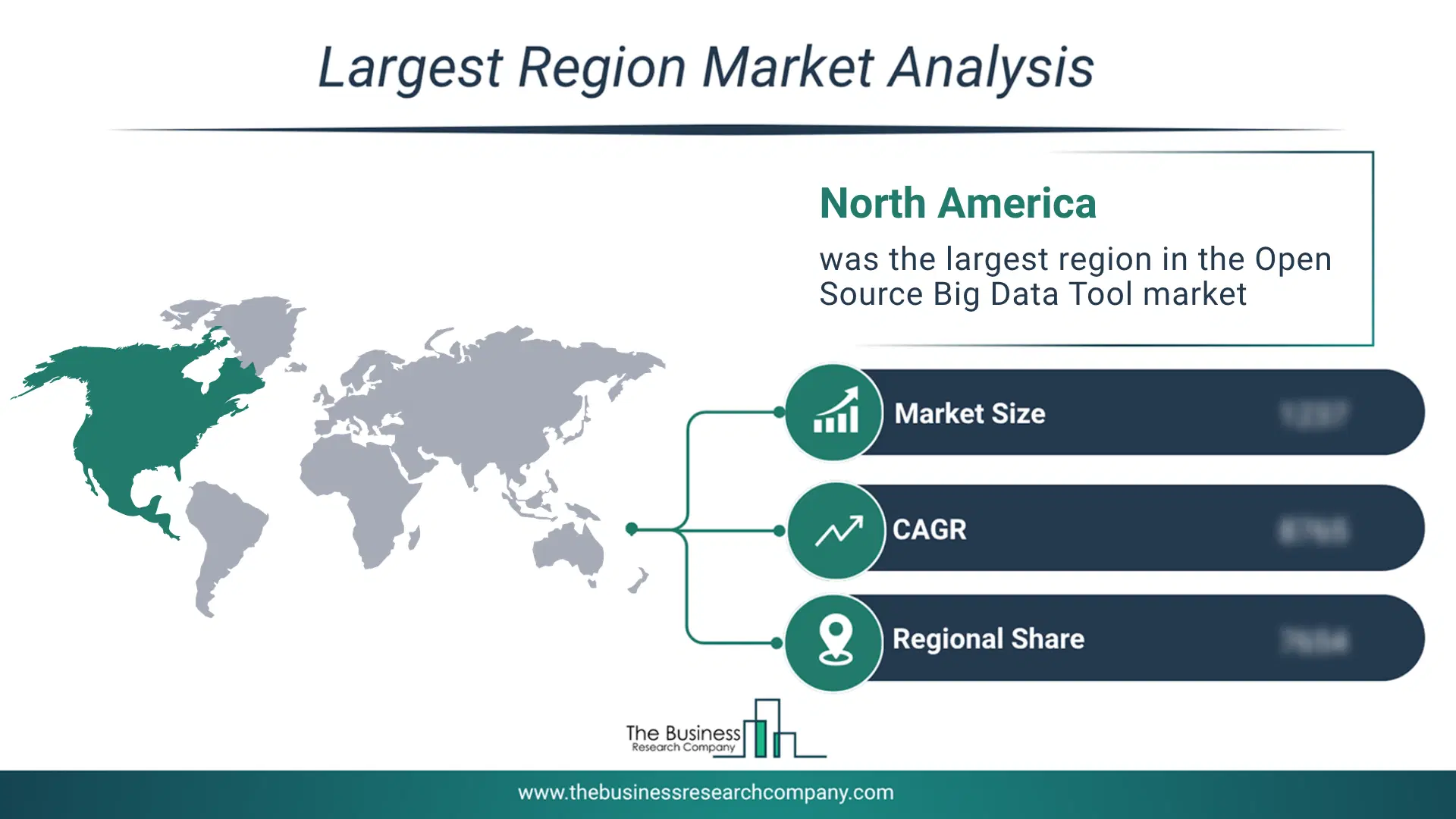
Regional Outlook
North America was the largest region in the open-source big data tool market in 2025. Asia-Pacific is expected to be the fastest-growing region in the forecast period. The regions covered in this market report are Asia-Pacific, South East Asia, Western Europe, Eastern Europe, North America, South America, Middle East, Africa. The countries covered in this market report are Australia, Brazil, China, France, Germany, India, Indonesia, Japan, Taiwan, Russia, South Korea, UK, USA, Canada, Italy, Spain.What Defines the Open Source Big Data Tool Market?
The open-source big data tool market consists of sales of products, such as open-source big data platforms, distributed data storage systems, data processing and analytics frameworks, data integration and streaming tools, and cluster management solutions. Values in this market are ‘factory gate’ values, that is, the value of goods sold by the manufacturers or creators of the goods, whether to other entities (including downstream manufacturers, wholesalers, distributors, and retailers) or directly to end customers. The value of goods in this market includes related services sold by the creators of the goods.How is Market Value Defined and Measured?
The market value is defined as the revenues that enterprises gain from the sale of goods and/or services within the specified market and geography through sales, grants, or donations in terms of the currency (in USD unless otherwise specified). The revenues for a specified geography are consumption values that are revenues generated by organizations in the specified geography within the market, irrespective of where they are produced. It does not include revenues from resales along the supply chain, either further along the supply chain or as part of other products.
This chart presents market attractiveness based on a quantitative evaluation of growth, competition, strategic alignment, and risk, offering a clear view of opportunity areas for decision-making. This chart is for illustrative purposes; the full report contains the complete analysis.

This chart highlights the Total Addressable Market (TAM) by estimating the maximum revenue opportunity using an assumption-driven approach, supporting strategic planning and opportunity sizing across markets. The chart is illustrative; the full report provides a more comprehensive analysis.
What Key Data and Analysis Are Included in the Open Source Big Data Tool Market Report 2026?
The open source big data tool market research report is one of a series of new reports from The Business Research Company that provides market statistics, including industry global market size, regional shares, competitors with the market share, detailed market segments, market trends and opportunities, and any further data you may need to thrive in the open source big data tool industry. The market research report delivers a complete perspective of everything you need, with an in-depth analysis of the current and future state of the industry.Open Source Big Data Tool Market Report Forecast Analysis
| Report Attribute | Details |
|---|---|
| Market Size Value In 2026 | $88.9 billion |
| Revenue Forecast In 2030 | $147.23 billion |
| Growth Rate | CAGR of 13.4% from 2026 to 2030 |
| Base Year For Estimation | 2025 |
| Actual Estimates/Historical Data | 2020-2025 |
| Forecast Period | 2026 - 2030 |
| Market Representation | Revenue in USD Billion and CAGR from 2026 to 2030 |
| Segments Covered | Tool Type, Deployment Model, Data Source, User Type, Industry Vertical |
| Regional Scope | Asia-Pacific, Western Europe, Eastern Europe, North America, South America, Middle East, Africa |
| Country Scope | The Countries Covered In This Market Report Are Australia, Brazil, China, France, Germany, India, Indonesia, Japan, Taiwan, Russia, South Korea, Uk, Usa, Canada, Italy, Spain. |
| Key Companies Profiled | Google LLC, Microsoft Corporation, International Business Machines Corporation (IBM), Oracle Corporation, Databricks Inc., Elastic N.V., Qualtrics International Inc., MongoDB Inc., Aiven Oy, Dremio Corporation, ClickHouse Inc., Yugabyte Inc., Redpanda Data Inc., Pinecone Systems Inc., MinIO Inc., Tessell Inc., Snowplow Analytics Ltd., MotherDuck Inc., HPCC Systems Inc., and TDengine Inc. |
| Customization Scope | Request for Customization |
| Pricing And Purchase Options | Explore Purchase Options |