
Open-Source Hardware Market Report 2026
Global Outlook – By Component (Hardware, Software And Firmware, Services), By Deployment (On-Premises, Cloud-Integrated, Hybrid), By Sales Channel (Direct Sales, Distributor Sales, Online Marketplaces, Retail Electronics Stores), By Application (Large Enterprises, Small And Medium Enterprises, Personal Do It Yourself (DIY), Other Applications), By End User (Individuals, Enterprises, Educational Institutions, Other End-Users) – Market Size, Trends, Strategies, and Forecast to 2030
Open-Source Hardware Market Overview
• Open-Source Hardware market size has reached to $28.25 billion in 2025 • Expected to grow to $45.33 billion in 2030 at a compound annual growth rate (CAGR) of 10% • Growth Driver: Growing Adoption Of IoT And Connected Devices Fueling The Growth Of The Market Due To Increasing Demand For Flexible And Customizable Hardware Solutions • Market Trend: Advancements In Open-Source Electronics And Microcontroller Boards Accelerating Innovation • North America was the largest region in 2025 and Asia-Pacific is the fastest growing region.What Is Covered Under Open-Source Hardware Market?
Open-source hardware refers to physical products whose design files, schematics, and documentation are openly shared so anyone can study, modify, and reproduce them. It promotes collaborative innovation by allowing communities and companies to improve and customize hardware without restrictive licensing. This approach encourages collaborative innovation, transparency, and knowledge sharing, enabling developers, researchers, and businesses to improve existing hardware, reduce development costs, and create customized solutions without being restricted by proprietary ownership. The main components of open-source hardware are hardware, software and firmware, and services. Hardware refers to the physical, open-source electronic components and devices that can be freely used, modified, and distributed by individuals or organizations. These solutions are deployed through different deployment models, including on-premises, cloud-integrated, and hybrid. They are distributed via multiple sales channels, such as direct sales, distributor sales, online marketplaces, and retail electronics stores, and are used across various applications, including large enterprises, small and medium enterprises, personal do-it-yourself (DIY) projects, and other applications. These serves a wide range of end-users, including individuals, enterprises, educational institutions, and other end-users.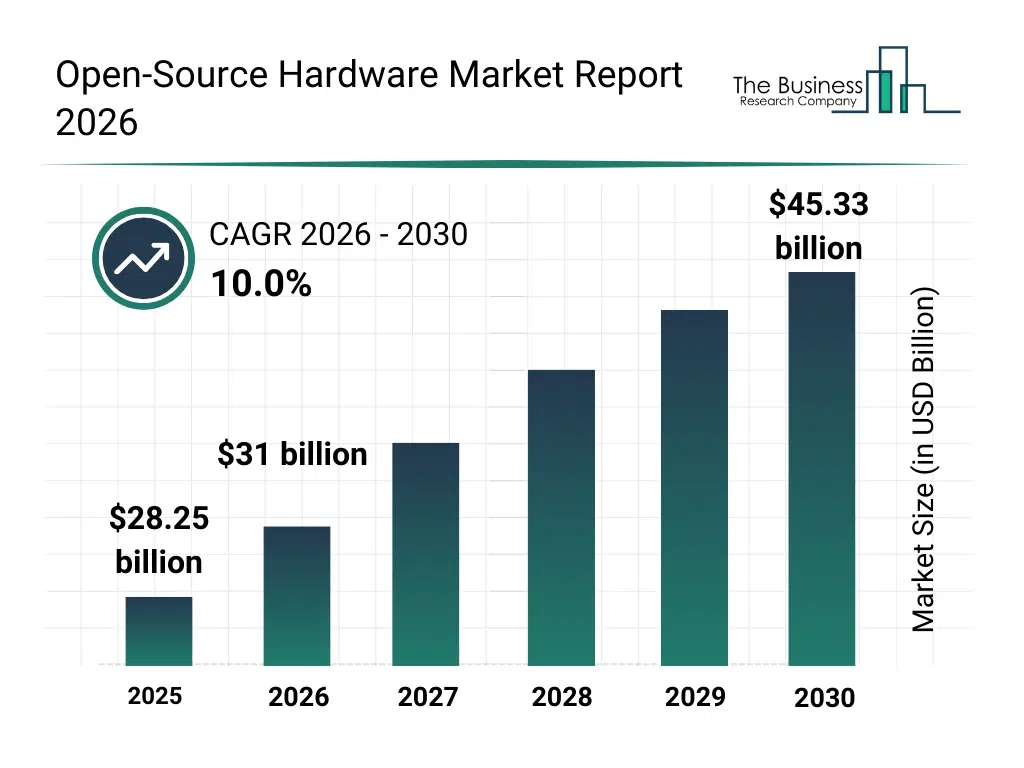
What Is The Open-Source Hardware Market Size and Share 2026?
The open-source hardware market size has grown strongly in recent years. It will grow from $28.25 billion in 2025 to $31 billion in 2026 at a compound annual growth rate (CAGR) of 9.7%. The growth in the historic period can be attributed to growth of maker and diy communities, availability of low cost prototyping tools, expansion of open source licensing practices, rise of educational robotics programs, increased use of microcontrollers in hobbyist projects.What Is The Open-Source Hardware Market Growth Forecast?
The open-source hardware market size is expected to see strong growth in the next few years. It will grow to $45.33 billion in 2030 at a compound annual growth rate (CAGR) of 10.0%. The growth in the forecast period can be attributed to enterprise demand for customizable hardware platforms, growth of smart home and iot device development, rising interest in sustainable and repairable hardware, expansion of stem education initiatives, increasing need for rapid hardware prototyping solutions. Major trends in the forecast period include growing popularity of open hardware design repositories and community collaboration, increasing adoption of open source microcontrollers and single board computers in diy projects, rising demand for customizable hardware platforms for education and research, expansion of open firmware and device driver ecosystems for hardware interoperability, growth of online marketplaces enabling distribution of open hardware kits and components.
Global Open-Source Hardware Market Segmentation
1) By Component: Hardware, Software And Firmware, Services 2) By Deployment: On-Premises, Cloud-Integrated, Hybrid 3) By Sales Channel: Direct Sales, Distributor Sales, Online Marketplaces, Retail Electronics Stores 4) By Application: Large Enterprises, Small And Medium Enterprises, Personal Do It Yourself (DIY), Other Applications 5) By End User: Individuals, Enterprises, Educational Institutions, Other End-Users Subsegments: 1) By Hardware: Open-Source Microcontrollers, Open-Source Single Board Computers, Open-Source Sensor Modules, Open-Source Communication Boards 2) By Software And Firmware: Open-Source Operating Systems, Open-Source Embedded Firmware, Open-Source Development Tools, Open-Source Device Drivers 3) By Services: Design Consulting, Customization Services, Integration Support, Maintenance And Technical AssistanceWhat Is The Driver Of The Open-Source Hardware Market?
The growing adoption of IoT and connected devices is expected to propel the growth of the open-source hardware market going forward. IoT and connected devices refer to physical objects embedded with sensors, software, and network connectivity that enable them to collect, exchange, and act on data over the internet or other communication networks, allowing for real-time monitoring, remote control, and automated decision-making across consumer, industrial, and enterprise applications. IoT and connected devices are increasing due to the growing demand for real-time monitoring and automation across industries and consumer applications. Open-source hardware supports IoT and connected devices by offering transparent, customizable, and interoperable hardware designs that reduce development time and costs while enabling rapid innovation for IoT applications. For instance, in May 2023, according to IoT Analytics GmbH, a UK-based IoT research firm, the number of connected IoT devices grew 18% in 2022 to 14.3 billion, and the total is expected to reach 16.7 billion in 2023. Therefore, the growing adoption of IoT and connected devices is driving the growth of the open-source hardware industry.Key Players In The Global Open-Source Hardware Market
Major companies operating in the open-source hardware market are Qualcomm Incorporated, Texas Instruments Incorporated, STMicroelectronics N.V., NXP Semiconductors N.V., SparkFun Electronics Inc., Seeed Studio Co. Ltd., BeagleBoard.org Foundation, Mycroft AI Inc., OpenBCI Inc., ITEAD Intelligent Systems Co. Ltd., Arduino S.r.l., UDOO S.r.l., Purism SPC, Olimex Ltd., Pine Microsystems Inc., Bunnie Studios LLC, Open Source Ecology Inc., Libre Computer Project LLC, Octavo Systems Inc., Pimoroni Ltd.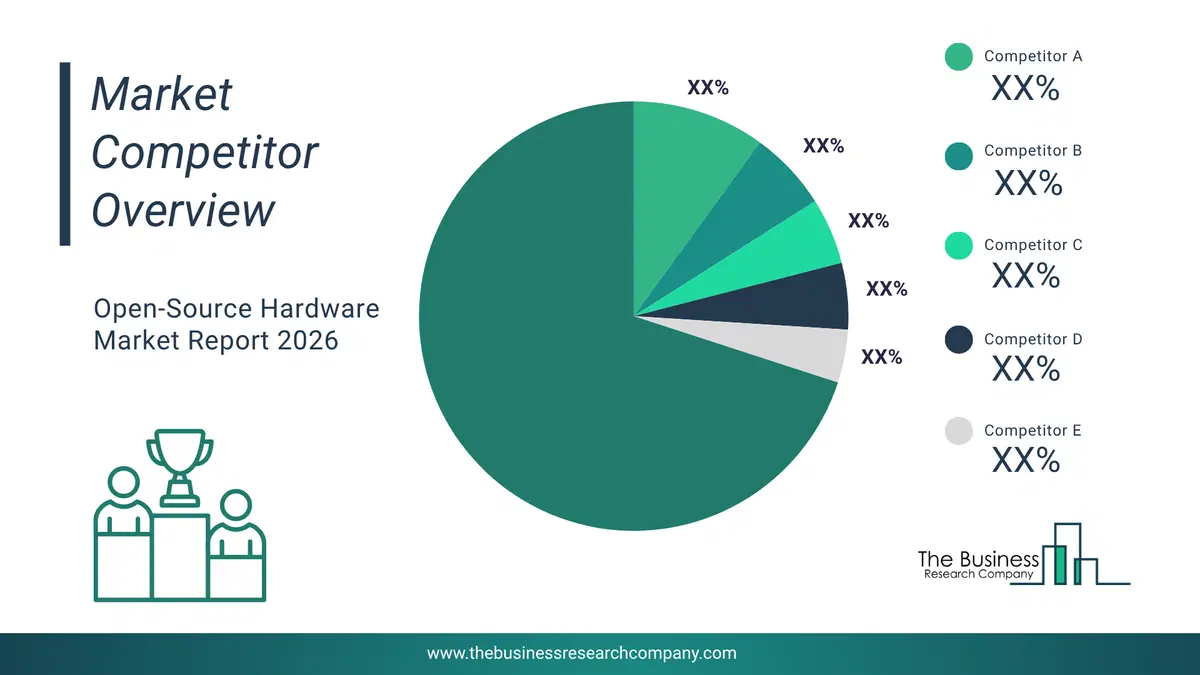
This chart is for illustrative purposes; the full report includes a detailed competitor analysis and comprehensive overview of the top 10 companies in the market.
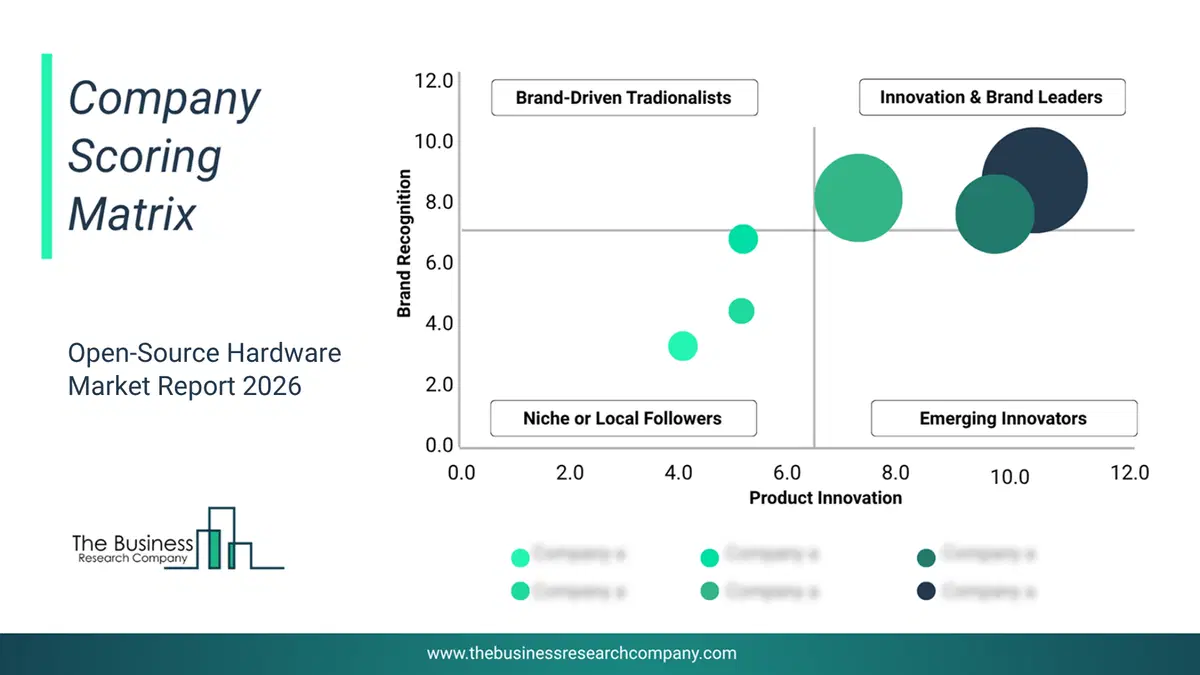
This chart maps companies by product innovation and brand strength, with bubble size indicating relative revenue, helping identify market leaders, challengers, and niche players. This is an illustrative chart; the full report provides a complete and accurate competitive analysis.
Global Open-Source Hardware Market Trends and Insights
Major companies operating in the open-source hardware market are focusing on developing innovative solutions, such as next-generation microcontroller architecture platforms, to broaden capabilities for embedded computing, automation, and IoT applications. Next-generation microcontroller architecture platforms refer to advanced microcontroller system designs that integrate improved processing performance, energy efficiency, security features, connectivity support, and flexible development ecosystems, enabling smarter, more scalable, and more secure embedded computing for modern applications such as IoT, industrial automation, robotics, and edge intelligence. For instance, in June 2023, Arduino Uno, an Italy-based company that provides open-source software and hardware, launched new 32-bit Arduino Uno boards designed to significantly enhance processing performance, memory capacity, and scalability while maintaining compatibility with the existing Arduino ecosystem and form factor. The boards maintain full backward compatibility with the Arduino Uno form factor and development ecosystem, allowing existing shields, libraries, and projects to scale seamlessly without redesign. Enhanced features include improved power efficiency, advanced peripheral integration, stronger security capabilities, and broader connectivity support, enabling developers to build more capable IoT, industrial, robotics, and edge-computing solutions while preserving Arduino’s open-source hardware philosophy and ease of use.What Are Latest Mergers And Acquisitions In The Open-Source Hardware Market?
In October 2025, Qualcomm Technologies Inc., a US-based technology company, acquired Arduino for an undisclosed amount. Through this acquisition, Qualcomm aimed to accelerate access to its edge computing and artificial intelligence technologies for a global developer community and expand its presence in robotics, the Internet of Things, and edge computing development by combining its processing capabilities with Arduino’s widely adopted open-source hardware platform. Arduino S.r.l. is an Italy-based company that specializes in providing accessible microcontroller and single-board computer platforms along with open design tools and a large global developer ecosystem.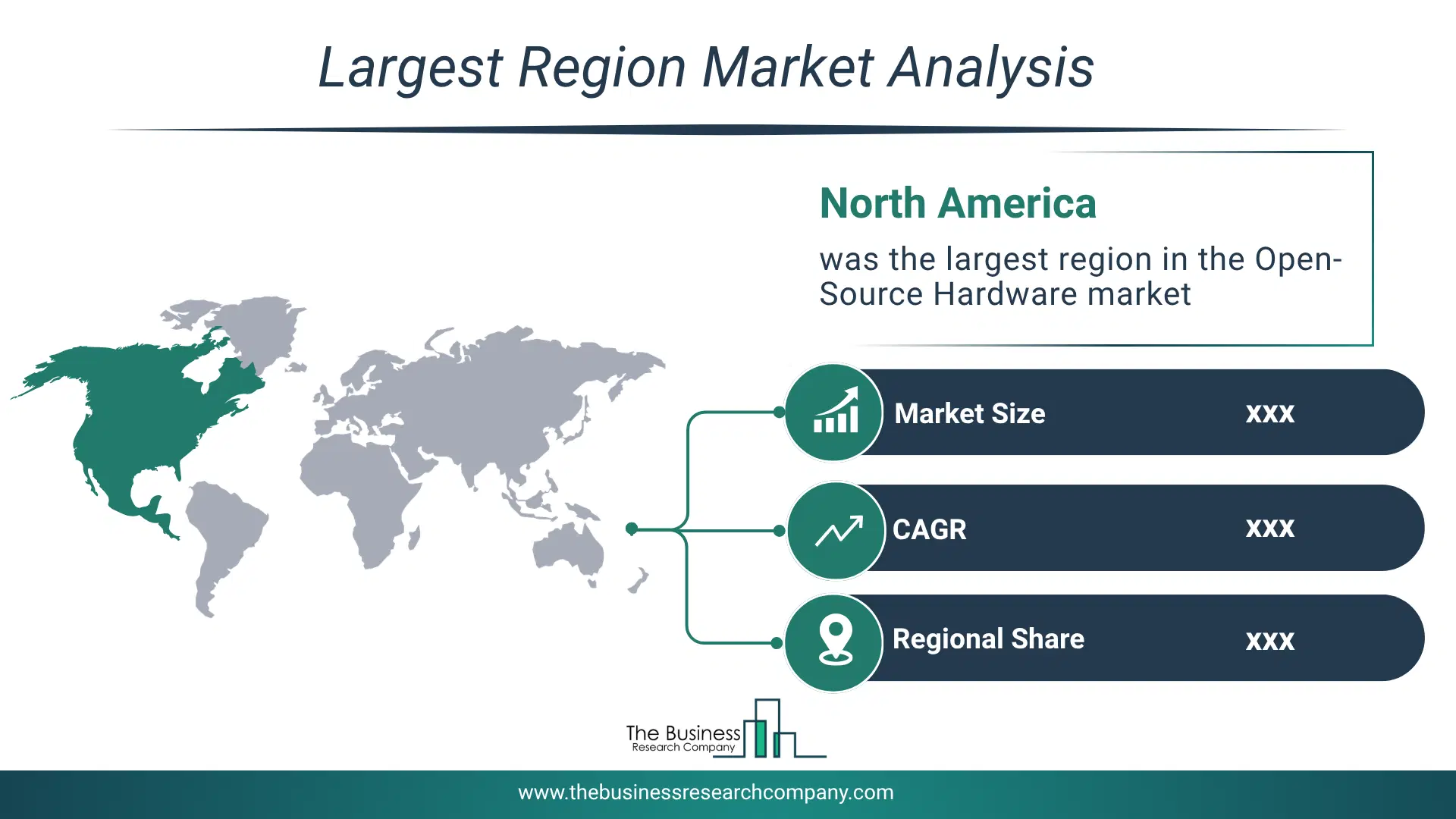
Regional Outlook
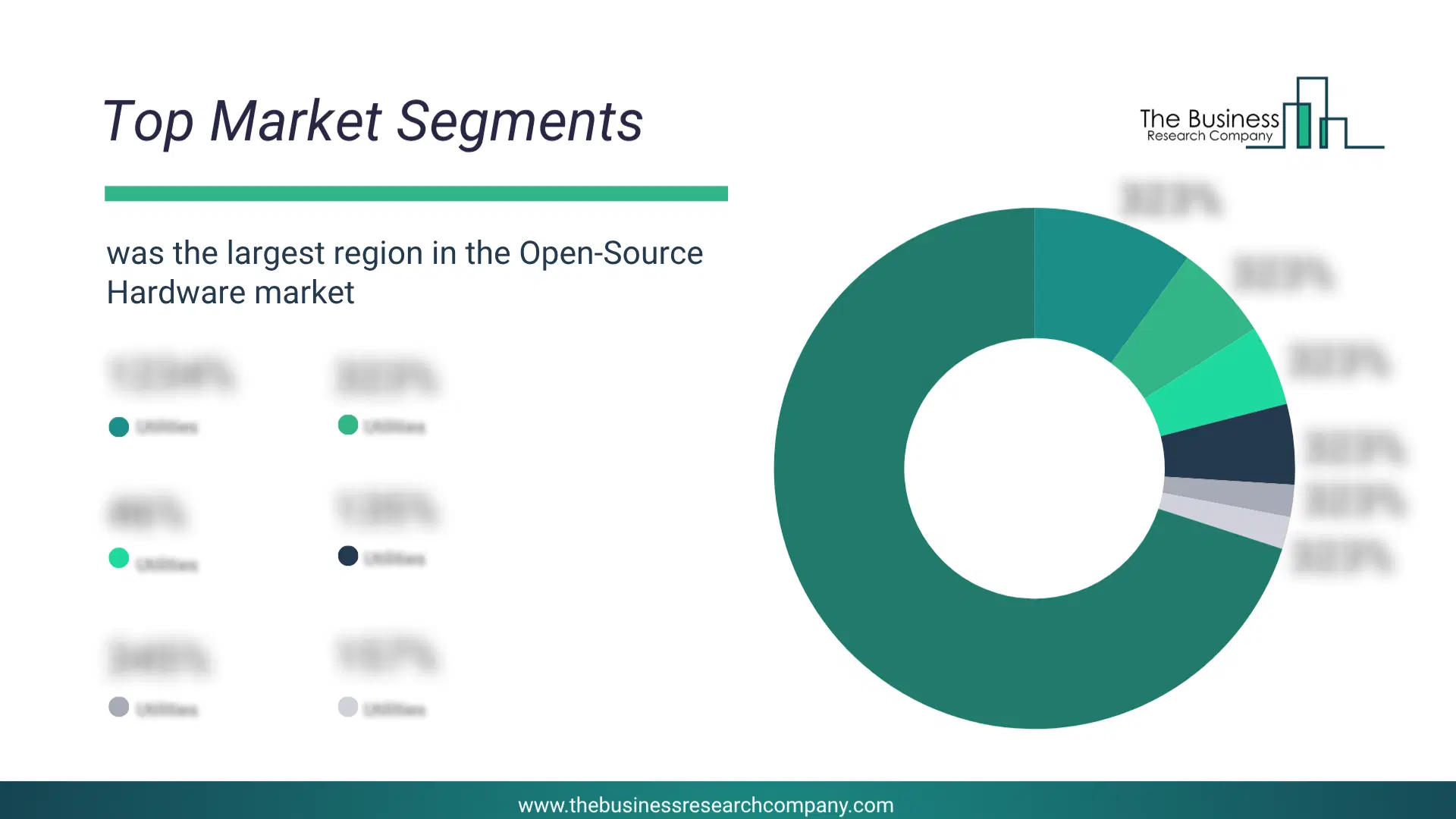
North America was the largest region in the open-source hardware market in 2025. Asia-Pacific is expected to be the fastest-growing region in the forecast period. The regions covered in this market report are Asia-Pacific, South East Asia, Western Europe, Eastern Europe, North America, South America, Middle East, Africa. The countries covered in this market report are Australia, Brazil, China, France, Germany, India, Indonesia, Japan, Taiwan, Russia, South Korea, UK, USA, Canada, Italy, Spain.What Defines the Open-Source Hardware Market?
The open-source hardware market consists of sales of electric vehicle controllers, educational robot kits, industrial robotic platforms, smart home controllers, and open microscopes. Values in this market are ‘factory gate’ values, that is, the value of goods sold by the manufacturers or creators of the goods, whether to other entities (including downstream manufacturers, wholesalers, distributors, and retailers) or directly to end customers. The value of goods in this market includes related services sold by the creators of the goods.How is Market Value Defined and Measured?
The market value is defined as the revenues that enterprises gain from the sale of goods and/or services within the specified market and geography through sales, grants, or donations in terms of the currency (in USD unless otherwise specified). The revenues for a specified geography are consumption values that are revenues generated by organizations in the specified geography within the market, irrespective of where they are produced. It does not include revenues from resales along the supply chain, either further along the supply chain or as part of other products.
This chart presents market attractiveness based on a quantitative evaluation of growth, competition, strategic alignment, and risk, offering a clear view of opportunity areas for decision-making. This chart is for illustrative purposes; the full report contains the complete analysis.

This chart highlights the Total Addressable Market (TAM) by estimating the maximum revenue opportunity using an assumption-driven approach, supporting strategic planning and opportunity sizing across markets. The chart is illustrative; the full report provides a more comprehensive analysis.
What Key Data and Analysis Are Included in the Open-Source Hardware Market Report 2026?
The open-source hardware market research report is one of a series of new reports from The Business Research Company that provides market statistics, including industry global market size, regional shares, competitors with the market share, detailed market segments, market trends and opportunities, and any further data you may need to thrive in the open-source hardware industry. The market research report delivers a complete perspective of everything you need, with an in-depth analysis of the current and future state of the industry.Open-Source Hardware Market Report Forecast Analysis
| Report Attribute | Details |
|---|---|
| Market Size Value In 2026 | $31 billion |
| Revenue Forecast In 2030 | $45.33 billion |
| Growth Rate | CAGR of 9.7% from 2026 to 2030 |
| Base Year For Estimation | 2025 |
| Actual Estimates/Historical Data | 2020-2025 |
| Forecast Period | 2026 - 2030 |
| Market Representation | Revenue in USD Billion and CAGR from 2026 to 2030 |
| Segments Covered | Component, Deployment, Sales Channel, Application, End User |
| Regional Scope | Asia-Pacific, Western Europe, Eastern Europe, North America, South America, Middle East, Africa |
| Country Scope | The countries covered in the report are Australia, Brazil, China, France, Germany, India, Indonesia, Japan, Taiwan, Russia, South Korea, UK, USA, Canada, Italy, Spain. |
| Key Companies Profiled | Qualcomm Incorporated, Texas Instruments Incorporated, STMicroelectronics N.V., NXP Semiconductors N.V., SparkFun Electronics Inc., Seeed Studio Co. Ltd., BeagleBoard.org Foundation, Mycroft AI Inc., OpenBCI Inc., ITEAD Intelligent Systems Co. Ltd., Arduino S.r.l., UDOO S.r.l., Purism SPC, Olimex Ltd., Pine Microsystems Inc., Bunnie Studios LLC, Open Source Ecology Inc., Libre Computer Project LLC, Octavo Systems Inc., Pimoroni Ltd. |
| Customization Scope | Request for Customization |
| Pricing And Purchase Options | Explore Purchase Options |