

Operating Systems Market Report 2026
Global Outlook – By Operating System (Windows, Mac Os, Linux, Other Operating Systems), By Device Type (Computer, Mobile), By Distribution Channel (Business-To-Business (B2B), Business-To-Consumer (B2C)) – Market Size, Trends, Strategies, and Forecast to 2030
Operating Systems Market Overview
• Operating Systems market size has reached to $48.5 billion in 2025 • Expected to grow to $54.22 billion in 2030 at a compound annual growth rate (CAGR) of 2.4% • Growth Driver: Growing Adoption Of Cloud Market • Market Trend: Growing Adoption Of Open Source Platforms In Operating Systems And Productivity Software Market • North America was the largest region in 2025 and Asia-Pacific is the fastest growing region.What Is Covered Under Operating Systems Market?
Operating Systems (OS) refer to the foundational software that manages a computer's hardware and software resources, providing a platform for other applications to run. The OS facilitates communication between the user and the device, overseeing essential functions such as file management, memory allocation, process scheduling, and input or output operations. The main types of operating systems are windows, mac OS, Linux and others. Windows operating systems is a software that acts as an interface between the end user and computer hardware. Various types of products include windows, linux, android, iOS, macos and others and are used in computer and mobile. It is distributed through business-to-business (B2B) and business-to-consumer (B2C) channel.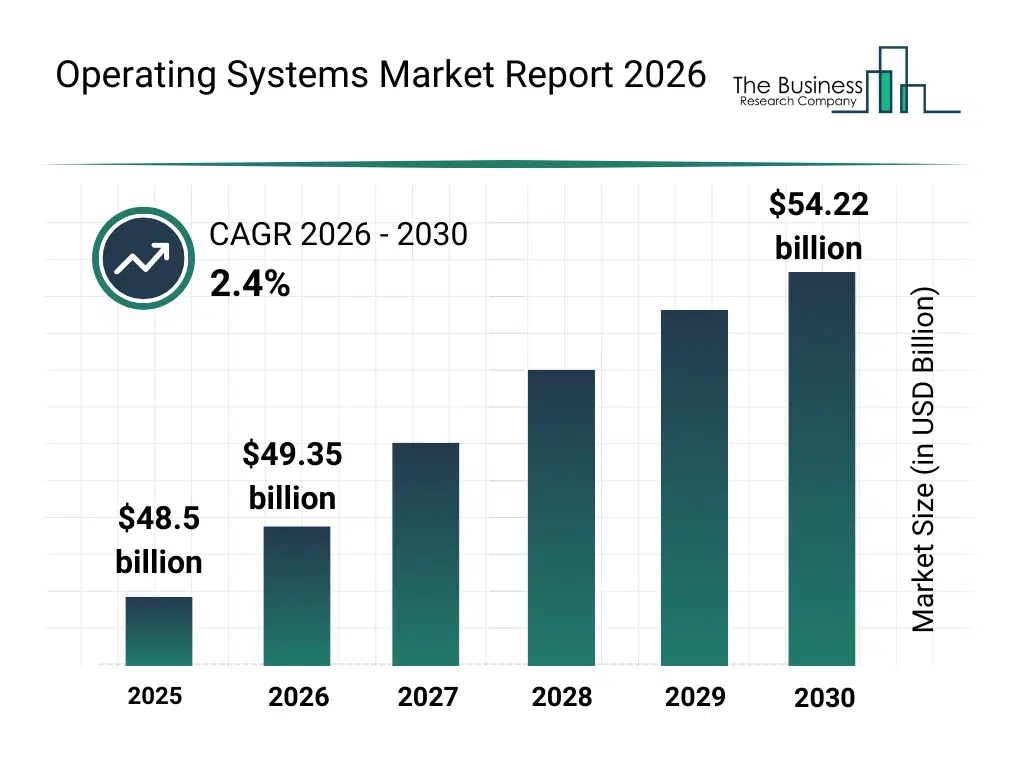
What Is The Operating Systems Market Size and Share 2026?
The operating systems market size has grown marginally in recent years. It will grow from $48.5 billion in 2025 to $49.35 billion in 2026 at a compound annual growth rate (CAGR) of 1.8%. The growth in the historic period can be attributed to growth of personal computing, enterprise software standardization, expansion of server infrastructure, rise of mobile devices, open-source software adoption.What Is The Operating Systems Market Growth Forecast?
The operating systems market size is expected to see steady growth in the next few years. It will grow to $54.22 billion in 2030 at a compound annual growth rate (CAGR) of 2.4%. The growth in the forecast period can be attributed to increasing cloud workloads, demand for secure operating environments, growth of iot devices, edge computing expansion, integration of AI at os level. Major trends in the forecast period include cloud-optimized operating systems, cross-platform compatibility, security-enhanced os architectures, lightweight operating systems, edge device os adoption.
Global Operating Systems Market Segmentation
1) By Operating System: Windows, Mac Os, Linux, Other Operating Systems 2) By Device Type: Computer, Mobile 3) By Distribution Channel: Business-To-Business (B2B), Business-To-Consumer (B2C) Subsegments: 1) By Windows: Windows 10, Windows 11, Windows Server, Windows Embedded 2) By Mac OS: MacOS Ventura, MacOS Monterey, MacOS Big Sur, MacOS Catalina 3) By Linux: Ubuntu, Fedora, Debian, Red Hat Enterprise Linux (RHEL) 4) By Other Operating Systems: Chrome OS, UNIX, BSD (Berkeley Software Distribution), Android OS For Non-Mobile DevicesWhat Is The Driver Of The Operating Systems Market?
The adoption of 5G networks with optimized high-speed connectivity is expected to propel the growth of the global operating system market going forward. 5G technology refers to the fifth-generation technology standard for cellular networks. 5G technology is designed to increase transmission speed to as much as 20 Gbps, reduce latency, and improve the flexibility of wireless services. The anticipated expansion of 5G networks will increase the market for mobile devices capable of harnessing the enhanced speeds and reduced latency of 5G technology, consequently spurring the need for operating systems tailored for high-speed connectivity. For instance, in November 2023, according to the Telefonaktiebolaget LM Ericsson, a Sweden-based networking and telecommunications company, global 5G subscriptions are projected to exceed 5.3 billion by 2029, while average smartphone data usage is expected to rise from 21 GB per month in 2023 to 56 GB per month by 2029, and 5G network availability is forecast to reach 85 percent of the world’s population by the end of 2029. Therefore, the adoption of 5G networks is driving the growth of the operating system industry going forward.Key Players In The Global Operating Systems Market
Major companies operating in the operating systems market are Microsoft Corporation, Apple Inc., Manjaro GmbH & Co KG, Canonical Ltd., Debian, IBM Corporation, SUSE, Google LLC, Red Hat Inc., Oracle Corporation, VMware Inc., Citrix Systems Inc., Hewlett Packard Enterprise Co, Dell Technologies Inc., Lenovo Limited, Fujitsu, NEC Corporation, Toshiba Corporation, Samsung Corporation, LG Corporation, Xiaomi Corporation, OnePlus Technology Co Ltd., Oppo, Vivo Communication Technology Co Ltd., Realme, ASUSTeK Computer Inc., Acer Inc., Micro-Star International Co Ltd., Gigabyte Technology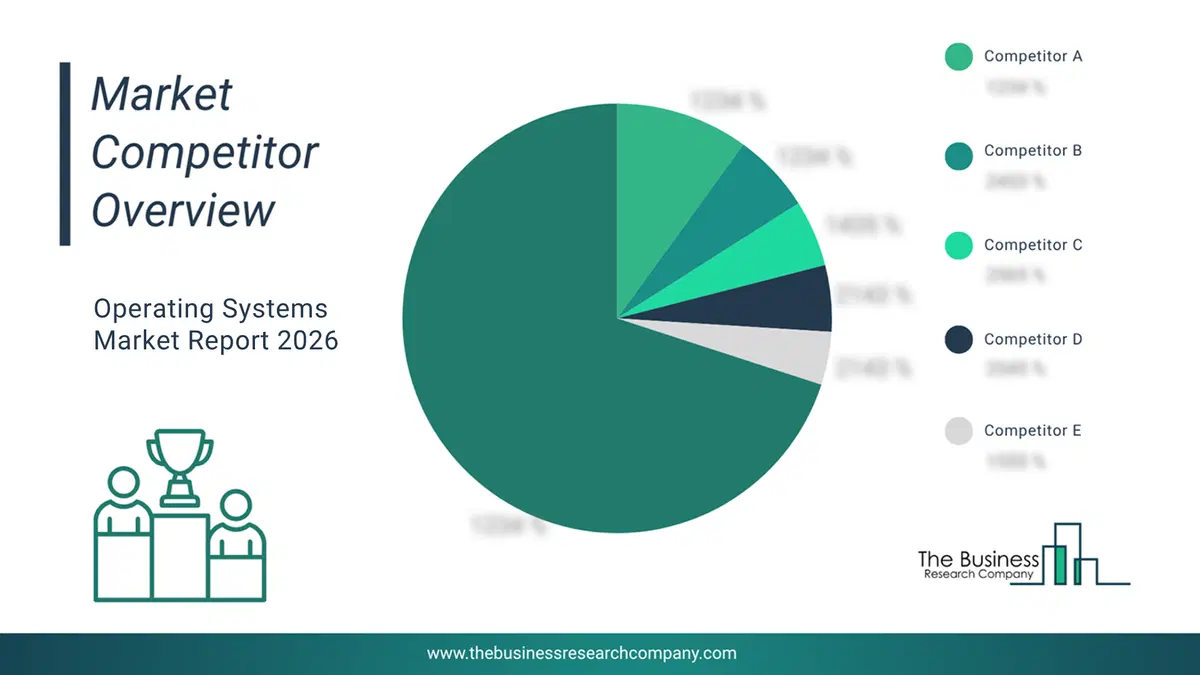
This chart is for illustrative purposes; the full report includes a detailed competitor analysis and comprehensive overview of the top 10 companies in the market.
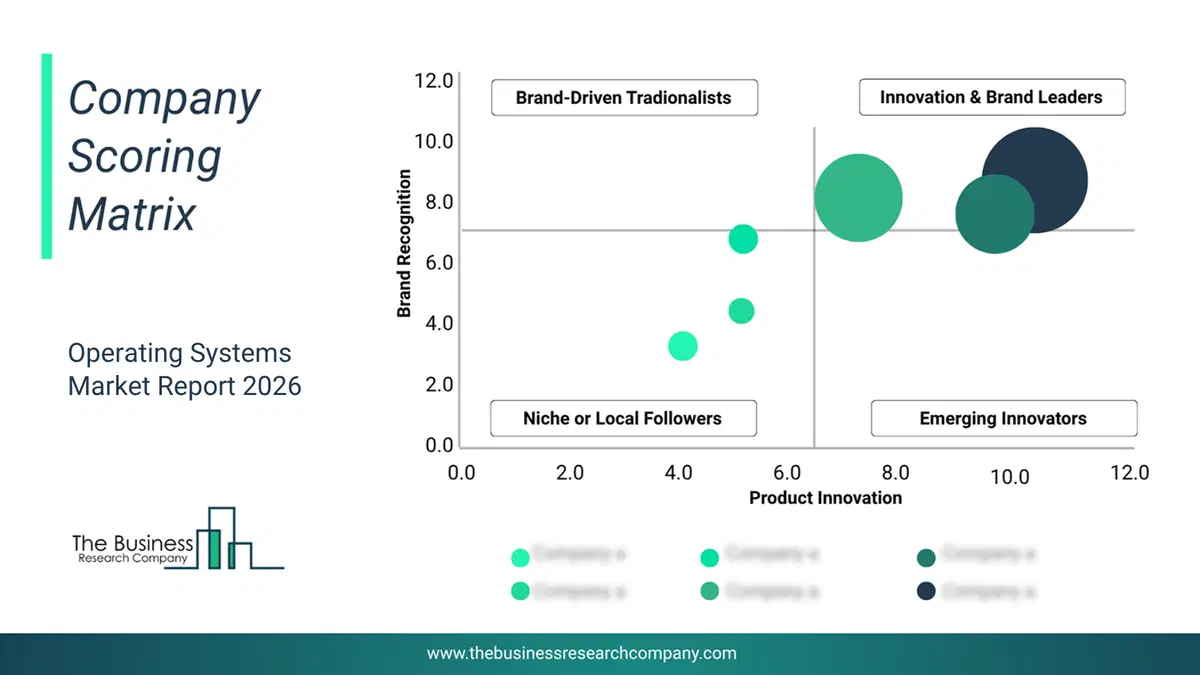
This chart maps companies by product innovation and brand strength, with bubble size indicating relative revenue, helping identify market leaders, challengers, and niche players. This is an illustrative chart; the full report provides a complete and accurate competitive analysis.
Global Operating Systems Market Trends and Insights
Major companies operating in the operating systems market are introducing innovative technology in operating systems, such as HarmonyOS 4, to gain a competitive edge in the market. HarmonyOS is a distributed operating system that allows devices to work together seamlessly and efficiently. HarmonyOS is adaptable to various types of hardware and is designed to work across many internet-connected devices, from smartphones to wearables and TVs. For instance, in August 2023, according to CNBC, a US-based news channel, Huawei announced the latest version of its mobile operating system, HarmonyOS 4, and an enhanced A.I. assistant as the embattled giant ramps up efforts to re-establish strength for its smartphone business. HarmonyOS 4, among other features, has a new app controller that provides protection against harmful applications and takes required actions without user attention.What Are Latest Mergers And Acquisitions In The Operating Systems Market?
In November 2023, Broadcom Inc., a U.S.–based provider of semiconductor and infrastructure software solutions, acquired VMware Inc. for approximately US$61 billion. With this acquisition, Broadcom aims to strengthen its enterprise software portfolio and accelerate deployment of private and hybrid cloud environments. VMware Inc. is a U.S.-based provider of cloud computing and virtualization software, offering products and services for private, hybrid, and multi-cloud infrastructure.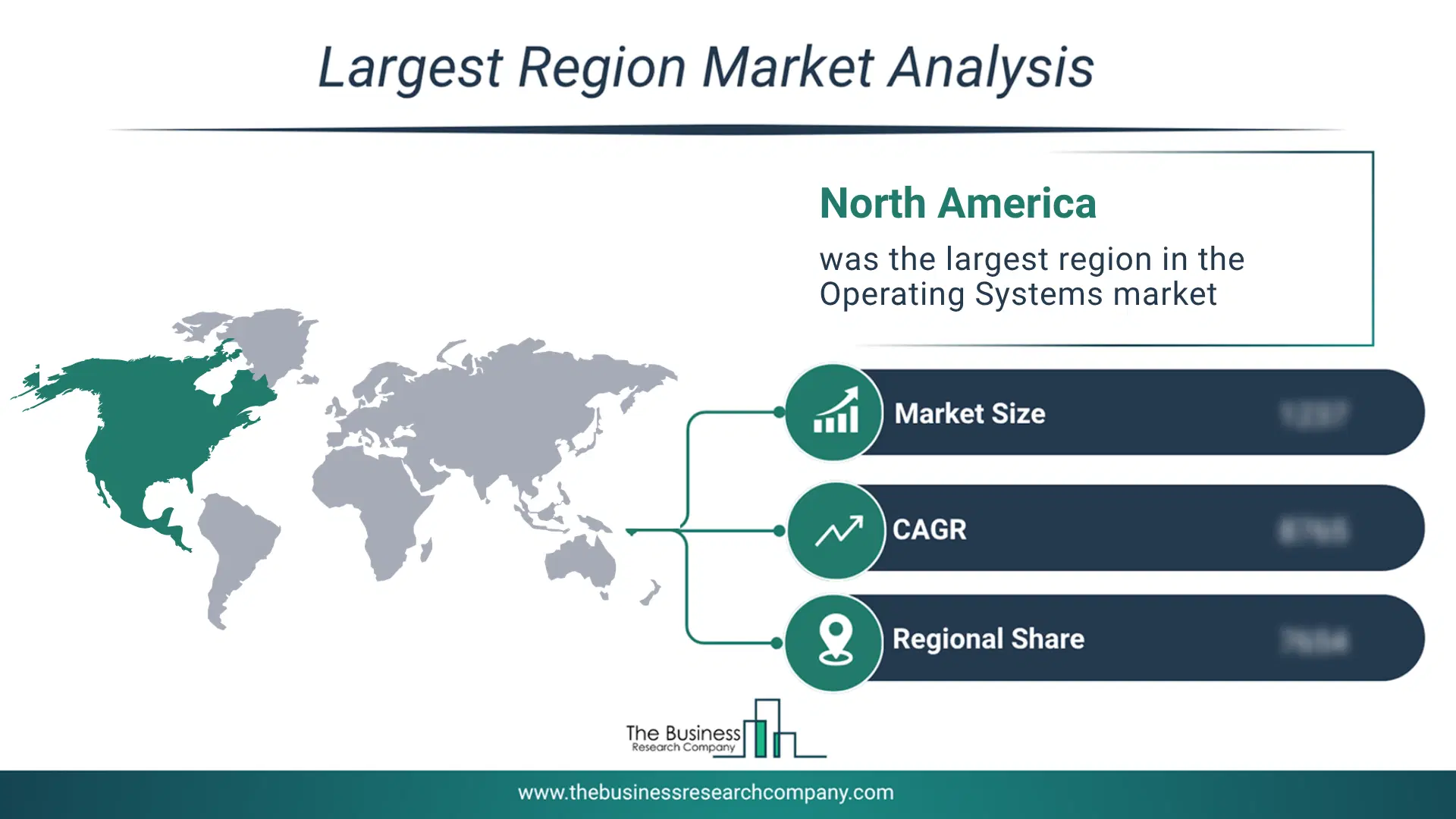
Regional Insights
North America was the largest region in operating systems & productivity software publishing market in 2025. Asia-Pacific is expected to be the fastest-growing region in the forecast period. The regions covered in this market report are Asia-Pacific, South East Asia, Western Europe, Eastern Europe, North America, South America, Middle East, Africa. The countries covered in this market report are Australia, Brazil, China, France, Germany, India, Indonesia, Japan, Taiwan, Russia, South Korea, UK, USA, Canada, Italy, Spain.What Defines the Operating Systems Market?
The operating systems market includes revenues earned by entities by developing and distributing software programs enabling computer hardware to communicate and operate with the computer software. Values in this market are factory gate values, that is the value of goods sold by the manufacturers or creators of the goods, whether to other entities (including downstream manufacturers, wholesalers, distributors and retailers) or directly to end customers. The value of goods in this market includes related services sold by the creators of the goods. Only goods and services traded between entities or sold to end consumers are included.How is Market Value Defined and Measured?
The market value is defined as the revenues that enterprises gain from the sale of goods and/or services within the specified market and geography through sales, grants, or donations in terms of the currency (in USD unless otherwise specified). The revenues for a specified geography are consumption values that are revenues generated by organizations in the specified geography within the market, irrespective of where they are produced. It does not include revenues from resales along the supply chain, either further along the supply chain or as part of other products.
This chart presents market attractiveness based on a quantitative evaluation of growth, competition, strategic alignment, and risk, offering a clear view of opportunity areas for decision-making. This chart is for illustrative purposes; the full report contains the complete analysis.

This chart highlights the Total Addressable Market (TAM) by estimating the maximum revenue opportunity using an assumption-driven approach, supporting strategic planning and opportunity sizing across markets. The chart is illustrative; the full report provides a more comprehensive analysis.
What Key Data and Analysis Are Included in the Operating Systems Market Report 2026?
The operating systems market research report is one of a series of new reports from The Business Research Company that provides market statistics, including industry global market size, regional shares, competitors with the market share, detailed market segments, market trends and opportunities, and any further data you may need to thrive in the operating systems industry. The market research report delivers a complete perspective of everything you need, with an in-depth analysis of the current and future state of the industry.Operating Systems Market Report Forecast Analysis
| Report Attribute | Details |
|---|---|
| Market Size Value In 2026 | $49.35 billion |
| Revenue Forecast In 2030 | $54.22 billion |
| Growth Rate | CAGR of 2.4% from 2026 to 2030 |
| Base Year For Estimation | 2025 |
| Actual Estimates/Historical Data | 2020-2025 |
| Forecast Period | 2026 - 2030 |
| Market Representation | Revenue in USD Billion and CAGR from 2026 to 2030 |
| Segments Covered | Operating System, Device Type, Distribution Channel |
| Regional Scope | Asia-Pacific, Western Europe, Eastern Europe, North America, South America, Middle East, Africa |
| Country Scope | The Countries Covered In This Market Report Are Australia, Brazil, China, France, Germany, India, Indonesia, Japan, Taiwan, Russia, South Korea, Uk, Usa, Canada, Italy, Spain. |
| Key Companies Profiled | Microsoft Corporation, Apple Inc., Manjaro GmbH & Co KG, Canonical Ltd., Debian, IBM Corporation, SUSE, Google LLC, Red Hat Inc., Oracle Corporation, VMware Inc., Citrix Systems Inc., Hewlett Packard Enterprise Co, Dell Technologies Inc., Lenovo Limited, Fujitsu, NEC Corporation, Toshiba Corporation, Samsung Corporation, LG Corporation, Xiaomi Corporation, OnePlus Technology Co Ltd., Oppo, Vivo Communication Technology Co Ltd., Realme, ASUSTeK Computer Inc., Acer Inc., Micro-Star International Co Ltd., Gigabyte Technology |
| Customization Scope | Request for Customization |
| Pricing And Purchase Options | Explore Purchase Options |