

Operational Predictive Maintenance Market Report 2026
Global Outlook – By Type (Software, Services), By Deployment Model (Cloud, On-Premise), By Technology (Machine Learning, Deep Learning, Big Data And Analytics), By End User (Public Sector, Automotive, Manufacturing, Healthcare, Energy And Utility, Transportation, Other End Users) – Market Size, Trends, Strategies, and Forecast to 2030
Operational Predictive Maintenance Market Overview
• Operational Predictive Maintenance market size has reached to $9.19 billion in 2025 • Expected to grow to $29.41 billion in 2030 at a compound annual growth rate (CAGR) of 26.2% • Growth Driver: Increasing Number Of IoT Devices Propels Operational Predictive Maintenance Market • Market Trend: Proactive Solutions: Hitachi’s New Service Aims to Minimize Downtime in Air Compressors • North America was the largest region in 2025.Market Gains By 2030 – Top Opportunities By Segment
Market Gain identifies the most promising market opportunities by highlighting the segments or products expected to generate the highest incremental revenue growth over the next five years.
What Is Covered Under Operational Predictive Maintenance Market?
Operational predictive maintenance (OPM) refers to a proactive maintenance strategy that utilizes data analytics, machine learning, and predictive modeling techniques to anticipate equipment failures or maintenance needs before they occur. The goal of OPM is to minimize downtime, reduce maintenance costs, and optimize the efficiency and reliability of equipment and processes. The main types of operational predictive maintenance are software and services. Software refers to a collection of programs, instructions, and data that enable computers and other electronic devices to perform specific tasks, functions, or operations. It can be deployed in the cloud or on-premise and uses different technologies such as machine learning, deep learning, big data, and analytics. It is used by various end users, including public sector, automotive, manufacturing, healthcare, energy and utility, transportation, and others.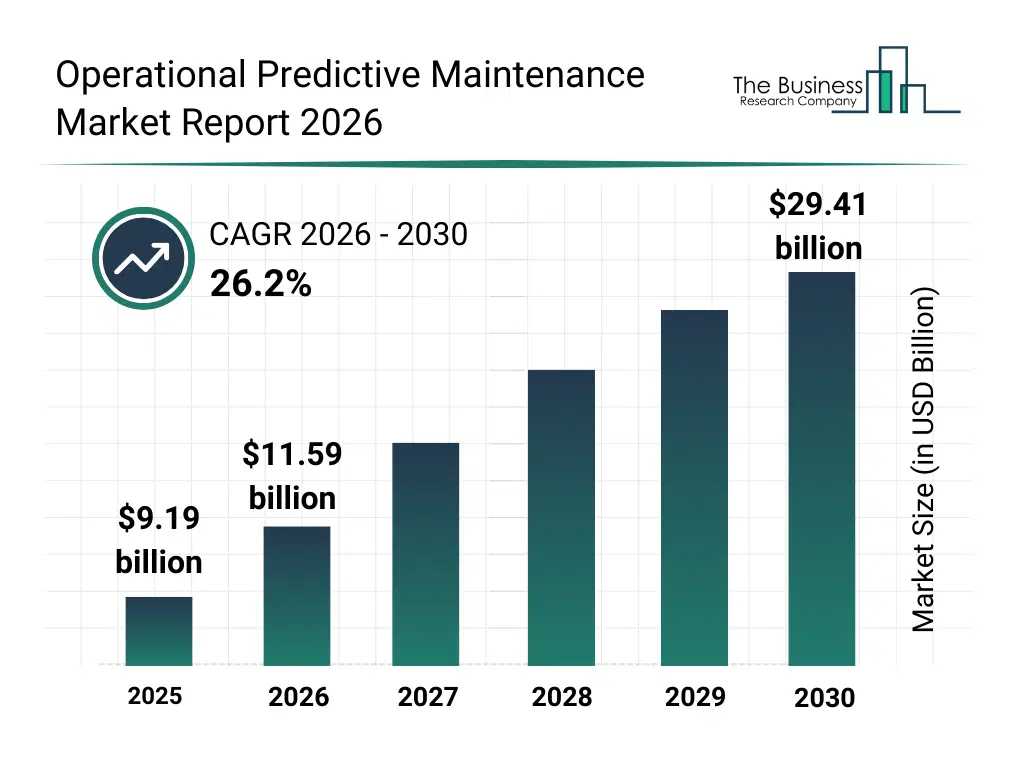
What Is The Operational Predictive Maintenance Market Size and Share 2026?
The operational predictive maintenance market size has grown exponentially in recent years. It will grow from $9.19 billion in 2025 to $11.59 billion in 2026 at a compound annual growth rate (CAGR) of 26.1%. The growth in the historic period can be attributed to reactive maintenance practices, high equipment downtime costs, growing industrial automation, adoption of sensor technologies, rising demand for operational efficiency.What Is The Operational Predictive Maintenance Market Growth Forecast?
The operational predictive maintenance market size is expected to see exponential growth in the next few years. It will grow to $29.41 billion in 2030 at a compound annual growth rate (CAGR) of 26.2%. The growth in the forecast period can be attributed to increasing use of AI and ml for maintenance, adoption of cloud-based predictive platforms, integration with iot-enabled devices, demand for cost optimization in operations, focus on minimizing unplanned downtime. Major trends in the forecast period include predictive analytics implementation, machine learning-based maintenance, real-time equipment monitoring, asset performance optimization, integration with enterprise systems.
Global Operational Predictive Maintenance Market Segmentation
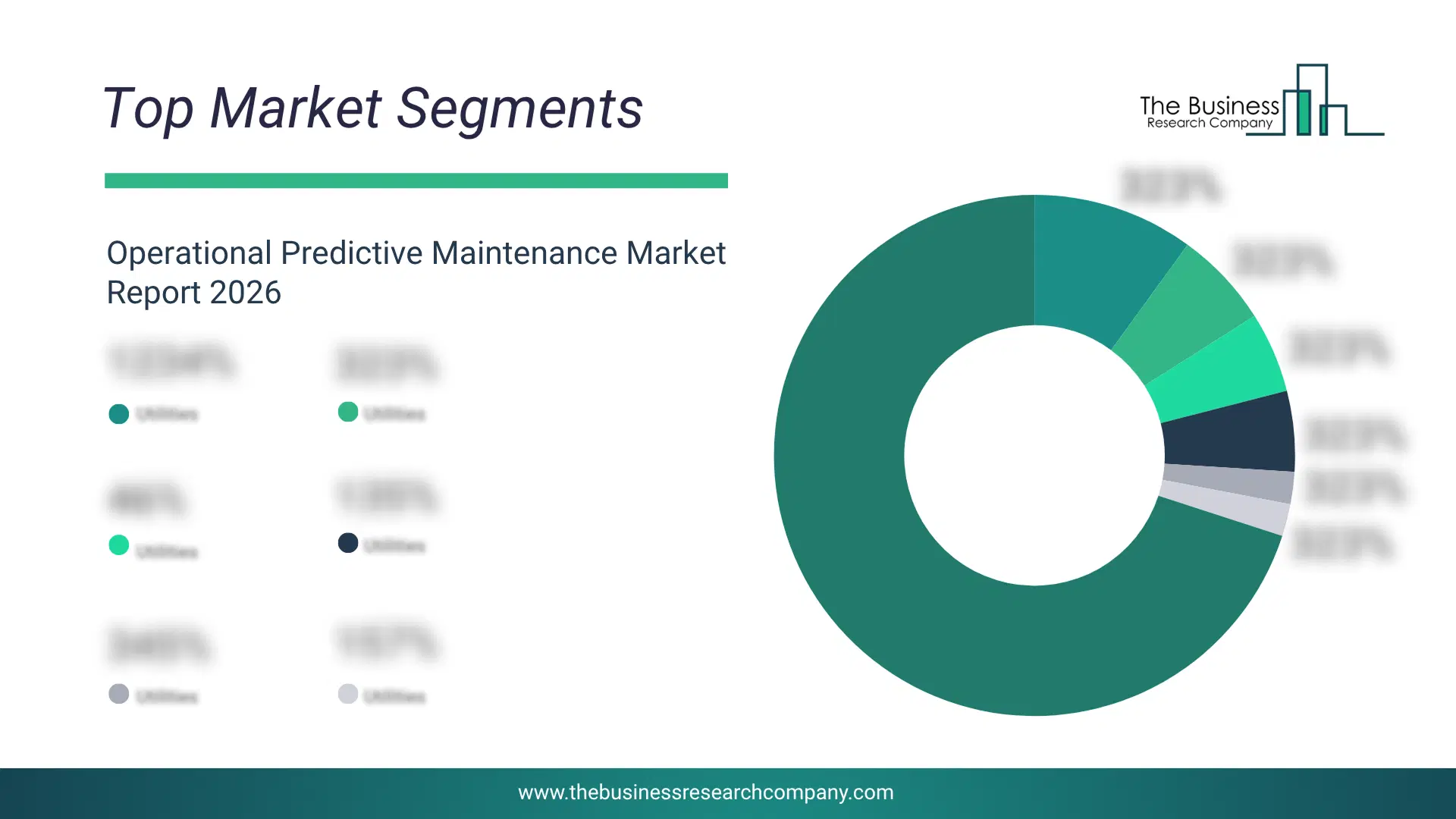
1) By Type: Software, Services 2) By Deployment Model: Cloud, On-Premise 3) By Technology: Machine Learning, Deep Learning, Big Data And Analytics 4) By End User: Public Sector, Automotive, Manufacturing, Healthcare, Energy And Utility, Transportation, Other End Users Subsegments: 1) By Software: Predictive Analytics Software, Machine Learning Software, Data Integration Tools, Asset Management Software, Real-Time Monitoring Software 2) By Services: Implementation Services, Consulting Services, Training and Support Services, Maintenance and Upgrades, Managed Services The top segments in the operational predictive maintenance market will be: • Software will reach $19.42 Billion by 2030. • Services will reach $9.98 Billion by 2030.What Is The Driver Of The Operational Predictive Maintenance Market?
The increasing number of IoT (Internet of Things) devices is expected to propel the growth of the operational predictive maintenance market going forward. IoT devices refer to nonstandard computing hardware such as sensors, actuators, or appliances that connect wirelessly to a network and can transmit data. It arises because of the widespread availability of high-speed internet connectivity, increasing industrial automation and supply chain management, and data analytics capabilities. IoT devices play a critical role in operational predictive maintenance by enabling real-time monitoring, data analytics, early issue detection, condition-based maintenance, predictive insights, and continuous improvement, ultimately assisting organizations in optimizing asset performance, lowering costs, and increasing operating efficiency. For instance, according to the GSM Association, a UK-based non-profit industry organization, the global IoT connections are expected to surge to 23.3 billion by 2025, an increase from the 15.1 billion connections recorded in 2021. Therefore, the increasing number of IoT devices drives the operational predictive maintenance industry.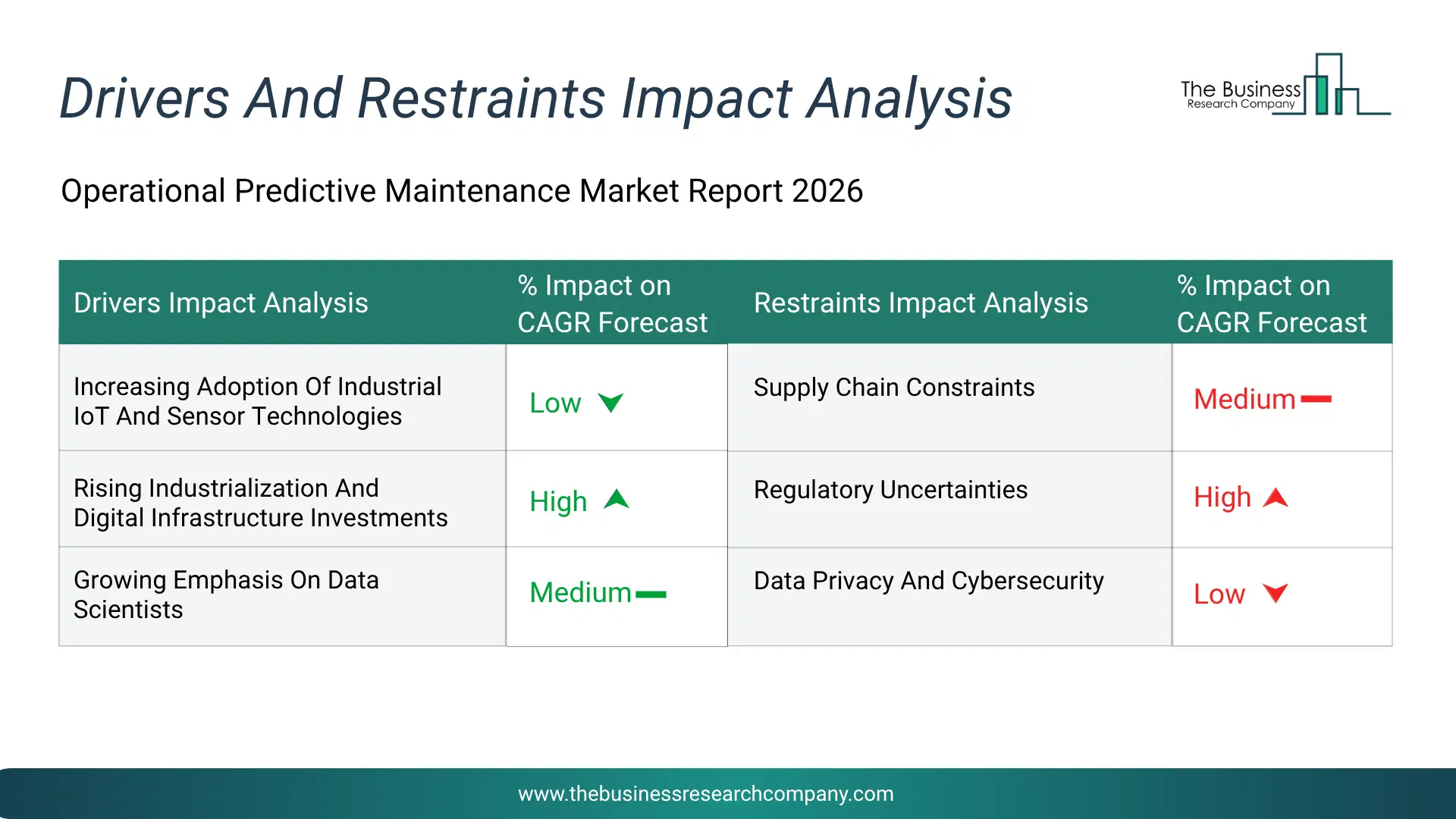
Infographic Chart Showing Key Market Drivers Analysis And Restraints For Operational Predictive Maintenance Market
The chart presents an impact analysis of key drivers and restraints, quantifying their relative influence on the market's growth rate and helping assess the balance between growth enablers and limiting factors. This chart offers a high-level perspective; the full report contains more detailed insights.
How Will The Drivers Impact Growth In The Global Operational Predictive Maintenance Market?
• Increasing Adoption Of Industrial IoT And Sensor Technologies (Low) – During the forecast period, the increasing adoption of industrial IoT and sensor technologies is expected to become a key growth driver for the operational predictive maintenance market by 2030. Increasing adoption of Industrial IoT and sensor technologies is significantly driving the operational predictive maintenance market by enabling continuous real-time monitoring of industrial assets and machinery. Advanced sensors installed across equipment collect operational data such as vibration, temperature, pressure, and energy consumption, allowing predictive maintenance platforms to identify abnormal patterns before failures occur. This real-time visibility improves asset reliability, reduces unexpected downtime, and enhances operational efficiency across manufacturing, energy, transportation, and process industries. The integration of connected IoT ecosystems with artificial intelligence and cloud analytics further strengthens predictive capabilities and maintenance accuracy. As industries increasingly prioritize smart factory initiatives and automation, the demand for predictive maintenance solutions continues to accelerate. Additionally, declining sensor costs and improvements in wireless connectivity are encouraging wider adoption among both large enterprises and mid-sized industrial facilities. This growing digital equipment connectivity is therefore creating strong long-term growth opportunities for the operational predictive maintenance market. • Rising Industrialization And Digital Infrastructure Investments (High) – During the forecast period, the rising industrialization and digital infrastructure investments are expected to emerge as a major factor driving the expansion of the operational predictive maintenance market by 2030. Rising industrialization and digital infrastructure investments are acting as major growth drivers for the operational predictive maintenance market by expanding the deployment of advanced industrial systems and connected production environments. Governments and private organizations across developing and developed economies are heavily investing in smart manufacturing facilities, automated plants, industrial digitalization, and intelligent infrastructure projects. These investments increase the need for efficient maintenance strategies capable of minimizing operational disruptions and maximizing equipment productivity. Predictive maintenance solutions help industries optimize machine performance, reduce maintenance costs, and improve production continuity in highly competitive industrial environments. The expansion of sectors such as manufacturing, oil & gas, utilities, mining, and logistics is further increasing the demand for advanced maintenance analytics platforms. In addition, modernization of aging industrial infrastructure is encouraging companies to adopt predictive technologies for better asset lifecycle management. As industrial operations become more digitally interconnected, the importance of operational predictive maintenance solutions continues to grow globally. • Growing Emphasis On Data Scientists (Medium) – During the forecast period, the growing emphasis on data scientists is expected to act as a key growth catalyst for the operational predictive maintenance market by 2030. Growing emphasis on data scientists is supporting the expansion of the operational predictive maintenance market by improving the ability of organizations to extract meaningful insights from large volumes of industrial data. Predictive maintenance systems rely heavily on data analytics, machine learning algorithms, and statistical modeling to forecast equipment failures and optimize maintenance schedules. The increasing availability of skilled data scientists enables companies to build more accurate predictive models and improve decision-making capabilities across industrial operations. Organizations are investing in analytics teams to better interpret sensor-generated data and enhance maintenance efficiency through advanced forecasting techniques. This growing analytical expertise also supports the development of customized predictive maintenance solutions tailored to specific operational requirements. Furthermore, the rising importance of AI-driven industrial intelligence is encouraging enterprises to integrate data science capabilities into maintenance management strategies. As industries continue prioritizing data-driven operational optimization, the demand for operational predictive maintenance platforms is expected to strengthen substantially.How Will The Restraints Impact Growth In The Global Operational Predictive Maintenance Market?
• Supply Chain Constraints (Low) – During the forecast period, the supply chain constraints are restraining the operational predictive maintenance market by limiting the availability of critical hardware components such as sensors, semiconductor chips, industrial controllers, and connectivity devices required for predictive maintenance systems. Disruptions in global supply networks increase procurement delays, transportation costs, and equipment shortages, making it difficult for industries to implement or expand predictive maintenance infrastructure on schedule. Many organizations also face extended lead times for industrial automation equipment and IoT devices, slowing digital transformation initiatives. These disruptions can increase overall project costs and delay return on investment for predictive maintenance deployments. In addition, smaller enterprises with limited budgets are often more vulnerable to fluctuating component prices and sourcing challenges. Supply chain instability also affects system maintenance and replacement cycles, reducing operational continuity for predictive monitoring systems. As a result, ongoing global supply chain pressures continue to hinder the smooth adoption of operational predictive maintenance solutions across industries. • Regulatory Uncertainties (High) – During the forecast period, the regulatory uncertainties act as a restraint on the operational predictive maintenance market because industries operating across different regions must comply with varying industrial safety, data governance, and operational regulations. Frequent changes in compliance standards related to industrial data handling, AI implementation, cloud storage, and cross-border data transfer create challenges for predictive maintenance solution providers and end users. Companies may delay investments in predictive maintenance technologies when regulatory requirements remain unclear or inconsistent across jurisdictions. In highly regulated sectors such as energy, healthcare, aerospace, and utilities, additional certification and compliance procedures can increase deployment complexity and operational costs. Regulatory ambiguity surrounding artificial intelligence usage and automated decision-making systems can further slow technology adoption. Moreover, organizations often require additional legal and technical assessments before integrating predictive maintenance platforms into critical industrial environments. These factors collectively create uncertainty that can negatively impact market expansion and long-term investment planning. • Data Privacy And Cybersecurity (Medium) – During the forecast period, the data privacy and cybersecurity concerns are major challenges for the operational predictive maintenance market because predictive maintenance systems continuously collect, transmit, and analyze large volumes of sensitive operational and industrial data. Connected IoT devices, cloud-based monitoring platforms, and remote analytics systems increase the risk of cyberattacks, unauthorized access, ransomware incidents, and industrial data breaches. Many organizations remain cautious about adopting predictive maintenance technologies due to concerns over protecting proprietary operational information and critical infrastructure systems. Cybersecurity vulnerabilities in connected industrial networks can disrupt operations, compromise equipment performance, and create significant financial losses. In addition, strict data protection regulations require companies to implement advanced security frameworks and compliance measures, increasing deployment and maintenance costs. Industries handling critical infrastructure, such as energy, transportation, and manufacturing, face particularly high security risks associated with digital predictive systems. As cyber threats continue to evolve globally, concerns related to data protection and system security may limit the pace of operational predictive maintenance adoption.Key Players In The Global Operational Predictive Maintenance Market
Major companies operating in the operational predictive maintenance market are Google LLC; Microsoft Corporation; Robert Bosch GmbH; Hitachi Ltd.; Amazon Web Services Inc.; The International Business Machines Corporation; General Electric Company; Schneider Electric SE; SAP SE; Svenska Kullagerfabriken AB; Rockwell Automation Inc.; SAS Institute Inc.; Micro Focus; Splunk Inc.; PTC Inc.; Software AG; TIBCO Software Inc.; C3.AI Inc; Softweb Solutions Inc; Fiix Software; Uptake Technologies Inc.; eMaint Enterprises LLC; Seebo Interactive Ltd.; Asystom; Ecolibrium Energy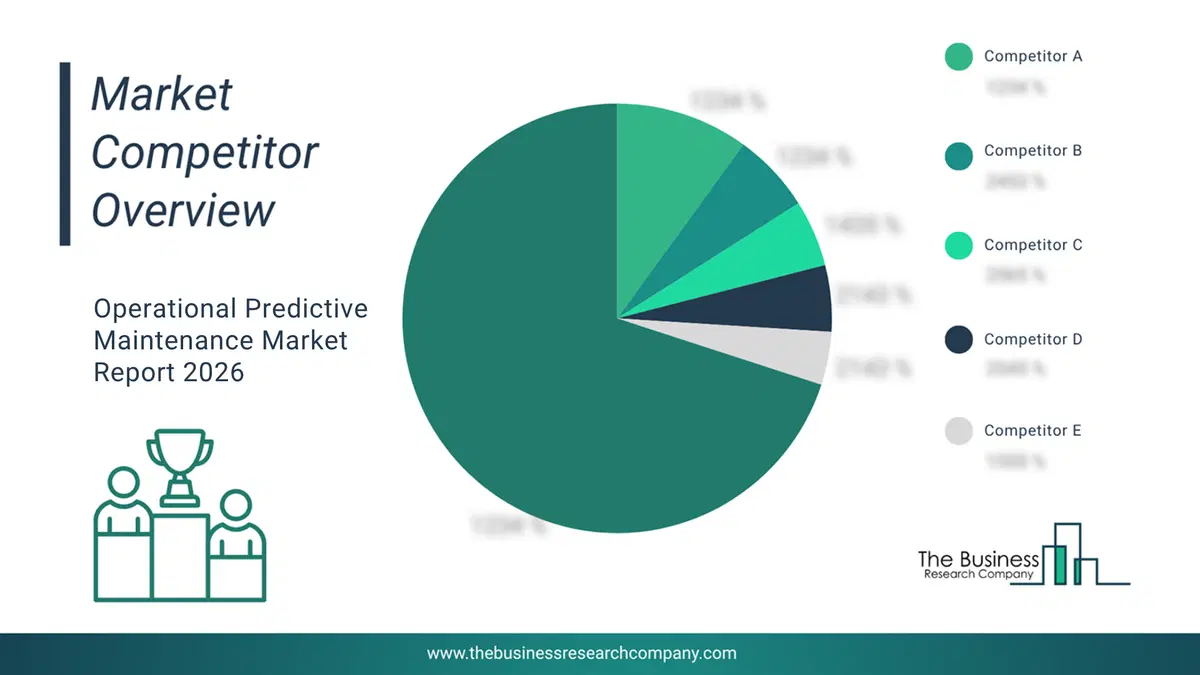
This chart is for illustrative purposes; the full report includes a detailed competitor analysis and comprehensive overview of the top 10 companies in the market.
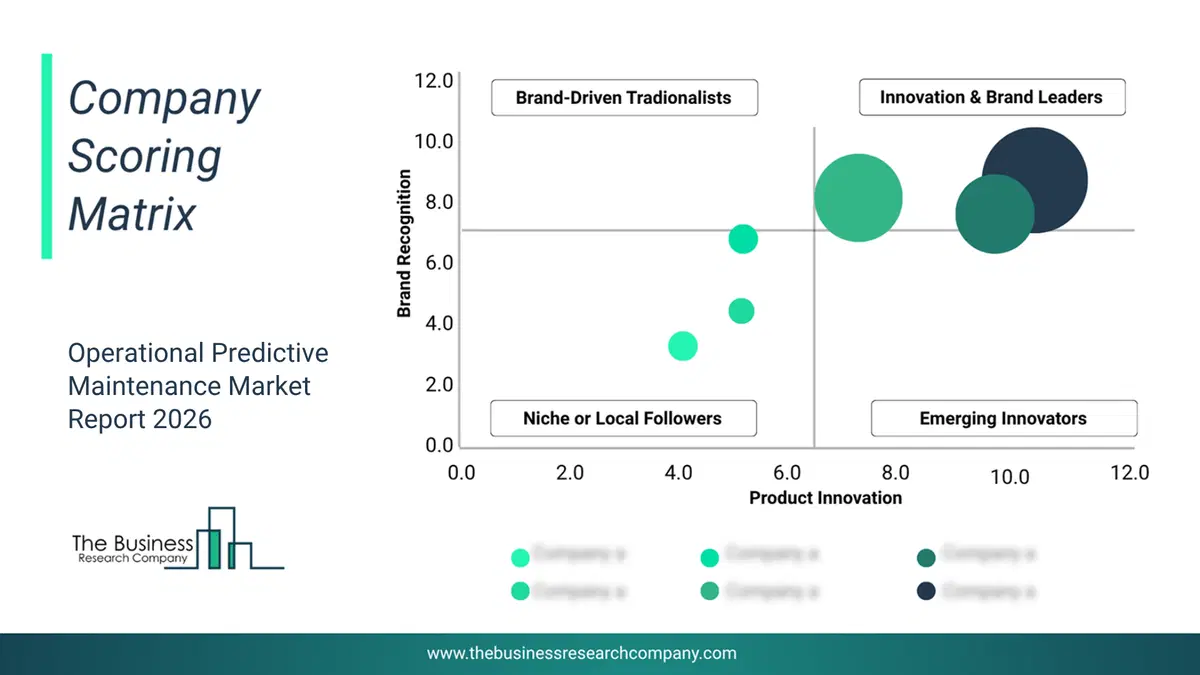
This chart maps companies by product innovation and brand strength, with bubble size indicating relative revenue, helping identify market leaders, challengers, and niche players. This is an illustrative chart; the full report provides a complete and accurate competitive analysis.
Global Operational Predictive Maintenance Market Trends and Insights
Major companies in the operational predictive maintenance market are focusing on technological advancements, such as AI-driven analytics and real-time monitoring, to enhance equipment reliability and efficiency, helping businesses proactively address maintenance needs and minimize operational disruptions. Machine learning analyses sensor data to identify patterns that indicate potential issues, enabling proactive maintenance to optimize performance and prevent failures. For instance, in June 2024, Hitachi Industrial Equipment Systems Co., Ltd., a Japan-based company that manufactures and sells industrial equipment and components, launched the 'Predictive Diagnosis Service' for air compressors, using machine learning and remote monitoring to detect and prevent potential issues. This service combines real-time data with maintenance expertise to enhance operational efficiency, minimize downtime, and reduce environmental impact.What Are Latest Mergers And Acquisitions In The Operational Predictive Maintenance Market?
In March 2023, Schaeffler Group, a Germany-based automotive industry company, acquired ECO-Adapt SAS for an undisclosed amount. This acquisition aims to strengthen Schaeffler’s position in the growing predictive maintenance market, expand its service offerings, and contribute to a more sustainable future for its customers. ECO-Adapt SAS is a France-based company specializing in energy monitoring and predictive maintenance services.Regional Insights
North America was the largest region in the operational predictive maintenance market in 2025. The regions covered in this market report are Asia-Pacific, South East Asia, Western Europe, Eastern Europe, North America, South America, Middle East, Africa. The countries covered in this market report are Australia, Brazil, China, France, Germany, India, Indonesia, Japan, Taiwan, Russia, South Korea, UK, USA, Canada, Italy, SpainWhat Defines the Operational Predictive Maintenance Market?
The operational predictive maintenance market includes revenues earned by entities by providing services such as data analytics and modeling, predictive maintenance modeling, condition monitoring, failure prediction and diagnostics, performance monitoring and optimization, and training and support. The market value includes the value of related goods sold by the service provider or included within the service offering. Only goods and services traded between entities or sold to end consumers are included.How is Market Value Defined and Measured?
The market value is defined as the revenues that enterprises gain from the sale of goods and/or services within the specified market and geography through sales, grants, or donations in terms of the currency (in USD unless otherwise specified). The revenues for a specified geography are consumption values that are revenues generated by organizations in the specified geography within the market, irrespective of where they are produced. It does not include revenues from resales along the supply chain, either further along the supply chain or as part of other products.
This chart presents market attractiveness based on a quantitative evaluation of growth, competition, strategic alignment, and risk, offering a clear view of opportunity areas for decision-making. This chart is for illustrative purposes; the full report contains the complete analysis.

This chart highlights the Total Addressable Market (TAM) by estimating the maximum revenue opportunity using an assumption-driven approach, supporting strategic planning and opportunity sizing across markets. The chart is illustrative; the full report provides a more comprehensive analysis.
What Key Data and Analysis Are Included in the Operational Predictive Maintenance Market Report 2026?
The operational predictive maintenance market research report is one of a series of new reports from The Business Research Company that provides market statistics, including industry global market size, regional shares, competitors with the market share, detailed market segments, market trends and opportunities, and any further data you may need to thrive in the operational predictive maintenance industry. The market research report delivers a complete perspective of everything you need, with an in-depth analysis of the current and future state of the industry.Operational Predictive Maintenance Market Report Forecast Analysis
| Report Attribute | Details |
|---|---|
| Market Size Value In 2026 | $11.59 billion |
| Revenue Forecast In 2030 | $29.41 billion |
| Growth Rate | CAGR of 26.1% from 2026 to 2030 |
| Base Year For Estimation | 2025 |
| Actual Estimates/Historical Data | 2020-2025 |
| Forecast Period | 2026 - 2030 |
| Market Representation | Revenue in USD Billion and CAGR from 2026 to 2030 |
| Segments Covered | Type, Deployment Model, Technology, End User |
| Regional Scope | Asia-Pacific, Western Europe, Eastern Europe, North America, South America, Middle East, Africa |
| Country Scope | The countries covered in the report are Australia, Brazil, China, France, Germany, India, Indonesia, Japan, Taiwan, Russia, South Korea, UK, USA, Canada, Italy, Spain. |
| Key Companies Profiled | Google LLC; Microsoft Corporation; Robert Bosch GmbH; Hitachi Ltd.; Amazon Web Services Inc.; The International Business Machines Corporation; General Electric Company; Schneider Electric SE; SAP SE; Svenska Kullagerfabriken AB; Rockwell Automation Inc.; SAS Institute Inc.; Micro Focus; Splunk Inc.; PTC Inc.; Software AG; TIBCO Software Inc.; C3.AI Inc; Softweb Solutions Inc; Fiix Software; Uptake Technologies Inc.; eMaint Enterprises LLC; Seebo Interactive Ltd.; Asystom; Ecolibrium Energy |
| Customization Scope | Request for Customization |
| Pricing And Purchase Options | Explore Purchase Options |