
Optical Biometers Market Report 2026
Global Outlook – By Product Type (Contact Optical Biometers, Non Contact Optical Biometers), By Technology (Partial Coherence Interferometry, Optical Low Coherence Reflectometry, Swept Source Optical Coherence Tomography), By Application (Cataract Surgery, Refractive Surgery, Glaucoma Surgery, Other Applications), By End User (Hospitals, Ophthalmic Clinics, Ambulatory Surgical Centers, Other End Users) – Market Size, Trends, Strategies, and Forecast to 2030
Optical Biometers Market Overview
• Optical Biometers market size has reached to $5.91 billion in 2025 • Expected to grow to $9.84 billion in 2030 at a compound annual growth rate (CAGR) of 10.8% • Growth Driver: Surge In Ophthalmic Surgeries Fueling The Growth Of The Market Due To Increasing Demand For Precise Preoperative Measurements And Improved Surgical Outcomes In Vision Correction Procedures • Market Trend: Advanced Non-Contact Ophthalmic Diagnostic Innovations Improve Cataract Assessment And Surgical Planning Efficiency • North America was the largest region in 2025 and Asia-Pacific is the fastest growing region.What Is Covered Under Optical Biometers Market?
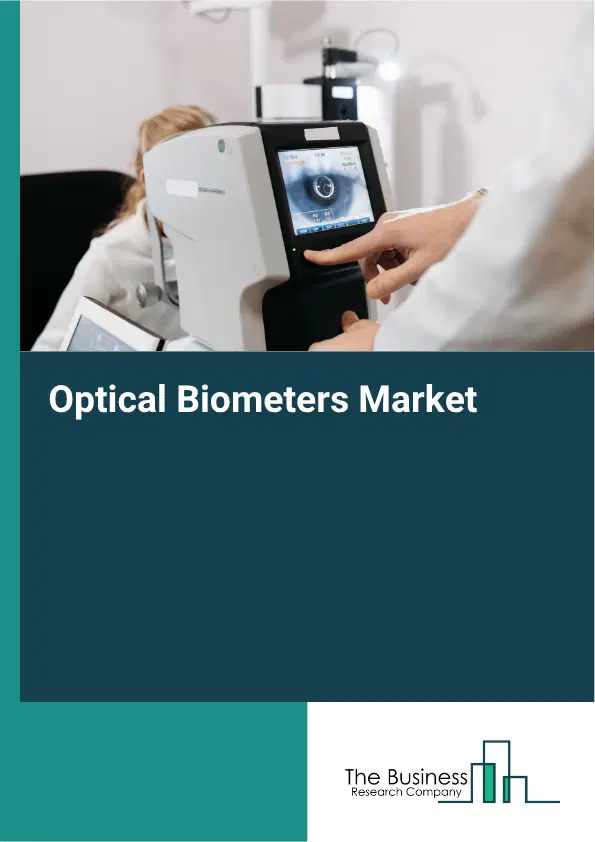
Optical biometers are non-contact ophthalmic diagnostic devices used to measure the anatomical and optical parameters of the eye with high precision. They use advanced optical technologies to obtain accurate biometric data. These measurements are essential for calculating intraocular lens power and supporting precise outcomes in vision correction procedures. The main product types of optical biometers include contact optical biometers and non contact optical biometers. Contact optical biometers refer to ophthalmic diagnostic devices that measure eye parameters through direct contact with the eye for surgical planning and vision assessment. These devices are based on technologies including partial coherence interferometry, optical low coherence reflectometry, and swept source optical coherence tomography. The key applications of cataract surgery, refractive surgery, glaucoma surgery, and others, while the end-users includes hospitals, ophthalmic clinics, ambulatory surgical centers, and others.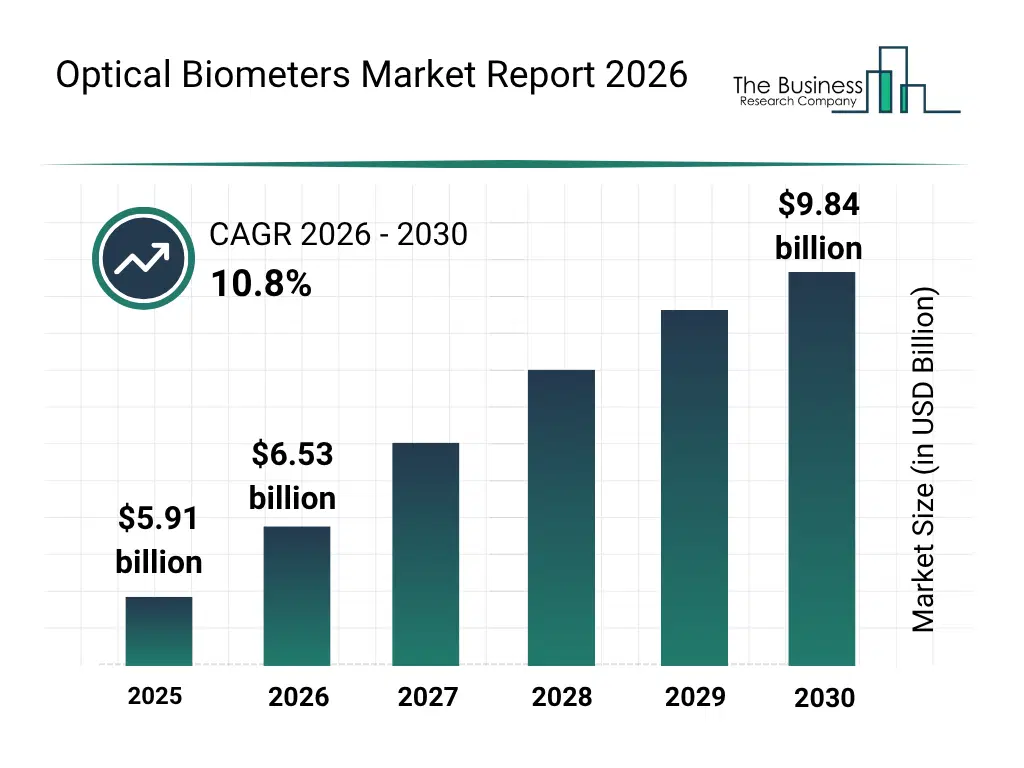
What Is The Optical Biometers Market Size and Share 2026?
The optical biometers market size has grown rapidly in recent years. It will grow from $5.91 billion in 2025 to $6.53 billion in 2026 at a compound annual growth rate (CAGR) of 10.6%. The growth in the historic period can be attributed to dependence on ultrasound based biometric measurement techniques, increasing prevalence of cataract and refractive disorders, limitations in accuracy of contact based ophthalmic devices, rising demand for improved intraocular lens calculation outcomes, gradual adoption of optical coherence based diagnostic technologies.What Is The Optical Biometers Market Growth Forecast?
The optical biometers market size is expected to see rapid growth in the next few years. It will grow to $9.84 billion in 2030 at a compound annual growth rate (CAGR) of 10.8%. The growth in the forecast period can be attributed to expansion of AI enabled ophthalmic diagnostic systems, growing demand for minimally invasive non contact eye examination tools, increasing adoption of advanced cataract and refractive surgical procedures, technological advancements in optical coherence tomography systems, rising geriatric population driving vision correction procedures. Major trends in the forecast period include integration of AI driven ocular biometric measurement for improved iol power calculation accuracy, advancement of swept source optical biometry for high precision eye parameter mapping, rising adoption of non contact optical biometers in cataract and refractive surgeries, development of multi parameter ophthalmic diagnostic platforms combining imaging and biometry, increasing use of cloud connected ophthalmic devices for centralized patient data management.
Global Optical Biometers Market Segmentation
1) By Product Type: Contact Optical Biometers, Non Contact Optical Biometers 2) By Technology: Partial Coherence Interferometry, Optical Low Coherence Reflectometry, Swept Source Optical Coherence Tomography 3) By Application: Cataract Surgery, Refractive Surgery, Glaucoma Surgery, Other Applications 4) By End User: Hospitals, Ophthalmic Clinics, Ambulatory Surgical Centers, Other End Users Subsegments: 1) By Contact Optical Biometers: Applanation Based Contact Optical Biometers, Immersion Based Contact Optical Biometers, Portable Contact Optical Biometers, Clinical Grade Contact Optical Biometers 2) By Non Contact Optical Biometers: Optical Coherence Based Non Contact Optical Biometers, Swept Source Optical Biometers, Non Contact Optical Low Coherence Reflectometry Biometers, Integrated Multi Parameter Non Contact Optical BiometersWhat Is The Driver Of The Optical Biometers Market?
The rising number of ophthalmic surgeries is expected to propel the growth of the optical biometers market going forward. Ophthalmic surgeries refer to surgical procedures performed on the eye and its surrounding structures to diagnose, treat, or correct vision-related conditions and eye diseases. The rising number of ophthalmic surgeries is driven by an increasing aging population, as age-related eye conditions such as cataracts and glaucoma become more prevalent, leading to higher demand for surgical vision correction and treatment. Optical biometers help increase the precision and success rate of ophthalmic surgeries by providing highly accurate measurements of the eye’s anatomical parameters, which support better intraocular lens selection and improved surgical outcomes. For instance, in May 2024, according to the Office for Health Improvement & Disparities, a UK-based government department, there were 516,073 hospital admissions for cataract surgery, equating to a rate of 4,679 per 100,000 population (within a range of 4,663 to 4,694). Therefore, the rising number of ophthalmic surgeries is driving the growth of the optical biometers industry.Key Players In The Global Optical Biometers Market
Major companies operating in the optical biometers market are Carl Zeiss Meditec AG, Alcon Inc., Haag-Streit AG, Topcon Healthcare Inc., NIDEK Co. Ltd., Bausch + Lomb, Ziemer Ophthalmic Systems, Huvitz Co. Ltd., Tomey Corporation, Lumibird Medical, Shanghai MediWorks Precision Instruments Co. Ltd., Nanjing Redsun Optical Co. Ltd.,TowardPi Medical Technology Co. Ltd.,Tianjin Suowei Electronic Technology Co. Ltd.,Optopol Technology Sp. z o.o.,Visionix Company,Halma plcGlobal Optical Biometers Market Trends and Insights
Major companies operating in the optical biometers market are focusing on developing advanced ophthalmic diagnostic solutions, such as non-contact cataract examination devices, to improve diagnostic accuracy, patient comfort, and preoperative surgical planning efficiency. Non-contact cataract examination devices are advanced ophthalmic diagnostic systems that evaluate cataract conditions and ocular structures without direct eye contact, improving patient comfort, diagnostic precision, and preoperative assessment efficiency. For instance, in February 2024, Huvitz, a South Korea-based medical technology manufacturer, launched its HBM-1 optical biometry system, a non-contact cataract examination device. It is designed to support improved clinical accuracy and workflow efficiency. The device enables high-precision ocular measurements, enhanced cataract surgery planning, and streamlined diagnostic processes, strengthening overall outcomes in modern ophthalmic care and vision correction procedures.What Are Latest Mergers And Acquisitions In The Optical Biometers Market?
In February 2023, NIDEK CO., LTD., a Japan-based manufacturer of advanced optical biometers, specifically the AL-Scan and AL-Scan M, partnered with HOYA Vision Care to strengthen global cataract and refractive surgery workflows by integrating precise biometric measurements with advanced intraocular lens solutions. Through this partnership, NIDEK and HOYA Vision Care aim to integrate high-precision optical biometry with advanced intraocular lens technologies to improve accuracy in cataract and refractive surgery planning and enhance overall patient visual outcomes. HOYA Vision Care is a Japan-based optical technology company.Regional Outlook
North America was the largest region in the optical biometers market in 2025. Asia-Pacific is expected to be the fastest-growing region in the forecast period. The regions covered in this market report are Australia, Brazil, China, France, Germany, India, Indonesia, Japan, Taiwan, Russia, South Korea, UK, USA, Canada, Italy, Spain. The countries covered in this market report are Australia, Brazil, China, France, Germany, India, Indonesia, Japan, Taiwan, Russia, South Korea, UK, USA, Canada, Italy, Spain.What Defines the Optical Biometers Market?
The optical biometers market consists of sales of keratometry devices, optical coherence tomography-based biometers, and intraocular lens power calculation systems. Values in this market are ‘factory gate’ values, that is, the value of goods sold by the manufacturers or creators of the goods, whether to other entities (including downstream manufacturers, wholesalers, distributors, and retailers) or directly to end customers. The value of goods in this market includes related services sold by the creators of the goods.How is Market Value Defined and Measured?
The market value is defined as the revenues that enterprises gain from the sale of goods and/or services within the specified market and geography through sales, grants, or donations in terms of the currency (in USD unless otherwise specified). The revenues for a specified geography are consumption values that are revenues generated by organizations in the specified geography within the market, irrespective of where they are produced. It does not include revenues from resales along the supply chain, either further along the supply chain or as part of other products.What Key Data and Analysis Are Included in the Optical Biometers Market Report 2026?
The optical biometers market research report is one of a series of new reports from The Business Research Company that provides optical biometers market statistics, including optical biometers industry global market size, regional shares, competitors with a optical biometers market share, detailed optical biometers market segments, market trends and opportunities, and any further data you may need to thrive in the optical biometers industry. This optical biometers market research report delivers a complete perspective of everything you need, with an in-depth analysis of the current and future scenario of the industry.Optical Biometers Market Report Forecast Analysis
| Report Attribute | Details |
|---|---|
| Market Size Value In 2026 | $6.53 billion |
| Revenue Forecast In 2030 | $9.84 billion |
| Growth Rate | CAGR of 10.8% from 2026 to 2030 |
| Base Year For Estimation | 2025 |
| Actual Estimates/Historical Data | 2020-2025 |
| Forecast Period | 2026 - 2030 |
| Market Representation | Revenue in USD Billion and CAGR from 2026 to 2030 |
| Segments Covered | Product Type, Technology, Application, End User |
| Regional Scope | Asia-Pacific, Western Europe, Eastern Europe, North America, South America, Middle East, Africa |
| Country Scope | The countries covered in the optical biometers market report are Australia, Brazil, China, France, Germany, India, Indonesia, Japan, Taiwan, Russia, South Korea, UK, USA, Canada, Italy, Spain. |
| Key Companies Profiled | Carl Zeiss Meditec AG, Alcon Inc., Haag-Streit AG, Topcon Healthcare Inc., NIDEK Co. Ltd., Bausch + Lomb, Ziemer Ophthalmic Systems, Huvitz Co. Ltd., Tomey Corporation, Lumibird Medical, Shanghai MediWorks Precision Instruments Co. Ltd., Nanjing Redsun Optical Co. Ltd.,TowardPi Medical Technology Co. Ltd.,Tianjin Suowei Electronic Technology Co. Ltd.,Optopol Technology Sp. z o.o.,Visionix Company,Halma plc |
| Customization Scope | Request for Customization |
| Pricing And Purchase Options | Explore Purchase Options |