

Optical Brightener Market Report 2026
Global Outlook – By Type (Triazine-Stilbenes, Coumarins, Diazoles, Benzoxazolines), By Application (Paper, Fabrics, Detergents And Soaps, Synthetics And Plastics, Lacquers, Pigmented Lacquers), By End-Use (Consumer Product, Textiles And Apparel, Packaging) – Market Size, Trends, Strategies, and Forecast to 2030
Optical Brightener Market Overview
• Optical Brightener market size has reached to $1.41 billion in 2025 • Expected to grow to $2.17 billion in 2030 at a compound annual growth rate (CAGR) of 8.9% • Growth Driver: Expansion Of Manufacturing Sector To Drive Market Growth • Market Trend: Product Advancements Driving Innovation In Optical Brighteners Market • Asia-Pacific was the largest region and fastest growing region.What Is Covered Under Optical Brightener Market?
Optical brightener refers to added synthetic additives to the liquid and detergent powder and pigments. Optical brighteners transform ultraviolet (UV) light waves into stronger blue light and less yellow light, making objects look whiter. The optical brightener is used to make clothing and other surfaces appear whiter, cleaner, and brighter. The main types of optical brightener markets are triazine-stilbenes, coumarins, imidazolines, diazoles, and benzoxazolines. The triazine-stilbenes are used to solve the problem of poor whitening effect and high cost in existing whiteners. They are used in industrial applications as whitening agents. They are used in industrial applications as whitening agents. The various applications include paper, fabrics, detergents and soaps, synthetics and plastics, lacquers, ultraviolet tracer, and pigmented lacquers, and their end uses are for consumer products, security and safety, textiles and apparel, and packaging.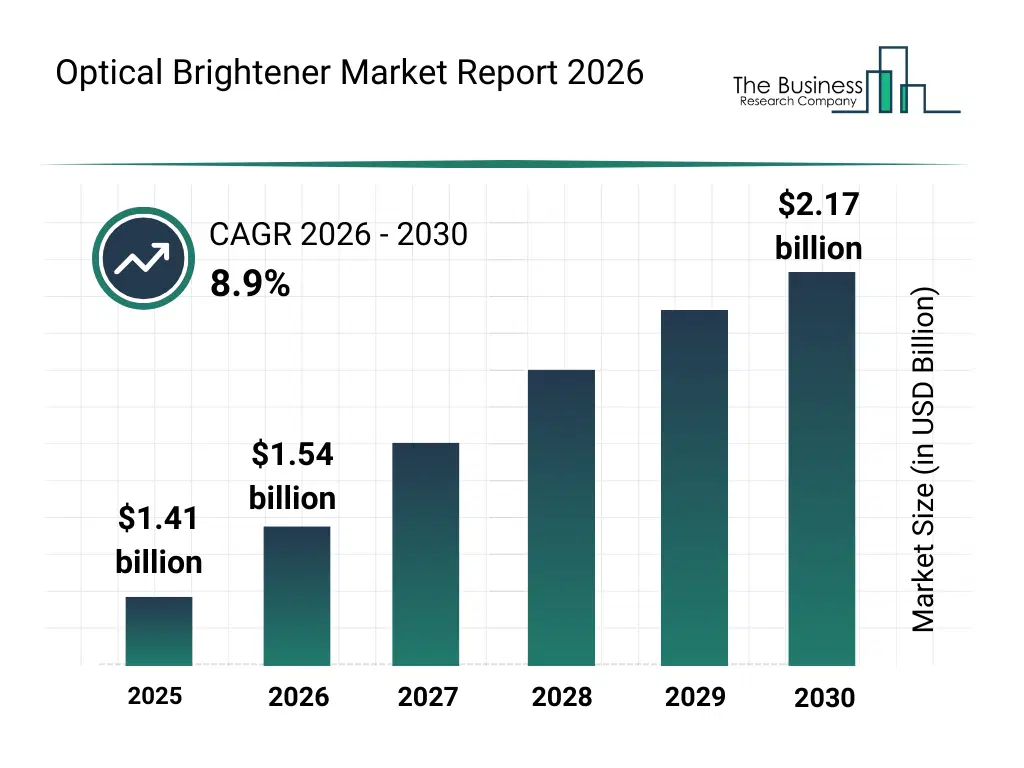
What Is The Optical Brightener Market Size and Share 2026?
The optical brightener market size has grown strongly in recent years. It will grow from $1.41 billion in 2025 to $1.54 billion in 2026 at a compound annual growth rate (CAGR) of 9.6%. The growth in the historic period can be attributed to growth of detergent manufacturing, increased textile production volumes, expansion of paper and packaging industries, rising consumer preference for bright fabrics, availability of synthetic brightener compounds.What Is The Optical Brightener Market Growth Forecast?
The optical brightener market size is expected to see strong growth in the next few years. It will grow to $2.17 billion in 2030 at a compound annual growth rate (CAGR) of 8.9%. The growth in the forecast period can be attributed to increasing demand for premium detergents, expansion of sustainable textile processing, rising adoption in security and anti-counterfeiting applications, growing focus on visual product differentiation, increasing innovation in low-toxicity brighteners. Major trends in the forecast period include increasing use of optical brighteners in detergents, rising demand for high-whiteness textiles, growing application in packaging and printing, expansion of fluorescent tracing applications, enhanced product aesthetic performance.
Global Optical Brightener Market Segmentation
1) By Type: Triazine-Stilbenes, Coumarins, Diazoles, Benzoxazolines 2) By Application: Paper, Fabrics, Detergents And Soaps, Synthetics And Plastics, Lacquers, Pigmented Lacquers 3) By End-Use: Consumer Product, Textiles And Apparel, Packaging Subsegments: 1) By Triazine-Stilbenes: Disperse Blue, Disperse Yellow 2) By Coumarins: Coumarin 1, Coumarin 6 3) By Diazoles: Benzothiazole Derivatives, Benzimidazole Derivatives 4) By Benzoxazolines: Substituted Benzoxazolines, Non-Substituted BenzoxazolinesWhat Is The Driver Of The Optical Brightener Market?
The growing manufacturing activities are expected to propel the growth of the optical brighteners market going forward. Manufacturing is a sector of the economy involved in the production of goods for sale. Optical brighteners are used in manufacturing as a raw material for certain industries such as fabrics, synthetics, plastics, detergents, and so on. For instance, according to the United Nations Industrial Development Organization, an Austria-based specialized agency, China’s manufacturing sector maintained its dynamism, growing by 1.5% in 2024. In inter-annual comparison, manufacturing production in China grew by 6.7 percent, while it increased by 2.5 percent in the rest of Asia and Oceania. In 2024, manufacturing in industrial and industrializing economies grew by approximately 1% in a quarter-over-quarter comparison. Therefore, expansion of the manufacturing sector is driving growth in the optical brightener industry.Key Players In The Global Optical Brightener Market
Major companies operating in the optical brightener market are BASF Colors & Effects GmbH, Huntsman International LLC, Archroma, Clariant AG, Keystone Aniline Corporation, Aron Universal Ltd., Brilliant Colors Inc., 3V Company Inc., The Fong Min International Company Limited, BoldChem Technology Co. Ltd., Beijing Odyssey Chemicals Co. Ltd., Hebei Xingyu Chemical Co. Ltd., Nantong Huanuo Pigment Co. Ltd., Shandong Joy-ring Chemical Co. Ltd., Shanxi Colorshine Chemical Industry Co. Ltd., Dystar Singapore Pte Ltd., Everlight Chemical Industrial Corporation, Ciba Specialty Chemicals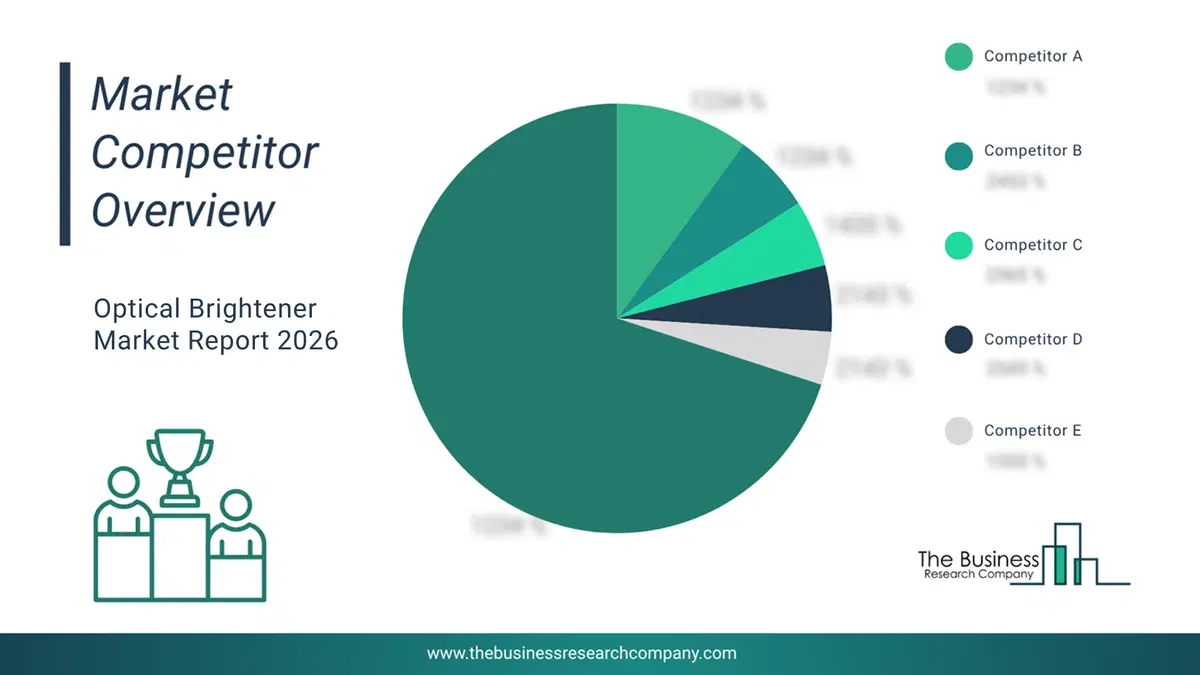
This chart is for illustrative purposes; the full report includes a detailed competitor analysis and comprehensive overview of the top 10 companies in the market.
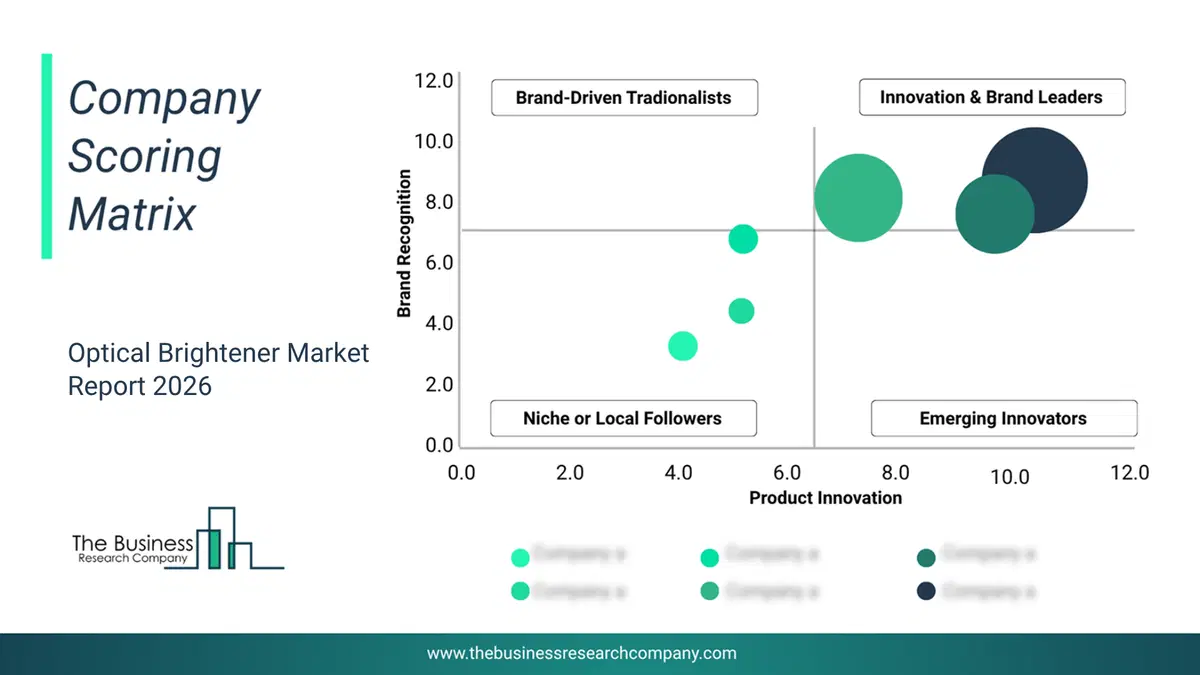
This chart maps companies by product innovation and brand strength, with bubble size indicating relative revenue, helping identify market leaders, challengers, and niche players. This is an illustrative chart; the full report provides a complete and accurate competitive analysis.
Global Optical Brightener Market Trends and Insights
Major companies operating in the optical brightener market are focusing on developing innovative solutions, such as high-performance fluorescent whitening agents, to meet the rising demand for enhanced brightness, improved visual appeal, and color consistency in textiles, paper, and detergent applications. These advanced brighteners outperform traditional optical agents by offering stronger fluorescence, better stability, and broader compatibility with different materials. For instance, in March 2024, Novonesis, a specialty chemicals company, launched Luminous, a new optical brightener. Luminous is designed to improve the whiteness and brightness of textiles and other materials by absorbing UV light and re-emitting it as visible blue light, effectively counteracting yellowing and enhancing overall visual appearance. The product provides excellent stability, compatibility, and performance across a range of substrates, making it suitable for industrial applications where consistent high-quality whitening is critical.What Are Latest Mergers And Acquisitions In The Optical Brightener Market?
In February 2023, Archroma, a Switzerland-based provider of specialty chemicals and dyes for textiles, paper, packaging, coatings, and adhesives, acquired Huntsman Textile Effects for US$593 million (plus assumed pension liabilities). With this acquisition, Archroma aimed to deepen its product portfolio, expand geographic reach across textile and paper value chains, and strengthen its technological and manufacturing capabilities in dyes, finishing chemicals, and ancillary products, including optical brighteners. Huntsman Textile Effects is a Singapore-based manufacturer of textile dyes, finishing agents, and related chemical additives used in fabrics and papers globally.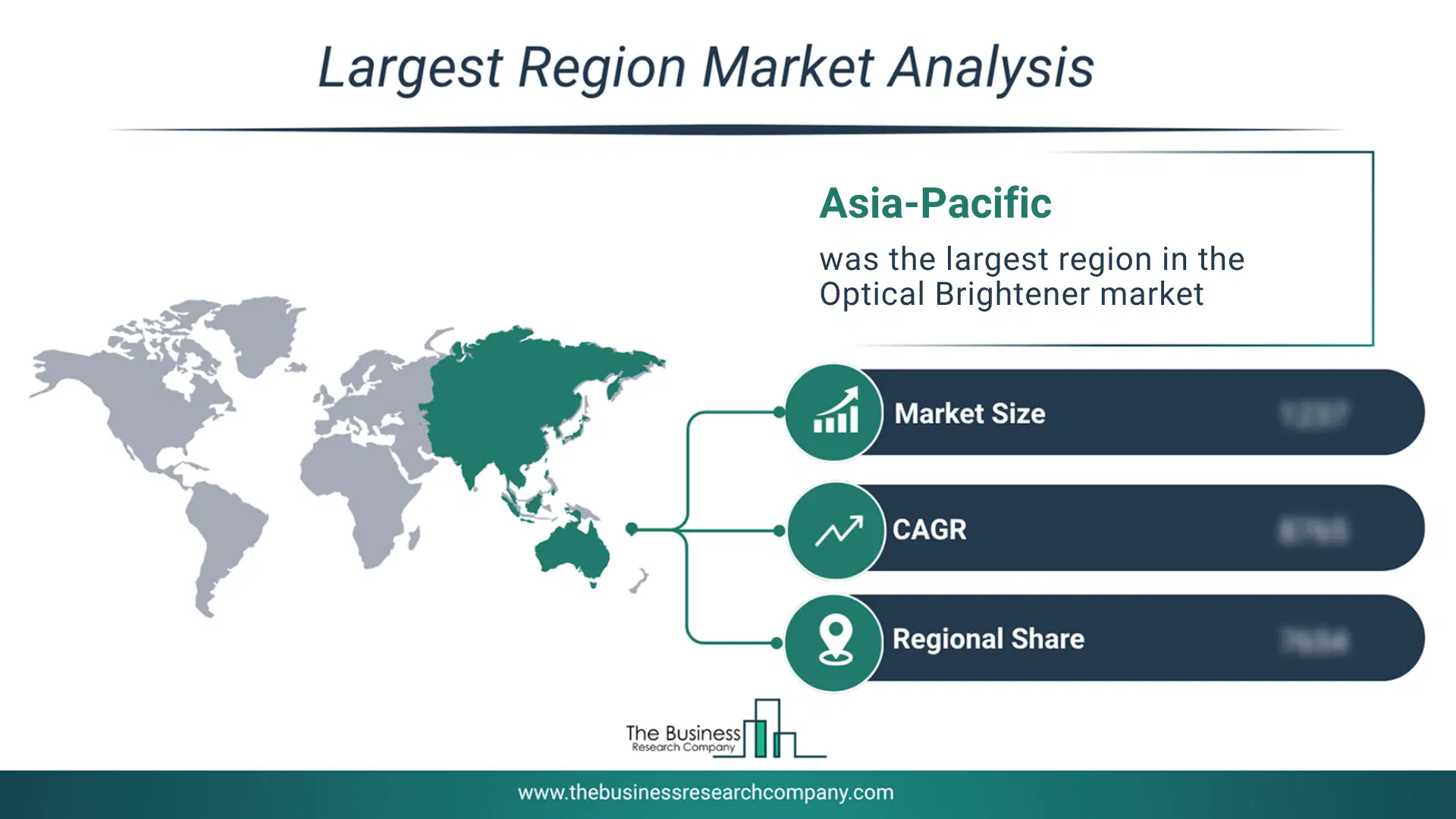
Regional Insights
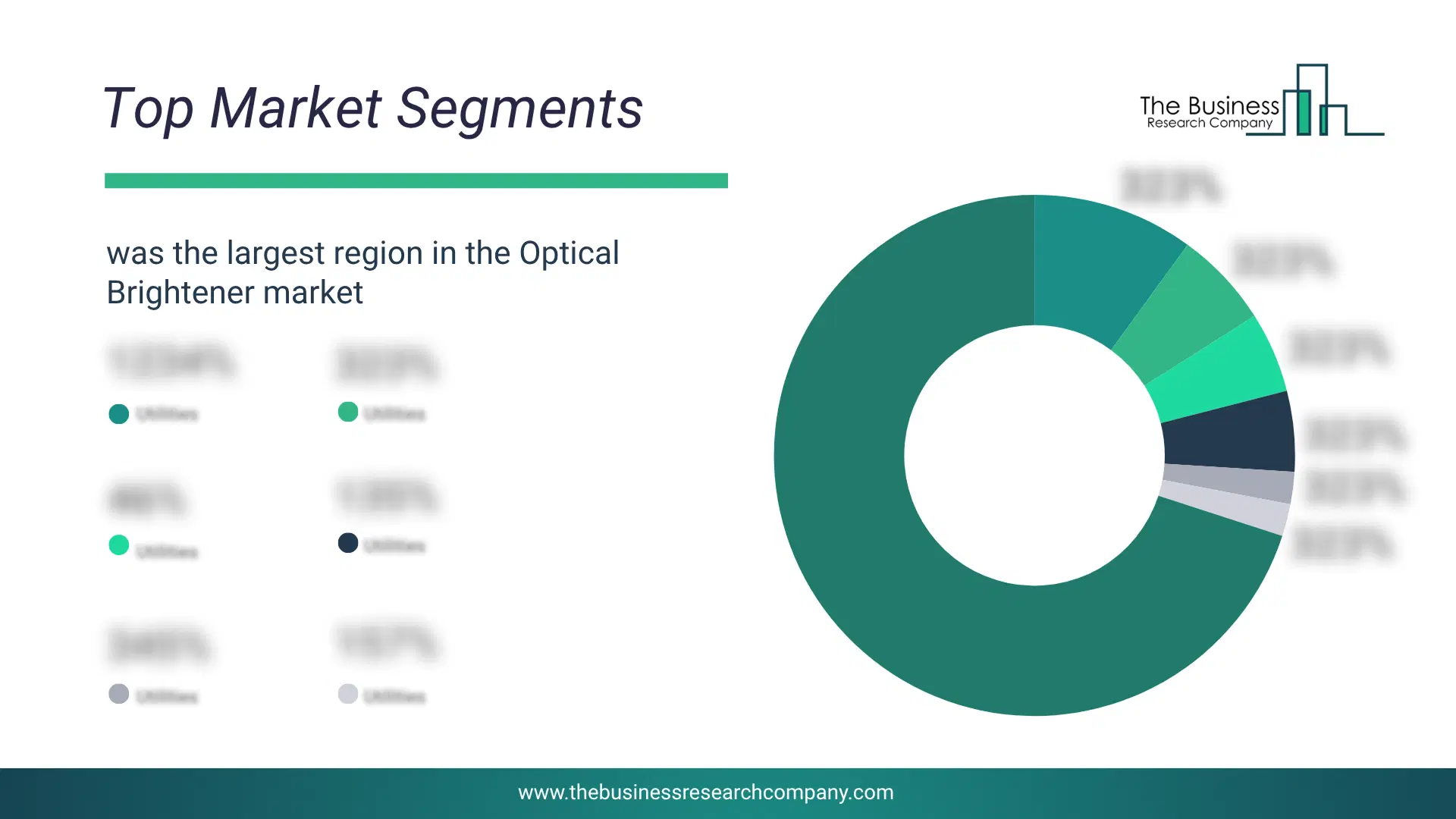
Asia-Pacific dominated the optical brightener market and is expected to be the largest market in 2025. The regions covered in this market report are Asia-Pacific, South East Asia, Western Europe, Eastern Europe, North America, South America, Middle East, Africa The countries covered in this market report are Australia, Brazil, China, France, Germany, India, Indonesia, Japan, Taiwan, Russia, South Korea, UK, USA, Canada, Italy, SpainWhat Defines the Optical Brightener Market?
The optical brightener market consists of sales of cinnamic acid, coumarin, dicarboxylic acid, diphenyl pyrazoline, and stilbene. Values in this market are ‘factory gate’ values, that is, the value of goods sold by the manufacturers or creators of the goods, whether to other entities (including downstream manufacturers, wholesalers, distributors, and retailers) or directly to end customers. The value of goods in this market includes related services sold by the creators of the goods.How is Market Value Defined and Measured?
The market value is defined as the revenues that enterprises gain from the sale of goods and/or services within the specified market and geography through sales, grants, or donations in terms of the currency (in USD unless otherwise specified). The revenues for a specified geography are consumption values that are revenues generated by organizations in the specified geography within the market, irrespective of where they are produced. It does not include revenues from resales along the supply chain, either further along the supply chain or as part of other products.
This chart presents market attractiveness based on a quantitative evaluation of growth, competition, strategic alignment, and risk, offering a clear view of opportunity areas for decision-making. This chart is for illustrative purposes; the full report contains the complete analysis.

This chart highlights the Total Addressable Market (TAM) by estimating the maximum revenue opportunity using an assumption-driven approach, supporting strategic planning and opportunity sizing across markets. The chart is illustrative; the full report provides a more comprehensive analysis.
What Key Data and Analysis Are Included in the Optical Brightener Market Report 2026?
The optical brightener market research report is one of a series of new reports from The Business Research Company that provides market statistics, including industry global market size, regional shares, competitors with the market share, detailed market segments, market trends and opportunities, and any further data you may need to thrive in the optical brightener industry. The market research report delivers a complete perspective of everything you need, with an in-depth analysis of the current and future state of the industry.Optical Brightener Market Report Forecast Analysis
| Report Attribute | Details |
|---|---|
| Market Size Value In 2026 | $1.54 billion |
| Revenue Forecast In 2030 | $2.17 billion |
| Growth Rate | CAGR of 9.6% from 2026 to 2030 |
| Base Year For Estimation | 2025 |
| Actual Estimates/Historical Data | 2020-2025 |
| Forecast Period | 2026 - 2030 |
| Market Representation | Revenue in USD Billion and CAGR from 2026 to 2030 |
| Segments Covered | Type, Application, End-Use |
| Regional Scope | Asia-Pacific, Western Europe, Eastern Europe, North America, South America, Middle East, Africa |
| Country Scope | The countries covered in this market report are Australia, Brazil, China, France, Germany, India, Indonesia, Japan, Taiwan, Russia, South Korea, UK, USA, Canada, Italy, Spain |
| Key Companies Profiled | BASF Colors & Effects GmbH, Huntsman International LLC, Archroma, Clariant AG, Keystone Aniline Corporation, Aron Universal Ltd., Brilliant Colors Inc., 3V Company Inc., The Fong Min International Company Limited, BoldChem Technology Co. Ltd., Beijing Odyssey Chemicals Co. Ltd., Hebei Xingyu Chemical Co. Ltd., Nantong Huanuo Pigment Co. Ltd., Shandong Joy-ring Chemical Co. Ltd., Shanxi Colorshine Chemical Industry Co. Ltd., Dystar Singapore Pte Ltd., Everlight Chemical Industrial Corporation, Ciba Specialty Chemicals |
| Customization Scope | Request for Customization |
| Pricing And Purchase Options | Explore Purchase Options |