
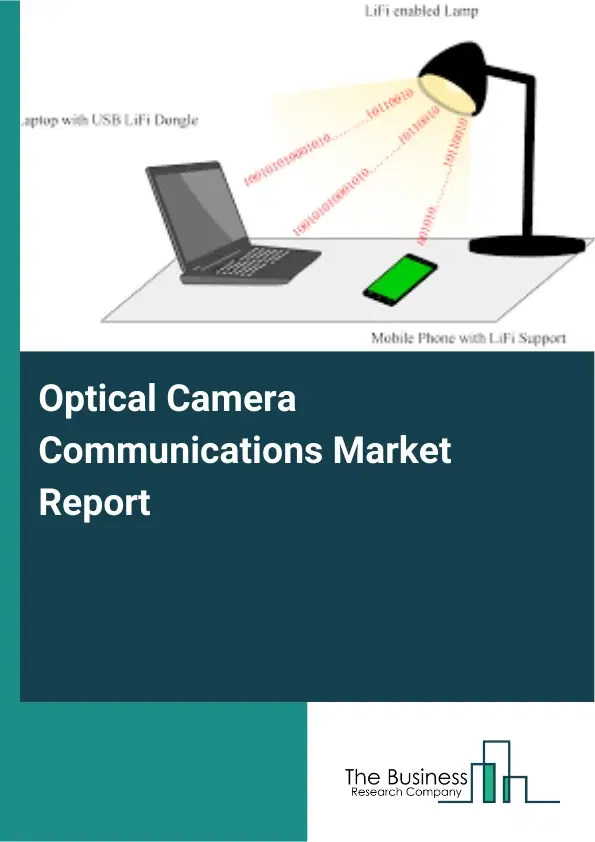
Optical Camera Communications Market Report 2026
Global Outlook – By Component (Light Emitting Diodes (LED), Photodetectors, Image Sensors, Transmitters, Receivers, Other Components), By Communication Technology (Visible Light Communication (VLC), Infrared Communication (IR), Ultraviolet Communication (UV)), By Application (Consumer Electronics, Automotive Systems, Industrial Automation, Defense And Security, Healthcare Monitoring, Other Applications), By End User (Banking Financial Services And Insurance (BFSI), Retail, Transportation, Information Technology (IT) And Telecommunications, Other End Users) – Market Size, Trends, Strategies, and Forecast to 2030
Optical Camera Communications Market Overview
• Optical Camera Communications market size has reached to $1.6 billion in 2025 • Expected to grow to $4.85 billion in 2030 at a compound annual growth rate (CAGR) of 24.9% • Growth Driver: The Growing Emphasis on Data Security and Privacy Is Fueling the Growth of the Market Due to Rising Cyber Risks and Regulatory Pressure • Market Trend: Innovations In Optical Camera Communication Technology Enhance 3D Sensing And Signal Reliability • North America was the largest region in 2025 and Asia-Pacific is the fastest growing region.What Is Covered Under Optical Camera Communications Market?
Optical camera communications is a wireless technology that transmits data using modulated light from sources and receives it through camera sensors. The light signals are transmitted at high frequencies that are imperceptible to the human eye but detectable by cameras. Optical camera communications is designed to deliver secure, low-interference, and energy-efficient communication, making it well-suited for indoor positioning, smart infrastructure, IoT systems, and vehicle-to-infrastructure applications. The main component of optical camera communication solutions include Light Emitting Diodes (LED), photodetectors, image sensors, transmitters, receivers, and other components. Hardware components such as LEDs, photodetectors, and image sensors enable data transmission and reception. The main communication technologies include visible light communication (VLC), infrared communication (IR), and ultraviolet communication (UV). The various applications involved are consumer electronics, automotive systems, industrial automation, defense and security, healthcare monitoring, and other applications, and are distributed to end users including banking, financial services and insurance (BFSI), retail, transportation, information technology (IT) and telecommunications, and other end users, providing high-speed, secure, and efficient optical communication capabilities.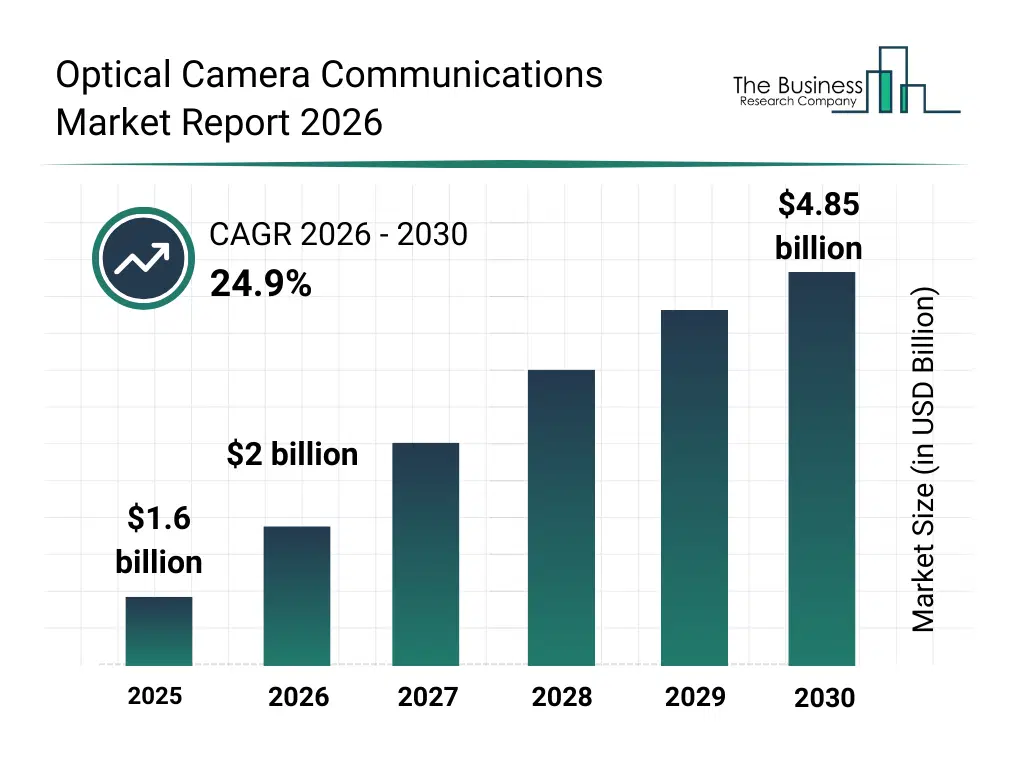
What Is The Optical Camera Communications Market Size and Share 2026?
The optical camera communications market size has grown exponentially in recent years. It will grow from $1.6 billion in 2025 to $2 billion in 2026 at a compound annual growth rate (CAGR) of 24.6%. The growth in the historic period can be attributed to rising adoption of visible light communication in consumer electronics, increasing demand for automotive optical communication systems, growing deployment in industrial automation, technological advances in photodetectors and LEDs, rising integration with IoT devices.What Is The Optical Camera Communications Market Growth Forecast?
The optical camera communications market size is expected to see exponential growth in the next few years. It will grow to $4.85 billion in 2030 at a compound annual growth rate (CAGR) of 24.9%. The growth in the forecast period can be attributed to increasing adoption of infrared and ultraviolet optical communication, expansion in smart city and smart infrastructure projects, rising demand in healthcare monitoring applications, growing integration with autonomous vehicle systems, development of high-efficiency modulation and demodulation circuits. Major trends in the forecast period include increasing adoption of camera-based optical receivers, rising integration of adaptive optical transmitters, growing demand for high-sensitivity image sensors, expansion of secure device-to-device communication, rising deployment of smart signage and traffic communication systems.
Global Optical Camera Communications Market Segmentation
1) By Component: Light Emitting Diodes (LED), Photodetectors, Image Sensors, Transmitters, Receivers, Other Components 2) By Communication Technology: Visible Light Communication (VLC), Infrared Communication (IR), Ultraviolet Communication (UV) 3) By Application: Consumer Electronics, Automotive Systems, Industrial Automation, Defense And Security, Healthcare Monitoring, Other Applications 4) By End User: Banking Financial Services And Insurance (BFSI), Retail, Transportation, Information Technology (IT) And Telecommunications, Other End Users Subsegments: 1) By Light Emitting Diodes (LED): High Brightness Light Emitting Diodes, Organic Light Emitting Diodes, Micro Light Emitting Diodes, White Light Emitting Diodes 2) By Photodetectors: Photodiodes, Avalanche Photodiodes, Charge Coupled Device Sensors, Complementary Metal Oxide Semiconductor Sensors 3) By Image Sensors: Complementary Metal Oxide Semiconductor Image Sensors, Charge Coupled Device Image Sensors, Stacked Image Sensors, Global Shutter Image Sensors 4) By Transmitters: Single Light Source Transmitters, Multi Light Source Transmitters, Integrated Optical Transmitters, Adaptive Optical Transmitters 5) By Receivers: Camera Based Optical Receivers, Single Sensor Optical Receivers, Multi Sensor Optical Receivers, High Sensitivity Optical Receivers 6) By Other Components: Optical Filters, Lenses And Optics, Signal Processing Units, Synchronization ControllersWhat Is The Driver Of The Optical Camera Communications Market?
The growing emphasis on data security and privacy is expected to propel the growth of the optical camera communications market going forward. Data security and privacy refer to safeguarding digital information from unauthorized access, breaches, and misuse while ensuring compliance with legal and ethical standards for data handling. The emphasis on data security and privacy is increasing due to the rapid rise in cyberattacks and large-scale data breaches affecting enterprises, governments, and consumers. Optical camera communication supports data security and privacy by enabling light-based data transmission that reduces interception risks and electromagnetic interference compared to radio-frequency communication systems. For instance, in January 2024, according to the Identity Theft Resource Center, a US-based nonprofit organization focused on data breach tracking, 3,205 data compromises were reported in 2023, compared to 1,801 in 2022, representing a 78 percentage point increase year over year, highlighting the growing need for more secure communication technologies. Therefore, the growing emphasis on data security and privacy is driving the growth of the optical camera communications industry.Key Players In The Global Optical Camera Communications Market
Major companies operating in the optical camera communications market are Sony Corporation, Panasonic Corporation, General Electric Company, Nokia Corporation, NEC Corporation, Hamamatsu Photonics K K, Jenoptik AG, fSONA Networks Corporation, FireFly Wireless Networks LLC, Lucibel SA, Mostcom Ltd, Velmenni Research & Development Private Limited, PURELIFI LIMITED, Oledcomm SAS, VLNComm Inc, BridgeWave Communications Inc, Wireless Excellence Limited, aeroLiFi GmbH, Axiom Optics Inc, and Linktel Info Technology Private Limited.
This chart is for illustrative purposes; the full report includes a detailed competitor analysis and comprehensive overview of the top 10 companies in the market.
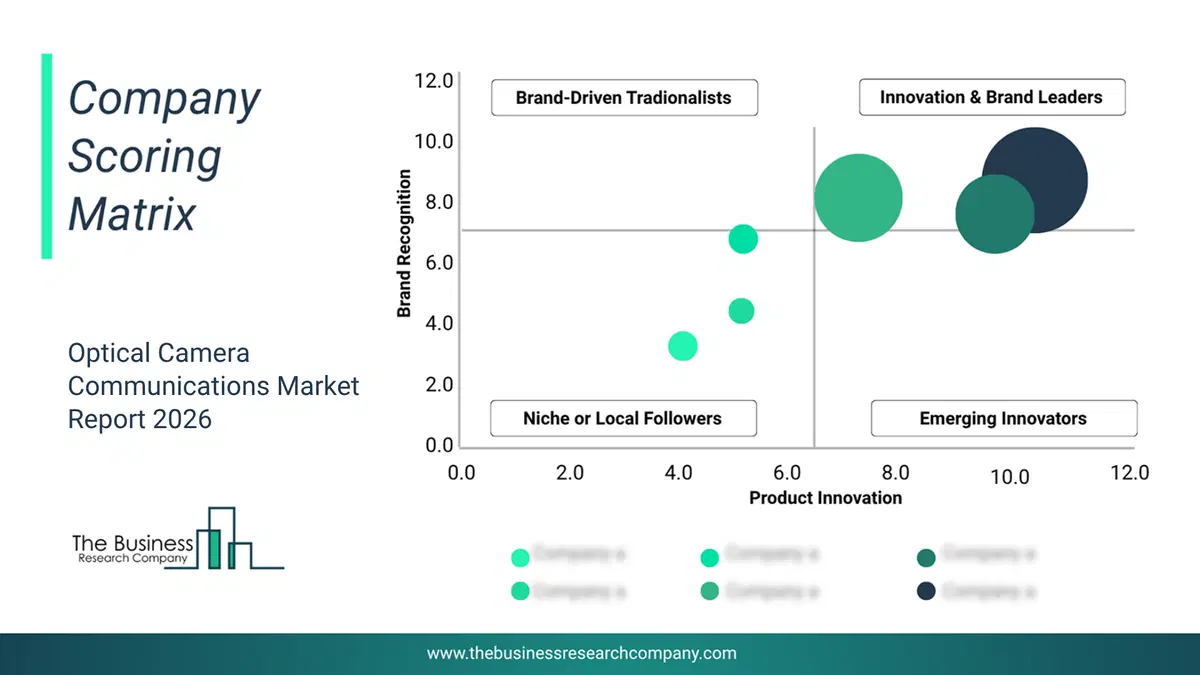
This chart maps companies by product innovation and brand strength, with bubble size indicating relative revenue, helping identify market leaders, challengers, and niche players. This is an illustrative chart; the full report provides a complete and accurate competitive analysis.
Global Optical Camera Communications Market Trends and Insights
Major companies operating in the optical camera communication market are focusing on developing advanced solutions such as software-defined light control and high-efficiency sensing to improve signal quality, adaptability, and system performance. Software-defined light control allows light output, modulation, and signaling to be flexibly managed through software to optimize communication performance, while high-efficiency sensing enables precise, low-power detection of optical signals, enhancing system accuracy, reliability, and overall efficiency. For instance, in November 2024, Lumotive, a US-based optical semiconductor technology company, introduced the MD41 Development Kit, which combines scalable, software-defined Light Control Metasurface (LCM) technology with advanced sensors to support optical camera communication use cases. The solution provides adaptive control over lasers, processors, and time-of-flight sensors, improving photon detection efficiency, enhancing depth sensing accuracy, and enabling real-time parameter adjustments. Additionally, its modular architecture significantly reduces design cycles from 18 months to 3–6 months while ensuring robust optical signal quality for 3D sensing and communication applications.What Are Latest Mergers And Acquisitions In The Optical Camera Communications Market?
In September 2025, Voyager Technologies, Inc., a US-based optical communication company, acquired proprietary technology from BridgeComm for an undisclosed amount. Through this acquisition, Voyager aims to accelerate the development of advanced optical communication solutions, including high‑throughput, low‑latency, and secure connectivity for defense and commercial markets. BridgeComm is a US-based company that develops optical wireless communication systems, including next-generation optical cameras and laser-based data links.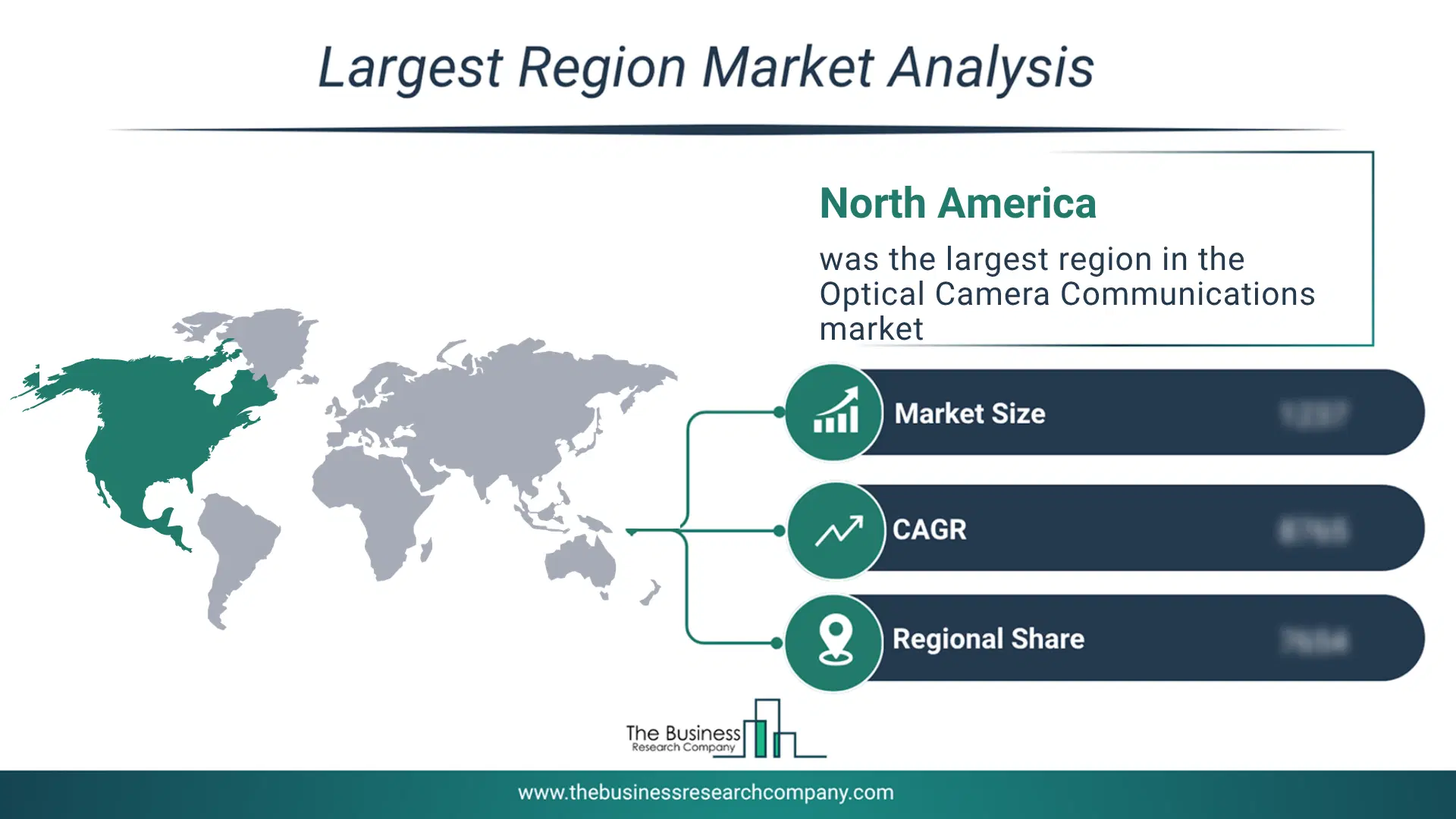
Regional Insights
North America was the largest region in the optical camera communications in 2025. Asia-Pacific is expected to be the fastest-growing region in the forecast period. The regions covered in this market report are Asia-Pacific, South East Asia, Western Europe, Eastern Europe, North America, South America, Middle East, Africa. The countries covered in this market report are Australia, Brazil, China, France, Germany, India, Indonesia, Japan, Taiwan, Russia, South Korea, UK, USA, Canada, Italy, Spain.What Defines the Optical Camera Communications Market?
The optical camera communications market consists of revenues earned by entities by providing services such as secure data transmission, device-to-device communication, smart signage and information broadcasting, and traffic and vehicle-to-infrastructure communication. The market value includes the value of related goods sold by the service provider or included within the service offering. The optical camera communications market also includes sales of optical lenses, signal processing units, modulation and demodulation circuits, synchronization and timing modules, optical filters, control and interface modules, and power management units. Values in this market are ‘factory gate’ values, that is, the value of goods sold by the manufacturers or creators of the goods, whether to other entities (including downstream manufacturers, wholesalers, distributors, and retailers) or directly to end customers. The value of goods in this market includes related services sold by the creators of the goods.How is Market Value Defined and Measured?
The market value is defined as the revenues that enterprises gain from the sale of goods and/or services within the specified market and geography through sales, grants, or donations in terms of the currency (in USD unless otherwise specified). The revenues for a specified geography are consumption values that are revenues generated by organizations in the specified geography within the market, irrespective of where they are produced. It does not include revenues from resales along the supply chain, either further along the supply chain or as part of other products.
This chart presents market attractiveness based on a quantitative evaluation of growth, competition, strategic alignment, and risk, offering a clear view of opportunity areas for decision-making. This chart is for illustrative purposes; the full report contains the complete analysis.

This chart highlights the Total Addressable Market (TAM) by estimating the maximum revenue opportunity using an assumption-driven approach, supporting strategic planning and opportunity sizing across markets. The chart is illustrative; the full report provides a more comprehensive analysis.
What Key Data and Analysis Are Included in the Optical Camera Communications Market Report 2026?
The optical camera communications market research report is one of a series of new reports from The Business Research Company that provides optical camera communications market statistics, including optical camera communications industry global market size, regional shares, competitors with a optical camera communications market share, detailed optical camera communications market segments, market trends and opportunities, and any further data you may need to thrive in the optical camera communications industry. This optical camera communications market research report delivers a complete perspective of everything you need, with an in-depth analysis of the current and future scenario of the industry.Optical Camera Communications Market Report Forecast Analysis
| Report Attribute | Details |
|---|---|
| Market Size Value In 2026 | $2 billion |
| Revenue Forecast In 2030 | $4.85 billion |
| Growth Rate | CAGR of 24.9% from 2026 to 2030 |
| Base Year For Estimation | 2025 |
| Actual Estimates/Historical Data | 2020-2025 |
| Forecast Period | 2026 - 2030 |
| Market Representation | Revenue in USD Billion and CAGR from 2026 to 2030 |
| Segments Covered | Component, Communication Technology, Application, End User |
| Regional Scope | Asia-Pacific, Western Europe, Eastern Europe, North America, South America, Middle East, Africa |
| Country Scope | The Countries Covered In This Market Report Are Australia, Brazil, China, France, Germany, India, Indonesia, Japan, Taiwan, Russia, South Korea, Uk, Usa, Canada, Italy, Spain. |
| Key Companies Profiled | Sony Corporation, Panasonic Corporation, General Electric Company, Nokia Corporation, NEC Corporation, Hamamatsu Photonics K K, Jenoptik AG, fSONA Networks Corporation, FireFly Wireless Networks LLC, Lucibel SA, Mostcom Ltd, Velmenni Research & Development Private Limited, PURELIFI LIMITED, Oledcomm SAS, VLNComm Inc, BridgeWave Communications Inc, Wireless Excellence Limited, aeroLiFi GmbH, Axiom Optics Inc, and Linktel Info Technology Private Limited. |
| Customization Scope | Request for Customization |
| Pricing And Purchase Options | Explore Purchase Options |