
Optical Character Recognition (OCR) Systems Market Report 2026
Global Outlook – By Type (Software, Services), By Enterprise Size (Small And Medium Enterprises, Large Enterprises), By Vertical (Retail, Banking, Financial Services and Insurance (BFSI), Government, Education, Transport And Logistics, Healthcare, IT And Telecom, Manufacturing, Other Verticals) – Market Size, Trends, Strategies, and Forecast to 2030
Optical Character Recognition (OCR) Systems Market Overview
• Optical Character Recognition (OCR) Systems market size has reached to $17.58 billion in 2025 • Expected to grow to $40.61 billion in 2030 at a compound annual growth rate (CAGR) of 18.3% • Growth Driver: OCR Systems Meeting The Challenge Of Rising Document Numbers • Market Trend: OCR Systems Market Soars With Upstage's Cutting-Edge Api Series • North America was the largest region in 2025.Market Gains By 2030 – Top Opportunities By Segment
Market Gain identifies the most promising market opportunities by highlighting the segments or products expected to generate the highest incremental revenue growth over the next five years.
What Is Covered Under Optical Character Recognition (OCR) Systems Market?
Optical character recognition (OCR) is a technology that allows computers to recognize text characters within digital images, such as scanned documents or photographs. An OCR system, also known as an optical character recognition system, is a tool that is commonly used to convert printed or handwritten text into machine-readable text that can be edited, searched, and analyzed. The main types of optical character recognition (OCR) systems are software and services. OCR software is a standalone application or a component that can be integrated into other applications. This type of OCR system is typically designed for desktop use and requires the user to install the software on their computer. These are used in small and medium enterprises and large enterprises for B2B and B2C end-use. These are used by retail, BFSI, government, education, transport and logistics, healthcare, it and telecom, manufacturing, and others.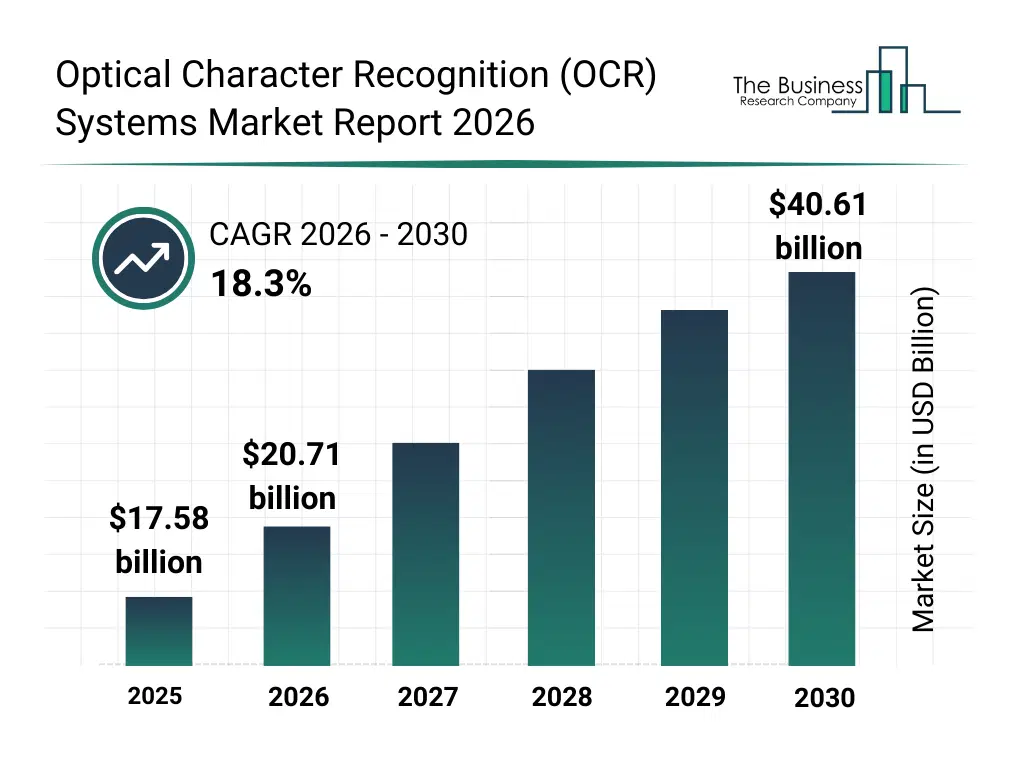
What Is The Optical Character Recognition (OCR) Systems Market Size and Share 2026?
The optical character recognition (ocr) systems market size has grown rapidly in recent years. It will grow from $17.58 billion in 2025 to $20.71 billion in 2026 at a compound annual growth rate (CAGR) of 17.8%. The growth in the historic period can be attributed to digitization of paper documents, growth of enterprise content management, demand for workflow automation, early adoption in banking, expansion of scanning technologies.What Is The Optical Character Recognition (OCR) Systems Market Growth Forecast?
The optical character recognition (ocr) systems market size is expected to see rapid growth in the next few years. It will grow to $40.61 billion in 2030 at a compound annual growth rate (CAGR) of 18.3%. The growth in the forecast period can be attributed to AI driven accuracy improvements, growth of digital transformation initiatives, rising compliance requirements, expansion of remote work models, demand for real time data extraction. Major trends in the forecast period include AI based text recognition, cloud deployed ocr solutions, multilingual ocr capabilities, mobile ocr applications, intelligent document processing.
Global Optical Character Recognition (OCR) Systems Market Segmentation
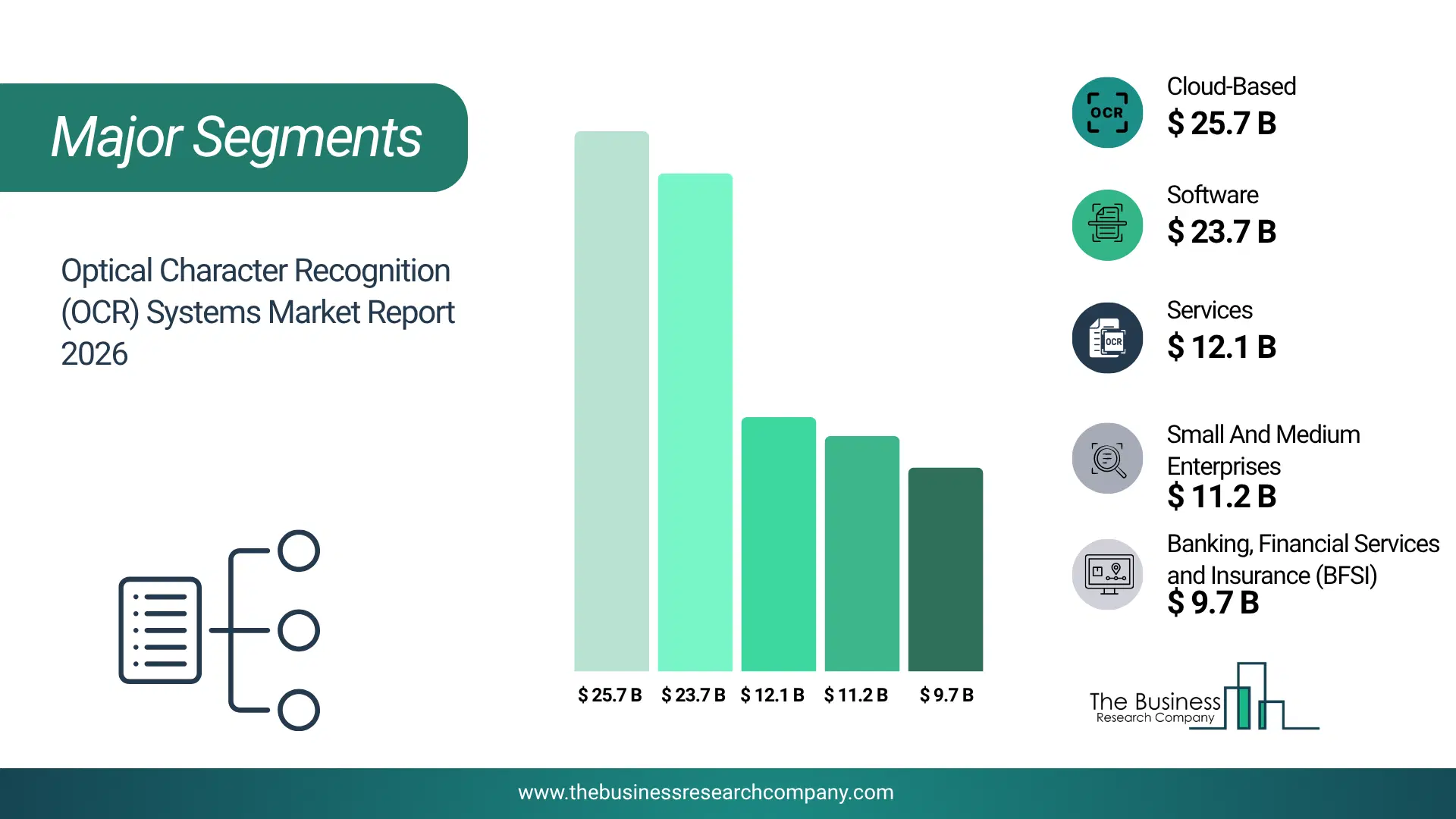
1) By Type: Software, Services 2) By Enterprise Size: Small And Medium Enterprises, Large Enterprises 3) By Vertical: Retail, Banking, Financial Services and Insurance (BFSI), Government, Education, Transport And Logistics, Healthcare, IT And Telecom, Manufacturing, Other Verticals Subsegments: 1) By Software: Cloud-based OCR Software, On-Premise OCR Software, Mobile OCR Applications 2) By Services: Consulting Services, Implementation Services, Support And Maintenance Services The top segments in the optical character recognition (ocr) systems market will be: • Large Enterprises will reach $25713.17 Million by 2030. • Software will reach $23786.3 Million by 2030. • Small And Medium Enterprises will reach $11276.7 Million by 2030. • Services will reach $12103.49 Million by 2030. • Banking, Financial Services and Insurance (BFSI) will reach $9707.04 Million by 2030.What Is The Driver Of The Optical Character Recognition (OCR) Systems Market?
The rising volume of paper documents is expected to propel the growth of the optical character recognition (OCR) systems market going forward. Paper documents refer to physical documents that are tangible, paper-based materials containing information. Optical Character Recognition (OCR) systems play a crucial role in transforming paper documents into digital formats by converting printed or handwritten text into machine-readable text. For instance, in October 2023, according to the ECM Consultant Company, a US-based management firm, in the United States, businesses expend $8 billion annually on the management of paper documents, incurring an average cost of $20 per document filing. Roughly one billion trees' worth of paper is discarded annually in the United States. Therefore, the rising volume of paper documents is driving the growth of the optical character recognition (OCR) systems industry going forward.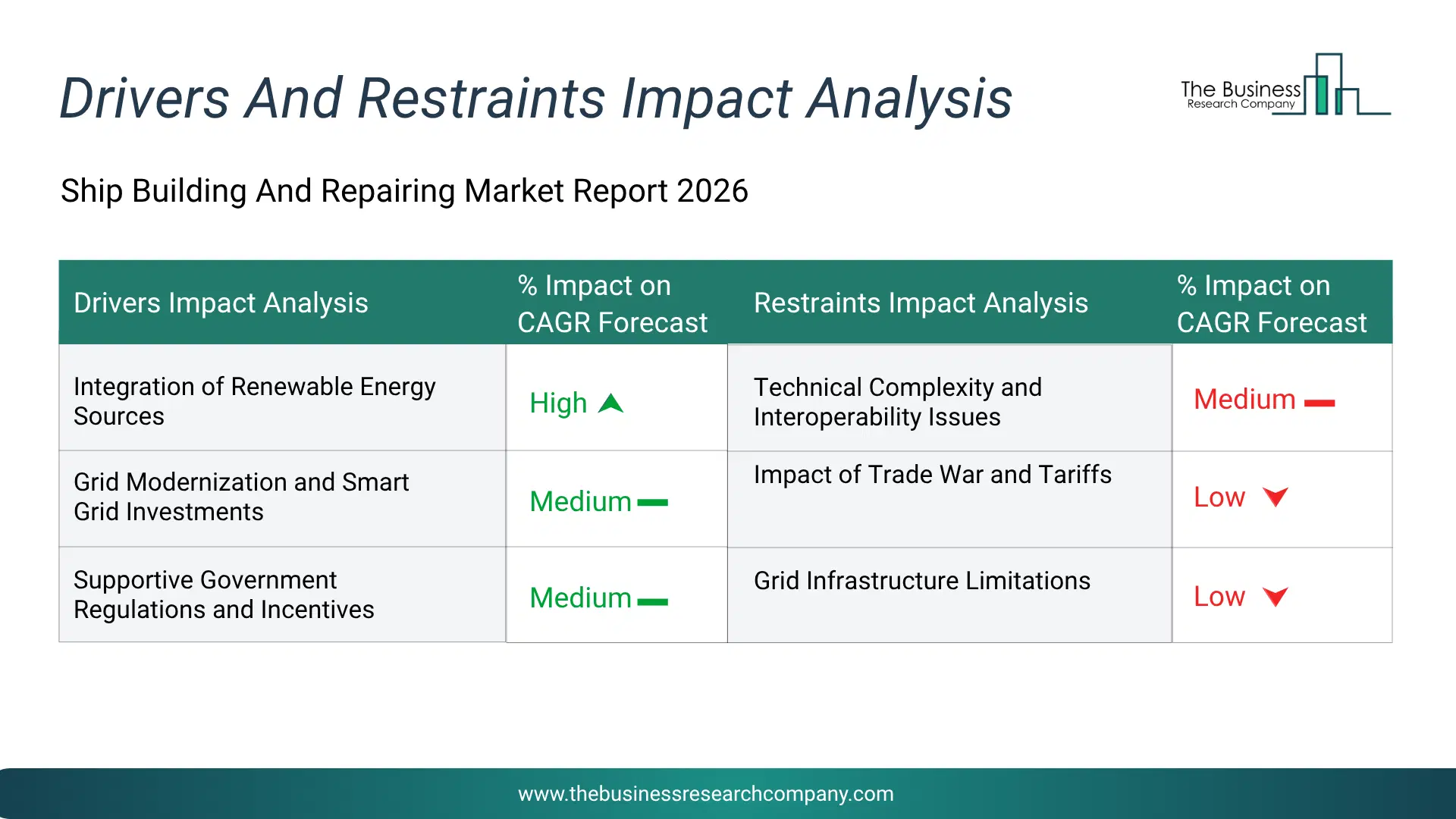
Infographic Chart Showing Key Market Drivers Analysis And Restraints For Optical Character Recognition (Ocr) Systems Market
The chart presents an impact analysis of key drivers and restraints, quantifying their relative influence on the market's growth rate and helping assess the balance between growth enablers and limiting factors. This chart offers a high-level perspective; the full report contains more detailed insights.
How Will The Drivers Impact Growth In The Global Optical Character Recognition (OCR) Systems Market?
• Rising Demand For Process Automation (Medium) – During the forecast period, the rising demand for process automation will become a key driver of growth in the optical character recognition (ocr) systems market by 2030. enterprises across bfsi, government, healthcare, logistics and manufacturing are under pressure to reduce operational bottlenecks, improve turnaround times and enhance service delivery by automating repetitive, manual tasks. ocr serves as a foundational technology within intelligent document processing (idp) and workflow automation platforms by converting unstructured paper-based or image-based content into machine-readable data that can flow directly and document management systems. as businesses expand their digital transformation initiatives, ocr adoption is being driven by the need to enable straight-through processing, minimize human intervention and support scalable automation across finance, compliance, onboarding and records management functions. as a result, rising demand for process automation is anticipated to contributing to a 1.5% annual growth in the market. • Rising Cost And Inefficiency Of Manual Document Handling (Medium) – During the forecast period, the rising cost and inefficiency of manual document handling will emerge as a major factor driving the expansion of the optical character recognition (ocr) systems market by 2030. manual data entry, document sorting and record verification consume substantial employee time and increase the risk of inconsistencies, processing delays and compliance failures. ocr-based automation enables enterprises to replace these manual workflows with faster, more reliable digital processes that reduce operational costs and improve accuracy. as labor costs rise and businesses face pressure to optimize back-office operations, ocr solutions are becoming a strategic investment to improve productivity, reallocate human resources to higher-value tasks and ensure consistent processing quality across large document volumes. consequently, the rising cost and inefficiency of manual document handling is projected to contributing to a 1.3% annual growth in the market. • Rising Volume Of Paper Documents (Low) – During the forecast period, the rising volume of paper documents will serve as a key growth catalyst for the optical character recognition (ocr) systems market by 2030. despite ongoing digital transformation, many enterprises and government agencies still rely on paper-based documentation for legal, financial and operational purposes, creating growing backlogs of records that must be digitized for accessibility, compliance and analytics. ocr technology enables large-scale document digitization by transforming scanned images into searchable, editable and structured digital text that can be stored, indexed and retrieved efficiently. as organizations seek to modernize legacy archives and handle expanding document inflows, ocr adoption is accelerating to support digital record-keeping, long-term data preservation and enterprise-wide information management. therefore, rising volume of paper documents is projected to supporting to a 0.8% annual growth in the market. • Increasing Need For Data Entry Efficiency (Low) – During the forecast period, rising volume of paper documents is expected to be a key driver of the growth of the optical character recognition (ocr) systems market in the forecast period. despite ongoing digital transformation, many enterprises and government agencies still rely on paper-based documentation for legal, financial and operational purposes, creating growing backlogs of records that must be digitized for accessibility, compliance and analytics. ocr technology enables large-scale document digitization by transforming scanned images into searchable, editable and structured digital text that can be stored, indexed and retrieved efficiently. as organizations seek to modernize legacy archives and handle expanding document inflows, ocr adoption is accelerating to support digital record-keeping, long-term data preservation and enterprise-wide information management. the rising volume of paper documents growth contribution during the forecast period in 2025 is 0.8%.How Will The Restraints Impact Growth In The Global Optical Character Recognition (OCR) Systems Market?
• High Initial Implementation And Integration Costs (Medium) – During the forecast period, high initial implementation and integration costs is restricting the growth of the optical character recognition (ocr) systems market during the forecast period. deploying enterprise-grade ocr solutions often requires substantial upfront investment in software licenses, cloud subscriptions, infrastructure upgrades and system customization to fit specific document workflows. in addition, integrating ocr platforms with existing erp (enterprise resource planning), crm (customer relationship management), document management and workflow automation systems can be complex, time-consuming and resource-intensive, often requiring specialized it (information technology) expertise and professional services. these cost and complexity barriers delay adoption decisions, extend return-on-investment timelines and limit market penetration in cost-sensitive industries and emerging economies, thereby slowing the overall pace of ocr deployment. growth affected by the high initial implementation and integration costs during the forecast period in 2025 is -2.0%. • Limited Standardization And Interoperability (Medium) – During the forecast period, limited standardization and interoperability are restricting the growth of the optical character recognition (ocr) systems market during the forecast period. ocr vendors often use proprietary data formats, apis and processing workflows, making it difficult for enterprises to integrate multiple ocr tools or switch providers without significant reengineering. inconsistent support for document templates, metadata structures, language models and output schemas further complicate downstream system integration and automation. this lack of interoperability creates vendor lock-in risks, increases long-term operational costs and discourages large-scale, multi-vendor ocr deployments, particularly for organizations seeking unified, cross-departmental document automation strategies. growth affected by the limited standardization and interoperability during the forecast period in 2025 is -1.2%. • Impact Of Trade War And Tariff (Low) – During the forecast period, the impact of the trade war and tariffs restricting the growth of the optical character recognition (ocr) systems market during the forecast period. higher tariffs on semiconductors, processors, camera modules and networking equipment raise infrastructure and deployment costs for ocr providers and enterprise customers alike. these cost pressures reduce pricing flexibility for ocr vendors and delay investment decisions for large-scale digitization initiatives. in addition, trade tensions and regulatory uncertainty discourage cross-border technology partnerships, slow international market expansion and limit access to specialized hardware and ai components needed to scale ocr solutions, ultimately constraining market growth and adoption momentum. growth affected by the impact of the trade war and tariffs during the forecast period in 2025 is -0.2%.Key Players In The Global Optical Character Recognition (OCR) Systems Market
Major companies operating in the optical character recognition (ocr) systems market are The International Business Machines Corporation; Microsoft Corporation; Google Inc.; Nuance Communications Inc.; Adobe Inc.; Anyline GmbH; NTT Data Corporation; Lead Technologies Inc.; IntSig Information Co. Ltd.; Atapy software; Captricity Inc.; Creaceed; CVISION Technologies Inc.; Exper-OCR Inc.; The Naver Corporation; OpenText Corporation; Accusoft; Contact center intelligence; Image Recognition Integrated Systems; Prime Recognition Corporation; Simple Software; ABBYY Software; Adlib Software Ltd.; Alfresco Software LLC.; Artsyl Technologies lnc.; Axyon AI; Cognex Corporation; Hyland Software; Xerox Corporation; Zoho Corporation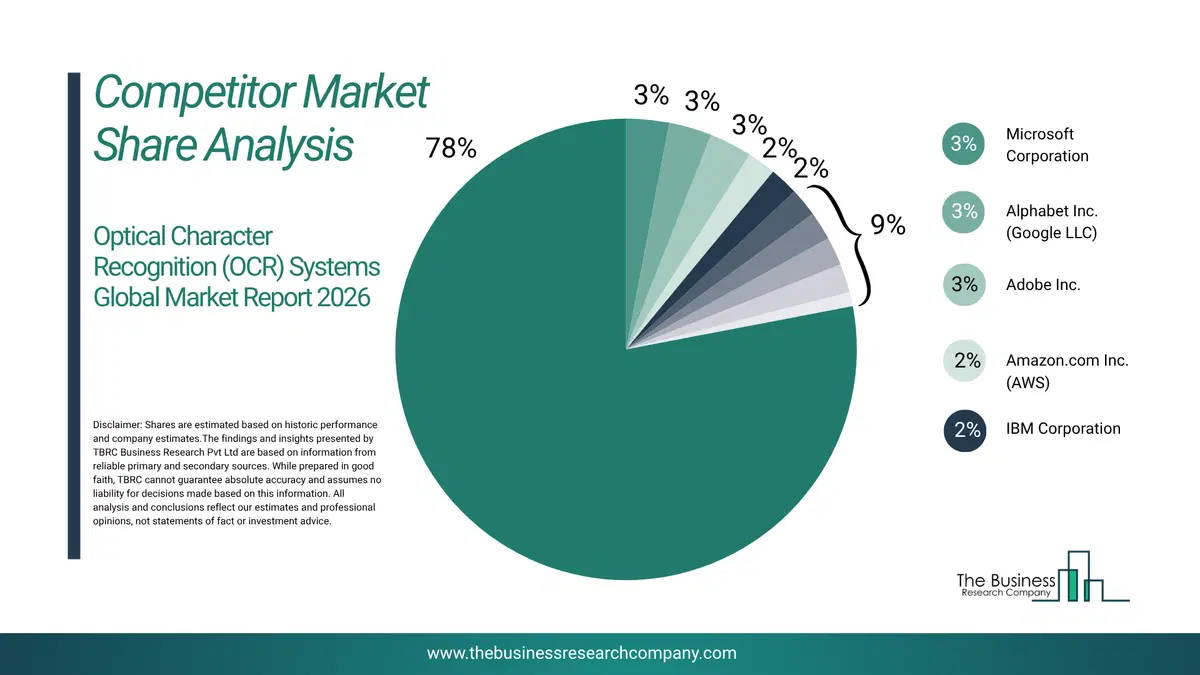
This chart is for illustrative purposes; the full report includes a detailed competitor analysis and comprehensive overview of the top 10 companies in the market.
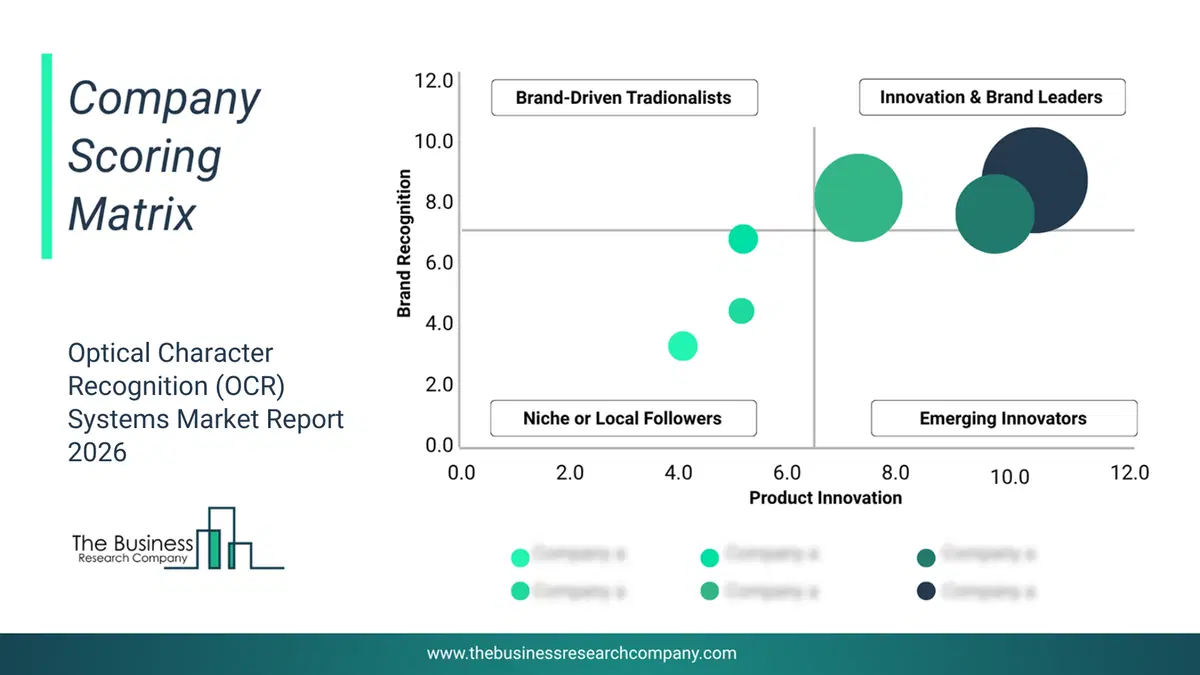
This chart maps companies by product innovation and brand strength, with bubble size indicating relative revenue, helping identify market leaders, challengers, and niche players. This is an illustrative chart; the full report provides a complete and accurate competitive analysis.
Global Optical Character Recognition (OCR) Systems Market Trends and Insights
Major companies operating in the optical character recognition (OCR) systems market are increasingly focusing on advanced technological solutions to enhance accuracy, automation, and overall data processing capabilities. AI-driven OCR platforms that can extract and interpret complex information from images are emerging as significant developments in this space. For instance, in March 2023, Upstage, a Korea-based provider of customized AI services for enterprise machine learning applications, launched its API (Application Programming Interface) Series. This suite includes advanced OCR technology capable of extracting text from images and identifying targeted information using Upstage’s AI Pack technology. The API Series also features recommendation capabilities that analyze user behavior data to deliver personalized suggestions. These innovations reflect the growing adoption of AI-powered tools aimed at improving data extraction efficiency and strengthening competitive positioning in the OCR systems market.What Are Latest Mergers And Acquisitions In The Optical Character Recognition (OCR) Systems Market?
In April 2024, Ricoh Company, Ltd., a Japan-based provider of integrated digital services and print and imaging solutions, acquired natif.AI GmbH for an undisclosed amount. With this acquisition, Ricoh aims to enhance its data extraction, intelligent capture, and optical character recognition (OCR) technologies to advance its process automation and document workflow offerings. Natif.AI is a Germany-based software startup offering AI-enabled intelligent capture, advanced image recognition, and OCR technology for unstructured and handwritten documents.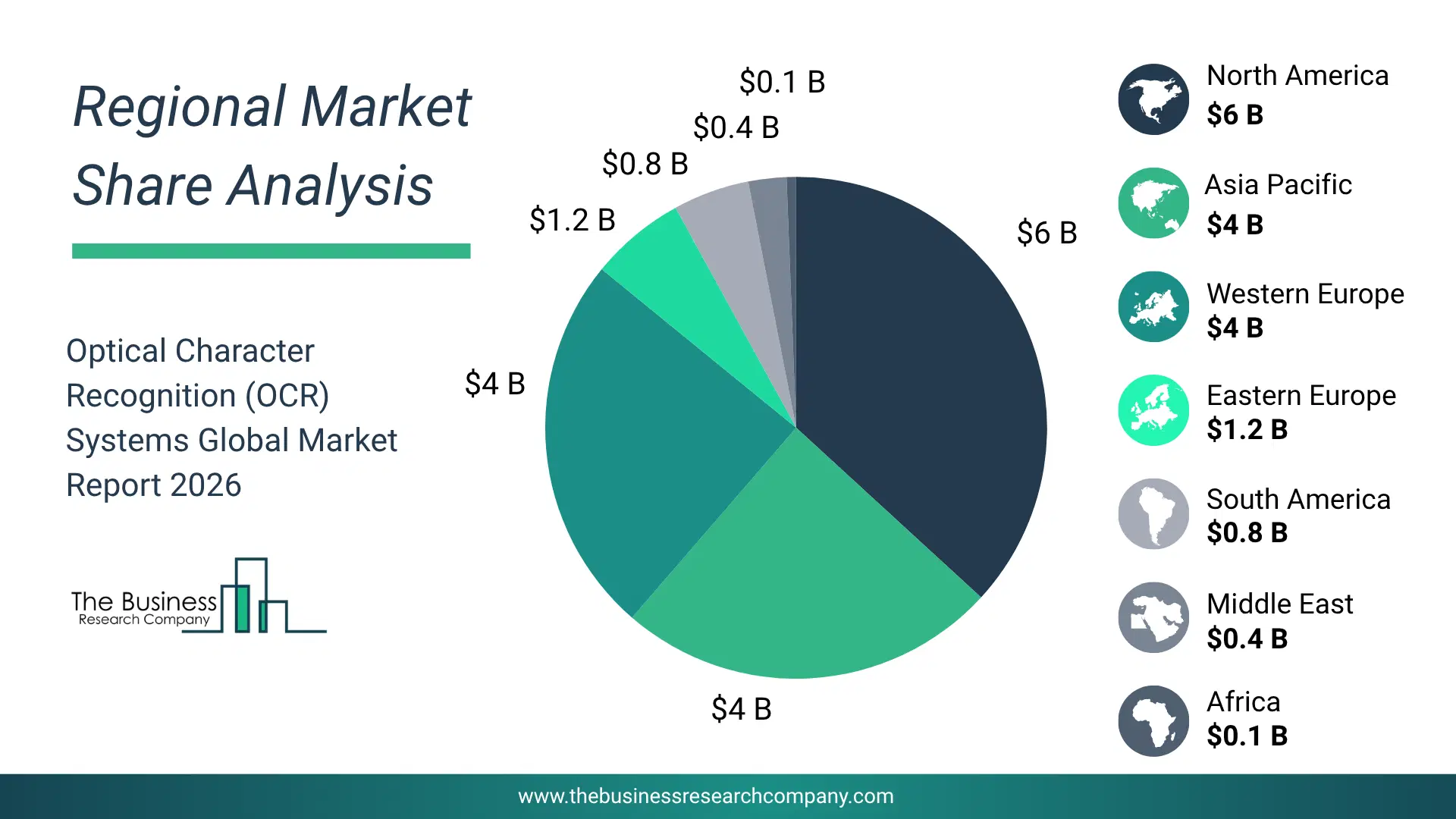
Regional Insights
North America was the largest region in the optical character recognition (OCR) systems market in 2025. Asia-Pacific is expected to be the fastest-growing region in the global optical character recognition (OCR) systems market during the forecast period. The regions covered in this market report are Asia-Pacific, South East Asia, Western Europe, Eastern Europe, North America, South America, Middle East, Africa. The countries covered in this market report are Australia, Brazil, China, France, Germany, India, Indonesia, Japan, Taiwan, Russia, South Korea, UK, USA, Canada, Italy, SpainWhat Defines the Optical Character Recognition (OCR) Systems Market?
The optical character recognition (OCR) systems market includes revenues earned by entities by providing software licenses and OCR web services. The market value includes the value of related goods sold by the service provider or included within the service offering. Only goods and services traded between entities or sold to end consumers are included. The optical character recognition (OCR) systems market consists of sales of simple OCR, intelligent character recognition (ICR), intelligent word recognition, and optical mark recognition systems. Values in this market are ‘factory gate’ values, that is the value of goods sold by the manufacturers or creators of the goods, whether to other entities (including downstream manufacturers, wholesalers, distributors and retailers) or directly to end customers. The value of goods in this market includes related services sold by the creators of the goods.How is Market Value Defined and Measured?
The market value is defined as the revenues that enterprises gain from the sale of goods and/or services within the specified market and geography through sales, grants, or donations in terms of the currency (in USD unless otherwise specified). The revenues for a specified geography are consumption values that are revenues generated by organizations in the specified geography within the market, irrespective of where they are produced. It does not include revenues from resales along the supply chain, either further along the supply chain or as part of other products.
This chart presents market attractiveness based on a quantitative evaluation of growth, competition, strategic alignment, and risk, offering a clear view of opportunity areas for decision-making. This chart is for illustrative purposes; the full report contains the complete analysis.

This chart highlights the Total Addressable Market (TAM) by estimating the maximum revenue opportunity using an assumption-driven approach, supporting strategic planning and opportunity sizing across markets. The chart is illustrative; the full report provides a more comprehensive analysis.
What Key Data and Analysis Are Included in the Optical Character Recognition (OCR) Systems Market Report 2026?
The optical character recognition (ocr) systems market research report is one of a series of new reports from The Business Research Company that provides market statistics, including industry global market size, regional shares, competitors with the market share, detailed market segments, market trends and opportunities, and any further data you may need to thrive in the optical character recognition (ocr) systems industry. The market research report delivers a complete perspective of everything you need, with an in-depth analysis of the current and future state of the industry.Optical Character Recognition (OCR) Systems Market Report Forecast Analysis
| Report Attribute | Details |
|---|---|
| Market Size Value In 2026 | $20.71 billion |
| Revenue Forecast In 2030 | $40.61 billion |
| Growth Rate | CAGR of 17.8% from 2026 to 2030 |
| Base Year For Estimation | 2025 |
| Actual Estimates/Historical Data | 2020-2025 |
| Forecast Period | 2026 - 2030 - 2035 |
| Market Representation | Revenue in USD Billion and CAGR from 2026 to 2030 |
| Segments Covered | Type, Enterprise Size, Vertical |
| Regional Scope | Asia-Pacific, Western Europe, Eastern Europe, North America, South America, Middle East, Africa |
| Country Scope | The countries covered in the report are Australia, Brazil, China, France, Germany, India, Indonesia, Japan, Taiwan, Russia, South Korea, UK, USA, Canada, Italy, Spain. |
| Key Companies Profiled | The International Business Machines Corporation; Microsoft Corporation; Google Inc.; Nuance Communications Inc.; Adobe Inc.; Anyline GmbH; NTT Data Corporation; Lead Technologies Inc.; IntSig Information Co. Ltd.; Atapy software; Captricity Inc.; Creaceed; CVISION Technologies Inc.; Exper-OCR Inc.; The Naver Corporation; OpenText Corporation; Accusoft; Contact center intelligence; Image Recognition Integrated Systems; Prime Recognition Corporation; Simple Software; ABBYY Software; Adlib Software Ltd.; Alfresco Software LLC.; Artsyl Technologies lnc.; Axyon AI; Cognex Corporation; Hyland Software; Xerox Corporation; Zoho Corporation |
| Customization Scope | Request for Customization |
| Pricing And Purchase Options | Explore Purchase Options |