

Optical Character Recognition (OCR) Global Market Opportunities And Strategies To 2035
By Type (Software, Hardware, Services), By Enterprise Size (Small And Medium Enterprises, Large Enterprises), By Vertical (Retail, Banking, Financial Services And Insurance (BFSI), Government, Education, Transport And Logistics, Healthcare, IT And Telecom, Manufacturing, Other Verticals), And By Region, Opportunities And Strategies – Global Forecast To 2035
Optical Character Recognition (OCR) Market Definition
Optical character recognition (OCR) systems refer to technologies and solutions that convert different types of printed, typed, or handwritten text into machine‑encoded, editable and searchable data. OCR systems are used to automate the extraction of text from physical documents such as invoices, forms, receipts, books and historical archives, enabling businesses and institutions to digitize paper records and streamline information workflows. The primary users of OCR systems include enterprises, government agencies, educational institutions and service providers that require accurate, rapid conversion of text from scanned images, digital photos and documents into digital formats that can be processed, stored and analyzed by computer systems. The optical character recognition (OCR) systems market consists of sales, by entities (organizations, sole traders, or partnerships) that develop, license, distribute, or provide software and services used to recognize and convert printed or handwritten text from images, scanned documents and digital files into machine-readable, editable and searchable text.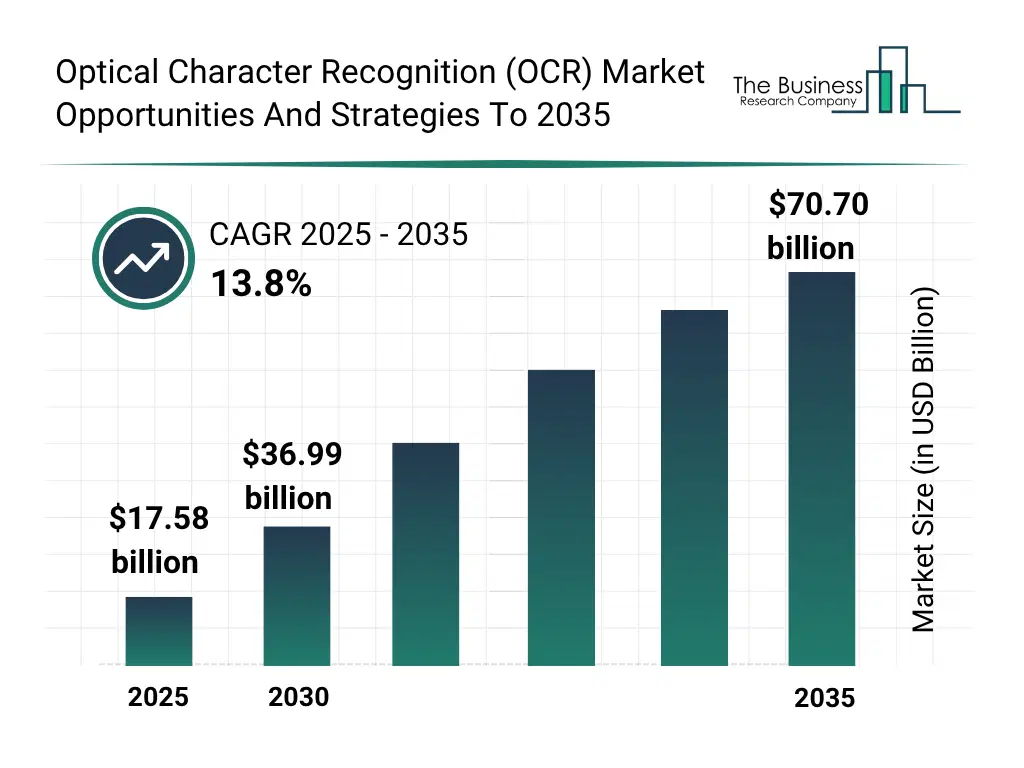
Optical Character Recognition (OCR) Market Size
The global optical character recognition (OCR) systems market reached a value of nearly $17,583.3 million in 2025, having grown at a compound annual growth rate (CAGR) of 17.4% since 2020. The market is expected to grow from $17,583.3 million in 2025 to $36,989.9 million in 2030 at a rate of 16.0%. The market is then expected to grow at a CAGR of 13.8% from 2030 and reach $70,703.1 million in 2035. Growth in the historic period resulted from increasing digital transformation, rising digitization of medical records and diagnostic reports, growing digitization of identity documents and growing automation of logistics, customs, and trade documentation. Factors that negatively affected growth in the historic period were accuracy limitations with low-quality documents and data security and privacy concerns. Going forward, growth in rising demand for process automation, rising cost and inefficiency of manual document handling, rising volume of paper documents and increasing need for data entry efficiency will drive the growth. Factors that could hinder the growth of the optical character recognition (OCR) systems market in the future include high initial implementation and integration costs, limited standardization and interoperability and impact of trade war and tariffs.
Optical Character Recognition (OCR) Market Segmentation
The optical character recognition (OCR) market is segmented by type, by enterprise size and by vertical.By Product –
The optical character recognition (OCR) market is segmented by type into:
- a) Software
- b) Hardware
- c) Services
By Enterprise Size –
The optical character recognition (OCR) market is segmented by enterprise size into:
- a) Small And Medium Enterprises
- b) Large Enterprises
By Vertical –
The optical character recognition (OCR) market is segmented by vertical into:
- a) Retail
- b) Banking, Financial Services And Insurance (BFSI)
- c) Government
- d) Education
- e) Transport And Logistics
- f) Healthcare
- g) IT And Telecom
- h) Manufacturing
- i) Other Verticals
By Geography - The optical character recognition (OCR) market is segmented by geography into:
- China
- India
- Japan
- Australia
- Indonesia
- South Korea
- USA
- Canada
- Brazil
- France
- Germany
- UK
- Italy
- Spain
- Russia
-
o Asia Pacific
o Africa