

Contact Us
  Search
The Business Research Company Logo
Optical Communication And Networking Global Market Opportunities And Strategies To 2035
Published :July 2026
Pages :417
Format :PDF
Delivery Time :2-3 Business Days
ⓘ
Why 2-3 days? We update the report with the latest data and news before delivery. Let us know if you need us to expedite.
Report Price :$4,490.00

Optical Communication And Networking Global Market Opportunities And Strategies To 2035

By Component (Optical Fiber, Optical Transceiver, Optical Switch, Optical Amplifier, Optical Circulator, Other Components), By Technology (Wavelength Division Multiplexing (WDM), Synchronous Optical Network (SONET), Fiber Channel, Other Technologies), By End-Use (IT And Telecom, Banking, Financial Services And Insurance (BFSI), Aerospace And Defense, Healthcare, Energy And Utilities, Other End Users), And By Region, Opportunities And Strategies – Global Forecast To 2035

Optical Communication And Networking Market Definition

Optical communication and networking are a technology system that uses light signals, typically transmitted through optical fiber cables, to transfer data, voice, video, and internet traffic between devices, networks, and communication systems. It relies on lasers or light-emitting diodes (LEDs) to convert electrical signals into optical signals, which are then transmitted over fiber-optic infrastructure at very high speeds and over long distances. The primary purpose of optical communication and networking is to enable high-speed, high-capacity, reliable, and low-latency data transmission while supporting the growing global demand for digital connectivity and bandwidth-intensive applications. The optical communication and networking market consists of sales by entities (organizations, sole traders and partnerships) of optical communication and networking that are used by telecommunications operators, internet service providers, cloud computing companies, enterprises, governments, financial institutions, healthcare providers and defense organizations to support internet connectivity, voice communication, video streaming, cloud applications and data center operations. These systems are used in environments where large volumes of data need to be transmitted with low latency, high reliability and minimal signal degradation. Optical communication and networking solutions are deployed in metropolitan networks, long-haul communication systems, subsea cable networks, enterprise campuses, hyperscale data centers and industrial communication infrastructure.
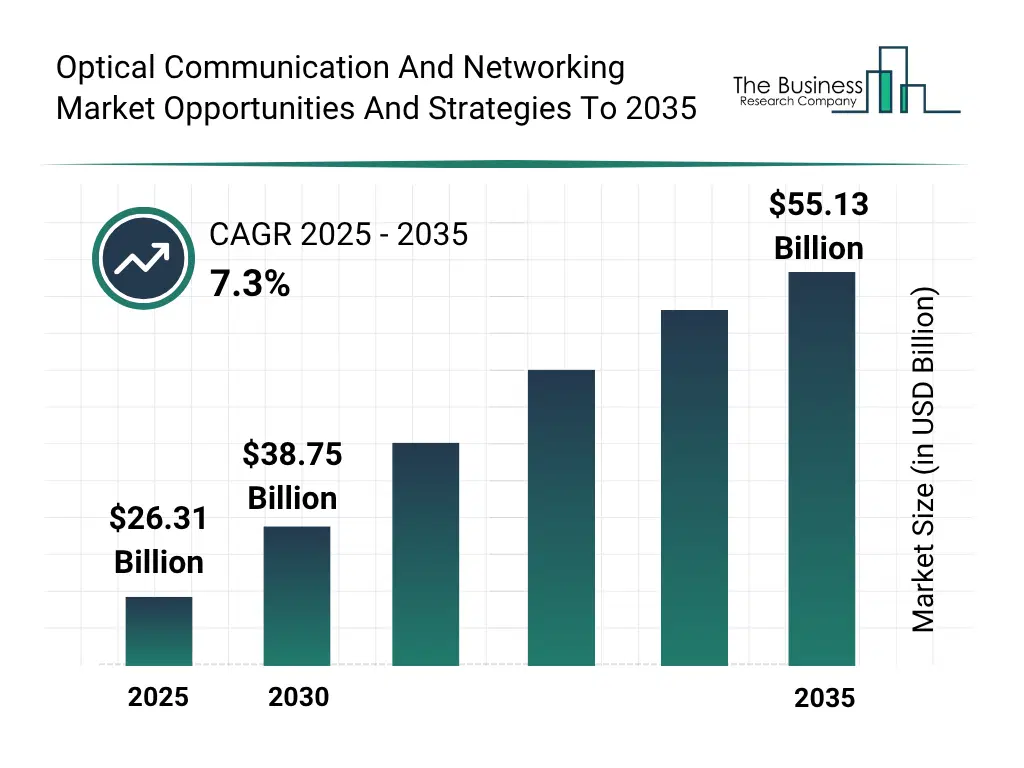
Optical Communication And Networking Global Market Opportunities And Strategies To 2035 Market Size and growth rate 2026 to 2030: Graph

Optical Communication And Networking Market Size

The global optical communication and networking market reached a value of nearly $26,306.4 million in 2025, having grown at a compound annual growth rate (CAGR) of 8.8% since 2020. The market is expected to grow from $26,306.4 million in 2025 to $38,748.3 million in 2030 at a rate of 8.1%. The market is then expected to grow at a CAGR of 7.3% from 2030 and reach $55,131.5 million in 2035. Growth in the historic period resulted from rising global internet traffic, expansion of 5G infrastructure, growth of artificial intelligence (AI) workloads and growing adoption of cloud computing services. Factors that negatively affected growth in the historic period were high initial infrastructure costs and high energy consumption of data transmission networks. Going forward, government investments in broadband and fiber infrastructure, rising deployment of passive optical networks (PON), increasing adoption of high-performance computing (HPC) and rapid proliferation of hyperscale data centers will drive the growth. Factors that could hinder the growth of the optical communication and networking market in the future include complex installation and maintenance requirements, supply chain constraints for optical components and impact of trade wars and tariffs.
Research Expert

Book your 30 minutes free consultation with our research experts

Optical Communication And Networking Market Segmentation

The optical communication and networking market is segmented by component, by technology and by end-use.

By Component –
The optical communication and networking market is segmented by component into:
    • a) Optical Fiber
    • b) Optical Transceiver
    • c) Optical Switch
    • d) Optical Amplifier
    • e) Optical Circulator
    • f) Other Components
The optical transceiver market was the largest segment of the optical communication and networking market segmented by component, accounting for 35.1% or $9,236.1 million of the total in 2025. Going forward, the optical fiber segment is expected to be the fastest growing segment in the optical communication and networking market segmented by component, at a CAGR of 9.5% during 2025-2030.

By Technology –
The optical communication and networking market is segmented by Technology into:
    • a) Wavelength Division Multiplexing (WDM)
    • b) Synchronous Optical Network (SONET)
    • c) Fiber Channel
The wavelength division multiplexing (WDM) market was the largest segment of the optical communication and networking market segmented by technology, accounting for 40.9% or $10,765.9 million of the total in 2025. Going forward, the fiber channel segment is expected to be the fastest growing segment in the optical communication and networking market segmented by technology, at a CAGR of 10.3% during 2025-2030.

By End User –
The optical communication and networking market is segmented end user into:
    • a) IT And Telecom
    • b) Banking, Financial Services And Insurance (BFSI)
    • c) Aerospace And Defense
    • d) Healthcare
    • e) Energy And Utilities
    • f) Other End Users
The IT and telecom market was the largest segment of the optical communication and networking market segmented by end-use, accounting for 35.2% or $9,270.8 million of the total in 2025. Going forward, the healthcare segment is expected to be the fastest growing segment in the optical communication and networking market segmented by end-use, at a CAGR of 10.3% during 2025-2030.

By Geography - The optical communication and networking market is segmented by geography into:
      o Asia Pacific
      • China
      • India
      • Japan
      • Australia
      • Taiwan
      • South Korea
      o South East Asia
      • Indonesia
      o North America
      • USA
      • Canada
      o South America
      • Brazil
      o Western Europe
      • France
      • Germany
      • UK
      • Italy
      • Spain
      o Eastern Europe
      • Russia
      o Middle East
      o Africa
Asia Pacific was the largest region in the optical communication and networking market, accounting for 40.2% or $10,582.9 million of the total in 2025. It was followed by North America, Western Europe and then the other regions. Going forward, the fastest-growing regions in the optical communication and networking market will be Asia Pacific and Middle East where growth will be at CAGRs of 8.9% and 8.5% respectively. These will be followed by Africa and Western Europe where the markets are expected to grow at CAGRs of 8.0% and 7.9% respectively.

Optical Communication And Networking Market Drivers

The key drivers of the optical communication and networking market include: Rapid Proliferation Of Hyperscale Data Centers The rapid proliferation of hyperscale data centers is expected to propel the growth of the optical communication and networking market in the forecast period. Increasing demand for cloud computing, artificial intelligence, big data analytics and video streaming services is driving the expansion of large-scale data centers globally. Hyperscale facilities require high-speed, low-latency and energy-efficient networking infrastructure to manage massive volumes of data traffic and ensure seamless connectivity. Optical communication technologies play a critical role in enabling fast data transmission, high bandwidth capacity and reliable interconnectivity within and between data centers. In addition, rising investments by technology companies and cloud service providers in hyperscale infrastructure are expected to create significant growth opportunities for the market. The rapid proliferation of hyperscale data centers growth contribution during the forecast period in 2026 is 2.5%.

Optical Communication And Networking Market Restraints

The key restraints on the optical communication and networking market include: Complex Installation And Maintenance Requirements Complex installation and maintenance requirements is expected to hinder the growth of the optical communication and networking market in forecast period. Deploying optical communication infrastructure involves significant technical expertise, specialized equipment and precise network configuration, increasing implementation complexity for service providers and enterprises. In addition, the installation of fiber-optic networks often requires extensive civil work, higher labor costs and longer deployment timelines, particularly in remote and densely populated areas. Maintenance and repair activities can also be challenging due to the need for skilled professionals and advanced diagnostic tools. These operational difficulties may increase overall project costs and limit adoption among small and medium-sized organizations, thereby restraining market growth during the forecast period. Growth affected by the complex installation and maintenance requirements during the forecast period in 2026 is -3.0%.

Optical Communication And Networking Market Competitive Landscape

Major Competitors are:

  • Huawei Technologies Co. Ltd.
  • Ciena Corp.
  • Nokia Corp.
  • Cisco Systems Inc.
  • ZTE Corp.
  • Other Competitors Include:

  • Broadcom Inc.
  • NEC Corporation
  • Telefonaktiebolaget LM Ericsson
  • FUJITSU Ltd.
  • Juniper Networks Inc.
  • Eoptolink Technology
  • Zhongji Innolight
  • FiberHome
  • Yangtze Optical Fibre and Cable (YOFC)
  • Hengtong Group
  • TFC Communication
  • HFCL Limited
  • Tejas Networks
  • Aksh Optifibre Limited
  • PT Voksel Electric Tbk
  • NTT Corporation
  • Sumitomo Electric
  • Hamamatsu Photonics
  • Seikoh Giken Co., Ltd.
  • Hakusan Inc.
  • Mitsubishi Electric Corporation
  • Taihan Fiberoptics
  • LiComm
  • Opticis
  • OE Solutions
  • Wooribyul Co., Ltd.
  • Ribbon Communications Inc.
  • Adtran
  • Ericsson
  • II-VI Incorporated
  • Finisar
  • Oclaro Inc.
  • Cargill Incorporated
  • NeoPhotonics Corporation
  • Bunge
  • Infinera
  • Arva Flour Mills
  • Lumentum Operations LLC
  • Ardent Mills
  • Lumen Technologies
  • Tridon Communications
  • TeraXion
  • OZ Optics
  • Kepler Communications
  • Need data on a specific region in this market?

    Opportunities And Recommendations In The Optical Communication And Networking Market

    Opportunities – The top opportunities in the optical communication and networking market segmented by component will arise in the optical transceiver segment, which will gain $4,923.7 million of global annual sales by 2030. The top opportunities in the optical communication and networking market segmented by technology will arise in the wavelength division multiplexing (WDM) segment, which will gain $5,790.4 million of global annual sales by 2030. The top opportunities in the optical communication and networking market segmented by end-use will arise in the IT and telecom segment, which will gain $5,171.0 million of global annual sales by 2030. The optical communication and networking market size will gain the most in China at $3,182.5 million. Recommendations- To take advantage of the opportunities, The Business Research Company recommends the optical communication and networking companies to focus on AI-driven optical network scaling and photonic efficiency optimization, focus on advanced fiber architecture development for low latency optical networks, focus on AI driven automation and interoperable optical network orchestration, focus on scalable optical networking and AI driven transceiver optimization, focus on intelligent optical switching and scalable data center connectivity, focus on application optimized coherent optical networks for AI era scaling, focus on optical fiber expansion as the fastest growing connectivity segment, focus on fiber channel SAN expansion for high growth enterprise connectivity, expand in emerging markets, continue to focus on developed markets, focus on value-based and tiered pricing strategies for optical networking solutions, focus on technical credibility driven promotion for optical networking adoption, focus on ecosystem partnerships and digital channels for market expansion and focus on healthcare optical networking as the fastest growing segment.
    Chat with us