
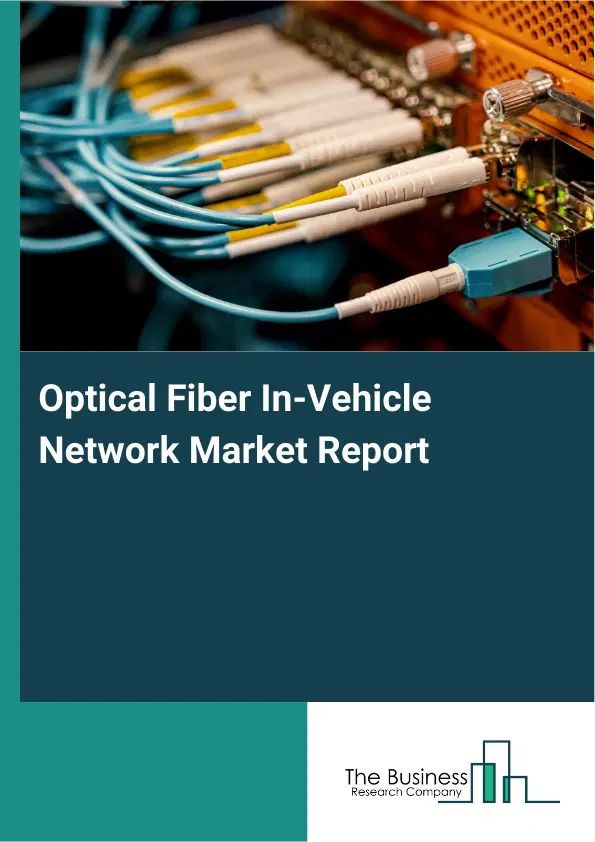
Optical Fiber In-Vehicle Network Market Report 2026
Global Outlook – By Product Type (Optical Fiber Cables, Optical Transceivers, Fiber Connectors, Network Control Modules, Optical Signal Amplifiers), By Material Type (Plastic Optical Fiber (POF), Glass Optical Fiber (GOF) ), By Vehicle Type (Passenger Cars, Commercial Vehicles, Electric Vehicles, Autonomous Vehicles), By Mode (Multi-Mode Fiber (MMF), Single-Mode Fiber (SMF) ), By Application End Use Function (Advanced Driver Assistance Systems, High Resolution Sensor Data Transmission, Real Time Data Processing, Infotainment Systems, High Definition Video And Audio Streaming, Telematics And Navigation, Safety And Security Systems) – Market Size, Trends, Strategies, and Forecast to 2030
Optical Fiber In-Vehicle Network Market Overview
• Optical Fiber In-Vehicle Network market size has reached to $2.75 billion in 2025 • Expected to grow to $5.20 billion in 2030 at a compound annual growth rate (CAGR) of 13.6% • Growth Driver: Surge In Demand For High-Speed Data In Vehicle Fueling The Growth Of The Market Due To Increasing Vehicle Connectivity And Advanced Electronic Systems • Market Trend: Advancing Optical Multi-Gigabit Ethernet Systems To Enable High-Speed Connectivity And Power Next-Generation Software-Defined Vehicles • North America was the largest region in 2025 and Asia-Pacific is the fastest growing region.What Is Covered Under Optical Fiber In-Vehicle Network Market?
Optical fiber in-vehicle network market refers to advanced communication systems that utilize optical fibers to enable high-speed and reliable data transmission within vehicles. It focuses on enhancing connectivity, reducing signal interference, and supporting complex electronic architectures. It plays a key role in improving vehicle performance, safety, and overall intelligent transportation capabilities. The main product types of the optical fiber in-vehicle network market include optical fiber cables, optical transceivers, fiber connectors, network control modules, and optical signal amplifiers. Optical Fiber Cables refer to high-speed transmission media designed to carry large volumes of data between vehicle components with minimal signal loss and electromagnetic interference, ensuring reliable connectivity for in-vehicle networks. The material type, including plastic optical fiber (POF) and glass optical fiber (GOF). The vehicle type, it serves passenger cars, commercial vehicles, electric vehicles, and autonomous vehicles. The mode, the network can use multi-mode fiber (mmf) or single-mode fiber (smf). The applications include advanced driver assistance systems, high resolution sensor data transmission, real-time data processing, infotainment systems, high definition video and audio streaming, telematics and navigation, and safety and security systems.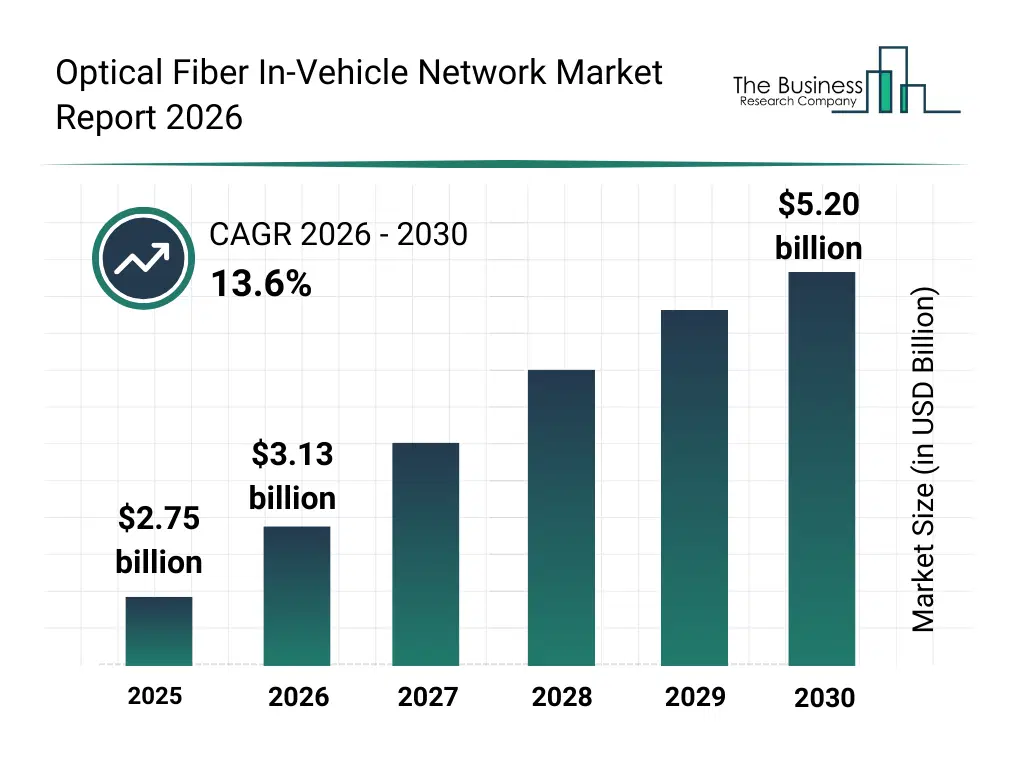
What Is The Optical Fiber In-Vehicle Network Market Size and Share 2026?
The optical fiber in-vehicle network market size has grown rapidly in recent years. It will grow from $2.75 billion in 2025 to $3.13 billion in 2026 at a compound annual growth rate (CAGR) of 13.8%. The growth in the historic period can be attributed to increasing demand for high-speed data transmission, growing adoption of electric vehicles, rising need for vehicle safety systems, expansion of infotainment features, and increasing complexity of vehicle electronics.What Is The Optical Fiber In-Vehicle Network Market Growth Forecast?
The optical fiber in-vehicle network market size is expected to see rapid growth in the next few years. It will grow to $5.20 billion in 2030 at a compound annual growth rate (CAGR) of 13.6%. The growth in the forecast period can be attributed to rising adoption of autonomous vehicles, growing integration of Ethernet and most-based networks, increasing investment in smart transportation systems, expansion of connected vehicle platforms, and growing demand for interference-free in-vehicle networks. Major trends in the forecast period include technology advancements in optical fiber materials, innovations in high-speed communication protocols, developments in compact and lightweight network components, research and development in ADAS and safety systems, and advancements in vehicle-to-everything (V2X) communication.
Global Optical Fiber In-Vehicle Network Market Segmentation
1) By Product Type: Optical Fiber Cables, Optical Transceivers, Fiber Connectors, Network Control Modules, Optical Signal Amplifiers 2) By Material Type: Plastic Optical Fiber (POF), Glass Optical Fiber (GOF) 3) By Vehicle Type: Passenger Cars, Commercial Vehicles, Electric Vehicles, Autonomous Vehicles 4) By Mode: Multi-Mode Fiber (MMF), Single-Mode Fiber (SMF) 5) By Application End Use Function: Advanced Driver Assistance Systems, High Resolution Sensor Data Transmission, Real Time Data Processing, Infotainment Systems, High Definition Video And Audio Streaming, Telematics And Navigation, Safety And Security Systems Subsegments: 1) By Optical Fiber Cables: Single Mode Optical Fiber Cable, Multi Mode Optical Fiber Cable, Plastic Optical Fiber Cable, Armored Optical Fiber Cable, Ribbon Optical Fiber Cable 2) By Optical Transceivers: Bidirectional Optical Transceiver, Unidirectional Optical Transceiver, Wavelength Division Multiplexed Optical Transceiver, Small Form Factor Optical Transceiver, High Speed Optical Transceiver 3) By Fiber Connectors: LC Fiber Connector, SC Fiber Connector, ST Fiber Connector, MTP Fiber Connector, FC Fiber Connector 4) By Network Control Modules: Optical Switch Module, Media Converter Module, Network Management Module, Data Multiplexer Module, Signal Routing Module 5) By Optical Signal Amplifiers: Erbium Doped Optical Amplifier, Raman Optical Amplifier, Semiconductor Optical Amplifier, Fiber Line Optical Amplifier, Booster Optical AmplifierWhat Are The Drivers Of The Optical Fiber In-Vehicle Network Market?
The increasing demand for high-speed data in vehicle is expected to propel the growth of the optical fiber in-vehicle network market going forward. High-speed in-vehicle data transmission refers to the need for rapid, high-bandwidth data exchange between sensors, control units, infotainment systems, cameras, and communication modules within vehicles, reflecting the growing complexity of modern automotive electronic architectures. The rise in demand for high-speed data in vehicle is due to the increasing integration of advanced driver assistance systems and connected vehicle technologies that require low-latency and high-bandwidth communication. The optical fiber in-vehicle network supports high-speed data in vehicle by providing high-bandwidth, low-latency, and interference-free data transfer essential for seamless vehicle system communication. For instance, in March 2024, according to the International Telecommunication Union, a Switzerland-based specialized agency of the United Nations for information and communication technologies, China recorded a 78.31% vehicle network connection penetration rate for new passenger cars in 2023, with vehicles equipped with 5G modules rising sharply to 1,737,300 from 466,400 in 2022 and those fitted with Long Term Evolution Vehicle to Everything (LTE-V2X) PC5 modules increasing to 311,300 from 170,000 year on year. Therefore, the increasing demand for high-speed data in vehicle is driving the growth of the optical fiber in-vehicle network industry. The expansion of electric and autonomous vehicles is expected to propel the growth of the optical fiber in-vehicle network market going forward. Electric and autonomous vehicles are automobiles that rely on electric powertrains and advanced self-driving technologies, requiring complex electronic architectures and real-time data processing. The rise in electric and autonomous vehicles is due to growing pressure to cut emissions and improve road safety through cleaner energy efficient and intelligent transportation systems. Optical fiber in-vehicle networks support electric and autonomous vehicles by enabling high-speed, low-latency, and interference-free data transmission between cameras, sensors, control units, and infotainment systems, which is critical for safe and efficient vehicle operation. For instance, in May 2025, according to the International Energy Agency (IEA), a France-based intergovernmental organization, electric car sales exceeded 17 million globally in 2024, representing more than 20 percent of total car sales with an additional 3.5 million electric cars sold compared to 2023, and sales in 2025 are expected to surpass 20 million worldwide, accounting for more than one-quarter of cars sold, following a 35 percent year-on-year increase in the first quarter across all major markets. Therefore, the expansion of electric and autonomous vehicles is driving the growth of the optical fiber in-vehicle network industry.Key Players In The Global Optical Fiber In-Vehicle Network Market
Major companies operating in the optical fiber in-vehicle network market are Sumitomo Electric Industries Ltd., Toray Industries Inc., Prysmian S.p.A., TE Connectivity Ltd., Yazaki Corporation, Corning Incorporated, Amphenol Corporation, Molex LLC, Nexans S.A., Furukawa Electric Co., Hengtong Group Co. Ltd., Leoni AG, Fujikura Ltd., Rosenberger Hochfrequenztechnik GmbH & Co. KG, Belden Inc., Yangtze Optical Fibre and Cable Joint Stock Limited Company (YOFC), BizLink Holding Inc., HUBER+SUHNER AG, Acome Group, ZTT Group, Hitachi Cable
This chart is for illustrative purposes; the full report includes a detailed competitor analysis and comprehensive overview of the top 10 companies in the market.
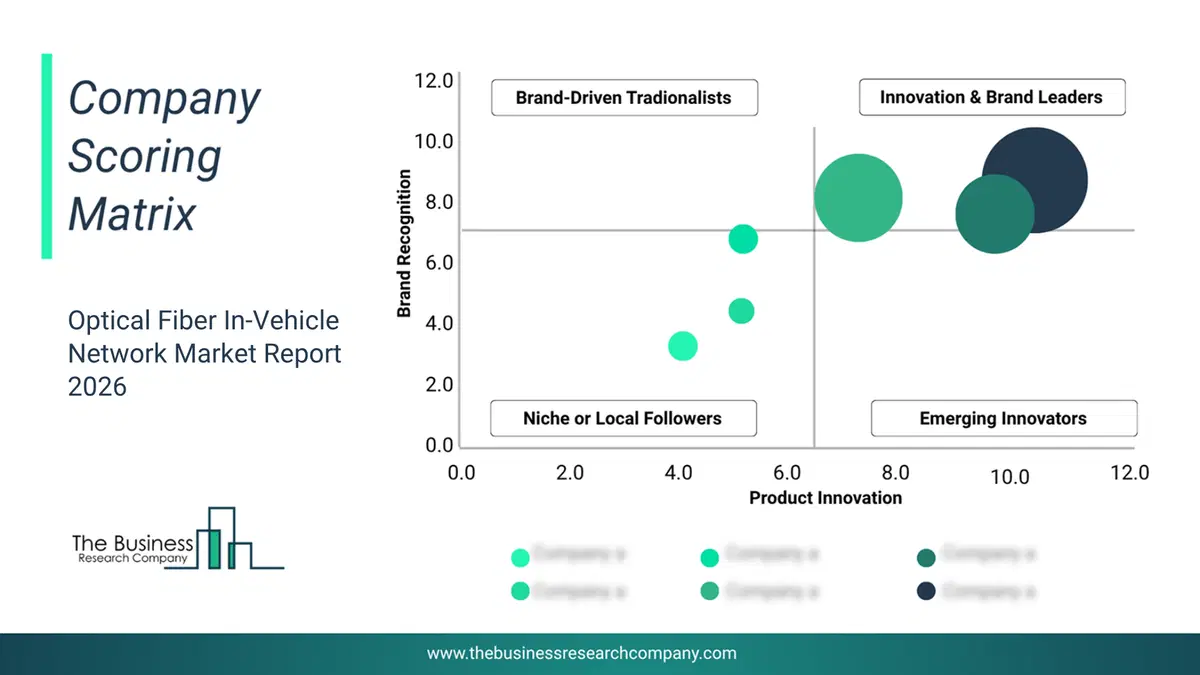
This chart maps companies by product innovation and brand strength, with bubble size indicating relative revenue, helping identify market leaders, challengers, and niche players. This is an illustrative chart; the full report provides a complete and accurate competitive analysis.
Global Optical Fiber In-Vehicle Network Market Trends and Insights
Major companies operating in the optical fiber in-vehicle network market are focusing on developing advanced products, such as multi-gigabit optical automotive Ethernet, to enable high-bandwidth, low-latency, and electromagnetic interference-resistant communication for modern vehicles. Multi-gigabit optical automotive Ethernet refers to high-speed in-vehicle networking that uses optical fiber to carry Ethernet data streams of several gigabits per second between automotive electronic control units with low latency and strong immunity to electromagnetic interference. For instance, in October 2025, Keysight Technologies Inc., a US-based electronics measurement company, launched the AE6980T nGBASE-AU Optical Automotive Ethernet Transmitter Test Solution. It introduces a robust multi‑gigabit optical automotive Ethernet solution (2.5G–50G) over multimode fiber that delivers low‑latency, EMI‑immune, high‑bandwidth connectivity with lighter cabling, providing a backbone for software‑defined vehicles and next‑generation driver‑assistance features.The platform is designed to qualify next-generation optical automotive Ethernet PHYs in compliance with the IEEE 802.3cz standard, supporting speeds from 2.5 gigabits per second to 50 gigabits per second over multimode fiber. The solution includes a TDFOM measurement suite for comprehensive signal quality assessment and an intuitive test automation interface for both conformant and developer test configurations.
Regional Insights
North America was the largest region in the optical fiber in-vehicle network market in 2025. Asia-Pacfic is expected to be the fastest-growing region in the forecast period. The regions covered in this market report are Asia-Pacific, South East Asia, Western Europe, Eastern Europe, North America, South America, Middle East, Africa. The countries covered in this market report are Australia, Brazil, China, France, Germany, India, Indonesia, Japan, Taiwan, Russia, South Korea, UK, USA, Canada, Italy, Spain.What Defines the Optical Fiber In-Vehicle Network Market?
The optical fiber in-vehicle network market consists of revenues earned by entities by providing services such as system integration services, network installation services, fiber testing services, maintenance and support services, and network optimization services. The market value includes the value of related goods sold by the service provider or included within the service offering. The optical fiber in-vehicle network market also includes sales of optical fiber cables, optical transceivers, fiber connectors, network control modules, optical signal amplifiers. Values in this market are ‘factory gate’ values, that is the value of goods sold by the manufacturers or creators of the goods, whether to other entities (including downstream manufacturers, wholesalers, distributors and retailers) or directly to end customers. The value of goods in this market includes related services sold by the creators of the goods.How is Market Value Defined and Measured?
The market value is defined as the revenues that enterprises gain from the sale of goods and/or services within the specified market and geography through sales, grants, or donations in terms of the currency (in USD unless otherwise specified). The revenues for a specified geography are consumption values that are revenues generated by organizations in the specified geography within the market, irrespective of where they are produced. It does not include revenues from resales along the supply chain, either further along the supply chain or as part of other products.
This chart presents market attractiveness based on a quantitative evaluation of growth, competition, strategic alignment, and risk, offering a clear view of opportunity areas for decision-making. This chart is for illustrative purposes; the full report contains the complete analysis.

This chart highlights the Total Addressable Market (TAM) by estimating the maximum revenue opportunity using an assumption-driven approach, supporting strategic planning and opportunity sizing across markets. The chart is illustrative; the full report provides a more comprehensive analysis.
What Key Data and Analysis Are Included in the Optical Fiber In-Vehicle Network Market Report 2026?
The optical fiber in-vehicle network market research report is one of a series of new reports from The Business Research Company that provides market statistics, including industry global market size, regional shares, competitors with the market share, detailed market segments, market trends and opportunities, and any further data you may need to thrive in the optical fiber in-vehicle network industry. The market research report delivers a complete perspective of everything you need, with an in-depth analysis of the current and future state of the industry.Optical Fiber In-Vehicle Network Market Report Forecast Analysis
| Report Attribute | Details |
|---|---|
| Market Size Value In 2026 | $3.13 billion |
| Revenue Forecast In 2030 | $5.20 billion |
| Growth Rate | CAGR of 13.8% from 2026 to 2030 |
| Base Year For Estimation | 2025 |
| Actual Estimates/Historical Data | 2020-2025 |
| Forecast Period | 2026 - 2030 - 2030 |
| Market Representation | Revenue in USD Billion and CAGR from 2026 to 2030 |
| Segments Covered | Product Type, Material Type, Vehicle Type, Mode, Application End Use Function |
| Regional Scope | Asia-Pacific, Western Europe, Eastern Europe, North America, South America, Middle East, Africa |
| Country Scope | The countries covered in the report are Australia, Brazil, China, France, Germany, India, Indonesia, Japan, Taiwan, Russia, South Korea, UK, USA, Canada, Italy, Spain. |
| Key Companies Profiled | Sumitomo Electric Industries Ltd., Toray Industries Inc., Prysmian S.p.A., TE Connectivity Ltd., Yazaki Corporation, Corning Incorporated, Amphenol Corporation, Molex LLC, Nexans S.A., Furukawa Electric Co., Hengtong Group Co. Ltd., Leoni AG, Fujikura Ltd., Rosenberger Hochfrequenztechnik GmbH & Co. KG, Belden Inc., Yangtze Optical Fibre and Cable Joint Stock Limited Company (YOFC), BizLink Holding Inc., HUBER+SUHNER AG, Acome Group, ZTT Group, Hitachi Cable |
| Customization Scope | Request for Customization |
| Pricing And Purchase Options | Explore Purchase Options |