
Optical Local Area Network (OLAN) Market Report 2026
Global Outlook – By Component (Optical Line Terminal, Optical Network Terminal, Optical Splitter, Fiber Optic Cables, Other Components), By Technology (Passive Optical Local Area Network (LAN), Active Optical Local Area Network (LAN)), By Application (Residential, Commercial, Industrial, Other Applications), By End-User (Banking, Financial Services, And Insurance (BFSI), Healthcare, Education, Government, Information Technology And Telecom, Hospitality, Other End-Users) – Market Size, Trends, Strategies, and Forecast to 2030
Optical Local Area Network (OLAN) Market Overview
• Optical Local Area Network (OLAN) market size has reached to $11.02 billion in 2025 • Expected to grow to $19.86 billion in 2030 at a compound annual growth rate (CAGR) of 12.4% • Growth Driver: Rising Demand For High-Speed Internet Driving The Growth Of The Market Due To Remote Work And Digital Connectivity Needs • Market Trend: Next-Generation Fiber-Based Optical LAN Solution For High-Speed, Future-Proof Connectivity • North America was the largest region in 2025 and Asia-Pacific is the fastest growing region.Market Gains By 2030 – Top Opportunities By Segment
Market Gain identifies the most promising market opportunities by highlighting the segments or products expected to generate the highest incremental revenue growth over the next five years.
What Is Covered Under Optical Local Area Network (OLAN) Market?
An optical local area network (OLAN) refers to a network infrastructure that utilizes optical fiber cables rather than traditional copper wiring to interconnect computers, servers, and other devices within a confined area such as a building, campus, or data center, enabling faster and more reliable communication. This type of network offers high-bandwidth, low-latency, and scalable connectivity, allowing simultaneous transmission of data, voice, and video over a single fiber network while simplifying network management and reducing power consumption. The main types of components in an optical local area network (OLAN) are optical line terminals, optical network terminals, optical splitters, fiber optic cables, and others. Optical line terminal refers to the centralized device in an optical LAN that manages signal transmission, aggregates data traffic, and controls downstream and upstream communication to connected endpoints. It includes various technologies, such as passive optical local area network (LAN) and active optical local area network (LAN), and is used for applications, including residential, commercial, industrial, and others. Key end-users include banking, financial services, and insurance (BFSI); healthcare; education; government; information technology and telecom; hospitality; and others.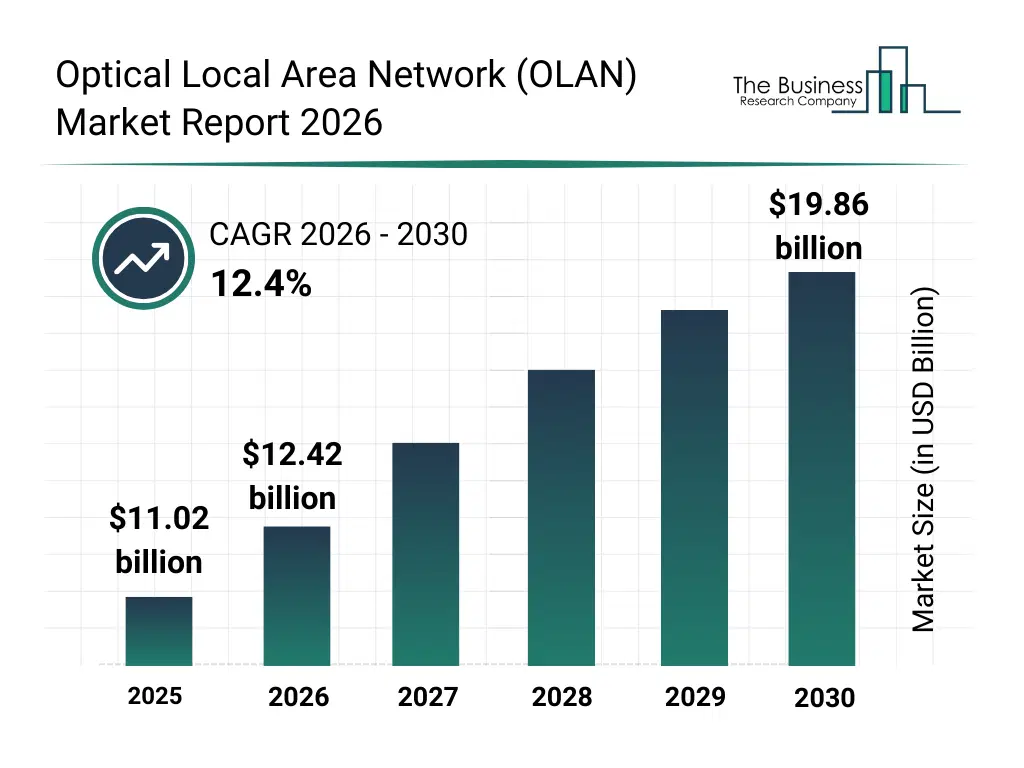
What Is The Optical Local Area Network (OLAN) Market Size and Share 2026?
The optical local area network (olan) market size has grown rapidly in recent years. It will grow from $11.02 billion in 2025 to $12.42 billion in 2026 at a compound annual growth rate (CAGR) of 12.7%. The growth in the historic period can be attributed to increasing replacement of copper cabling, growth in enterprise network traffic, rising demand for reliable high-speed connectivity, expansion of commercial buildings and campuses, need for reduced network maintenance costs.What Is The Optical Local Area Network (OLAN) Market Growth Forecast?
The optical local area network (olan) market size is expected to see rapid growth in the next few years. It will grow to $19.86 billion in 2030 at a compound annual growth rate (CAGR) of 12.4%. The growth in the forecast period can be attributed to growth of smart buildings and campuses, rising adoption of passive optical LAN, demand for future-proof network infrastructure, increasing deployment in healthcare and education sectors, focus on energy-efficient networking solutions. Major trends in the forecast period include fiber-based network consolidation, simplified network architecture and management, low-power and energy-efficient lan infrastructure, high-bandwidth converged data transmission, scalable campus and building connectivity.
Global Optical Local Area Network (OLAN) Market Segmentation
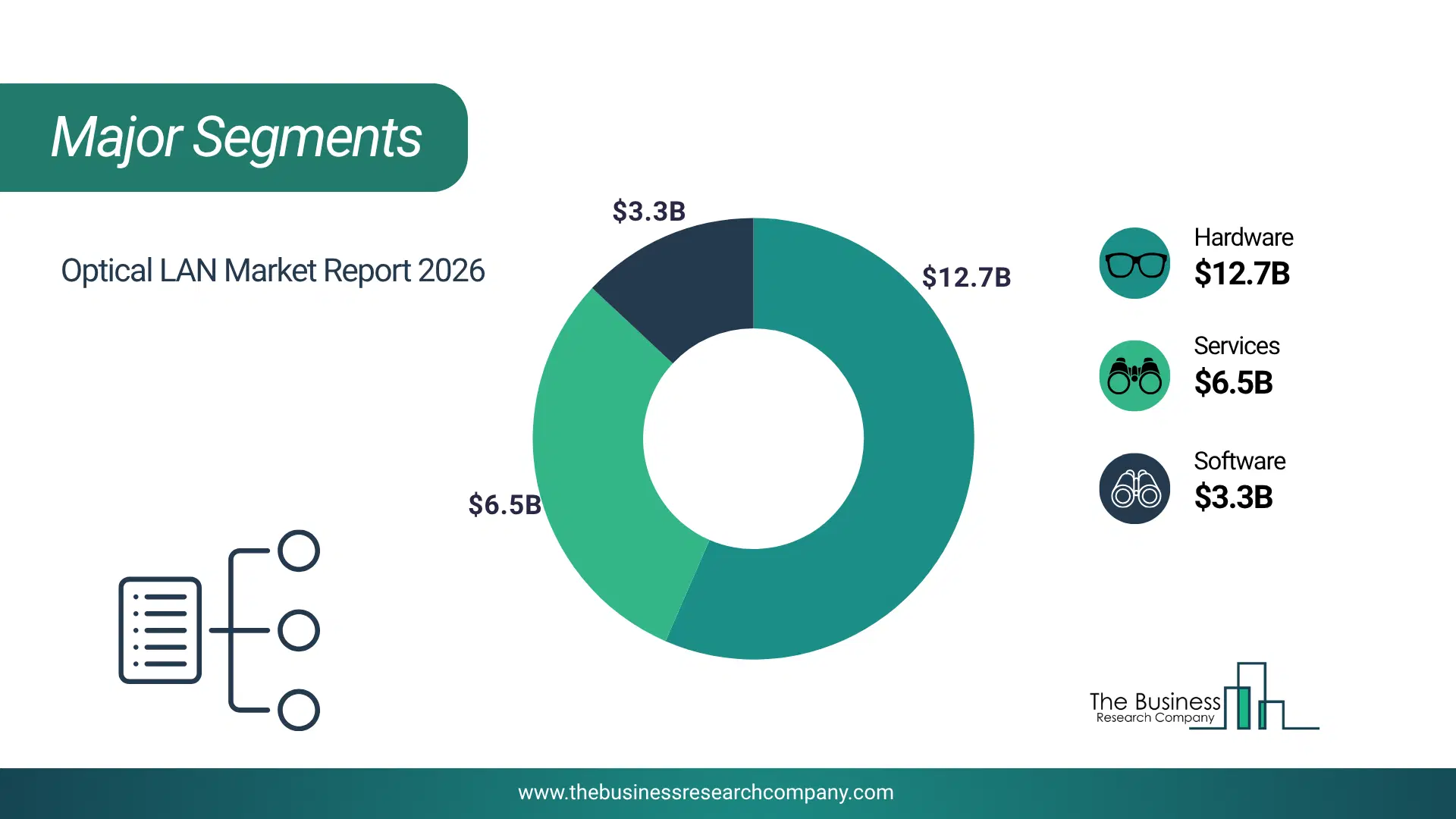
1) By Component: Optical Line Terminal, Optical Network Terminal, Optical Splitter, Fiber Optic Cables, Other Components 2) By Technology: Passive Optical Local Area Network (LAN), Active Optical Local Area Network (LAN) 3) By Application: Residential, Commercial, Industrial, Other Applications 4) By End-User: Banking, Financial Services, And Insurance (BFSI), Healthcare, Education, Government, Information Technology And Telecom, Hospitality, Other End-Users Subsegments: 1) By Optical Line Terminal: Centralized Terminal, Distributed Terminal 2) By Optical Network Terminal: Residential Terminal, Business Terminal, Industrial Terminal 3) By Optical Splitter: Planar Lightwave Circuit Splitter, Fused Biconical Taper Splitter 4) By Fiber Optic Cables: Single Mode Cable, Multi Mode Cable, Armored Cable, Indoor Cable, Outdoor Cable 5) By Other Components: Transceivers, Connectors, Patch Panels, Enclosures The top segments in the optical lan market will be: • Hardware will reach $12.62 billion by 2030. • Services will reach $6.41 billion by 2030. • Software will reach $3.23 billion by 2030.What Is The Driver Of The Optical Local Area Network (OLAN) Market?
The rising growing demand for high-speed internet is expected to propel the growth of the optical local area network (OLAN) market going forward. High-speed internet refers to a fast and reliable internet connection that enables quick data transmission, seamless streaming, and smooth online communication. The demand for high-speed internet is rising as more people are working remotely and need fast, reliable connections for video conferencing and online collaboration. Optical local area network (OLAN) supports high-speed internet by utilizing fiber-optic technology to provide greater bandwidth and faster data transfer, ensuring stable and low-latency connections for homes, businesses, and organizations. For instance, in December 2024, according to the Office of Communications, a UK-based government-approved regulatory and competition authority, as more customers upgrade to higher-speed broadband packages, the UK’s average maximum download speed rose from 170 Mbit/s in 2023 to 223 Mbit/s in 2024. Therefore, the rising growing demand for high-speed internet is driving the growth of the optical local area network (OLAN) industry.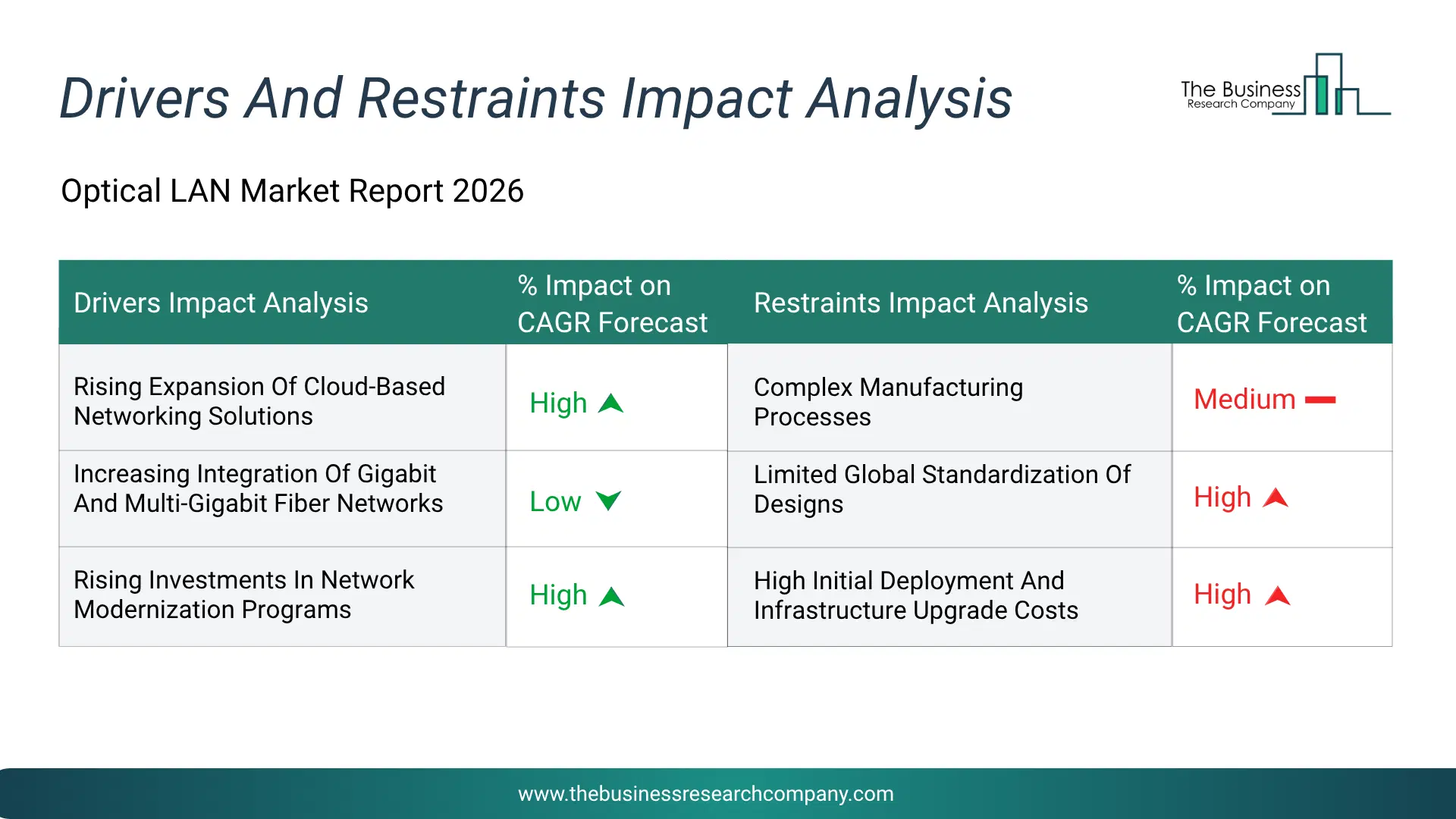
Infographic Chart Showing Key Market Drivers Analysis And Restraints For Optical Local Area Network (Olan) Market
The chart presents an impact analysis of key drivers and restraints, quantifying their relative influence on the market's growth rate and helping assess the balance between growth enablers and limiting factors. This chart offers a high-level perspective; the full report contains more detailed insights.
How Will The Drivers Impact Growth In The Global Optical LAN Market?
• Rising Expansion Of Cloud-Based Networking Solutions (High) – During the forecast period, the rising expansion of cloud-based networking solutions is expected to become a key growth driver for the optical local area network (lan) market by 2030. The rising adoption of cloud-based networking solutions drives demand for optical lan by requiring high-speed, reliable, and low-latency connectivity within buildings and campuses. As organizations migrate applications and services to the cloud, the volume of internal data traffic increases, necessitating robust fiber-based lan infrastructure. Optical lan provides the bandwidth and scalability needed to support seamless cloud access for multiple users and devices. Additionally, its energy-efficient design aligns with enterprises’ sustainability goals while maintaining performance. This combination of speed, reliability, and scalability positions optical lan as a key enabler for cloud-driven digital transformation. • Increasing Integration Of Gigabit And Multi-Gigabit Fiber Networks (Low) – During the forecast period, the increasing integration of gigabit and multi-gigabit fiber networks is expected to emerge as a major factor driving the expansion of the optical local area network (lan) market by 2030. The increasing integration of gigabit and multi-gigabit fiber networks fuels the growth of optical lan by enabling ultra-fast data transfer within enterprise and campus environments. Higher-speed fiber networks support the growing demand for bandwidth-intensive applications, such as video conferencing, cloud services, and iot devices. Optical lan leverages these high-capacity connections to provide low-latency, reliable, and scalable network performance. The seamless compatibility with existing network infrastructure makes deployment efficient and cost-effective. As a result, the widespread adoption of gigabit and multi-gigabit fiber networks drives broader optical lan implementation across modern organizations. • Rising Investments In Network Modernization Programs (High) – During the forecast period, the rising investments in network modernization programs is expected to act as a key growth catalyst for the optical local area network (lan) market by 2030. Rising investments in network modernization programs drive the growth of optical lan by encouraging organizations to upgrade legacy copper infrastructures to advanced fiber-based networks. These modernization initiatives aim to enhance network speed, reliability, and scalability to meet growing digital demands. Optical lan provides a cost-effective and energy-efficient solution that aligns with these upgrade goals. Its deployment supports future-ready connectivity for cloud services, iot, and high-bandwidth applications. As a result, increased funding for network modernization directly fuels the adoption of optical lan across enterprises and campuses.How Will The Restraints Impact Growth In The Global Optical LAN Market?
• Complex Manufacturing Processes (Medium) – During the forecast period, the complex manufacturing processes act as a significant restraint for the optical local area network (lan) market because producing high-quality optical fibers, connectors, amplifiers, and other network components requires advanced technology and precision engineering. These intricate production requirements increase manufacturing costs and extend lead times, limiting the ability of providers to scale operations quickly. Additionally, ensuring consistent performance and reliability across all components is technically challenging, which can hinder widespread adoption. The need for specialized equipment and skilled labor further restricts entry for smaller players, slowing market expansion. Overall, the complexity of manufacturing directly impacts both cost efficiency and deployment speed in optical lan networks. • Limited Global Standardization Of Designs (High) – During the forecast period, the limited global standardization of designs acts as a significant restraint for the optical local area network (lan) market because it hinders seamless interoperability between components from different manufacturers. The lack of uniform standards can lead to compatibility issues, increasing deployment complexity and costs for organizations. It also slows down large-scale adoption, as companies may be hesitant to invest in infrastructure that may not integrate easily with existing or future systems. Additionally, non-standardized designs complicate maintenance and upgrades, reducing overall network efficiency. Consequently, the absence of global standardization limits market growth and innovation in optical lan technology. • High Initial Deployment And Infrastructure Upgrade Costs (High) – During the forecast period, the high initial deployment and infrastructure upgrade costs act as a restraint for the optical local area network (lan) market because organizations need significant investment to replace or upgrade existing copper-based network systems with optical fiber infrastructure. The cost of optical cables, switching equipment, and installation adds a substantial financial burden, especially for small and medium-sized enterprises. Additionally, the requirement for skilled installation and potential downtime during transition further increases overall expenses. These high upfront costs slow down adoption despite long-term efficiency and performance benefits.Key Players In The Global Optical Local Area Network (OLAN) Market
Major companies operating in the optical local area network (olan) market are Huawei Technologies Co. Ltd., Cisco Systems Inc., Sumitomo Electric Industries Ltd., Fujitsu Limited, Ericsson AB, NEC Corporation, Nokia Corporation, AFL Global, ZTE Corporation, TE Connectivity Ltd., Corning Incorporated, CommScope Holding Company Inc., FiberHome Technologies Group, ADTRAN Inc., Calix Inc., Alpha Networks Inc., LightSpeed Technologies, Sterlite Technologies Limited, Dasan Zhone Solutions Inc., Allied Telesis Holdings K.K., AddOn Networks, UberData Networks.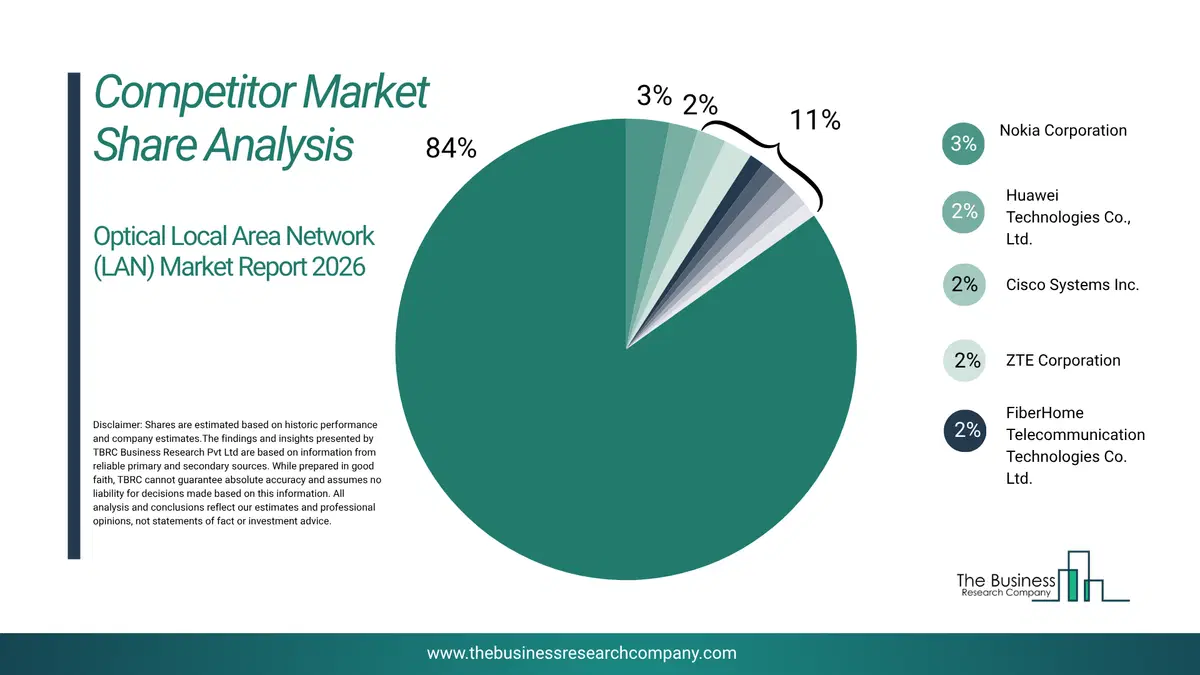
This chart is for illustrative purposes; the full report includes a detailed competitor analysis and comprehensive overview of the top 10 companies in the market.
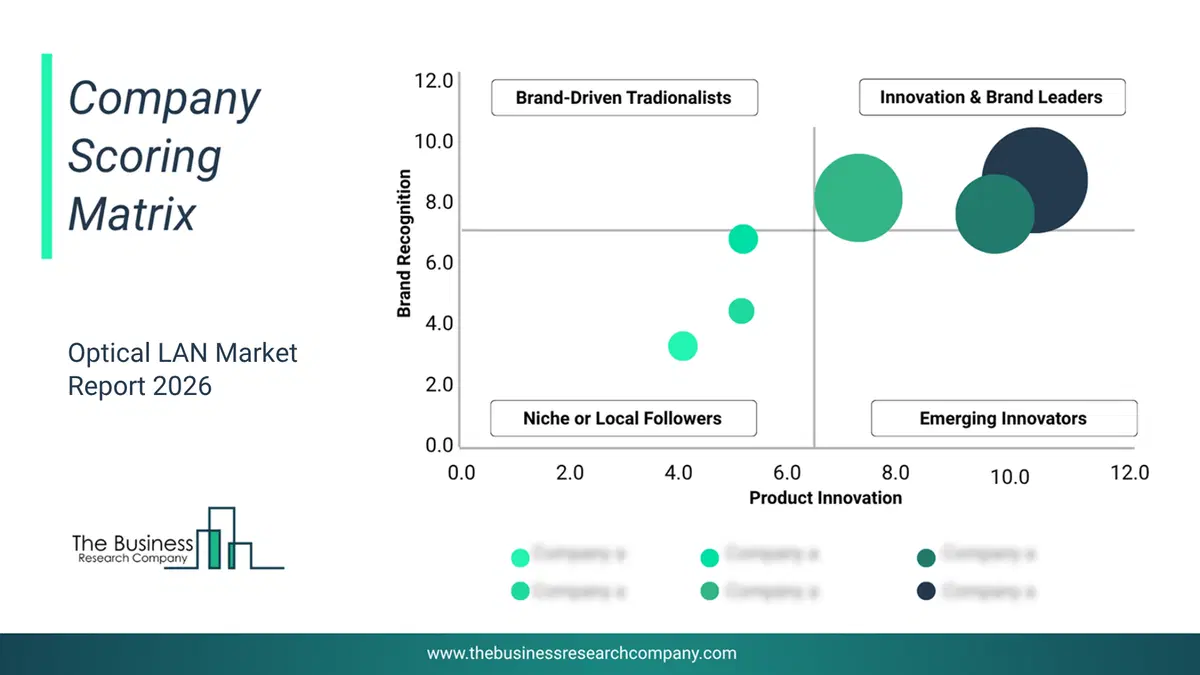
This chart maps companies by product innovation and brand strength, with bubble size indicating relative revenue, helping identify market leaders, challengers, and niche players. This is an illustrative chart; the full report provides a complete and accurate competitive analysis.
Global Optical Local Area Network (OLAN) Market Trends and Insights
Major companies operating in the optical local area network (OLAN) market are focusing on developing innovative solutions, such as next-generation fiber-based LAN solutions, to enhance network speed, reliability, and scalability for enterprise, industrial, and residential applications. Next-generation fiber-based LAN solution refers to an advanced local area network using optical fiber to deliver higher bandwidth, lower latency, longer reach, and enhanced reliability for modern enterprise, industrial, and residential connectivity. For instance, in May 2025, Nokia Corporation, a Finland-based consumer electronics company, launched Aurelis Optical LAN, a next-generation fiber-based LAN solution designed to provide simple, reliable, and future-proof connectivity for in-building and campus enterprise environments. The solution uses up to 70% less cabling and 40% less power compared to traditional copper LANs, with fiber infrastructure lasting more than 50 years, resulting in up to 50% savings in total cost of ownership. Aurelis supports current speeds of 1 Gb/s, 10 Gb/s, and 25 Gb/s, with an upgrade path to 50 Gb/s and 100 100Gb/s, making it ready for future high-bandwidth applications like Wi-Fi 7. It features open APIs for seamless integration and advanced automation for simplified operations, delivering high reliability with six-nines availability and strong security.What Are Latest Mergers And Acquisitions In The Optical Local Area Network (OLAN) Market?
In November 2025, Nokia, a Finland-based network company, entered into a strategic collaboration with Corning to deliver an end-to-end fiber-to-the-edge (FTTE) and optical local area network (optical LAN) solution that addresses the growing demand for high-bandwidth, low-latency, and future-flexible enterprise networks. With this collaboration, Nokia aims to expand its presence in the emerging Optical LAN segment by integrating Corning’s passive fiber components with its active optical access platforms to deliver scalable, efficient, and future-ready enterprise connectivity solutions. Corning is a US-based provider of advanced optical fiber, cabling, and passive network components designed for high-performance enterprise and smart-building networks.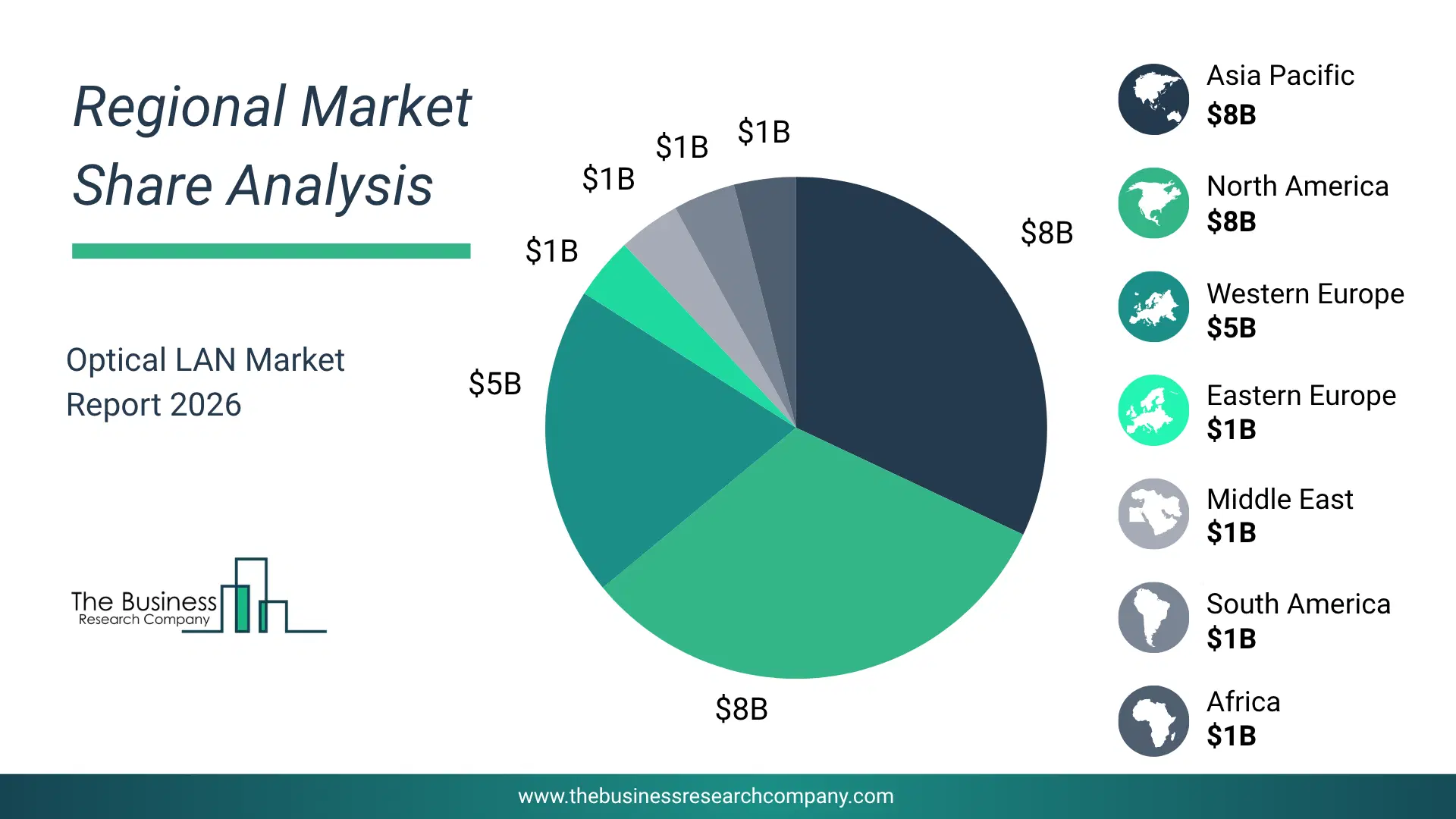
Regional Insights
North America was the largest region in the optical local area network (OLAN) market in 2025. Asia-Pacific is expected to be the fastest-growing region in the forecast period. The regions covered in this market report are Asia-Pacific, South East Asia, Western Europe, Eastern Europe, North America, South America, Middle East, Africa. The countries covered in this market report are Australia, Brazil, China, France, Germany, India, Indonesia, Japan, Taiwan, Russia, South Korea, UK, USA, Canada, Italy, Spain.What Defines the Optical Local Area Network (OLAN) Market?
The optical local area network (OLAN) market consists of revenues earned by entities by providing services such as high-speed data transmission, voice over IP (VoIP) services, video conferencing and streaming, network virtualization support, and centralized network management. The market value includes the value of related goods sold by the service provider or included within the service offering. The optical local area network (OLAN) market also includes sales of optical fiber cables, optical switches, fiber patch panels, media converters, and optical network interface cards. Values in this market are ‘factory gate’ values, that is the value of goods sold by the manufacturers or creators of the goods, whether to other entities (including downstream manufacturers, wholesalers, distributors and retailers) or directly to end customers. The value of goods in this market includes related services sold by the creators of the goods.How is Market Value Defined and Measured?
The market value is defined as the revenues that enterprises gain from the sale of goods and/or services within the specified market and geography through sales, grants, or donations in terms of the currency (in USD unless otherwise specified). The revenues for a specified geography are consumption values that are revenues generated by organizations in the specified geography within the market, irrespective of where they are produced. It does not include revenues from resales along the supply chain, either further along the supply chain or as part of other products.
This chart presents market attractiveness based on a quantitative evaluation of growth, competition, strategic alignment, and risk, offering a clear view of opportunity areas for decision-making. This chart is for illustrative purposes; the full report contains the complete analysis.

This chart highlights the Total Addressable Market (TAM) by estimating the maximum revenue opportunity using an assumption-driven approach, supporting strategic planning and opportunity sizing across markets. The chart is illustrative; the full report provides a more comprehensive analysis.
What Key Data and Analysis Are Included in the Optical Local Area Network (OLAN) Market Report 2026?
The optical local area network (olan) market research report is one of a series of new reports from The Business Research Company that provides market statistics, including industry global market size, regional shares, competitors with the market share, detailed market segments, market trends and opportunities, and any further data you may need to thrive in the optical local area network (olan) industry. The market research report delivers a complete perspective of everything you need, with an in-depth analysis of the current and future state of the industry.Optical Local Area Network (OLAN) Market Report Forecast Analysis
| Report Attribute | Details |
|---|---|
| Market Size Value In 2026 | $12.42 billion |
| Revenue Forecast In 2030 | $19.86 billion |
| Growth Rate | CAGR of 12.4% from 2026 to 2030 |
| Base Year For Estimation | 2025 |
| Actual Estimates/Historical Data | 2020-2025 |
| Forecast Period | 2026 - 2030 |
| Market Representation | Revenue in USD Billion and CAGR from 2026 to 2030 |
| Segments Covered | Component, Technology, Application, End-User |
| Regional Scope | Asia-Pacific, Western Europe, Eastern Europe, North America, South America, Middle East, Africa |
| Country Scope | The countries covered in the report are Australia, Brazil, China, France, Germany, India, ... |
| Key Companies Profiled | Huawei Technologies Co. Ltd., Cisco Systems Inc., Sumitomo Electric Industries Ltd., Fujitsu Limited, Ericsson AB, NEC Corporation, Nokia Corporation, AFL Global, ZTE Corporation, TE Connectivity Ltd., Corning Incorporated, CommScope Holding Company Inc., FiberHome Technologies Group, ADTRAN Inc., Calix Inc., Alpha Networks Inc., LightSpeed Technologies, Sterlite Technologies Limited, Dasan Zhone Solutions Inc., Allied Telesis Holdings K.K., AddOn Networks, UberData Networks. |
| Customization Scope | Request for Customization |
| Pricing And Purchase Options | Explore Purchase Options |