

Optical Networking Market Report 2026
Global Outlook – By Component (Optical Fibers, Optical Switches, Optical Amplifiers, Optical Splitters, Optical Transceivers, Optical Circulators), By Service (Network Design, Data Centre Network Maintenance And Support), By Technology (Synchronous Optical Networking, Wavelength Division Multiplexing, Coarse Wavelength Division Multiplexing, Dense Wavelength Division Multiplexing, Reconfigurable Optical Add-Drop Multiplexer, Fiber Channels), By End User (Military And Defense, Banking, Financial Services, And Insurance, Information Technology And Telecommunications, Government, Other End Users) – Market Size, Trends, Strategies, and Forecast to 2035
Optical Networking Market Overview
• Optical Networking market size has reached to $17.14 billion in 2025 • Expected to grow to $26.57 billion in 2030 at a compound annual growth rate (CAGR) of 8.8% • Growth Driver: Impact Of Cloud Services On Optical Networking Market • Market Trend: Innovation In Coherent Optical Transceivers Accelerates Capacity And Reach For Next-Gen Networks • Asia-Pacific was the largest region in 2025.Market Gains By 2030 – Top Opportunities By Segment
Market Gain identifies the most promising market opportunities by highlighting the segments or products expected to generate the highest incremental revenue growth over the next five years.
What Is Covered Under Optical Networking Market?
Optical networking refers to the use of optical fibers and related technologies to transmit data over long distances with high bandwidth and low latency. It involves the use of light signals to carry information, offering significant advantages over traditional electrical-based communication systems. The primary purpose of optical networking is to facilitate fast, efficient, and reliable communication over vast distances. The main components of optical networking are optical fibers, optical switches, optical amplifiers, optical splitters, optical transceivers, and optical circulators. Optical fibers are thin, flexible strands made of glass or plastic that carry light signals over long distances, enabling high-speed data transmission in telecommunications networks. The various services including network design and data center network maintenance and support by using synchronous optical networking, wavelength division multiplexing, coarse wavelength division multiplexing, dense wavelength division multiplexing, reconfigurable optical add-drop multiplexer, and fiber channels technologies. It helps military and defense, banking, financial services, and insurance, information technology and telecommunications, government, and others.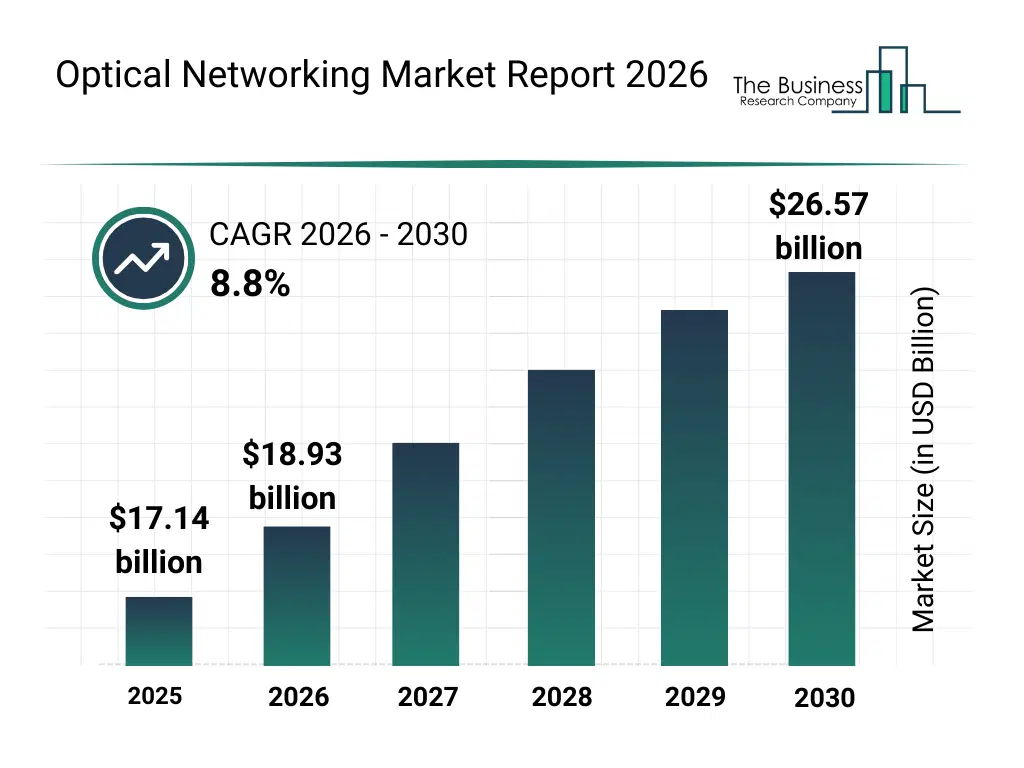
What Is The Optical Networking Market Size and Share 2026?
The optical networking market size has grown rapidly in recent years. It will grow from $17.14 billion in 2025 to $18.93 billion in 2026 at a compound annual growth rate (CAGR) of 10.5%. The growth in the historic period can be attributed to expansion of national broadband initiatives, growth of enterprise data traffic, increasing investments in optical backbone infrastructure, early adoption of sonet and wdm technologies, rising demand for carrier-grade networks.What Is The Optical Networking Market Growth Forecast?
The optical networking market size is expected to see strong growth in the next few years. It will grow to $26.57 billion in 2030 at a compound annual growth rate (CAGR) of 8.8%. The growth in the forecast period can be attributed to expansion of 5G transport networks, increasing investments in data center interconnects, growing adoption of cloud-native networking, rising demand for ultra-low latency services, advancement in programmable optical networks. Major trends in the forecast period include increasing adoption of dense wdm systems, rising deployment of optical switching technologies, growing demand for scalable fiber networks, expansion of software-defined optical networking, enhanced focus on network reliability and resilience.
Global Optical Networking Market Segmentation
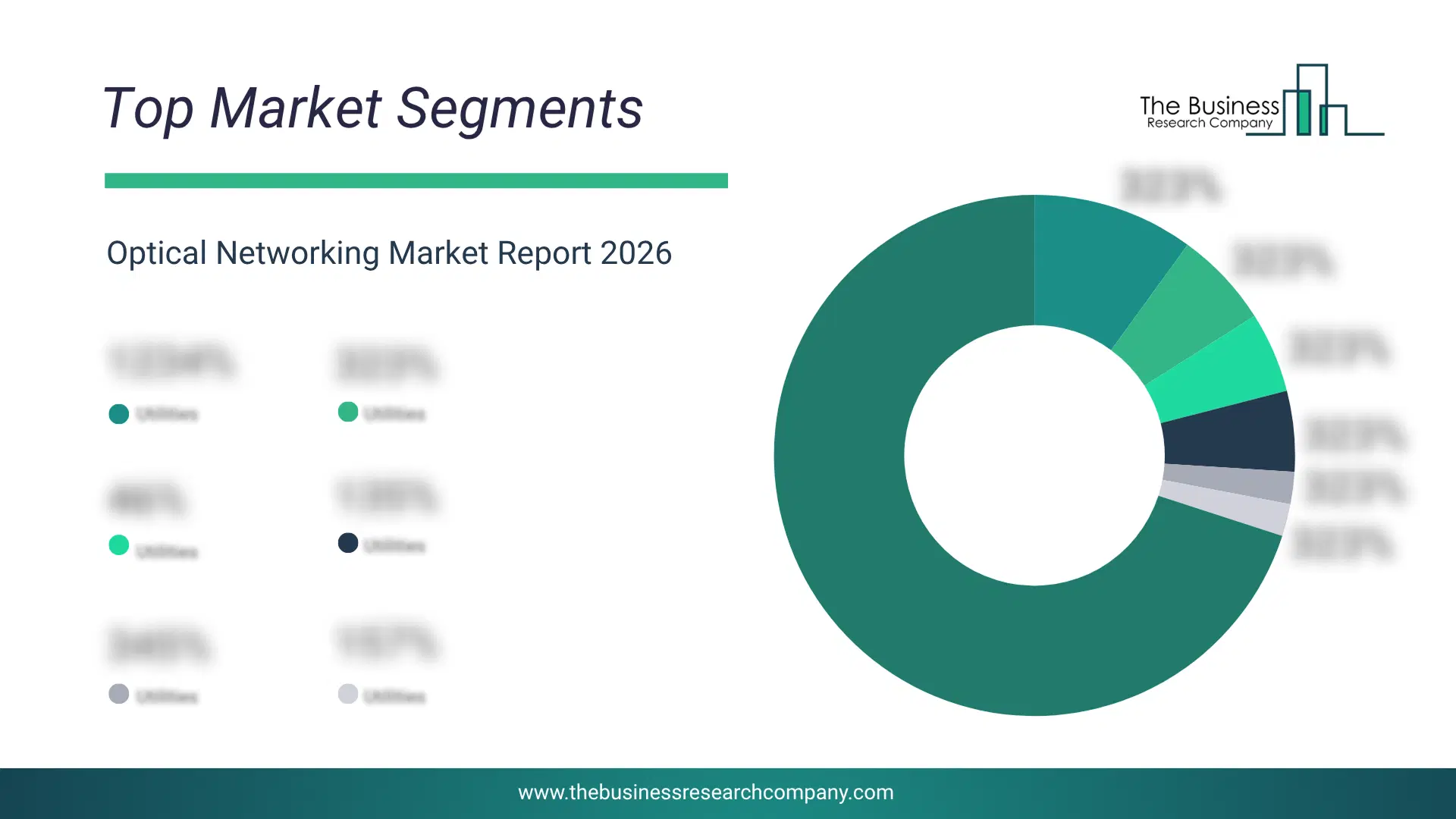
1) By Component: Optical Fibers, Optical Switches, Optical Amplifiers, Optical Splitters, Optical Transceivers, Optical Circulators 2) By Service: Network Design, Data Centre Network Maintenance And Support 3) By Technology: Synchronous Optical Networking, Wavelength Division Multiplexing, Coarse Wavelength Division Multiplexing, Dense Wavelength Division Multiplexing, Reconfigurable Optical Add-Drop Multiplexer, Fiber Channels 4) By End User: Military And Defense, Banking, Financial Services, And Insurance, Information Technology And Telecommunications, Government, Other End Users Subsegments: 1) By Optical Fibers: Single-Mode Optical Fibers, Multi-Mode Optical Fibers, Specialty Optical Fibers (Erbium-Doped, Photonic Crystal Fibers) 2) By Optical Switches: Mechanical Optical Switches, Solid-State Optical Switches, Mems (Micro-Electro-Mechanical Systems) Optical Switches, Optical Cross-connect (Oxc) Switches 3) By Optical Amplifiers: Erbium-Doped Fiber Amplifiers (Edfa), Raman Amplifiers, Semiconductor Optical Amplifiers (Soa), Fiber Bragg Grating (Fbg) Amplifiers 4) By Optical Splitters: Fused Biconical Taper (Fbt) Splitters, Planar Lightwave Circuit (Plc) Splitters, 1x2, 1x4, 1x8 Splitters, Wavelength Division Multiplexing (Wdm) Splitters 5) By Optical Transceivers: Sfp (Small Form-Factor Pluggable) Transceivers, Qsfp (Quad Small Form-Factor Pluggable) Transceivers, Cfp (C Form-Factor Pluggable) Transceivers, Xfp (10 Gigabit Small Form-Factor Pluggable) Transceivers 6) By Optical Circulators: 3-Port Optical Circulators, 4-Port Optical Circulators, Fiber Optic Circulators For Amplifiers And Network Protection The top segments in the optical networking market will be: • Network Design will reach $10465.6 Million by 2025. • Data Centre Network Maintenance And Support will reach $6671.7 Million by 2025. • Wavelength Division Multiplexing will reach $5126.6 Million by 2025. • Optical Transceivers will reach $4421 Million by 2025. • Optical Fibers will reach $4067.9 Million by 2025.What Is The Driver Of The Optical Networking Market?
The increasing use of cloud technologies is expected to propel the growth of the optical networking market going forward. Cloud technologies involve the delivery of scalable computing, storage, and analytics capabilities through remote infrastructure, enabling national statistical offices (NSOs) to manage large datasets, perform advanced analyses, and modernize statistical production processes. The rise in cloud adoption within NSOs is driven by the growing need for high-performance computing, secure data handling, and real-time analytics to support expanding digital workloads. Optical networking supports this transition by providing high-capacity, low-latency connectivity essential for transferring and processing large volumes of statistical data. For instance, in 2025, according to the cloud-awards a US-based is an international program reported grew from $735.45 billion in 2024 surpassing the earlier $690 billion estimate to approximately $833 billion in 2025. Therefore, the increasing use of cloud technologies is driving the growth of the optical networking industry.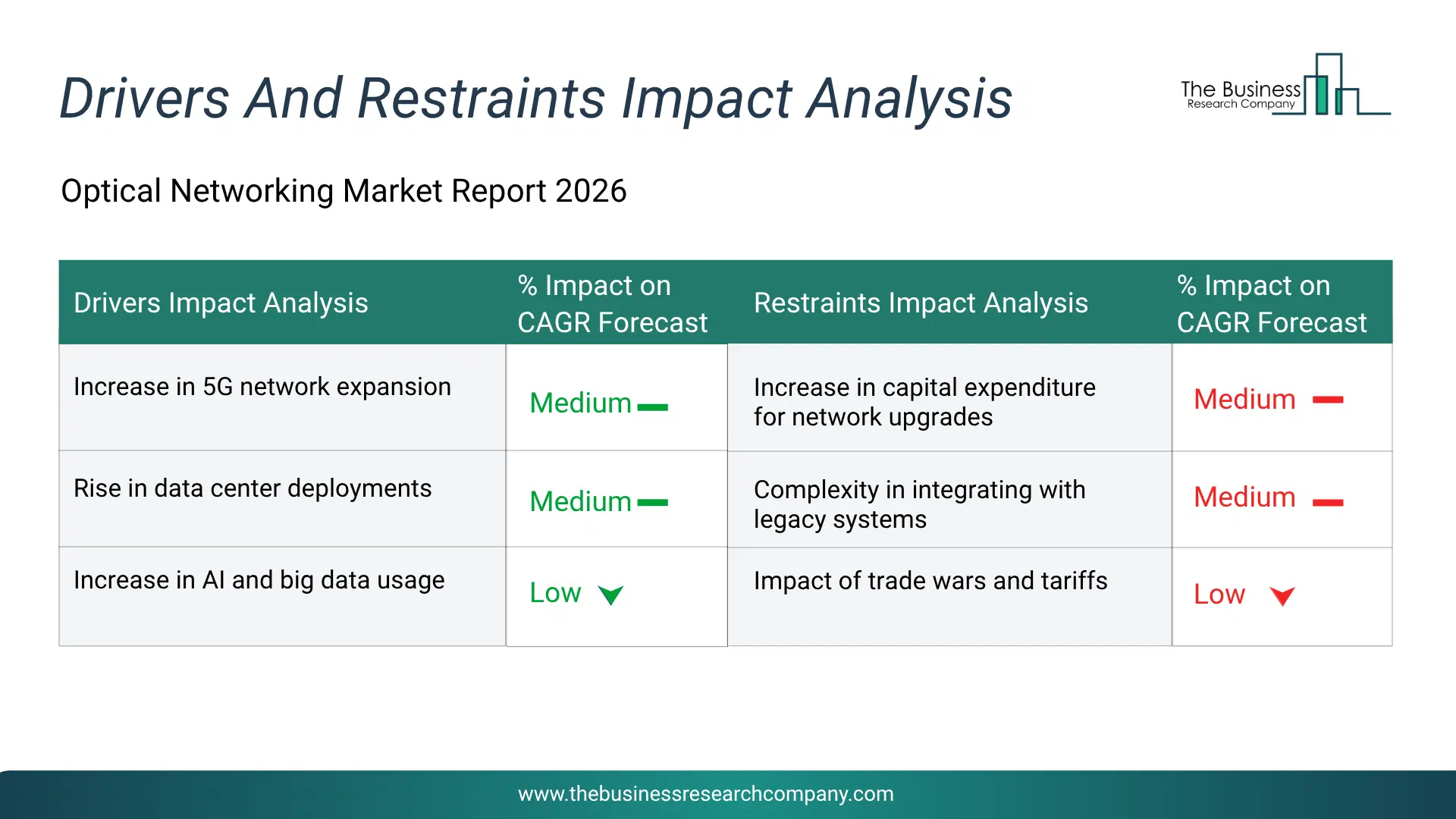
Infographic Chart Showing Key Market Drivers Analysis And Restraints For Optical Networking Market
The chart presents an impact analysis of key drivers and restraints, quantifying their relative influence on the market's growth rate and helping assess the balance between growth enablers and limiting factors. This chart offers a high-level perspective; the full report contains more detailed insights.
How Will The Drivers Impact Growth In The Global Optical Networking Market?
• Increase in 5G network expansion (Medium) – The increase in 5g network expansion will become a key driver of growth in the optical networking market by 2030. As telecom operators continue to accelerate 5G rollouts to support ultra-low latency, high-speed connectivity, and massive device density, the demand for high-capacity fiber backhaul and fronthaul networks is expected to increase substantially. Optical networking technologies are anticipated to play a critical role in enabling efficient data transmission across dense 5G architectures, particularly in urban and enterprise environments. The continued deployment of standalone 5G networks and the densification of small cell infrastructure are expected to further strengthen the need for advanced optical transport solutions, supporting sustained market expansion. As a result, the increase in 5g network expansion is anticipated to contributing to a 1.8% annual growth in the market. • Rise in data center deployments (Medium) – The rise in data center deployments will emerge as a major factor driving the expansion of the optical networking market by 2030. As enterprises and cloud service providers continue to expand hyperscale and edge data center infrastructure to support growing digital workloads, the need for high-speed, low-latency interconnectivity is expected to rise. Optical networking solutions are anticipated to be essential in enabling high-capacity data transmission between data centers and across cloud environments. The growing demand for colocation facilities and distributed edge computing architectures is expected to further accelerate the adoption of optical interconnect technologies, supporting efficient and scalable network performance. Consequently, the rise in data center deployments is projected to contributing to a 1.5% annual growth in the market. • Increase in AI and big data usage (Low) – The increase in AI and big data usage will serve as a key growth catalyst for the optical networking market by 2030. As organizations generate and process vast volumes of structured and unstructured data, the demand for high-bandwidth, low-latency networking infrastructure is expected to intensify. Optical networking technologies are anticipated to support the efficient movement of large datasets across data centers and cloud platforms, enabling real-time analytics and AI model training. The growing integration of AI-driven applications across industries is expected to further drive the need for scalable and high-performance optical communication networks. Therefore, this increase in AI and big data usage is projected to supporting to a 0.8% annual growth in the market. • Proliferation of IoT devices (Low) – The proliferation of IoT devices will become a significant driver contributing to the growth of the optical networking market by 2030. As connected devices continue to expand across smart cities, industrial automation, healthcare, and consumer applications, the volume of data generated at the network edge is expected to increase significantly. Optical networking infrastructure is anticipated to play a crucial role in aggregating and transmitting this data efficiently to centralized and cloud-based systems. The expansion of machine-to-machine communication and real-time monitoring applications is expected to further accelerate demand for high-capacity optical networks, supporting seamless connectivity and data exchange. Consequently, the proliferation of IoT devices is projected to contributing to a 0.6% annual growth in the market.How Will The Restraints Impact Growth In The Global Optical Networking Market?
• Increase in capital expenditure for network upgrades (Medium) – Increase in capital expenditure for network upgrades is expected to restrain market growth during the forecast period. It creates operational, financial, regulatory, or commercial challenges that can increase costs, delay projects, reduce investments, or discourage purchasing decisions depending on the market. These challenges can reduce product adoption, affect business confidence, and limit the ability of companies to expand efficiently across key regions. This can disrupt long-term growth strategies and reduce the ability of companies to capitalize on emerging market opportunities. • Complexity in integrating with legacy systems (Medium) – During the forecast period, complexity in integrating with legacy systems is likely to limit market expansion. It creates operational, financial, regulatory, or commercial challenges that can increase costs, delay projects, reduce investments, or discourage purchasing decisions depending on the market. These challenges can reduce product adoption, affect business confidence, and limit the ability of companies to expand efficiently across key regions. As a result, organizations may postpone purchasing decisions, limiting demand across both established and emerging markets. • Impact of trade wars and tariffs (Low) – The market is expected to face challenges due to impact of trade wars and tariffs over the forecast period. It creates operational, financial, regulatory, or commercial challenges that can increase costs, delay projects, reduce investments, or discourage purchasing decisions depending on the market. These challenges can reduce product adoption, affect business confidence, and limit the ability of companies to expand efficiently across key regions. This may reduce production efficiency, extend project timelines, and create challenges in meeting evolving customer requirements.Key Players In The Global Optical Networking Market
Major companies operating in the optical networking market are Huawei Technologies Co., Cisco Systems Inc., Broadcom Inc., Mitsubishi Electric Corporation, Ericsson, NEC Corporation, Nokia Corporation, Fujitsu Optical Components, ZTE Corporation, Sumitomo Electric Industries Ltd., Corning Inc., Fujikura Ltd., Juniper Networks, Ciena Corporation, II-VI Incorporated, Lumentum Holdings Inc., Infinera Corporation, Adtran Inc., Viavi Solutions Inc., ECI Telecom Ltd., Ribbon Communications Inc., ADVA Optical Networking SE, Oclaro Inc., Finisar Corporation, Applied Optoelectronics Inc.
This chart is for illustrative purposes; the full report includes a detailed competitor analysis and comprehensive overview of the top 10 companies in the market.
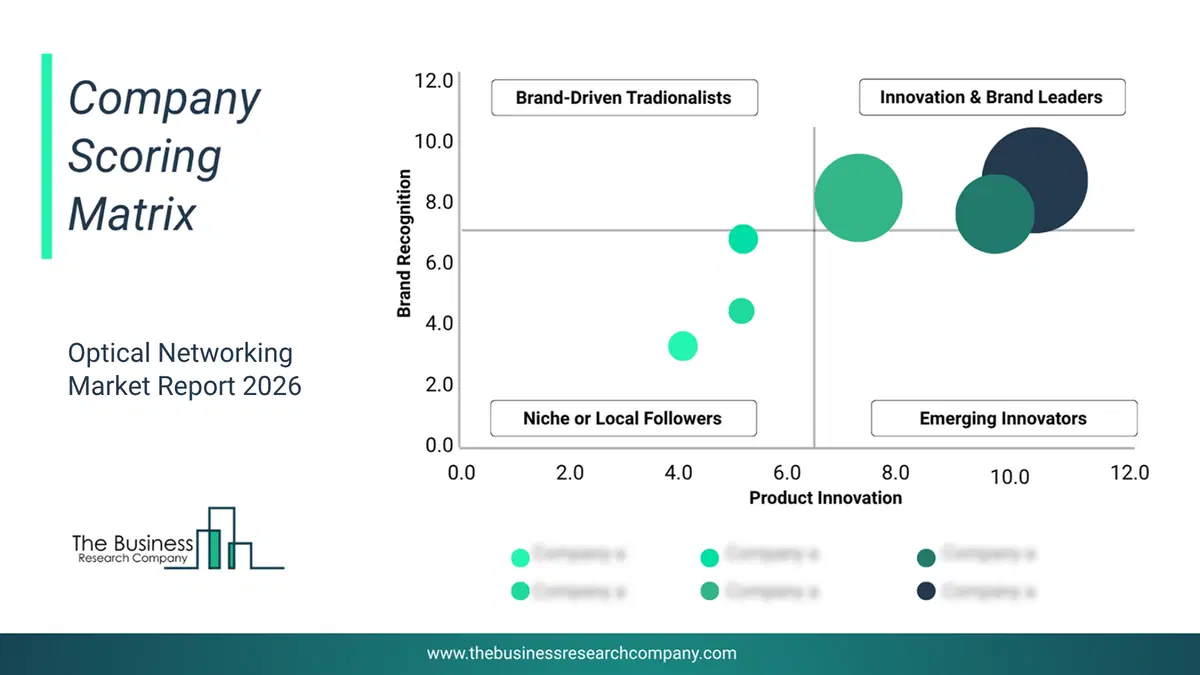
This chart maps companies by product innovation and brand strength, with bubble size indicating relative revenue, helping identify market leaders, challengers, and niche players. This is an illustrative chart; the full report provides a complete and accurate competitive analysis.
Global Optical Networking Market Trends and Insights
Major companies operating in the optical networking market are focusing on developing advanced solutions, such as next-generation optical transceiver modules, to improve network performance, increase data throughput, and meet the growing bandwidth demands of cloud, telecom, and data center operations. Optical transceiver modules are critical components that enable high-speed data transmission, superior signal integrity, and extended optical reach, supporting scalable and reliable fiber-optic connectivity. For instance, in October 2023, Coherent, a U.S.-based optical component company, announced that the Optical Internetworking Forum (OIF), a global nonprofit organization focused on advancing optical networking standards, approved the 800ZR Coherent Optics Implementation Agreement an important standard enabling interoperable 800-gigabit coherent optical modules for long-reach data center interconnect applications. This standards advancement accelerates the development of high-capacity optical modules, improves cross-vendor interoperability, and supports the widespread adoption of next-generation optical networking technologies.What Are Latest Mergers And Acquisitions In The Optical Networking Market?
In June 2024, Nokia Corporation, a Finland-based telecommunications and networking systems company, announced the acquisition of Infinera Corporation for US$2.3 billion. Through this acquisition, Nokia aims to scale its optical networks business, accelerate its product roadmap, and enhance its in-house expertise in optical semiconductors and coherent transport technologies. Infinera Corporation is a US-based optical networking and photonics company that provides high-capacity transport solutions for data center, telecom, and webscale environments.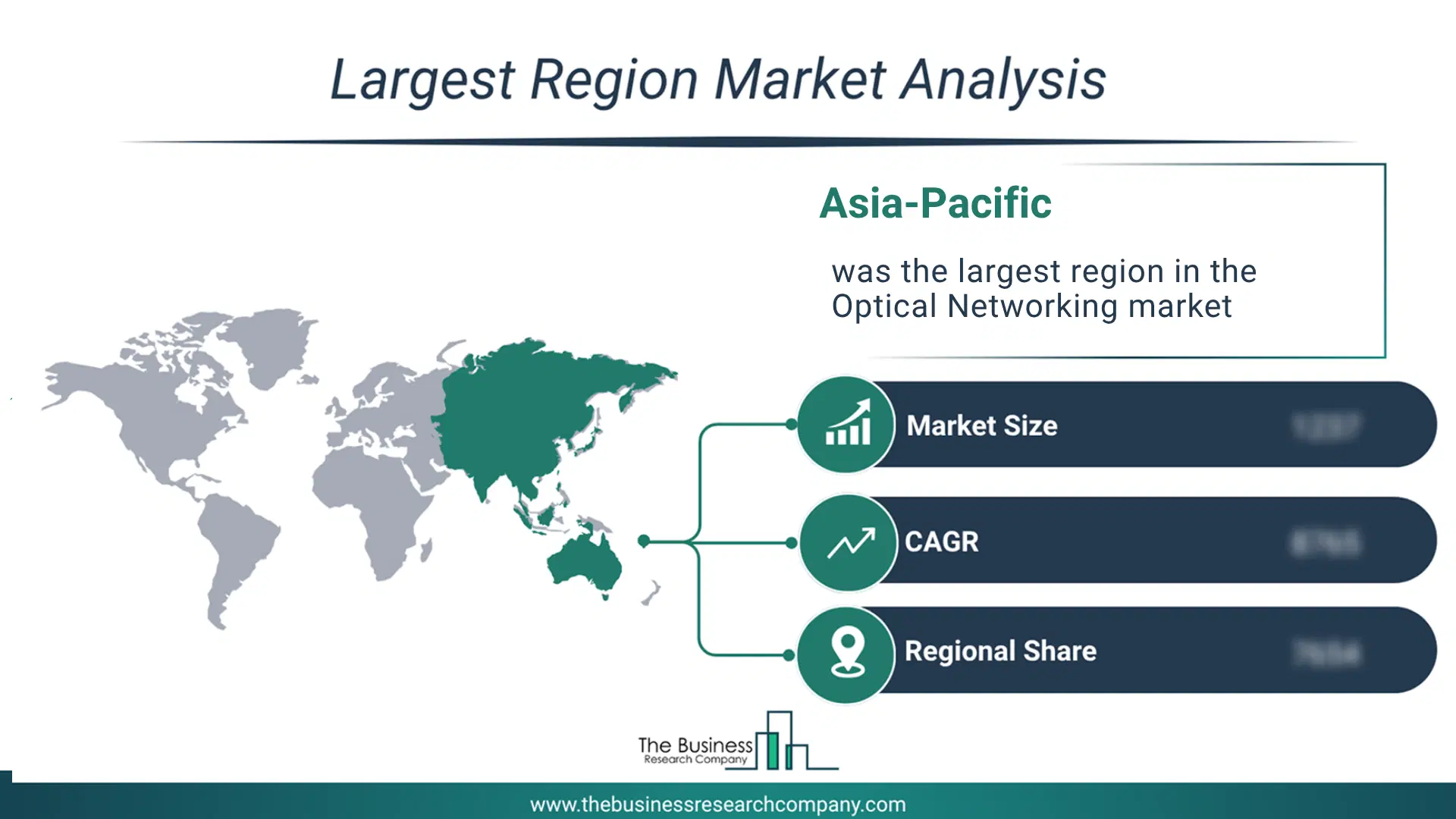
Regional Insights
Asia-Pacific was the largest region in the optical networking market in 2025. The regions covered in this market report are Asia-Pacific, South East Asia, Western Europe, Eastern Europe, North America, South America, Middle East, Africa. The countries covered in this market report are Australia, Brazil, China, France, Germany, India, Indonesia, Japan, Taiwan, Russia, South Korea, UK, USA, Canada, Italy, Spain.What Defines the Optical Networking Market?
The optical networking market includes revenues earned by providing services such as optical transport services, managed optical network services, wavelength services, managed optical network services, dark fiber services, and fiber optic cable installation. The market value includes the value of related goods sold by the service provider or included within the service offering. Only goods and services traded between entities or sold to end consumers are included. The optical networking market also consists of the sale of optical cross-connects (OXC), optical add-drop multiplexers (OADM), optical monitoring and management systems, optical cross-connects, and optical transceivers. Values in this market are ‘factory gate’ values, that is, the value of goods sold by the manufacturers or creators of the goods, whether to other entities (including downstream manufacturers, wholesalers, distributors, and retailers) or directly to end customers. The value of goods in this market includes related services sold by the creators of the goods.How is Market Value Defined and Measured?
The market value is defined as the revenues that enterprises gain from the sale of goods and/or services within the specified market and geography through sales, grants, or donations in terms of the currency (in USD unless otherwise specified). The revenues for a specified geography are consumption values that are revenues generated by organizations in the specified geography within the market, irrespective of where they are produced. It does not include revenues from resales along the supply chain, either further along the supply chain or as part of other products.
This chart presents market attractiveness based on a quantitative evaluation of growth, competition, strategic alignment, and risk, offering a clear view of opportunity areas for decision-making. This chart is for illustrative purposes; the full report contains the complete analysis.

This chart highlights the Total Addressable Market (TAM) by estimating the maximum revenue opportunity using an assumption-driven approach, supporting strategic planning and opportunity sizing across markets. The chart is illustrative; the full report provides a more comprehensive analysis.
What Key Data and Analysis Are Included in the Optical Networking Market Report 2026?
The optical networking market research report is one of a series of new reports from The Business Research Company that provides market statistics, including industry global market size, regional shares, competitors with the market share, detailed market segments, market trends and opportunities, and any further data you may need to thrive in the optical networking industry. The market research report delivers a complete perspective of everything you need, with an in-depth analysis of the current and future state of the industry.Optical Networking Market Report Forecast Analysis
| Report Attribute | Details |
|---|---|
| Market Size Value In 2026 | $18.93 billion |
| Revenue Forecast In 2035 | $26.57 billion |
| Growth Rate | CAGR of 10.5% from 2026 to 2035 |
| Base Year For Estimation | 2025 |
| Actual Estimates/Historical Data | 2020-2025 |
| Forecast Period | 2026 - 2030 - 2035 |
| Market Representation | Revenue in USD Billion and CAGR from 2026 to 2035 |
| Segments Covered | Component, Service, Technology, End User |
| Regional Scope | Asia-Pacific, Western Europe, Eastern Europe, North America, South America, Middle East, Africa |
| Country Scope | The countries covered in the report are Australia, Brazil, China, France, Germany, India, ... |
| Key Companies Profiled | Huawei Technologies Co., Cisco Systems Inc., Broadcom Inc., Mitsubishi Electric Corporation, Ericsson, NEC Corporation, Nokia Corporation, Fujitsu Optical Components, ZTE Corporation, Sumitomo Electric Industries Ltd., Corning Inc., Fujikura Ltd., Juniper Networks, Ciena Corporation, II-VI Incorporated, Lumentum Holdings Inc., Infinera Corporation, Adtran Inc., Viavi Solutions Inc., ECI Telecom Ltd., Ribbon Communications Inc., ADVA Optical Networking SE, Oclaro Inc., Finisar Corporation, Applied Optoelectronics Inc. |
| Customization Scope | Request for Customization |
| Pricing And Purchase Options | Explore Purchase Options |