
Optical Satellite Market Report 2026
Global Outlook – By Component (Imaging And Sensing Systems, Optical Communication Systems), By Size (Small, Medium, Large), By Application (Earth Observation, Communication), By End User (Commercial, Government, Defense) – Market Size, Trends, Strategies, and Forecast to 2030
Optical Satellite Market Overview
• Optical Satellite market size has reached to $2.56 billion in 2025 • Expected to grow to $4.36 billion in 2030 at a compound annual growth rate (CAGR) of 11.2% • Growth Driver: Growing Smartphone Adoption Fuels Optical Satellite Market Expansion • Market Trend: Innovative Optical Satellite For Military And Civilian Applications • North America was the largest region in 2025 and Asia-Pacific is the fastest growing region.What Is Covered Under Optical Satellite Market?
An optical satellite, also known as an optical imaging satellite, is equipped with sensors that capture images of the Earth's surface using visible light. It is predominantly employed for Earth observation purposes, enabling the monitoring of land-use alterations, the surveillance of natural disasters, and the evaluation of climate change effects. The main components of the optical satellite include imaging and sensing systems, and optical communication systems. Imaging and sensing systems refer to satellite-mounted technologies designed to capture high-resolution images, detect electromagnetic signals, and gather precise data from space for applications such as earth observation, environmental monitoring, and reconnaissance. These satellites are further categorized by size into small, medium, and large platforms. Various applications are earth observation, and communication, and they are used by several end users such as commercial enterprises, government agencies, and defense organizations.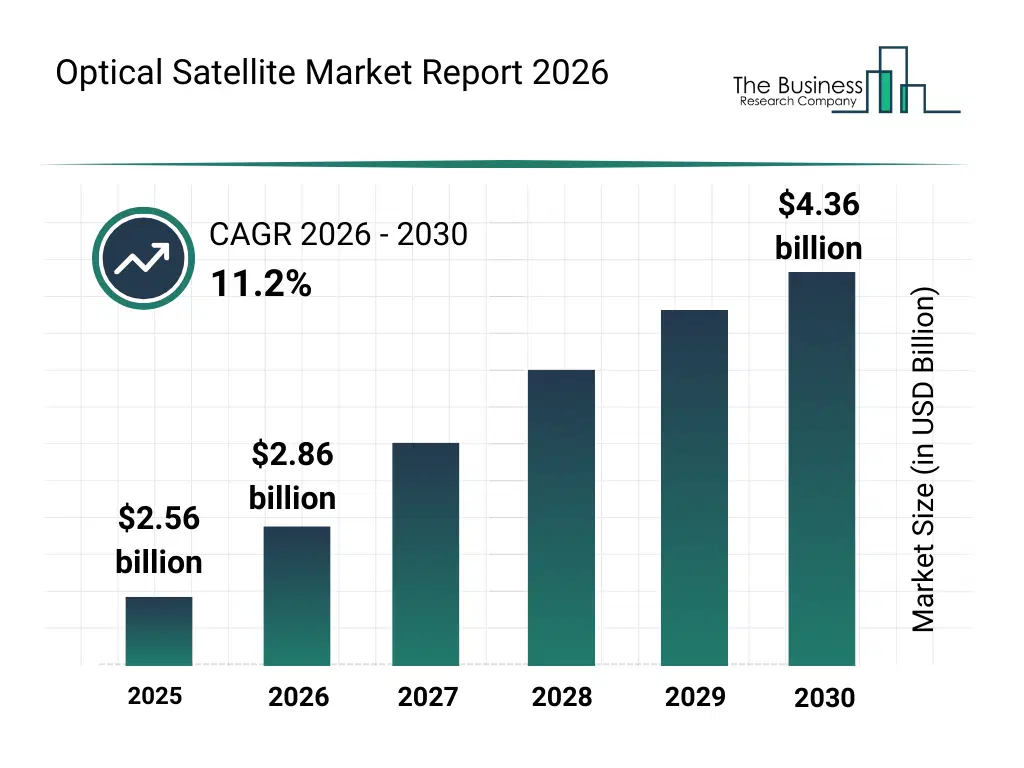
What Is The Optical Satellite Market Size and Share 2026?
The optical satellite market size has grown rapidly in recent years. It will grow from $2.56 billion in 2025 to $2.86 billion in 2026 at a compound annual growth rate (CAGR) of 11.4%. The growth in the historic period can be attributed to increasing demand for earth observation and land-use monitoring, technological advancements in high-resolution optical sensors, rising adoption of optical satellites for disaster management and environmental monitoring, government and defense investments in optical imaging capabilities, growth in agricultural monitoring using satellite imagery.What Is The Optical Satellite Market Growth Forecast?
The optical satellite market size is expected to see rapid growth in the next few years. It will grow to $4.36 billion in 2030 at a compound annual growth rate (CAGR) of 11.2%. The growth in the forecast period can be attributed to expansion of multi-sensor and constellation optical satellite networks, integration of ai and machine learning for image processing and analytics, rising commercial demand for high-resolution earth observation data, development of cost-effective small and medium optical satellites, increasing use of optical satellites for climate change monitoring and sustainable resource management. Major trends in the forecast period include high-resolution imaging adoption, multi-sensor satellite integration, constellation satellite deployment, real-time disaster monitoring, agricultural and environmental monitoring expansion.
Global Optical Satellite Market Segmentation
1) By Component: Imaging And Sensing Systems, Optical Communication Systems 2) By Size: Small, Medium, Large 3) By Application: Earth Observation, Communication 4) By End User: Commercial, Government, Defense Subsegments: 1) By Imaging And Sensing Systems: Earth Observation Cameras, Remote Sensing Sensors, Multispectral And Hyperspectral Sensors, Infrared Sensors 2) By Optical Communication Systems: Optical Transmitters, Optical Receivers, Fiber Optic Cables, Ground Stations And TerminalsWhat Is Driver Of The Optical Satellite Market?
The growing number of smartphone users is expected to propel the growth of the optical satellite market going forward. A smartphone user refers to an individual who owns and operates a smartphone, a mobile device that combines a computer's functionality with a mobile phone's convenience. Smartphone users use optical satellite data to enhance their experiences, address specific needs, and provide valuable information for navigation, exploration, emergency preparedness, environmental awareness, agriculture, urban planning, research, and education. For instance, in February 2024, according to Uswitch Limited, a UK-based financial conduct authority, by the end of 2023, the UK had 84.3 million active mobile subscriptions, marking a growth of over 3% compared to 2022. Therefore, the growing number of smartphone users is driving the growth of the optical satellite industry.Key Players In The Global Optical Satellite Market
Major companies operating in the optical satellite market are Raytheon Technologies Corporation, Lockheed Martin Corporation, Mitsubishi Electric Corporation, Northrop Grumman Corporation, Honeywell International Inc., NEC Corporation, Boeing Company, Safran SA, Thales Group, L3 Harris Corporation, Ball Aerospace & Technologies Corp., Leonardo S.p.A., Maxar Technologies Holdings Inc., Orbital Sciences Corporation, OHB SE, Tesat-Space GmbH & Co. KG, Surrey Satellite Technology, Planet Labs Inc., Sitael S.p.A., Analytical Space Inc., Hisdesat Servicios Estrategicos S.A., Mynaric AG, Airbus Defence and Space Company
This chart is for illustrative purposes; the full report includes a detailed competitor analysis and comprehensive overview of the top 10 companies in the market.
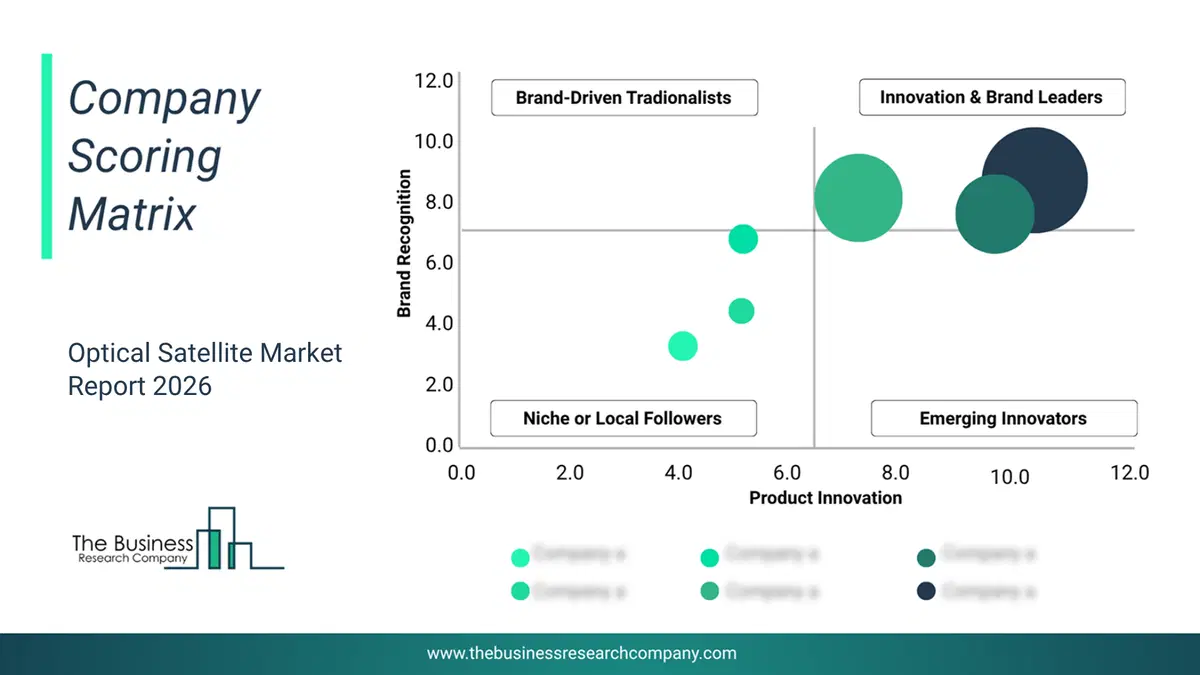
This chart maps companies by product innovation and brand strength, with bubble size indicating relative revenue, helping identify market leaders, challengers, and niche players. This is an illustrative chart; the full report provides a complete and accurate competitive analysis.
Global Optical Satellite Market Trends and Insights
Major companies operating in the optical satellite industry market are focusing developing innovative technologies such as Long March 5 Rocket and Optical Remote Sensing Technology to enhance satellite imaging and data collection capabilities. Long March 5 Rocket is a heavy-lift launch vehicle designed to carry large payloads, such as satellites, into various orbits. It can carry up to 14,000 kg to the Geostationary Transfer Orbit (GTO). Optical Remote Sensing Technology involves using satellite technology to capture images of the Earth’s surface for various applications, including military reconnaissance and environmental monitoring. For instance, in December 2023, China Aerospace Science and Technology Corporation (CASC), a China-based aerospace technology company, launched the Yaogan-41 optical satellite. To enhance China's capabilities in remote sensing, with implications for military and civilian application Main aim of launching is to improve land survey, crop yield estimation, environmental management, meteorological warning and forecasting, and comprehensive disaster prevention and reduction.What Are Latest Mergers And Acquisitions In The Optical Satellite Market? SES Acquires Intelsat In $2.6 Billion Deal To Form Satellite Connectivity Powerhouse
In July 2025, SES, a Luxembourg-based leading space solutions company, acquired Intelsat for a cash consideration of $2.6 billion (€2.2 billion) and certain contingent value rights . Through this acquisition, SES aims to create a global multi-orbit connectivity powerhouse by combining its satellite fleet with Intelsat's to better serve the evolving needs of governments, aviation, maritime, and media customers worldwide . Intelsat was a US-based global satellite operator providing communications services.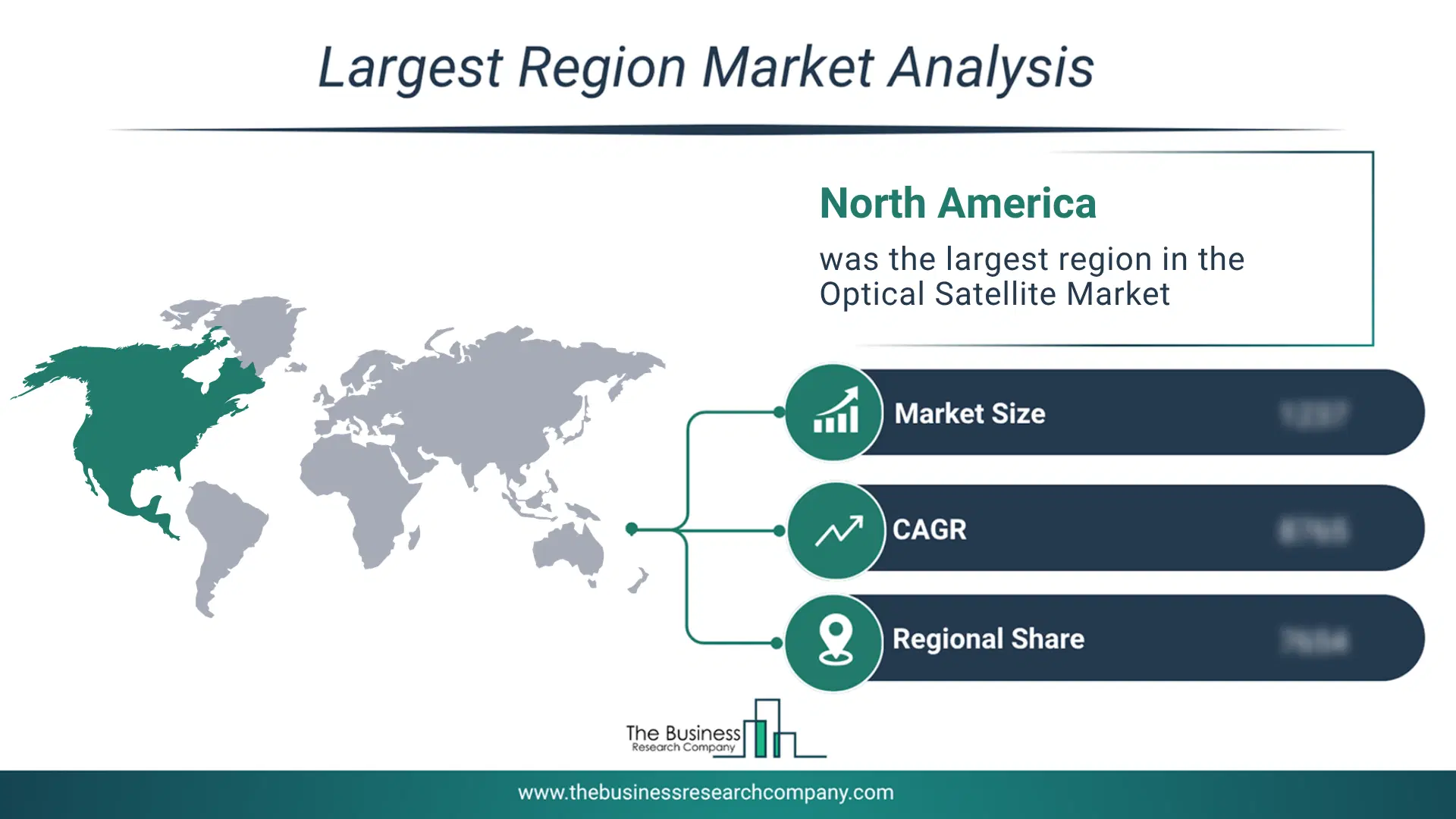
Regional Insights
North America was the largest region in the optical satellite market in 2025. Asia-Pacific is expected to be the fastest-growing region in the forecast period. The regions covered in this market report are Asia-Pacific, South East Asia, Western Europe, Eastern Europe, North America, South America, Middle East, Africa. The countries covered in this market report are Australia, Brazil, China, France, Germany, India, Indonesia, Japan, Taiwan, Russia, South Korea, UK, USA, Canada, Italy, SpainWhat Defines the Optical Satellite Market?
The optical satellite market consists of revenues earned by entities by providing services such as earth observation, disaster management, agricultural monitoring, and environmental monitoring. The market value includes the value of related goods sold by the service provider or included within the service offering. The optical satellite market also includes sales of high-resolution optical satellites, multi-sensor satellites, and constellation satellites. Values in this market are ‘factory gate’ values, that is, the value of goods sold by the manufacturers or creators of the goods, whether to other entities (including downstream manufacturers, wholesalers, distributors, and retailers) or directly to end customers. The value of goods in this market includes related services sold by the creators of the goods.How is Market Value Defined and Measured?
The market value is defined as the revenues that enterprises gain from the sale of goods and/or services within the specified market and geography through sales, grants, or donations in terms of the currency (in USD unless otherwise specified). The revenues for a specified geography are consumption values that are revenues generated by organizations in the specified geography within the market, irrespective of where they are produced. It does not include revenues from resales along the supply chain, either further along the supply chain or as part of other products.
This chart presents market attractiveness based on a quantitative evaluation of growth, competition, strategic alignment, and risk, offering a clear view of opportunity areas for decision-making. This chart is for illustrative purposes; the full report contains the complete analysis.

This chart highlights the Total Addressable Market (TAM) by estimating the maximum revenue opportunity using an assumption-driven approach, supporting strategic planning and opportunity sizing across markets. The chart is illustrative; the full report provides a more comprehensive analysis.
What Key Data and Analysis Are Included in the Optical Satellite Market Report 2026?
The optical satellite market research report is one of a series of new reports from The Business Research Company that provides market statistics, including industry global market size, regional shares, competitors with the market share, detailed market segments, market trends and opportunities, and any further data you may need to thrive in the optical satellite industry. The market research report delivers a complete perspective of everything you need, with an in-depth analysis of the current and future state of the industry.Optical Satellite Market Report Forecast Analysis
| Report Attribute | Details |
|---|---|
| Market Size Value In 2026 | $2.86 billion |
| Revenue Forecast In 2030 | $4.36 billion |
| Growth Rate | CAGR of 11.2% from 2026 to 2030 |
| Base Year For Estimation | 2025 |
| Actual Estimates/Historical Data | 2020-2025 |
| Forecast Period | 2026 - 2030 |
| Market Representation | Revenue in USD Billion and CAGR from 2026 to 2030 |
| Segments Covered | Component, Size, Application, End User |
| Regional Scope | Asia-Pacific, Western Europe, Eastern Europe, North America, South America, Middle East, Africa |
| Country Scope | The countries covered in the optical satellite market report are Australia, Brazil, China, France, Germany, India, Indonesia, Japan, Taiwan, Russia, South Korea, UK, USA, Canada, Italy, Spain |
| Key Companies Profiled | Raytheon Technologies Corporation, Lockheed Martin Corporation, Mitsubishi Electric Corporation, Northrop Grumman Corporation, Honeywell International Inc., NEC Corporation, Boeing Company, Safran SA, Thales Group, L3 Harris Corporation, Ball Aerospace & Technologies Corp., Leonardo S.p.A., Maxar Technologies Holdings Inc., Orbital Sciences Corporation, OHB SE, Tesat-Space GmbH & Co. KG, Surrey Satellite Technology, Planet Labs Inc., Sitael S.p.A., Analytical Space Inc., Hisdesat Servicios Estrategicos S.A., Mynaric AG, Airbus Defence and Space Company |
| Customization Scope | Request for Customization |
| Pricing And Purchase Options | Explore Purchase Options |