

Optical Transceiver Market Report 2026
Global Outlook – By Type (Single Mode Fiber, Multimode Fiber), By Protocol (Ethernet, Fiber Channel, CWDM and DWDM, FTTx, Other Protocols), By Connector (LC connector, SC connector, MPO connector, RJ-45), By Wavelength (Long-range, Extended-range, Short-range), By Application (Data Centers, Telecommunication) – Market Size, Trends, Strategies, and Forecast to 2030
Optical Transceiver Market Overview
• Optical Transceiver market size has reached to $12.75 billion in 2025 • Expected to grow to $27.6 billion in 2030 at a compound annual growth rate (CAGR) of 16.8% • Growth Driver: Surge In Data Traffic Fuels Growth Of Optical Transceiver Market • Market Trend: The Emergence Of Hot-Pluggable Solutions • North America was the largest region in 2025.What Is Covered Under Optical Transceiver Market?
An optical transceiver refers to a small and powerful interconnect device that can transmit and receive data which are transferred in the form of light pulses across an optical fiber at very high speeds and over vast distances in optical networking and communication. It is used to transform electrical impulses into optical (light) signals and optical signals into electrical signals. The main types of optical transceivers are single-mode fiber and multimode fiber. A single-mode fiber transceiver is a self-contained optical transceiver module that can receive and send data over single-mode optical fiber cables that enable signal transmission at extremely large bandwidths, allowing for signal transmission over extremely long distances. The various protocols are Ethernet, fiber channel, CWDM and DWDM, FTTx, and others that use various connectors such as LC connectors, SC connectors, MPO connectors, and RJ-45 connectors. It uses different wavelengths such as long-range, extended-range, and short-range, and is applied in data centers and telecommunications.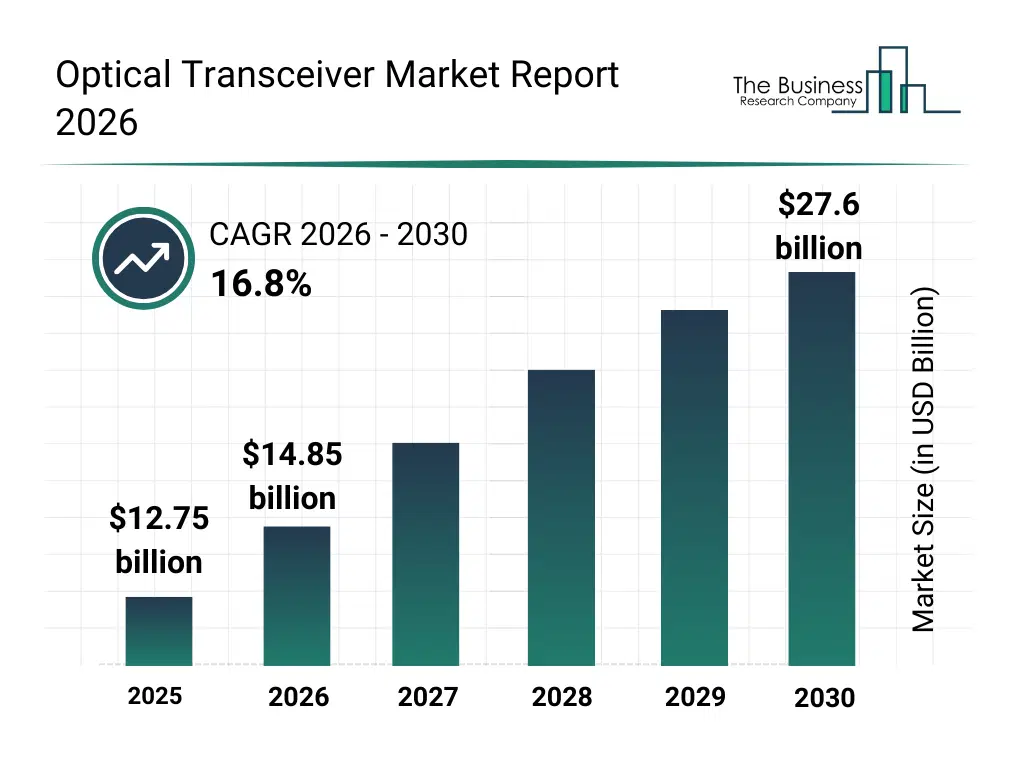
What Is The Optical Transceiver Market Size and Share 2026?
The optical transceiver market size has grown rapidly in recent years. It will grow from $12.75 billion in 2025 to $14.85 billion in 2026 at a compound annual growth rate (CAGR) of 16.4%. The growth in the historic period can be attributed to growth of fiber optic networks, expansion of data centers, rising internet traffic, adoption of cloud services, telecom infrastructure upgrades.What Is The Optical Transceiver Market Growth Forecast?
The optical transceiver market size is expected to see rapid growth in the next few years. It will grow to $27.6 billion in 2030 at a compound annual growth rate (CAGR) of 16.8%. The growth in the forecast period can be attributed to 5G network deployment, hyperscale data center growth, increasing bandwidth demand, adoption of 400g and above transceivers, growth of edge data centers. Major trends in the forecast period include high speed optical transceivers, data center network expansion, dwdm technology adoption, energy efficient optical modules, miniaturized transceiver design.
Global Optical Transceiver Market Segmentation
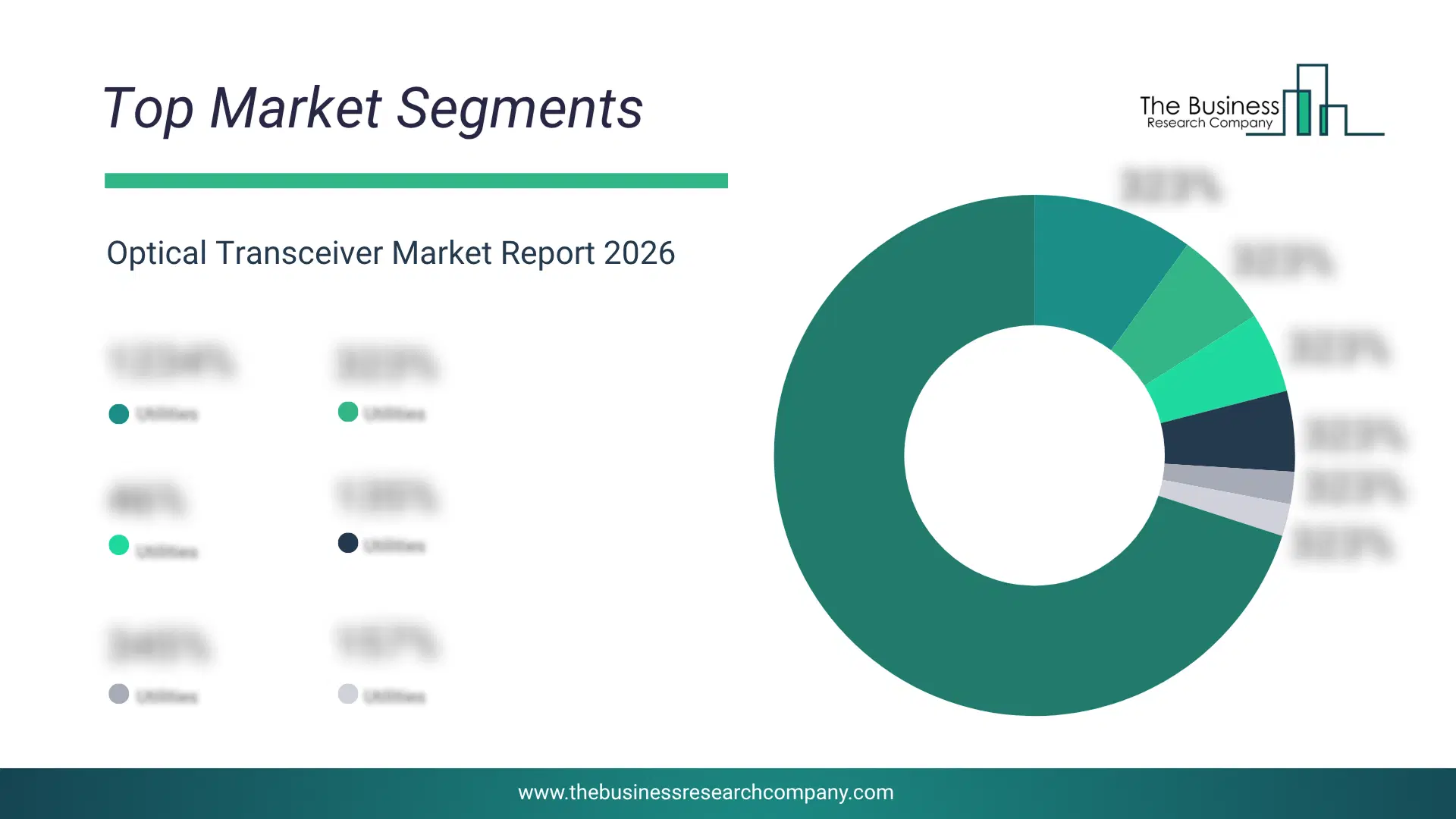
1) By Type: Single Mode Fiber, Multimode Fiber 2) By Protocol: Ethernet, Fiber Channel, CWDM and DWDM, FTTx, Other Protocols 3) By Connector: LC connector, SC connector, MPO connector, RJ-45 4) By Wavelength: Long-range, Extended-range, Short-range 5) By Application: Data Centers, Telecommunication Subsegments: 1) By Single Mode Fiber: Standard Single Mode Transceivers, High-Speed Single Mode Transceivers, Extended Temperature Range Single Mode Transceivers 2) By Multimode Fiber: Standard Multimode Transceivers, High-Speed Multimode Transceivers, Short Range Multimode TransceiversWhat Is The Driver Of The Optical Transceiver Market?
Increasing data traffic is expected to propel the growth of the optical transceiver market going forward. Data traffic, also known as network traffic, is the volume of data traveling over a computer network at any time that is divided into data packets and transmitted over the network before being reassembled by the receiving device or computer. Optical transceiver devices are used in high-data-traffic environments for transmitting and receiving data from one network to another. For instance, in 2023, according to Priori Data GmbH, a Germany-based data analytics company, mobile traffic accounted for 35.53% of total traffic, and it is projected to increase to 46.11% by the end of 2024. Therefore, the increase in data traffic drives the growth of the optical transceiver industry.Key Players In The Global Optical Transceiver Market
Major companies operating in the optical transceiver market are Coherent Corp.; Accelink Technology Co. Ltd.; Huawei Technologies Co. Ltd.; Broadcom Inc.; Source Photonics Inc.; Hisense Broadband Inc.; Juniper Networks Inc.; Cisco Systems Inc.; Fujitsu Optical Components Limited; Lumentum Holdings Inc.; Sumitomo Electric Industries Ltd.; Perle Systems; Fiber Optic Communications Inc.; Arista Networks Inc.; ZTE Corporation; Applied Optoelectronics Inc.; Infinera Corporation; Intel Corporation; InnoLight Technology Co. Ltd.; Molex LLC; NeoPhotonics Corporation; HUBER+SUHNER Cube Optics AG; NADDOD Pte. Ltd.; Reflex Photonics Inc.; Oclaro Inc.; Finisar Corporation; Acacia Communications Inc.; Ciena Corporation
This chart is for illustrative purposes; the full report includes a detailed competitor analysis and comprehensive overview of the top 10 companies in the market.
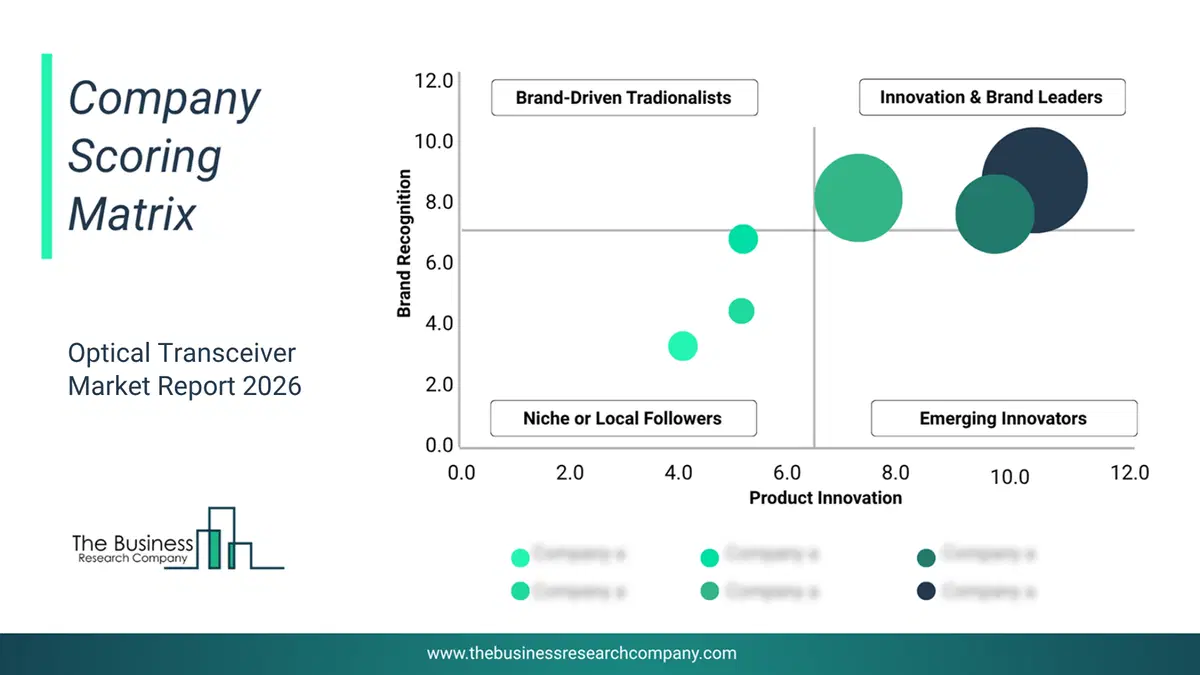
This chart maps companies by product innovation and brand strength, with bubble size indicating relative revenue, helping identify market leaders, challengers, and niche players. This is an illustrative chart; the full report provides a complete and accurate competitive analysis.
Global Optical Transceiver Market Trends and Insights
Major companies operating in the optical transceiver market are focused on developing innovative products, such as hot-pluggable optical transceivers, to gain a competitive edge in the market. A hot-pluggable optical transceiver is a device that can be inserted or removed from a network device without the need to power down the device. For instance, in 2023, Gigalight, a China-based optical communications company, launched the GIGALIGHT 32GFC SFP28 ER optical transceiver module for use in data center network storage areas. The high-performance optical transceiver module GIGALIGHT 32GFC SFP28 ER is intended to accommodate a 32 Gbps data rate for Fibre Channel applications. This module can cover up to 30 km over single-mode fiber, making it very useful for long-distance connections. The main application for the GIGALIGHT 32GFC SFP28 ER optical transceiver module is in data center storage area networks, or SANs.What Are Latest Mergers And Acquisitions In The Optical Transceiver Market?
In November 2023, Lumentum Holdings Inc., a US-based provider of optical and photonic components for telecommunications, data centers, and industrial applications, acquired Cloud Light Technology Limited for approximately US $750 million. With this acquisition, Lumentum seeks to integrate Cloud Light’s high-speed optical transceiver modules (including 400G and 800G offerings) and its manufacturing and supply-chain capabilities to accelerate its growth in cloud-data-center interconnect and next-generation high-bandwidth markets. Cloud Light Technology Limited is a China-based provider of advanced optical modules for data center interconnect and optical communications, specializing in 400G/800G transceivers and integrated photonics technologies.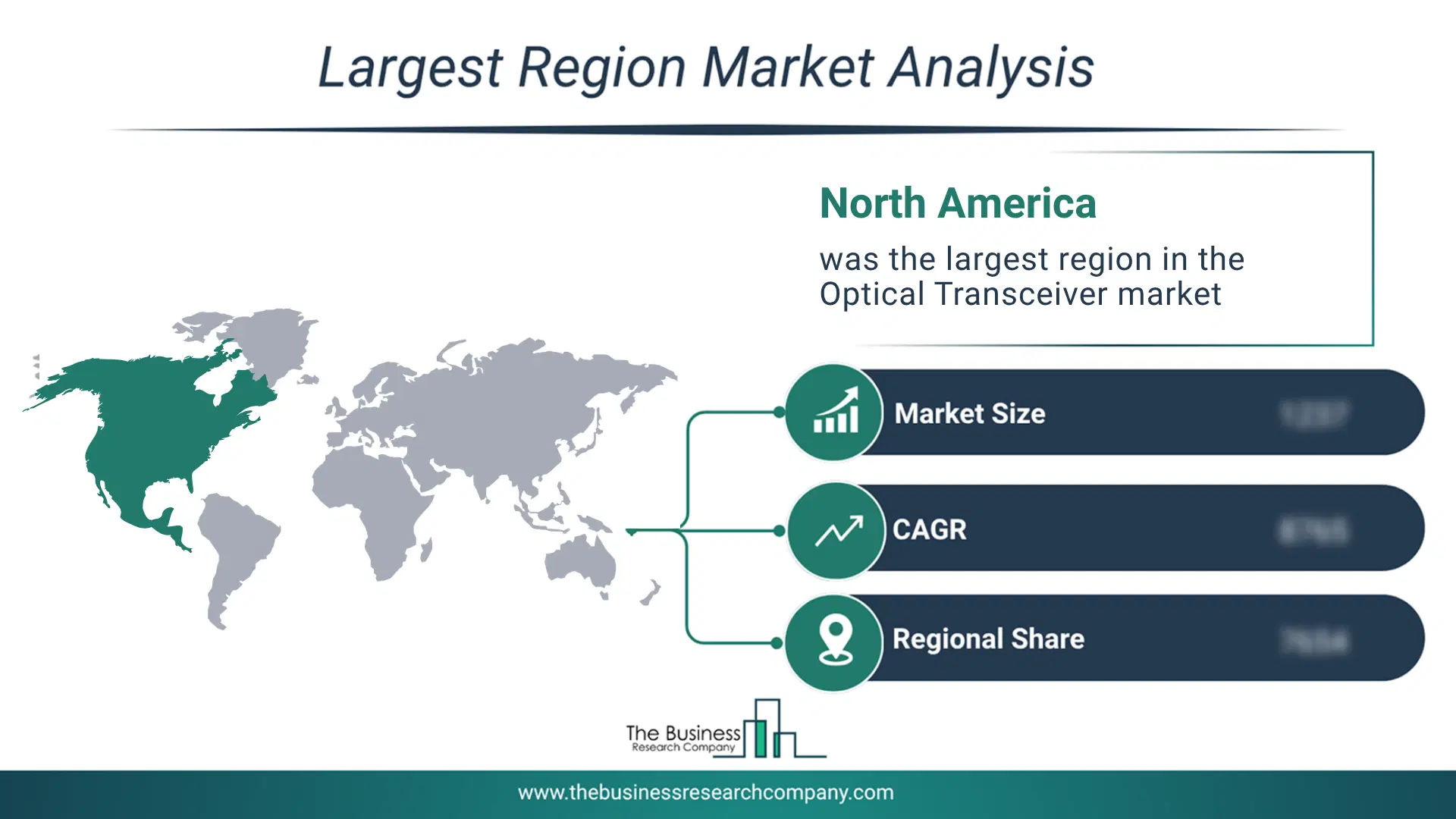
Regional Insights
North America was the largest region in the optical transceiver market in 2025. Asia-Pacific is expected to be the fastest-growing region in the global optical transceiver market during the forecast period. The regions covered in this market report are Asia-Pacific, South East Asia, Western Europe, Eastern Europe, North America, South America, Middle East, Africa. The countries covered in this market report are Australia, Brazil, China, France, Germany, India, Indonesia, Japan, Taiwan, Russia, South Korea, UK, USA, Canada, Italy, SpainWhat Defines the Optical Transceiver Market?
The optical transceiver market consists of sales of different rate optic transceivers such as 100GBase, 40GBase, 10GBase, 1000Base, and 100Base, in wave lengthens such as 850nm, 1310nm, and 1550nm. Values in this market are ‘factory gate’ values, that is the value of goods sold by the manufacturers or creators of the goods, whether to other entities (including downstream manufacturers, wholesalers, distributors, and retailers) or directly to end customers. The value of goods in this market includes related services sold by the creators of the goods.How is Market Value Defined and Measured?
The market value is defined as the revenues that enterprises gain from the sale of goods and/or services within the specified market and geography through sales, grants, or donations in terms of the currency (in USD unless otherwise specified). The revenues for a specified geography are consumption values that are revenues generated by organizations in the specified geography within the market, irrespective of where they are produced. It does not include revenues from resales along the supply chain, either further along the supply chain or as part of other products.
This chart presents market attractiveness based on a quantitative evaluation of growth, competition, strategic alignment, and risk, offering a clear view of opportunity areas for decision-making. This chart is for illustrative purposes; the full report contains the complete analysis.

This chart highlights the Total Addressable Market (TAM) by estimating the maximum revenue opportunity using an assumption-driven approach, supporting strategic planning and opportunity sizing across markets. The chart is illustrative; the full report provides a more comprehensive analysis.
What Key Data and Analysis Are Included in the Optical Transceiver Market Report 2026?
The optical transceiver market research report is one of a series of new reports from The Business Research Company that provides market statistics, including industry global market size, regional shares, competitors with the market share, detailed market segments, market trends and opportunities, and any further data you may need to thrive in the optical transceiver industry. The market research report delivers a complete perspective of everything you need, with an in-depth analysis of the current and future state of the industry.Optical Transceiver Market Report Forecast Analysis
| Report Attribute | Details |
|---|---|
| Market Size Value In 2026 | $14.85 billion |
| Revenue Forecast In 2030 | $27.6 billion |
| Growth Rate | CAGR of 16.8% from 2026 to 2030 |
| Base Year For Estimation | 2025 |
| Actual Estimates/Historical Data | 2020-2025 |
| Forecast Period | 2026 - 2030 |
| Market Representation | Revenue in USD Billion and CAGR from 2026 to 2030 |
| Segments Covered | Type, Protocol, Connector, Wavelength, Application |
| Regional Scope | Asia-Pacific, Western Europe, Eastern Europe, North America, South America, Middle East, Africa |
| Country Scope | The Countries Covered In This Market Report Are Australia, Brazil, China, France, Germany, India, Indonesia, Japan, Taiwan, Russia, South Korea, Uk, Usa, Canada, Italy, Spain. |
| Key Companies Profiled | Coherent Corp., Accelink Technology Co. Ltd., Huawei Technologies Co. Ltd., Broadcom Inc., Source Photonics Inc., Hisense Broadband Inc., Juniper Networks Inc., Cisco Systems Inc., Fujitsu Optical Components Limited, Lumentum Holdings Inc., Sumitomo Electric Industries Ltd., Perle Systems, Fiber Optic Communications Inc., Arista Networks Inc., ZTE Corporation, Applied Optoelectronics Inc., Infinera Corporation, Intel Corporation, InnoLight Technology Co. Ltd., Molex LLC, NeoPhotonics Corporation, HUBER+SUHNER Cube Optics AG, NADDOD Pte. Ltd., Reflex Photonics Inc., Oclaro Inc., Finisar Corporation, Acacia Communications Inc., Ciena Corporation |
| Customization Scope | Request for Customization |
| Pricing And Purchase Options | Explore Purchase Options |