
Orbital Propellant Depot Market Report 2026
Global Outlook – By Depot Type (Permanent, Temporary), By Propellant Type (Liquid Oxygen, Liquid Hydrogen, Methane, Other Propellant Types), By Service Type (In Orbit Refueling, Propellant Storage, Propellant Transfer, Fuel Management And Monitoring, On Orbit Logistics Support), By End User (Government Space Agencies, Commercial Satellite Operators, Defense Organizations, Space Logistics Service Providers) – Market Size, Trends, Strategies, and Forecast to 2035
Orbital Propellant Depot Market Overview
• Orbital Propellant Depot market size has reached to $1.4 billion in 2025 • Expected to grow to $3.47 billion in 2030 at a compound annual growth rate (CAGR) of 19.7% • Growth Driver: Increasing Number Of Satellite Launches Driving The Market Growth Due To Rising Demand For In-Space Propellant Storage And Refueling Infrastructure • Market Trend: Advancements In In-Orbit Refueling Systems Are Revolutionizing Space Logistics And Satellite Servicing • North America was the largest region in 2025 and Asia-Pacific is the fastest growing region.What Is Covered Under Orbital Propellant Depot Market?
Orbital propellant depots are space-based infrastructure systems designed to store, manage, and transfer propellants to spacecraft operating in Earth orbit or deep-space missions. These depots enable in-orbit refueling by maintaining propellant under controlled conditions and facilitating safe transfer between storage systems and receiving vehicles. They are designed to extend mission duration, increase payload capacity, reduce launch constraints, and support sustainable space exploration and transportation. The main depot types of orbital propellant depots include permanent and temporary. Permanent refer to facilities designed to remain in orbit for extended periods and provide sustained propellant storage and servicing capabilities for spacecraft. These depots support liquid oxygen, liquid hydrogen, methane, and other propellant types. The various services involved are in orbit refueling, propellant storage, propellant transfer, fuel management and monitoring, and on orbit logistics support, and they are used by several end users such as government space agencies, commercial satellite operators, defense organizations, and space logistics service providers.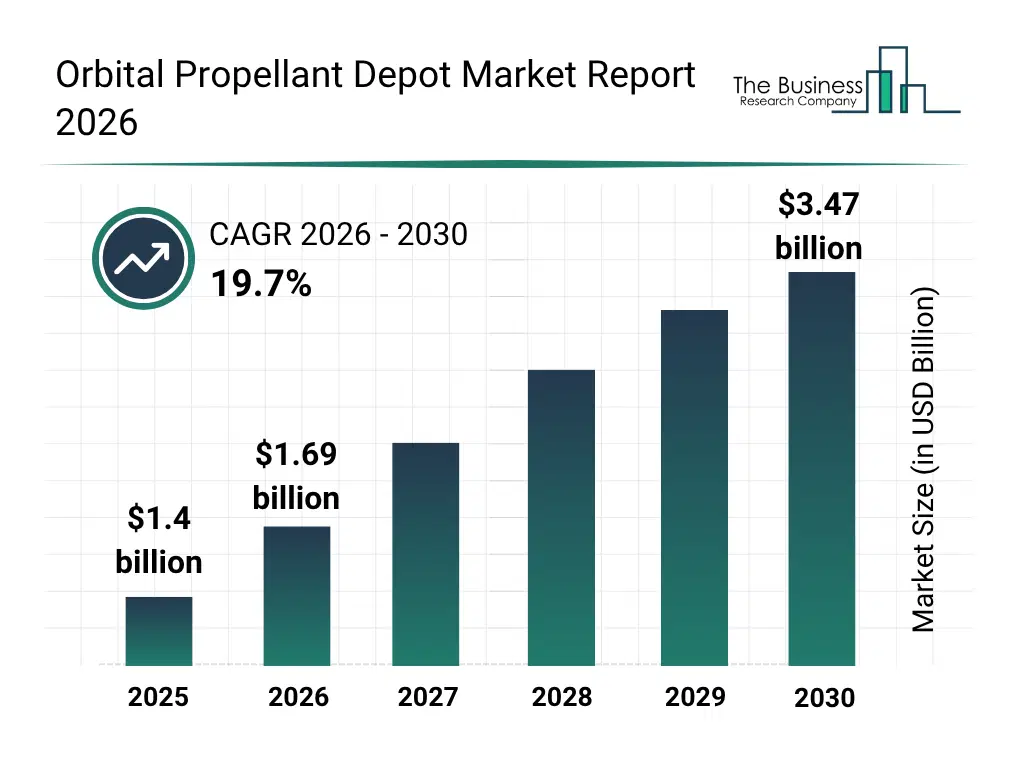
What Is The Orbital Propellant Depot Market Size and Share 2026?
The orbital propellant depot market size has grown exponentially in recent years. It will grow from $1.4 billion in 2025 to $1.69 billion in 2026 at a compound annual growth rate (CAGR) of 20.2%. The growth in the historic period can be attributed to increasing satellite launches, growing demand for extended spacecraft mission life, rising government investment in space infrastructure, increasing development of reusable launch vehicles, growing demand for in-orbit servicing capabilities.What Is The Orbital Propellant Depot Market Growth Forecast?
The orbital propellant depot market size is expected to see rapid growth in the next few years. It will grow to $3.47 billion in 2030 at a compound annual growth rate (CAGR) of 19.7%. The growth in the forecast period can be attributed to expansion of commercial space transportation, rising demand for in-orbit refueling services, increasing cislunar exploration missions, growing deployment of large spacecraft and satellite constellations, increasing investment in sustainable space logistics. Major trends in the forecast period include in-orbit propellant transfer technologies, cryogenic propellant storage systems, reusable space transportation infrastructure, standardized refueling interfaces, long-duration propellant management.Tariff Impact On Orbital Propellant Depot Market
Tariffs are impacting the orbital propellant depots market by increasing the cost of specialized aerospace components, cryogenic storage systems, valves, sensors, electronics, and manufacturing equipment used in depot development. Commercial satellite operators, space logistics service providers, and government programs may face higher procurement and development costs, particularly in North America, Europe, and Asia-Pacific where aerospace supply chains rely on internationally sourced components. However, tariffs can encourage regional manufacturing, supplier diversification, and domestic production of critical space infrastructure components, strengthening supply-chain resilience and supporting the development of localized orbital servicing capabilities.
Global Orbital Propellant Depot Market Segmentation
2) By Propellant Type: Liquid Oxygen, Liquid Hydrogen, Methane, Other Propellant Types 3) By Service Type: In Orbit Refueling, Propellant Storage, Propellant Transfer, Fuel Management And Monitoring, On Orbit Logistics Support 4) By End User: Government Space Agencies, Commercial Satellite Operators, Defense Organizations, Space Logistics Service Providers Subsegments: 1) By Permanent: Low Earth Orbit Depots, Medium Earth Orbit Depots, Geostationary Orbit Depots, Cislunar Propellant Depots 2) By Temporary: Mission Specific Propellant Depots, Campaign Based Propellant Depots, Deployable Propellant Depots, Mobile Orbital Propellant DepotsWhat Is The Driver Of The Orbital Propellant Depot Market?
The increasing number of satellite launches is expected to propel the growth of the orbital propellant depot market going forward. Satellite launches involve the deployment of communication, navigation, Earth observation, and scientific satellites into orbit to support various space-based applications. The demand for satellite launches is increasing due to the growing need for global connectivity, as satellites enable high-speed internet access, reliable communication services, and network coverage in remote and underserved regions where traditional terrestrial infrastructure is limited or unavailable. Rising satellite launch activities drive demand for orbital propellant depots by increasing the need for in-space refueling solutions that extend satellite operational lifespans, enable longer-duration missions, reduce launch costs, and support complex space operations. For instance, in July 2025, according to a report published by the Space Foundation, a US-based non-profit organization, global orbital launch activity reached record levels, with 149 orbital launches recorded during the first half of 2025, making it the busiest first half of a year on record at that time. The launch pace reached approximately one orbital launch every 28 hours, with most launches carrying communications satellites into orbit. Therefore, the increasing number of satellite launches is driving the growth of the orbital propellant depot industry.Key Players In The Global Orbital Propellant Depot Market
Major companies operating in the orbital propellant depot market are The Boeing Company, Lockheed Martin Corporation, Airbus SE, Space Exploration Technologies Corp., Blue Origin LLC, Firefly Aerospace Inc., Sierra Space Corporation, Northrop Grumman Corporation, Orbit Fab Inc., Momentus Inc., Exotrail SAS, SAB Aerospace Inc., Argo Space Corporation, Gateway Galactic Inc., OHB SE, Astrobotic Technology Inc., Astroscale Holdings Inc., Impulse Space Inc.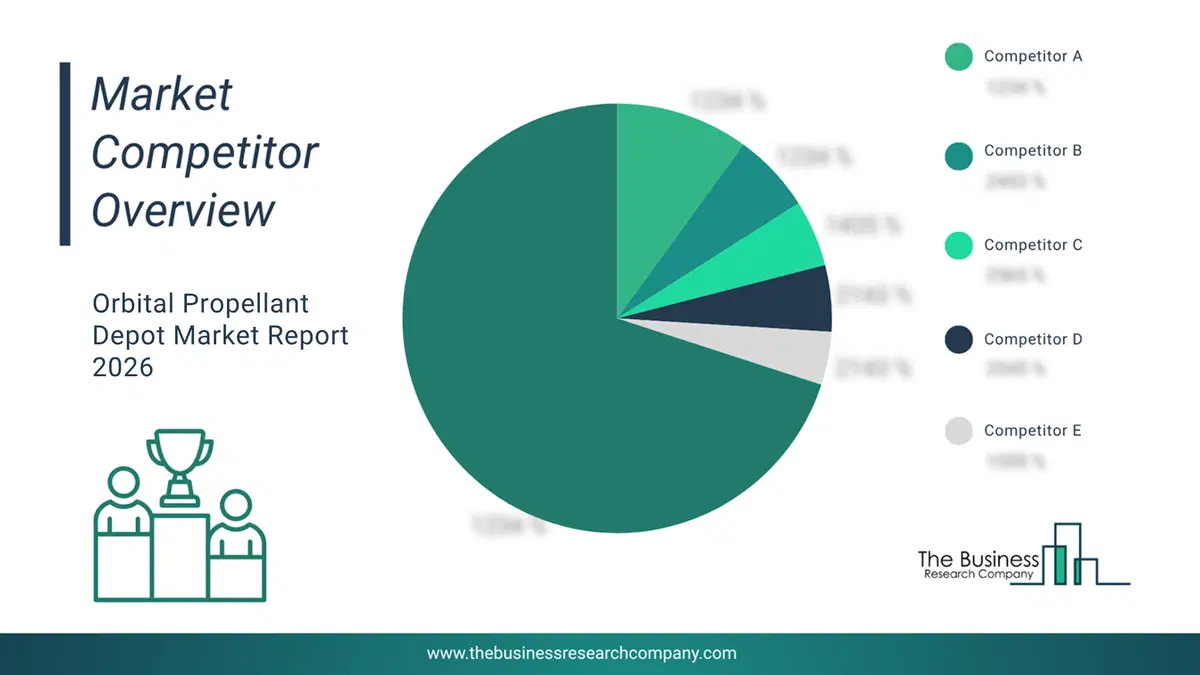
This chart is for illustrative purposes; the full report includes a detailed competitor analysis and comprehensive overview of the top 10 companies in the market.
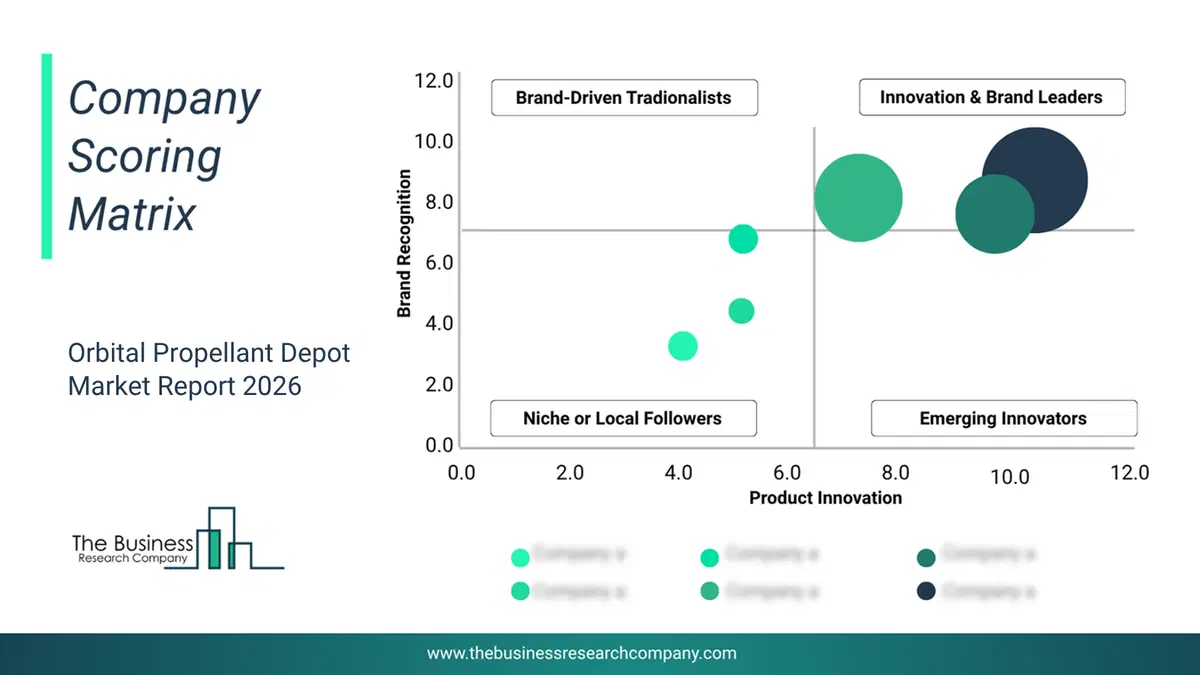
This chart maps companies by product innovation and brand strength, with bubble size indicating relative revenue, helping identify market leaders, challengers, and niche players. This is an illustrative chart; the full report provides a complete and accurate competitive analysis.
Global Orbital Propellant Depot Market Trends and Insights
Major companies operating in the orbital propellant depot market are focusing on developing advanced architectures such as, in-orbit refueling architectures to enhance satellite mission endurance, operational flexibility, and space logistics efficiency. In-orbit refueling architectures are integrated systems comprising orbital fuel depots and fuel transport vehicles that store, transfer, and replenish propellant for spacecraft in space, enabling satellites to extend operational life, perform multiple maneuvers, and reduce dependence on single-launch fuel capacity compared to traditional non-refuelable spacecraft. For instance, in April 2026, Orbit Fab Inc., a US-based space infrastructure company, unveiled RAVEN and NEST, an advanced in-space refueling architecture for orbital propellant depot applications. RAVEN is a refueling shuttle capable of transporting 150–200 kilograms of propellant and docking directly with compatible satellites using the company's active docking and fluid transfer technology, while NEST serves as an on-orbit fuel depot that stores larger propellant volumes and replenishes RAVEN for successive servicing missions. Together, the system creates a distributed orbital fuel network designed to support responsive satellite refueling across multiple missions and orbital regimes, improving spacecraft maneuverability, extending mission lifetimes, and enabling more sustainable space operations.What Are Latest Mergers And Acquisitions In The Orbital Propellant Depot Market?
In March 2026, Orbit Fab, a US-based space infrastructure company that develops orbital propellant depots, partnered with Airbus Defence and Space to assess the feasibility of integrating Orbit Fab’s RAFTI refueling valve into potential future Airbus geostationary satellites. Through this partnership, Orbit Fab aims to advance in-orbit satellite refueling capabilities by enabling Airbus satellites to be adapted for refueling operations, supporting longer mission lifetimes, and reducing reliance on replacement spacecraft. Airbus Defence and Space is a Germany-based aerospace and defense company that develops and manufactures military aircraft, space systems, satellites, and related defense technologies.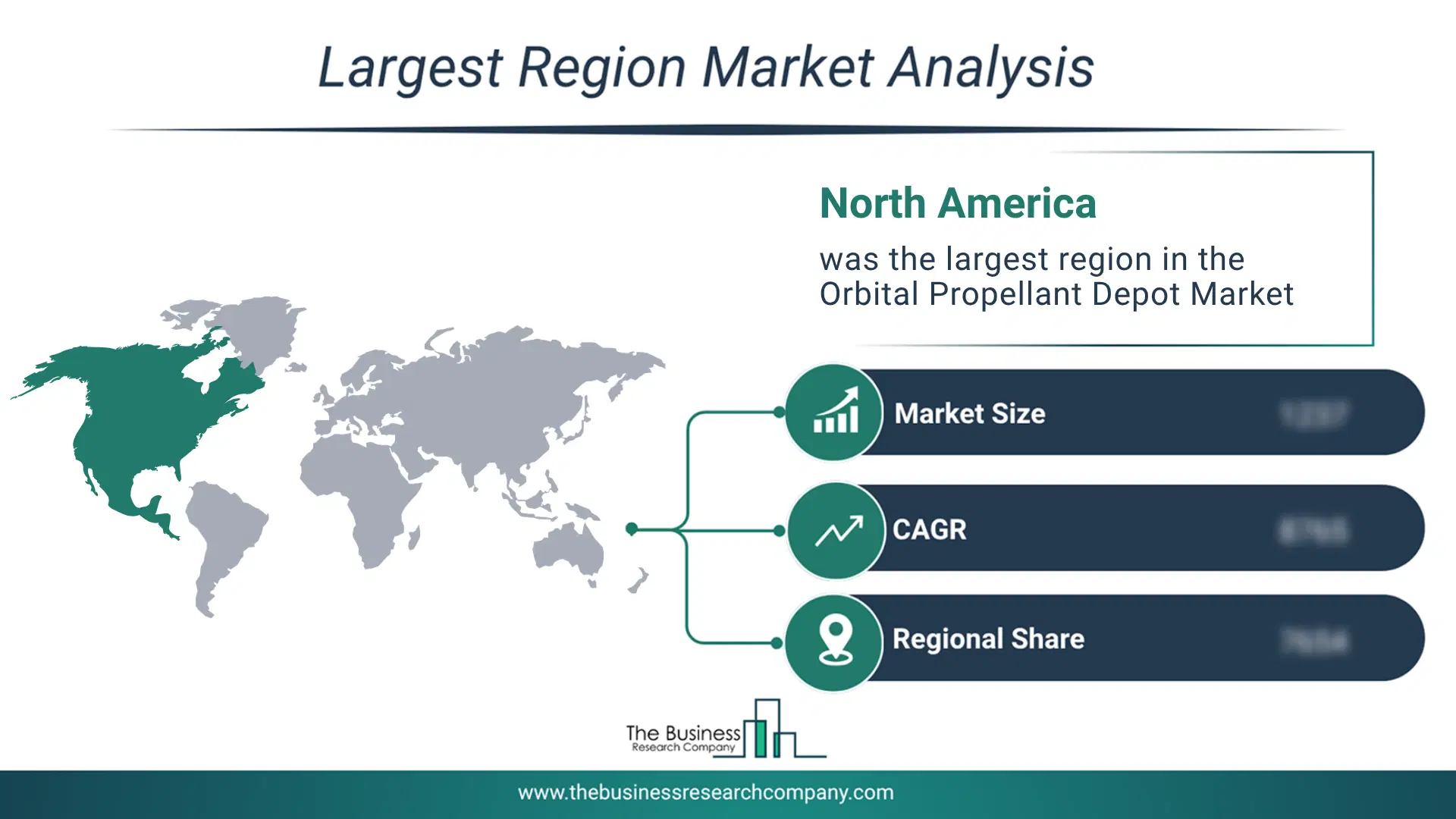
Regional Outlook/Insights
North America was the largest region in the orbital propellant depot market in 2025. Asia-Pacific is expected to be the fastest-growing region in the forecast period. The regions covered in this market report are Asia-Pacific, South East Asia, Western Europe, Eastern Europe, North America, South America, Middle East, Africa. The countries covered in this market report are Australia, Brazil, China, France, Germany, India, Indonesia, Japan, Taiwan, Russia, South Korea, UK, USA, Canada, Italy, Spain.What Defines the Orbital Propellant Depot Market?
The orbital propellant depot market consists of revenues earned by entities by providing services such as in-orbit propellant storage, refueling operations, propellant transfer, depot management, mission support, spacecraft docking and fueling coordination. The market value includes the value of related goods sold by the service provider or included within the service offering. The orbital propellant depot market also includes sales of propellant storage tanks, fluid transfer systems, cryogenic storage systems, docking and refueling interfaces, thermal management systems, pressure control equipment, valves, pumps, and sensors. Values in this market are ‘factory gate’ values, that is the value of goods sold by the manufacturers or creators of the goods, whether to other entities (including downstream manufacturers, wholesalers, distributors and retailers) or directly to end customers. The value of goods in this market includes related services sold by the creators of the goods.How is Market Value Defined and Measured?
The market value is defined as the revenues that enterprises gain from the sale of goods and/or services within the specified market and geography through sales, grants, or donations in terms of the currency (in USD unless otherwise specified). The revenues for a specified geography are consumption values that are revenues generated by organizations in the specified geography within the market, irrespective of where they are produced. It does not include revenues from resales along the supply chain, either further along the supply chain or as part of other products.
This chart presents market attractiveness based on a quantitative evaluation of growth, competition, strategic alignment, and risk, offering a clear view of opportunity areas for decision-making. This chart is for illustrative purposes; the full report contains the complete analysis.

This chart highlights the Total Addressable Market (TAM) by estimating the maximum revenue opportunity using an assumption-driven approach, supporting strategic planning and opportunity sizing across markets. The chart is illustrative; the full report provides a more comprehensive analysis.
What Key Data and Analysis Are Included in the Orbital Propellant Depot Market Report 2026?
The orbital propellant depot market research report is one of a series of new reports from The Business Research Company that provides market statistics, including industry global market size, regional shares, competitors with the market share, detailed market segments, market trends and opportunities, and any further data you may need to thrive in the orbital propellant depot industry. The market research report delivers a complete perspective of everything you need, with an in-depth analysis of the current and future state of the industry.Orbital Propellant Depot Market Report Forecast Analysis
| Report Attribute | Details |
|---|---|
| Market Size Value In 2026 | $1.69 billion |
| Revenue Forecast In 2030 | $3.47 billion |
| Growth Rate | CAGR of 19.7% from 2026 to 2035 |
| Base Year For Estimation | 2025 |
| Actual Estimates/Historical Data | 2020-2025 |
| Forecast Period | 2026 - 2030 |
| Market Representation | Revenue in USD Billion and CAGR from 2026 to 2030 |
| Segments Covered | Depot Type, Propellant Type, Service Type, End User |
| Regional Scope | Asia-Pacific, Western Europe, Eastern Europe, North America, South America, Middle East, Africa |
| Country Scope | The countries covered in the report are Australia, Brazil, China, France, Germany, India, Indonesia, Japan, Taiwan, Russia, South Korea, UK, USA, Canada, Italy, Spain. |
| Customization Scope | Request for Customization |
| Pricing And Purchase Options | Explore Purchase Options |