
Organic Light Emitting Diode (OLED) Market Report 2026
Global Outlook – By Product Type ( Display, Lighting), By Technology ( Active-Matrix OLED, Passive-Matrix OLED, Foldable OLED, White OLED, Transparent OLED, Other Technologies), By Display Panel Type ( Rigid, Flexible, Other Display Panels), By End-User ( Consumer Electronics, Automotive, Retail, Industrial, Commercial, Aerospace And Defense, Healthcare, Other End-Users) – Market Size, Trends, Strategies, and Forecast to 2030
Organic Light Emitting Diode (OLED) Market Overview
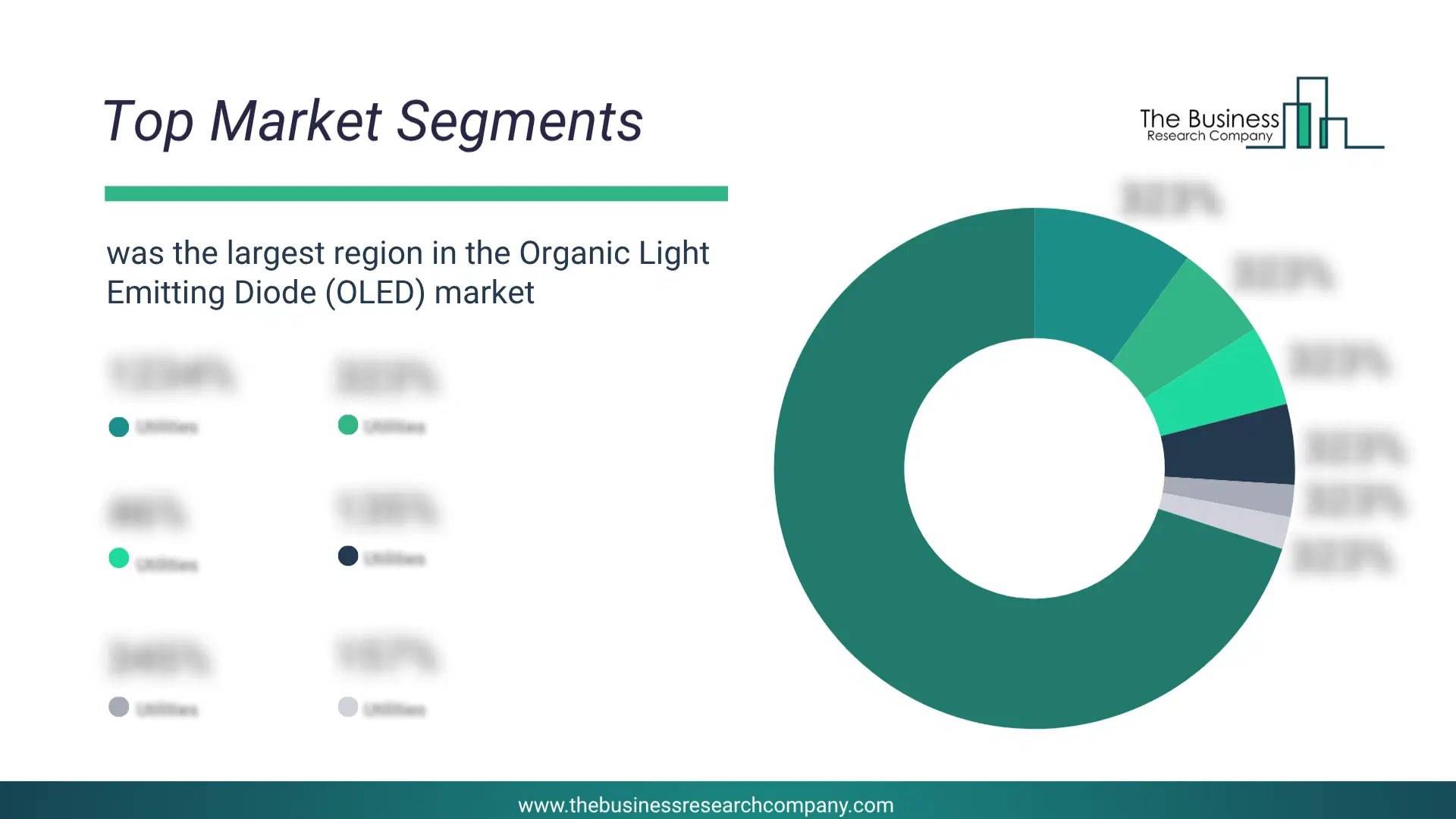
• Organic Light Emitting Diode (OLED) market size has reached to $52.8 billion in 2025 • Expected to grow to $94.93 billion in 2030 at a compound annual growth rate (CAGR) of 12.6% • Growth Driver: The Role Of The Automotive Industry In Fueling OLED Market Expansion • Market Trend: Strategic Partnership In The OLED Market • North America was the largest region in 2025.Market Gains By 2030 – Top Opportunities By Segment
Market Gain identifies the most promising market opportunities by highlighting the segments or products expected to generate the highest incremental revenue growth over the next five years.
What Is Covered Under Organic Light Emitting Diode (OLED) Market?
Organic light-emitting diodes known as OLEDs, are solid-state monolithic devices with several organic thin films sandwiched between two thin-film conducting electrodes. Organic light-emitting diodes (OLEDs) are utilized in display and lighting applications because they deliver bright, vibrant colors and rich blacks. Their energy efficiency, flexibility, and capability to be manufactured as thin panels make them suitable for a variety of devices that provide superior viewing angles. The main products of OLED are display and lighting. OLED display does not require a backlight as it generates its light and provides better picture quality and consumes less power and is more expensive. The technologies used are Active-matrix OLED (AMOLED), passive-matrix OLED (PAMOLED), foldable OLED, white OLED, and transparent OLED, for rigid, flexible, and other display panels by consumer electronics, automotive, retail, industrial, commercial, aerospace and defense, healthcare, and others.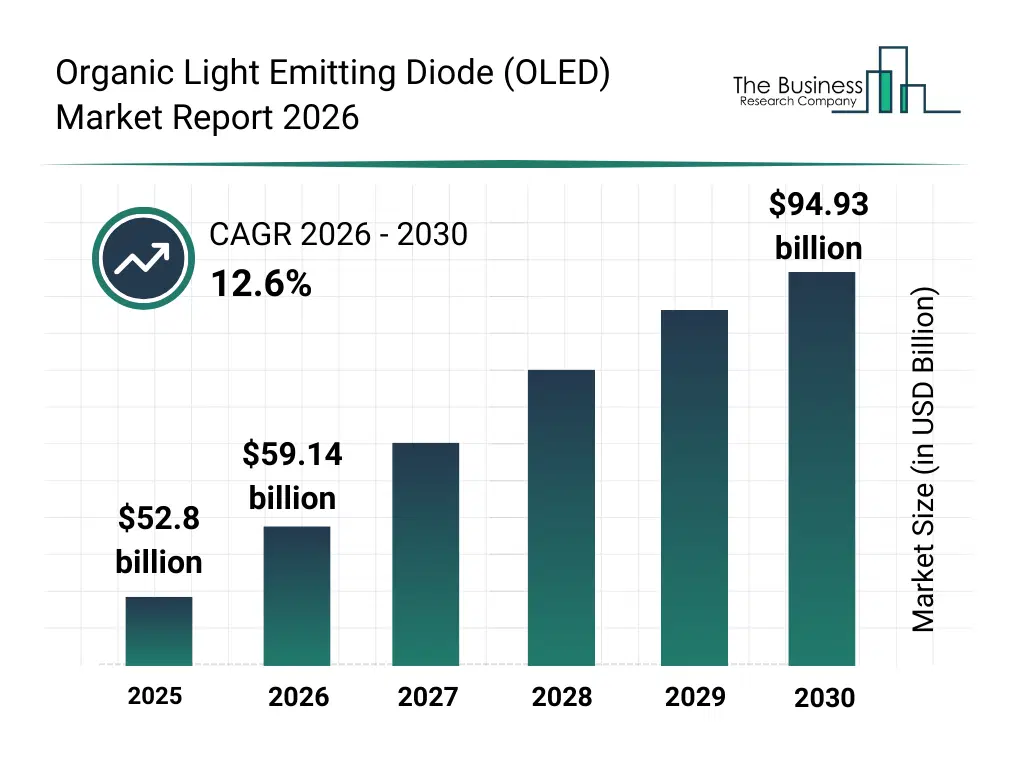
What Is The Organic Light Emitting Diode (OLED) Market Size 2026 And Growth Rate?
The organic light emitting diode (oled) market size has grown rapidly in recent years. It will grow from $52.8 billion in 2025 to $59.14 billion in 2026 at a compound annual growth rate (CAGR) of 12.0%. The growth in the historic period can be attributed to early adoption in smartphone displays, reliance on thin-film organic materials, initial deployment in premium televisions, expansion of oled signage applications, growth in automotive interior lighting.What Is The Organic Light Emitting Diode (OLED) Market Growth Forecast?
The organic light emitting diode (oled) market size is expected to see rapid growth in the next few years. It will grow to $94.93 billion in 2030 at a compound annual growth rate (CAGR) of 12.6%. The growth in the forecast period can be attributed to rising demand for foldable oled displays, increasing adoption of transparent oled panels, development of high-efficiency white oled lighting, expansion of wearable oled devices, growing use of oleds in medical and industrial imaging. Major trends in the forecast period include adoption of advanced oled display technologies, development of energy-efficient oled lighting, expansion of oleds in electric mobility displays, integration of intelligent manufacturing for oled panels, growth of IoT-connected oled applications.
Global Organic Light Emitting Diode (OLED) Market Segmentation
1) By Product Type: Display, Lighting 2) By Technology: Active-Matrix OLED, Passive-Matrix OLED, Foldable OLED, White OLED, Transparent OLED, Other Technologies 3) By Display Panel Type: Rigid, Flexible, Other Display Panels 4) By End-User: Consumer Electronics, Automotive, Retail, Industrial, Commercial, Aerospace And Defense, Healthcare, Other End-Users Subsegments: 1) By Display: Televisions, Smartphones, Tablets, Laptops Or Computers, Wearable Devices, Digital Signage, Automotive Displays 2) By Lighting: General Lighting, Architectural Lighting, Automotive Lighting, Decorative Lighting, Commercial Lighting The top segments in the organic light emitting diode (oled) market will be: • Display will reach $81.1 Billion by 2030. • Lighting will reach $13.38 Billion by 2030.What Is The Driver Of The Organic Light Emitting Diode (OLED) Market?
Increasing demand from the automotive industry is expected to propel the growth of the OLED market going forward. The automotive industry refers to the firms and organizations that are involved in the design, development, manufacture, marketing, and sale of motor vehicles, towing vehicles, motorcycles, and mopeds. OLEDs' self-illuminating nature is used in automobiles to offer vibrant colors, deep blacks, and wide viewing angles for instrument clusters, navigation systems, and infotainment screens. For instance, in February 2023, according to MotorCycles Data, a UK-based sales data reporting company for motorcycle brands, the sales of Honda Motor Co. Ltd., a Japan-based automobile, motorcycle, and two-wheeler manufacturing company, reached 17.6 million, an increase of 4.9% from the previous year with a 29.4% market share worldwide. Therefore, the increasing demand from the automotive industry is driving the growth of the OLED market.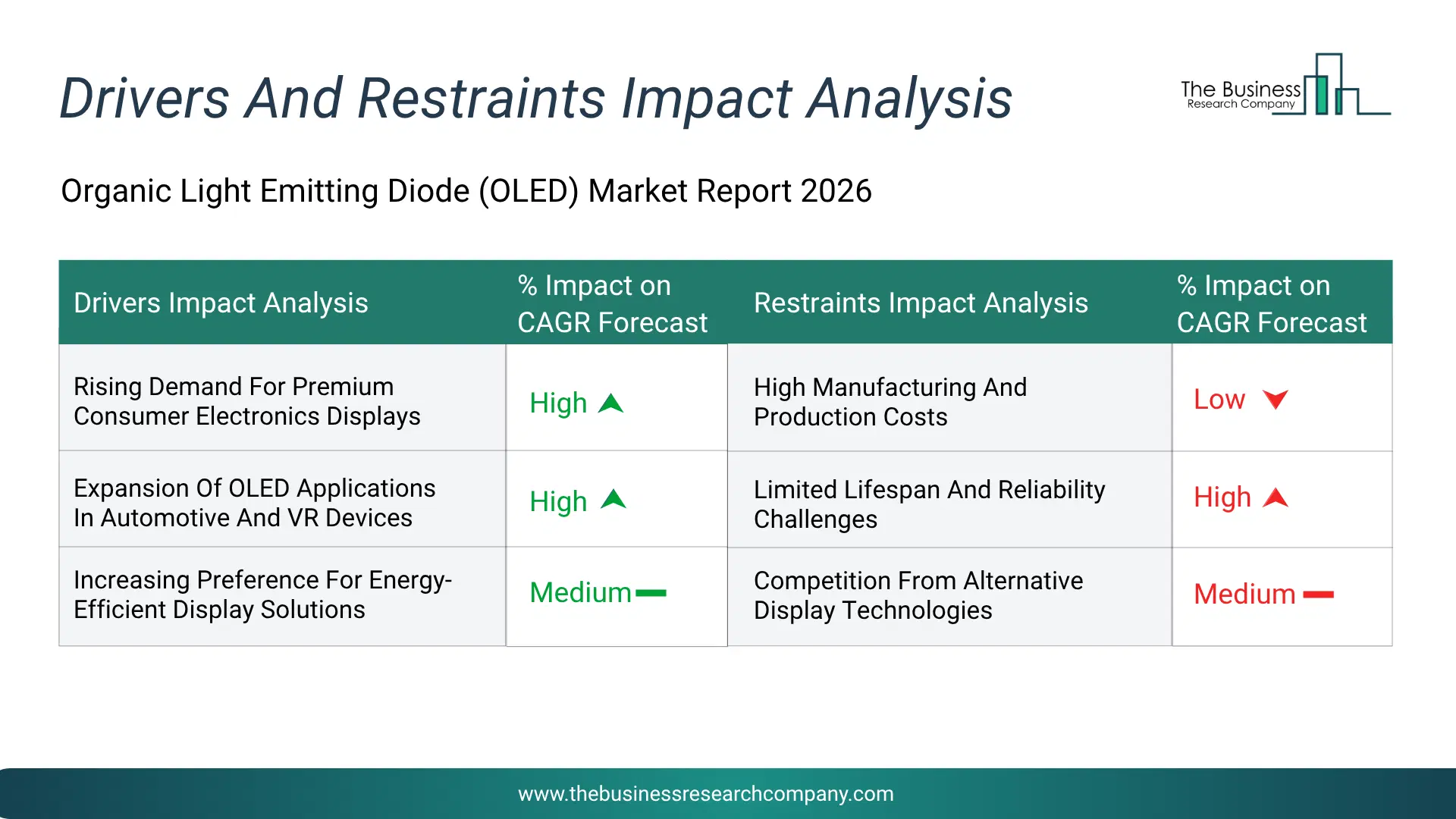
Infographic Chart Showing Key Market Drivers Analysis And Restraints For Organic Light Emitting Diode (Oled) Market
The chart presents an impact analysis of key drivers and restraints, quantifying their relative influence on the market's growth rate and helping assess the balance between growth enablers and limiting factors. This chart offers a high-level perspective; the full report contains more detailed insights.
How Will The Drivers Impact Growth In The Global Organic Light Emitting Diode (OLED) Market?
• Rising Demand For Premium Consumer Electronics Displays (High) – During the forecast period, the rising demand for premium consumer electronics displays is expected to become a key growth driver for the organic light emitting diode (OLED) market by 2030. The increasing consumer preference for high-resolution smartphones, televisions, laptops, tablets, and wearable devices is significantly driving the adoption of OLED technology. OLED displays offer superior image quality, deeper blacks, wider viewing angles, and enhanced color accuracy compared to conventional display technologies, making them a preferred choice for premium electronic products. Growing consumption of high-definition content, gaming applications, and immersive digital experiences is further accelerating demand for advanced display solutions. In addition, manufacturers are increasingly integrating OLED panels into flagship consumer devices to differentiate product offerings and enhance user experiences. • Expansion Of OLED Applications In Automotive And VR Devices (High) – During the forecast period, the expansion of OLED applications in automotive and virtual reality (VR) devices is expected to emerge as a major factor driving the expansion of the organic light emitting diode (OLED) market by 2030. OLED technology is increasingly being adopted across automotive and immersive technology applications due to its flexibility, lightweight structure, and superior display performance. Automotive manufacturers are integrating OLED displays into digital instrument clusters, infotainment systems, and advanced cockpit displays to enhance aesthetics and functionality. Similarly, the growing adoption of virtual reality and augmented reality devices is increasing demand for high-performance displays capable of delivering immersive visual experiences. As OLED technology continues to expand beyond traditional consumer electronics applications, its addressable market is broadening across multiple high-growth industries. • Increasing Preference For Energy-Efficient Display Solutions (Medium) – During the forecast period, the increasing preference for energy-efficient display solutions is expected to act as a key growth catalyst for the organic light emitting diode (OLED) market by 2030. OLED displays are gaining widespread acceptance due to their ability to deliver high-quality visual performance while consuming less power than many conventional display technologies. Since OLED panels do not require backlighting, they offer improved energy efficiency and support the development of thinner and lighter electronic devices. This characteristic is particularly valuable for battery-powered products such as smartphones, wearables, tablets, and electric vehicles, where energy optimization is critical. Furthermore, manufacturers are increasingly adopting energy-efficient technologies to meet sustainability goals and improve product performance.How Will The Restraints Impact Growth In The Global Organic Light Emitting Diode (OLED) Market?
• High Manufacturing And Production Costs (High) – During the forecast period, the high production costs remain a major barrier to OLED market expansion. OLED manufacturing requires complex fabrication processes, expensive materials, and specialized facilities, making it significantly costlier than LCD alternatives. For instance, automotive OLED displays can cost 5–6 times more than comparable consumer OLED displays, limiting adoption in cost-sensitive segments. These high costs are often passed to end users, restricting demand in mid-range and budget markets. As a result, OLED penetration remains concentrated in premium segments. • Limited Lifespan And Reliability Challenges (High) – During the forecast period, the OLED displays face durability and lifespan issues, particularly under demanding conditions. In automotive applications, around 20–25% of OLED panels fail to meet durability or cost targets, highlighting reliability concerns. OLED materials can degrade over time, leading to reduced brightness and performance inconsistencies. These limitations require additional engineering solutions, increasing costs and complexity. Such reliability concerns slow adoption in long-term use cases like automotive and large displays. • Competition From Alternative Display Technologies (Medium) – During the forecast period, the OLED market faces strong competition from alternative technologies such as LCD and Mini-LED. Despite OLED advantages, it still carries a price premium, and competing technologies continue to improve in performance and cost efficiency. Market data indicates that OLED pricing remains higher despite recent reductions of 15–20% compared to previous years, limiting its mass adoption. This competition reduces OLED’s share in price-sensitive segments and slows overall market penetration.Key Players In The Global Organic Light Emitting Diode (OLED) Market
Major companies operating in the organic light emitting diode (oled) market are Panasonic Corporation, Toshiba Corporation, BOE Technology Group Co. Ltd., LG Display Co. Ltd., Corning Incorporated, DuPont de Nemours Inc., AUO Corporation, Tianma Microelectronics Co. Ltd., Japan Display Inc., Truly Semiconductors Ltd, OSRAM Licht AG, Universal Display Corporation, Everdisplay Optronics (Shanghai) Co. Ltd., Futaba Corporation, Royole Corporation, Wisechip Semiconductor Inc., Kopin Corporation, Winstar Display Co. Ltd., OLEDWorks LLC, Newhaven Display International Inc, FlexEnable Limited, Luminescence Technology Corp., General Digital Corporation, Raystar Optronics Inc, Pixelligient Technologies LLC, Lumiotec Inc., Dresden Microdisplay GmbH, Samsung Display Co. Ltd.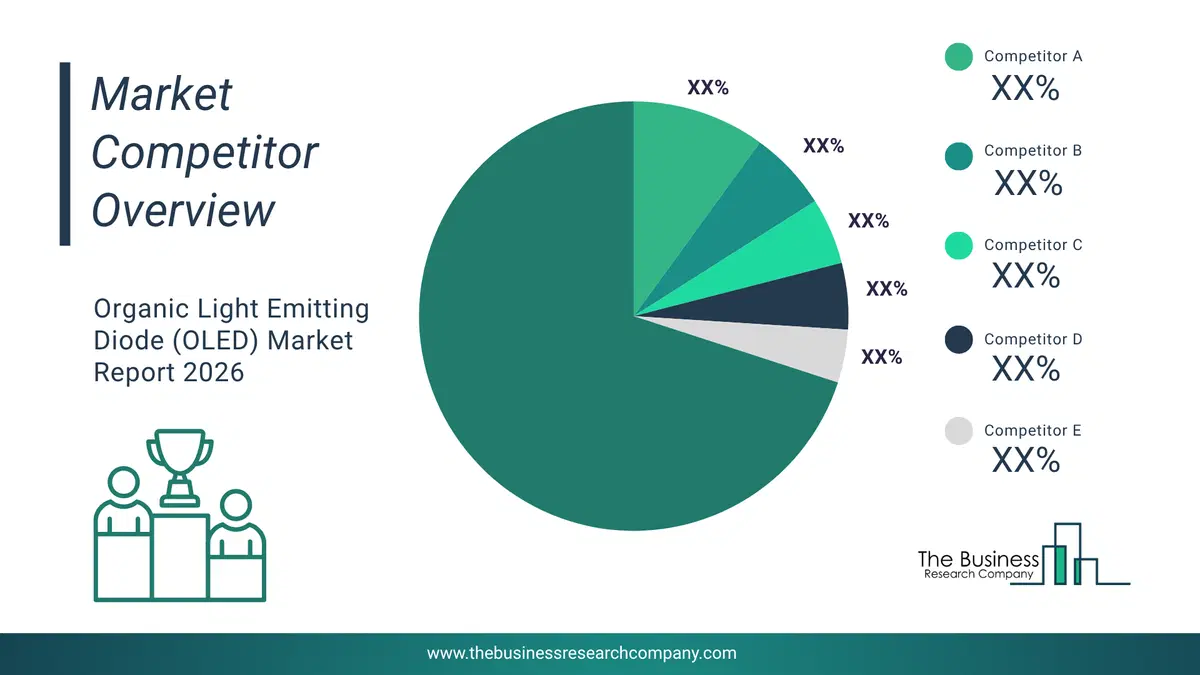
This chart is for illustrative purposes; the full report includes a detailed competitor analysis and comprehensive overview of the top 10 companies in the market.
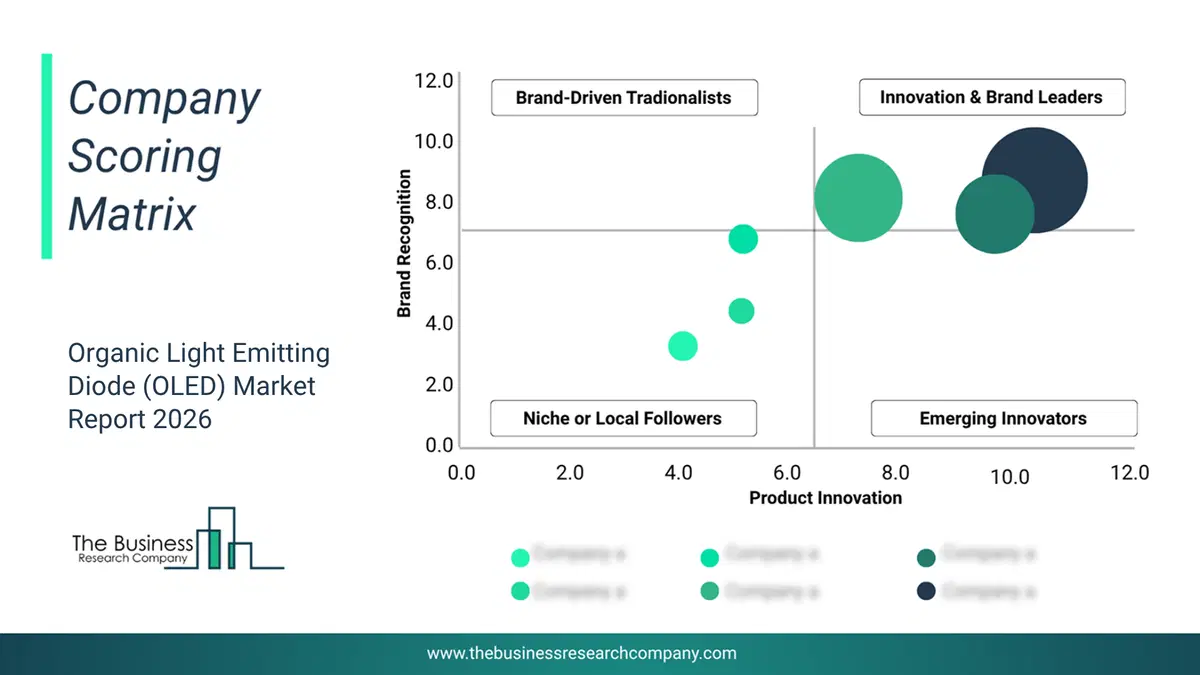
This chart maps companies by product innovation and brand strength, with bubble size indicating relative revenue, helping identify market leaders, challengers, and niche players. This is an illustrative chart; the full report provides a complete and accurate competitive analysis.
Global Organic Light Emitting Diode (OLED) Market Trends and Insights
Major companies operating in the organic light emitting diode market are focusing on developing innovative solutions such as in-vehicle infotainment (IVI) display upgrade to enhance driver experience, improve visual clarity, and integrate energy-efficient, high-resolution OLED screens into modern automobiles. In-vehicle infotainment (IVI) display upgrade refers to enhancing a vehicle’s built-in multimedia and information system with advanced screens, such as OLED panels, to provide higher resolution, better color, and improved functionality for navigation, entertainment, and connectivity. For instance, in April 2023, Ferrari, an Italy-based luxury sports car manufacturer, collaborated with Samsung Display, a South Korea-based electronics company, to incorporate Samsung’s OLED panels in upcoming vehicle models. This partnership allows Ferrari to enhance in-car displays with vibrant visuals, improved energy efficiency, and cutting-edge design flexibility, elevating the overall user experience.What Are Latest Mergers And Acquisitions In The Organic Light Emitting Diode (OLED) Market?
In May 2023, eMagin, a US-based microOLED display company, entered into a definitive merger agreement with Samsung Display to enhance microOLED technology development and expand its global market reach. This merger aims to combine eMagin’s expertise in microOLED displays with Samsung Display’s advanced OLED manufacturing capabilities to drive innovation and expand adoption of high-resolution displays in augmented reality (AR), virtual reality (VR), and wearable devices. Samsung Display is a South Korea-based electronics company specializing in OLED and advanced display technologies.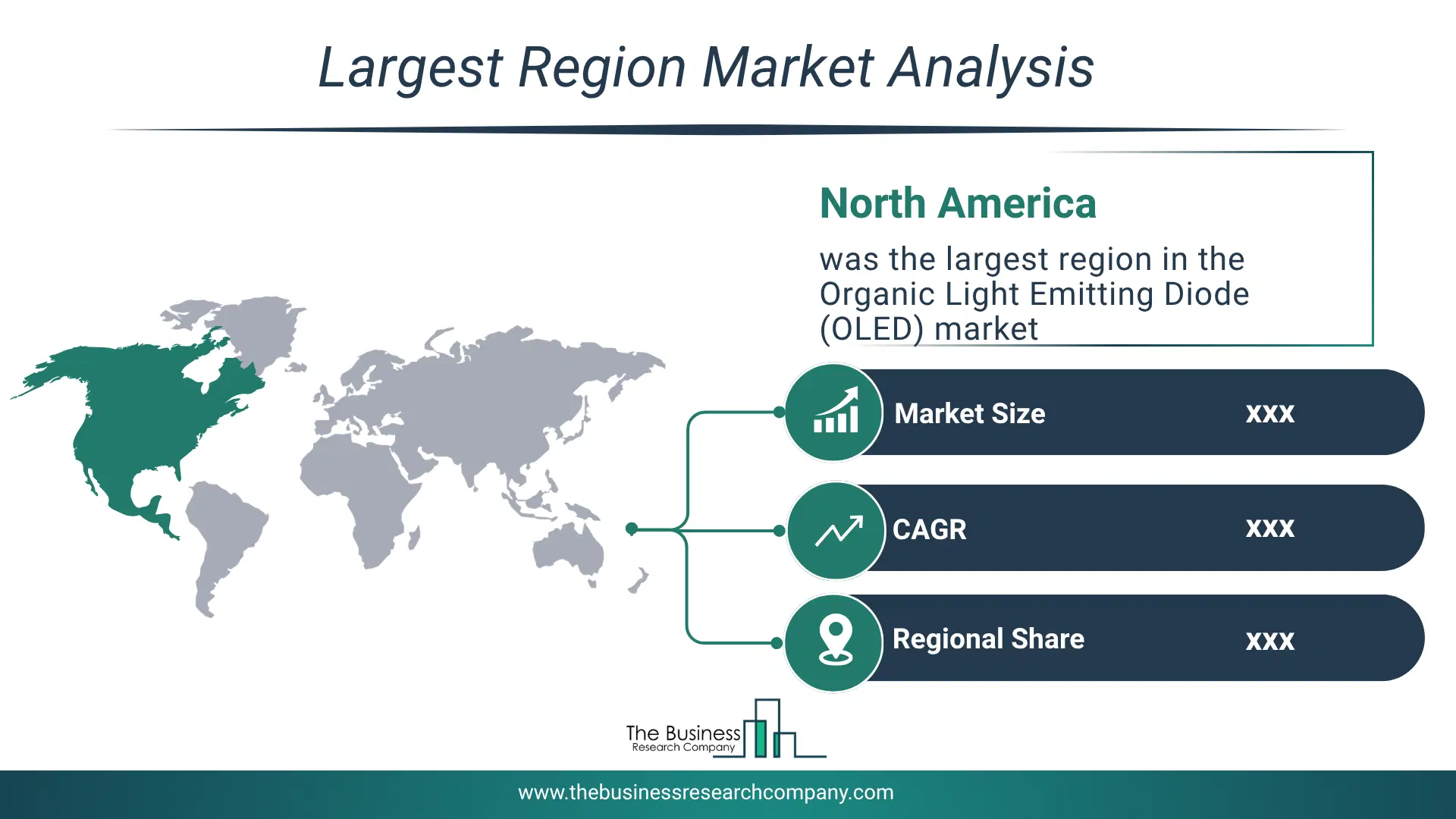
Regional Outlook
North America was the largest region in the OLED market in 2025. The regions covered in this market report are Asia-Pacific, South East Asia, Western Europe, Eastern Europe, North America, South America, Middle East, Africa. The countries covered in this market report are Australia, Brazil, China, France, Germany, India, Indonesia, Japan, Taiwan, Russia, South Korea, UK, USA, Canada, Italy, Spain.What Defines the Organic Light Emitting Diode (OLED) Market?
The OLED market includes revenues earned by providing services such as device management, content services, software updates, repair, and maintenance. The market value includes the value of related goods sold by the service provider or included within the service offering. The OLED market also includes sales of watches, notebooks, tablets, automobile displays, advertising displays, and virtual reality (VR) headsets. Values in this market are ‘factory gate’ values, that is the value of goods sold by the manufacturers or creators of the goods, whether to other entities (including downstream manufacturers, wholesalers, distributors and retailers) or directly to end customers. The value of goods in this market includes related services sold by the creators of the goods.How is Market Value Defined and Measured?
The market value is defined as the revenues that enterprises gain from the sale of goods and/or services within the specified market and geography through sales, grants, or donations in terms of the currency (in USD unless otherwise specified). The revenues for a specified geography are consumption values that are revenues generated by organizations in the specified geography within the market, irrespective of where they are produced. It does not include revenues from resales along the supply chain, either further along the supply chain or as part of other products.
This chart presents market attractiveness based on a quantitative evaluation of growth, competition, strategic alignment, and risk, offering a clear view of opportunity areas for decision-making. This chart is for illustrative purposes; the full report contains the complete analysis.

This chart highlights the Total Addressable Market (TAM) by estimating the maximum revenue opportunity using an assumption-driven approach, supporting strategic planning and opportunity sizing across markets. The chart is illustrative; the full report provides a more comprehensive analysis.
What Key Data and Analysis Are Included in the Organic Light Emitting Diode (OLED) Market Report 2026?
The organic light emitting diode (oled) market research report is one of a series of new reports from The Business Research Company that provides market statistics, including industry global market size, regional shares, competitors with the market share, detailed market segments, market trends and opportunities, and any further data you may need to thrive in the organic light emitting diode (oled) industry. The market research report delivers a complete perspective of everything you need, with an in-depth analysis of the current and future state of the industry.Organic Light Emitting Diode (OLED) Market Report Forecast Analysis Market Report Forecast Analysis
| Report Attribute | Details |
|---|---|
| Market Size Value In 2026 | $59.14 billion |
| Revenue Forecast In 2030 | $94.93 billion |
| Growth Rate | CAGR of 12.0% from 2026 to 2030 |
| Base Year For Estimation | 2025 |
| Actual Estimates/Historical Data | 2020-2025 |
| Forecast Period | 2026 - 2030 |
| Market Representation | Revenue in USD Billion and CAGR from 2026 to 2030 |
| Segments Covered | Product Type, Technology, Display Panel Type, End-User |
| Regional Scope | Asia-Pacific, Western Europe, Eastern Europe, North America, South America, Middle East, Africa |
| Country Scope | The countries covered in the report are Australia, Brazil, China, France, Germany, India, Indonesia, Japan, Taiwan, Russia, South Korea, UK, USA, Canada, Italy, Spain. |
| Key Companies Profiled | Panasonic Corporation, Toshiba Corporation, BOE Technology Group Co. Ltd., LG Display Co. Ltd., Corning Incorporated, DuPont de Nemours Inc., AUO Corporation, Tianma Microelectronics Co. Ltd., Japan Display Inc., Truly Semiconductors Ltd, OSRAM Licht AG, Universal Display Corporation, Everdisplay Optronics (Shanghai) Co. Ltd., Futaba Corporation, Royole Corporation, Wisechip Semiconductor Inc., Kopin Corporation, Winstar Display Co. Ltd., OLEDWorks LLC, Newhaven Display International Inc, FlexEnable Limited, Luminescence Technology Corp., General Digital Corporation, Raystar Optronics Inc, Pixelligient Technologies LLC, Lumiotec Inc., Dresden Microdisplay GmbH, Samsung Display Co. Ltd. |
| Customization Scope | Request for Customization |
| Pricing And Purchase Options | Explore Purchase Options |