

Organic Polysulfide Market Report 2026
Global Outlook – By Product Type (Liquid Organic Polysulfide, Solid Organic Polysulfide), By Grade (Industrial Grade, High-Purity Grade), By Distribution Channel (Direct Sales, Distributors And Traders), By Application (Adhesives And Sealants, Coatings, Rubber Compounding, Chemical Synthesis), By End-Use Industry (Construction, Automotive, Aerospace, Marine) – Market Size, Trends, Strategies, and Forecast to 2030
Organic Polysulfide Market Overview
• Organic Polysulfide market size has reached to $0.76 billion in 2025 • Expected to grow to $1.15 billion in 2030 at a compound annual growth rate (CAGR) of 8.5% • Growth Driver: Growth In Construction And Infrastructure Development Increasing Demand For The Market Due To High-Performance Sealants And Protective Materials • Market Trend: Polysulfide-Based Material Development Strengthens Environmental Remediation Capabilities • Asia-Pacific was the largest region and fastest growing region.What Is Covered Under Organic Polysulfide Market?
Organic polysulfide is a sulfur-containing polymer composed of organic molecular chains linked by sulfur atoms, offering a unique combination of chemical stability, elasticity, and durability. Its molecular structure provides excellent resistance to chemicals, moisture, oxidation, and environmental degradation while maintaining flexibility under a wide range of conditions. The main product types in the organic polysulfides market include liquid organic polysulfide and solid organic polysulfide. Liquid organic polysulfide refers to sulfur-containing polymeric materials in liquid form that provide flexibility, chemical resistance, and durability for bonding and sealing applications. These products are available in industrial grade and high-purity grade and distributed through direct sales and distributors and traders. The key applications include adhesives and sealants, coatings, rubber compounding, and chemical synthesis and end-use industries include construction, automotive, aerospace, and marine.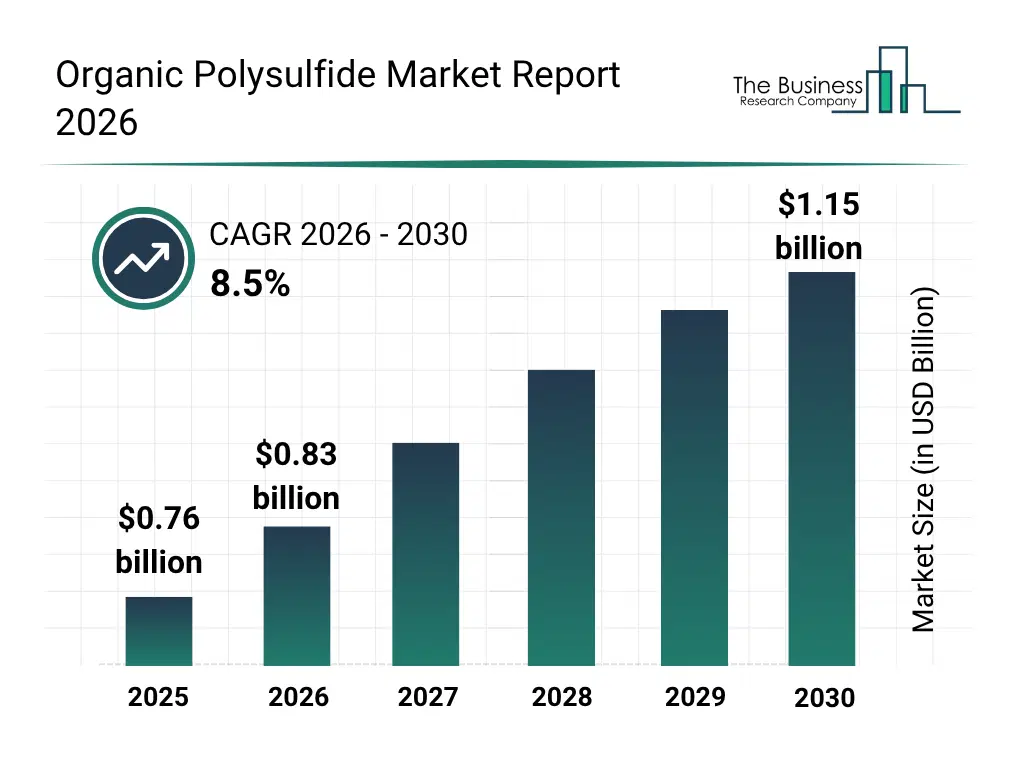
What Is The Organic Polysulfide Market Size and Share 2026?
The organic polysulfide market size has grown strongly in recent years. It will grow from $0.76 billion in 2025 to $0.83 billion in 2026 at a compound annual growth rate (CAGR) of 8.9%. The growth in the historic period can be attributed to growth in construction sealant applications, increasing automotive adhesive and sealant consumption, expansion of aerospace sealing applications, rising marine coating and sealing activities, growing use of polysulfides in rubber compounding.What Is The Organic Polysulfide Market Growth Forecast?
The organic polysulfide market size is expected to see strong growth in the next few years. It will grow to $1.15 billion in 2030 at a compound annual growth rate (CAGR) of 8.5%. The growth in the forecast period can be attributed to increasing demand for durable chemical-resistant sealants, growth in infrastructure construction and renovation, rising aircraft production and maintenance activities, increasing adoption of advanced automotive sealing materials, expansion of high-performance industrial coating applications. Major trends in the forecast period include increasing demand for high-performance polysulfide sealants, development of low-viscosity organic polysulfide formulations, growing use of solvent-free polysulfide products, rising demand for chemical- and moisture-resistant polymer materials, increasing development of specialized high-purity organic polysulfide grades.Tariff Impact On Organic Polysulfide Market
Tariffs are impacting the organic polysulfide market by increasing the cost of imported sulfur-based raw materials, specialty chemicals, additives, and processing equipment required for polymer production. This is slowing production and increasing costs for organic polysulfide manufacturers, particularly in regions dependent on imported chemical inputs such as Asia-Pacific and Europe. Application segments such as adhesives and sealants, coatings, and rubber compounding are most affected due to global supply chain dependencies. However, tariffs are also encouraging local raw material sourcing, regional supplier diversification, and increased investment in domestic polymer manufacturing, creating long-term resilience in the market.
Global Organic Polysulfide Market Segmentation
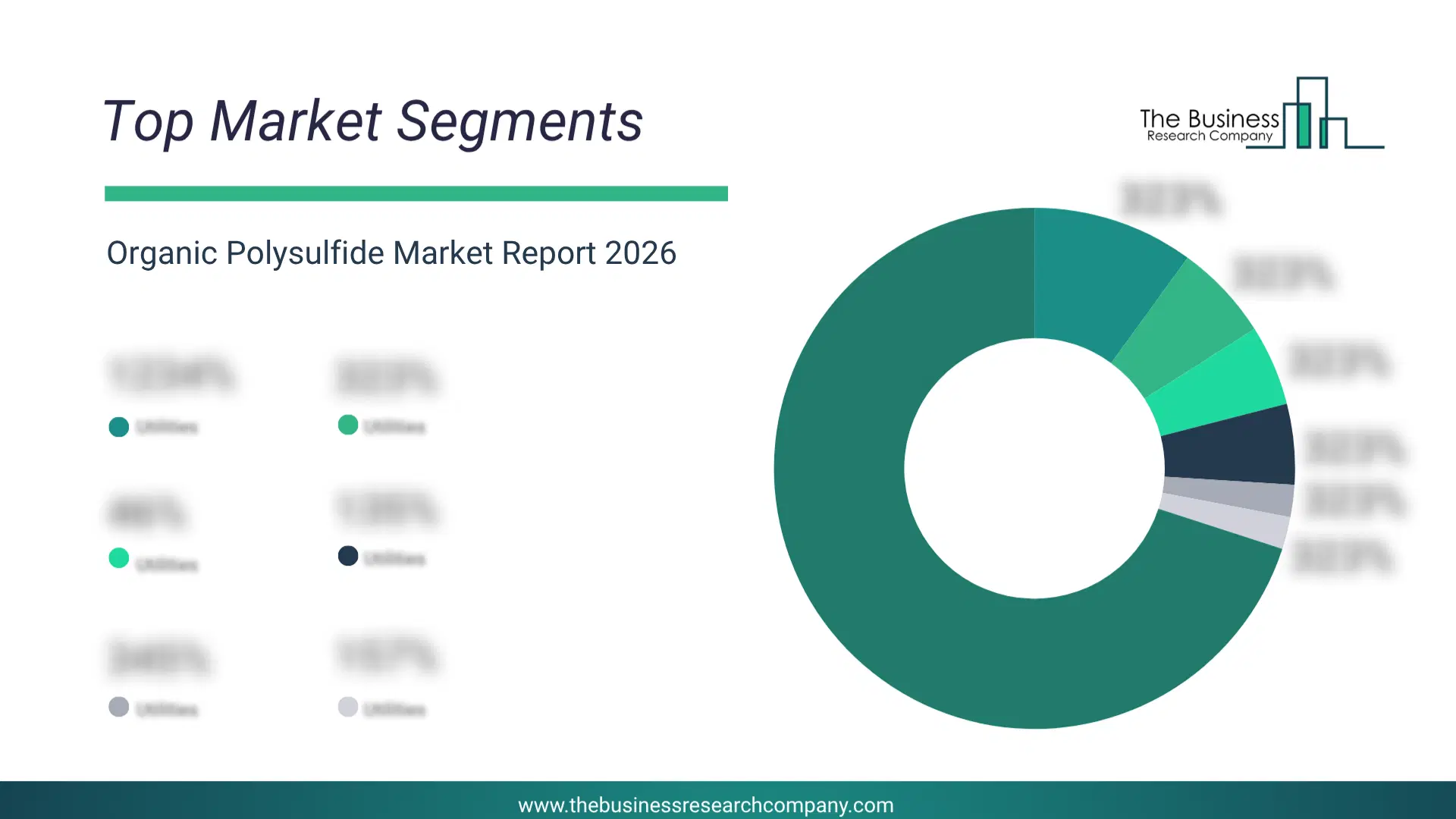
1) By Product Type: Liquid Organic Polysulfide, Solid Organic Polysulfide 2) By Grade: Industrial Grade, High-Purity Grade 3) By Distribution Channel: Direct Sales, Distributors And Traders 4) By Application: Adhesives And Sealants, Coatings, Rubber Compounding, Chemical Synthesis 5) By End-Use Industry: Construction, Automotive, Aerospace, Marine Subsegments: 1) By Liquid Organic Polysulfide: Single Component Liquid Organic Polysulfide, Two Component Liquid Organic Polysulfide, Solvent Based Liquid Organic Polysulfide, Solvent Free Liquid Organic Polysulfide 2) By Solid Organic Polysulfide: Granular Organic Polysulfide, Powder Organic Polysulfide, Pellet Organic Polysulfide, Flake Organic PolysulfideWhat Is The Driver Of The Organic Polysulfide Market?
The growth in construction and infrastructure development is expected to propel the growth of the organic polysulfide market going forward. Construction and infrastructure development is the process of building and upgrading physical structures and essential public facilities that support economic growth and improve quality of life. Construction and infrastructure development are increasing due to rapid urbanization, which drives demand for new housing, transportation networks, and essential public infrastructure. Construction and infrastructure development drive the growth of organic polysulfide by increasing demand for high-performance sealing and bonding materials that provide durability, flexibility, and resistance to harsh environmental conditions in buildings and infrastructure projects. For instance, in September 2026, according to the Institute of Chartered Accountants in England and Wales (ICAEW), a UK-based professional membership organization for chartered accountants and finance professionals, construction output in Great Britain increased by 0.3% in the second quarter of 2026. Therefore, the growth in construction and infrastructure development is driving the growth of the organic polysulfide industry.Key Players In The Global Organic Polysulfide Market
Major companies operating in the organic polysulfide market are Toray Industries Inc., Henkel AG & Co. KGaA, Arkema S.A., H.B. Fuller Company, PPG Industries Inc., Sika AG, RPM International Inc., Chevron Phillips Chemical Company LLC, KCC Corporation, Master Bond Inc., Robinson Brothers Limited, Kazan Synthetic Rubber Plant, Flamemaster Corporation, Anabond Limited, Choksey Chemicals Pvt. Ltd., Armstrong Chemicals Pvt. Ltd., Softex Industrial Products Pvt. Ltd., Alfashield Polymer LLP, Wessington Group Ltd.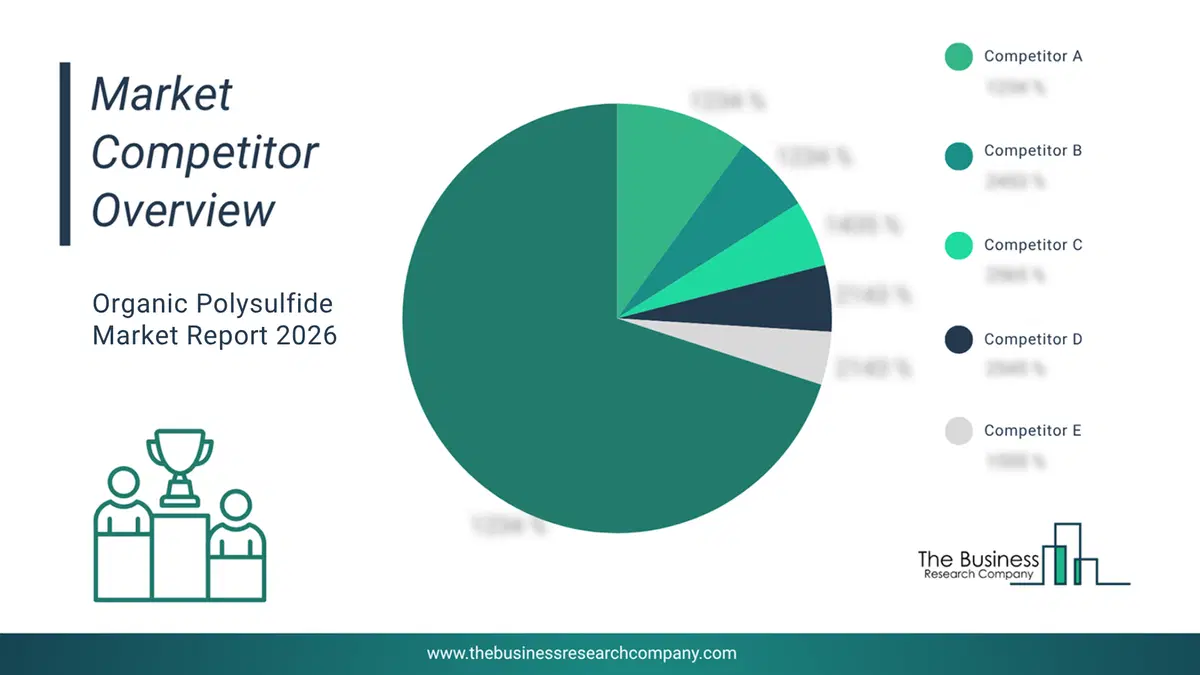
This chart is for illustrative purposes; the full report includes a detailed competitor analysis and comprehensive overview of the top 10 companies in the market.
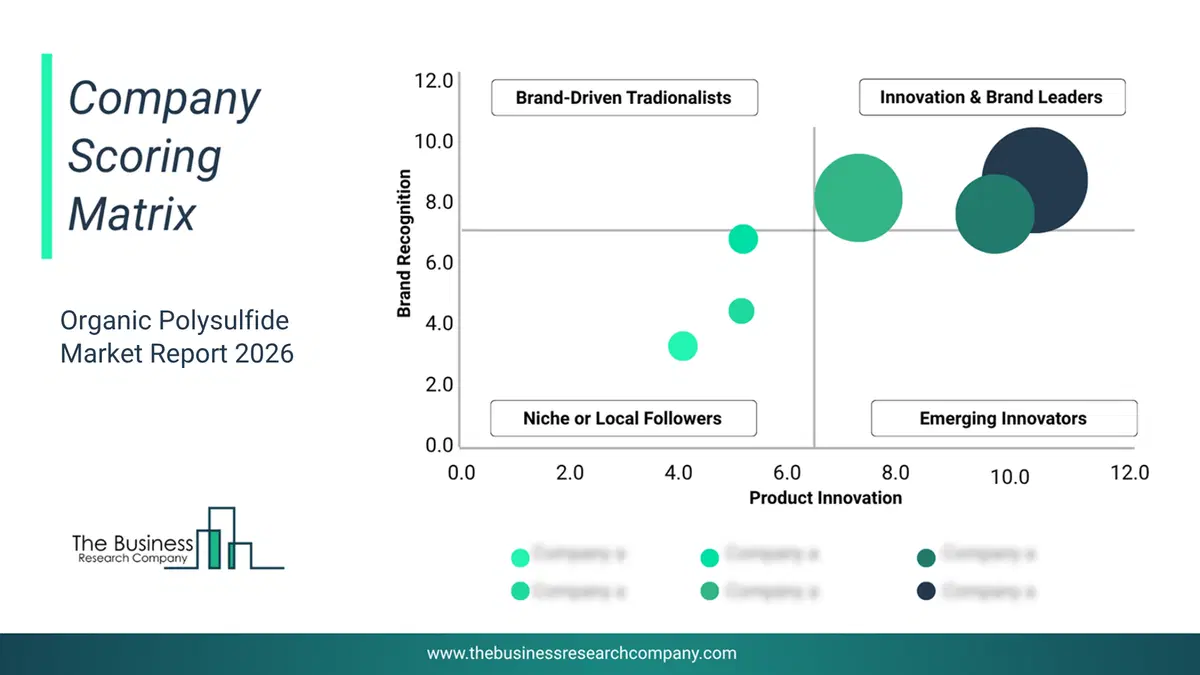
This chart maps companies by product innovation and brand strength, with bubble size indicating relative revenue, helping identify market leaders, challengers, and niche players. This is an illustrative chart; the full report provides a complete and accurate competitive analysis.
Global Organic Polysulfide Market Trends and Insights
Major companies operating in the organic polysulfide market are focusing on developing polysulfide-based materials for environmental remediation and oil-spill management, such as reusable polysulfide-based sorbents, to improve the recovery of petroleum products and promote the utilization of sulfur-based materials. A polysulfide-based sorbent is a sulfur-containing porous material designed to selectively absorb or adsorb oil and other hydrocarbons from contaminated water or surfaces while enabling potential reuse. For instance, in August 2026, Chennai Petroleum Corporation Ltd. (CPCL), an India-based petroleum refining company, reported the development of a reusable polysulfide-based sorbent material for oil-spill removal using refinery sulfur and used cooking oil as feedstocks. The developed porous material demonstrated hydrophobic properties and oil-absorption performance for petroleum products, supporting the potential use of organic polysulfide-based materials in oil-spill remediation and environmental cleanup applications.What Are Latest Mergers And Acquisitions In The Organic Polysulfide Market?
In June 2026, Carlyle, a US-based global investment firm, acquired BASF’s coatings business, with Qatar Investment Authority participating as a co-investor, in a transaction valued at €7.7 billion ($8.64 billion). This transaction aligns with Carlyle’s strategy to strengthen its presence in the coatings industry. However, the transaction raised regulatory concerns because Carlyle also owned Nouryon, a major supplier of polysulfides used in aerospace sealants. To address these concerns, the European Commission required the divestiture of Nouryon’s worldwide polysulfides business, including its manufacturing facility in Greiz, Germany. BASF is a Germany-based chemical company specializing in chemicals, materials, industrial solutions, surface technologies, and nutrition and care products.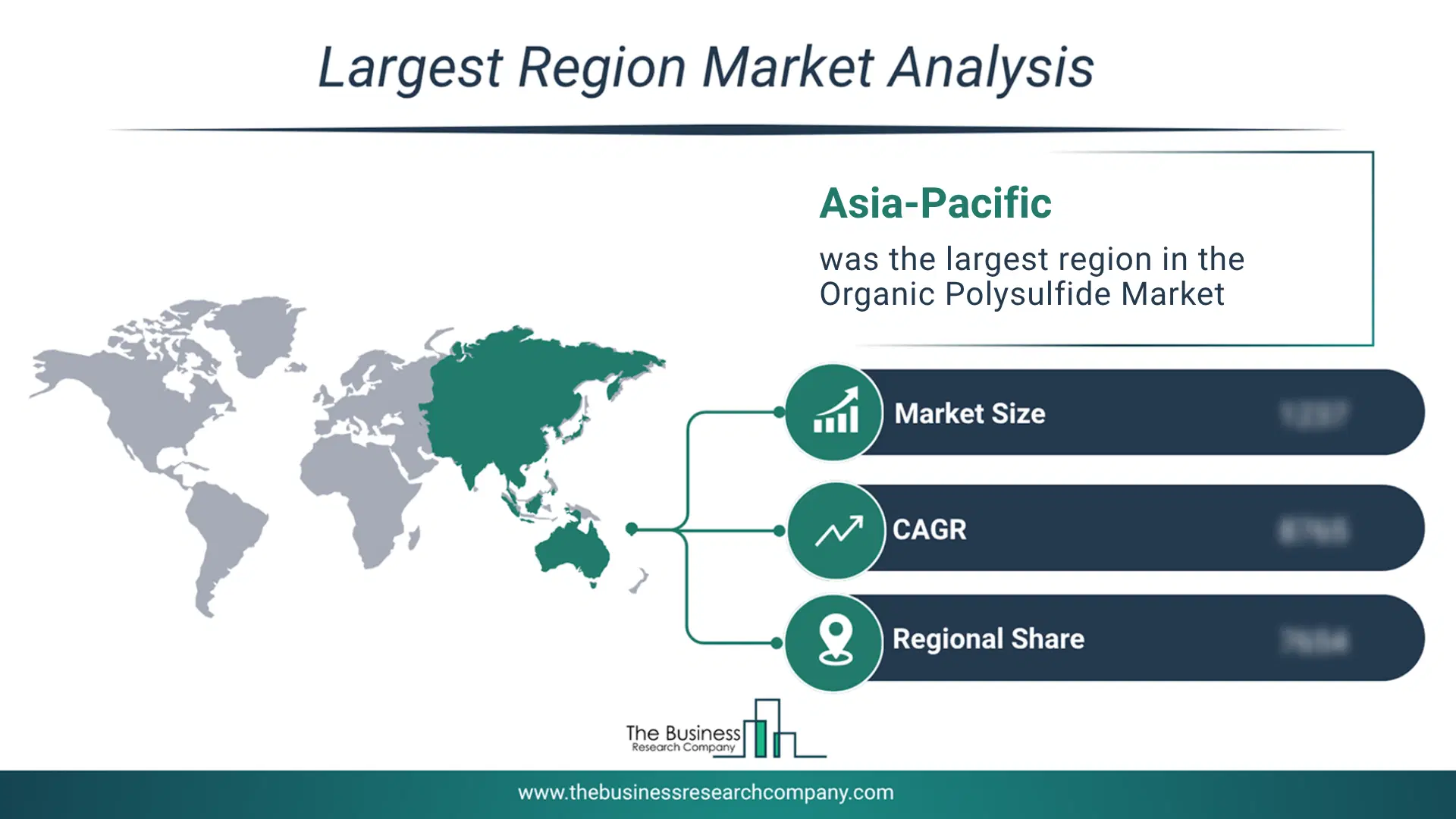
Regional Outlook
Asia-Pacific was the largest region in the organic polysulfide market in 2025. Asia-Pacific is expected to be the fastest-growing region in the forecast period. The regions covered in this market report are Asia-Pacific, South East Asia, Western Europe, Eastern Europe, North America, South America, Middle East, Africa. The countries covered in this market report are Australia, Brazil, China, France, Germany, India, Indonesia, Japan, Taiwan, Russia, South Korea, UK, USA, Canada, Italy, Spain.What Defines the Organic Polysulfide Market?
The organic polysulfide market consists of sales of polysulfide oligomers, polysulfide prepolymers, thiol-terminated polysulfides, and hydroxyl-terminated polysulfides. Values in this market are ‘factory gate’ values, that is, the value of goods sold by the manufacturers or creators of the goods, whether to other entities (including downstream manufacturers, wholesalers, distributors, and retailers) or directly to end customers. The value of goods in this market includes related services sold by the creators of the goods.How is Market Value Defined and Measured?
The market value is defined as the revenues that enterprises gain from the sale of goods and/or services within the specified market and geography through sales, grants, or donations in terms of the currency (in USD unless otherwise specified). The revenues for a specified geography are consumption values that are revenues generated by organizations in the specified geography within the market, irrespective of where they are produced. It does not include revenues from resales along the supply chain, either further along the supply chain or as part of other products.
This chart presents market attractiveness based on a quantitative evaluation of growth, competition, strategic alignment, and risk, offering a clear view of opportunity areas for decision-making. This chart is for illustrative purposes; the full report contains the complete analysis.

This chart highlights the Total Addressable Market (TAM) by estimating the maximum revenue opportunity using an assumption-driven approach, supporting strategic planning and opportunity sizing across markets. The chart is illustrative; the full report provides a more comprehensive analysis.
What Key Data and Analysis Are Included in the Organic Polysulfide Market Report 2026?
The organic polysulfide market research report is one of a series of new reports from The Business Research Company that provides market statistics, including industry global market size, regional shares, competitors with the market share, detailed market segments, market trends and opportunities, and any further data you may need to thrive in the organic polysulfide industry. The market research report delivers a complete perspective of everything you need, with an in-depth analysis of the current and future state of the industry.Organic Polysulfide Market Report Forecast Analysis
| Report Attribute | Details |
|---|---|
| Market Size Value In 2026 | $0.83 billion |
| Revenue Forecast In 2030 | $1.15 billion |
| Growth Rate | CAGR of 8.5% from 2026 to 2030 |
| Base Year For Estimation | 2025 |
| Actual Estimates/Historical Data | 2020-2025 |
| Forecast Period | 2026 - 2030 |
| Market Representation | Revenue in USD Billion and CAGR from 2026 to 2030 |
| Segments Covered | Product Type, Grade, Distribution Channel, Application, End-Use Industry |
| Regional Scope | Asia-Pacific, Western Europe, Eastern Europe, North America, South America, Middle East, Africa |
| Country Scope | The countries covered in the report are Australia, Brazil, China, France, Germany, India, Indonesia, Japan, Taiwan, Russia, South Korea, UK, USA, Canada, Italy, Spain. |
| Key Companies Profiled | Toray Industries Inc., Henkel AG & Co. KGaA, Arkema S.A., H.B. Fuller Company, PPG Industries Inc., Sika AG, RPM International Inc., Chevron Phillips Chemical Company LLC, KCC Corporation, Master Bond Inc., Robinson Brothers Limited, Kazan Synthetic Rubber Plant, Flamemaster Corporation, Anabond Limited, Choksey Chemicals Pvt. Ltd., Armstrong Chemicals Pvt. Ltd., Softex Industrial Products Pvt. Ltd., Alfashield Polymer LLP, Wessington Group Ltd. |
| Customization Scope | Request for Customization |
| Pricing And Purchase Options | Explore Purchase Options |