
Organoids And Spheroids Market 2026
By Type (Organoids, Spheroids), By Method (Extracellular Matrix Scaffold Method, Spinning Bioreactor Method, Hanging Drop Method, Low Adherent Culture Plate Method, Magnetic Levitation Method, Other Methods), By Application (Developmental Biology, Personalized Medicine, Regenerative Medicine, Disease Pathology Studies, Drug Toxicity And Efficacy Testing), By End-User (Biotechnology And Pharmaceutical Industry, Academic And Research Institutes, Hospitals And Diagnostic Centers), And By Region, Opportunities And Strategies – Global Forecast To 2035
Organoids And Spheroids Market Definition
Organoids and spheroids refer to three-dimensional (3D) cell culture models developed to closely mimic the architecture, function, and microenvironment of human tissues and organs in vitro. Spheroids are simple, spherical clusters of cells that self-assemble and replicate basic tissue organization, while organoids are more complex, stem cell–derived 3D structures that recreate specific organ functions and cellular diversity. These models are derived from stem cells, primary tissues, or cancer cells and are cultivated in a controlled environment that allows them to self-organize into complex tissue-like structures. The organoids and spheroids market consists of sales, by entities (organizations, sole traders, or partnerships), of organoids and spheroids that are used during early-stage biomedical research, preclinical drug development, and translational medicine studies. They are complementary to traditional two-dimensional (2D) cell culture methods and animal models, offering more physiologically relevant insights while reducing the ethical and logistical limitations associated with animal use. Substitute models include 2D cultures, animal studies, and organ-on-a-chip systems, although these substitutes often lack the biological complexity offered by organoids and spheroids.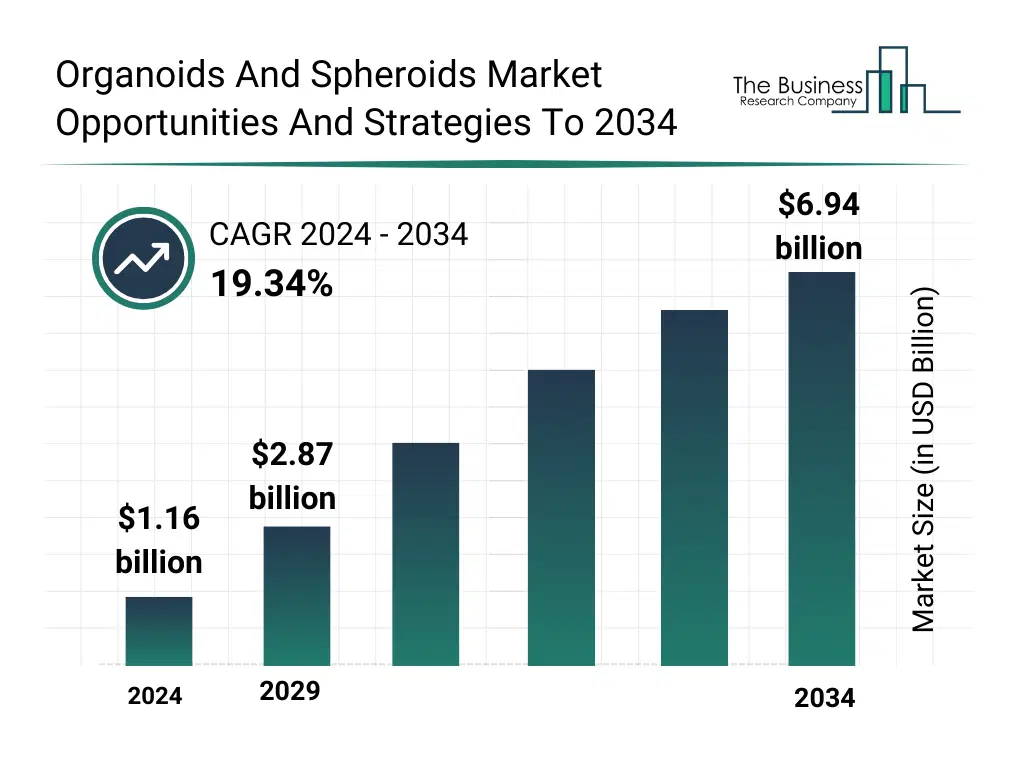
Organoids And Spheroids Market Size
The global organoids and spheroids market reached a value of nearly $1,159.46 million in 2024, having grown at a compound annual growth rate (CAGR) of 20.38% since 2019. The market is expected to grow from $1,159.46 million in 2024 to $2,867.20 million in 2029 at a rate of 19.85%. The market is then expected to grow at a CAGR of 19.34% from 2029 and reach $6,939.47 million in 2034. Growth in the historic period resulted from rising demand for personalized and precision medicine, rise in investments in pharmaceutical and biotechnology companies, rising clinical trial in pharmaceutical and growing therapeutic research on rare and genetic diseases. Factors that negatively affected growth in the historic period was high costs of development and maintenance and long development timelines. Going forward, rising burden of chronic diseases, rising development of biobanking and patient-derived models, rapid progress in regenerative medicine and increasing use in modeling and cancer drug screening will drive the growth. Factor that could hinder the growth of the organoids and spheroids market in the future include lack of standardization, lack of skilled professionals and impact of trade war and tariffs.Organoids And Spheroids Market Drivers
The key drivers of the organoids and spheroids market include: Rising Burden Of Chronic Diseases During the forecast period, the rising burden of chronic diseases will significantly propel the growth of the organoids and spheroids market. As conditions such as cancer, diabetes, and neurodegenerative disorders continue to rise, there is a growing demand for advanced, physiologically relevant models that can accurately replicate human tissues. Organoids and spheroids offer highly predictive platforms for drug discovery, disease modeling, and personalized medicine, enabling pharmaceutical and biotech companies to accelerate R&D while reducing costs and failure rates. Consequently, the expanding burden of chronic diseases is expected to act as a key catalyst, fueling investments and adoption in this high-potential segment. The rising burden of chronic diseases growth during the forecast period in 2024 is 2.00%.Organoids And Spheroids Market Restraints
The key restraints on the organoids and spheroids market include: Lack Of Standardization During the forecast period, lack of standardization will pose a restraint on the growth of the organoids and spheroids market. Variations in culture methods, quality control, and reproducibility can lead to inconsistent results, limiting their reliability for drug discovery, disease modeling, and clinical research. This inconsistency may deter widespread adoption among pharmaceutical and biotechnology companies, slowing investment and integration into research pipelines. Until industry-wide protocols, regulatory guidelines, and standardized practices are established, the market’s expansion could be constrained, despite the growing demand for advanced, human-relevant models in biomedical and pharmaceutical research. Growth affected by lack of standardization during the forecast period in 2024 is -2.00%.Organoids And Spheroids Market Trends
Major trends shaping the Organoids And Spheroids market include: Innovative Oxygen-Permeable Culture Technology Enhances 3D Cell Growth And In Vitro Modeling Efficiency Major companies operating in the organoids and spheroids market are focusing on developing advanced culture platforms and materials that enhance cell viability and oxygen delivery to improve the accuracy and scalability of in vitro models for drug discovery, regenerative medicine, and personalized therapy applications. For instance, in June 2025, Mitsui Chemicals Group, a Japan-based chemical manufacturing company, has introduced its InnoCell oxygen-permeable cell culture microplates. These novel microplates combine the company’s specialized materials and precision cutting techniques to enhance oxygen delivery to cells, especially useful in 3D spheroid and organoid cultures, reducing cell death and improving long-term viability. They come in both non-treated (N-type) and collagen-coated (C-type) versions for diverse cell types. The plates also feature low drug adsorption and excellent fluorescence imaging properties. With these advancements, the product is positioned to support drug discovery, personalized medicine, regenerative therapies, and advanced in vitro modeling in pharmaceutical research. Vascularized Organoid Engineering Opens New Pathways For Regenerative Medicine And Disease Modeling Companies operating in the organoids and spheroids market are focusing on vascularized and functionally mature organoid models that better replicate human tissue architecture and physiological responses, enabling advancements in disease modeling, regenerative therapies, and drug testing applications. For instance, in June 2025, Cincinnati Children's Hospital Medical Center, a US-based hospital, engineered a liver organoid capable of forming its own organ-specific blood vessels, marking a significant advancement in tissue engineering. Using a multilayer gel technique, liver sinusoidal progenitor cells were guided to migrate, sprout, and integrate with surrounding liver cells to form functional sinusoid-like vasculature. These vascularized organoids also produced critical coagulation factors, including Factor VIII, and were able to correct bleeding in hemophilia-model mice. The approach helps overcome the long-standing limitation of organoids lacking internal vasculature, and may pave the way for transplantable liver tissue, enhanced disease models, and novel therapies for coagulation disorders.Opportunities And Recommendations In The Organoids And Spheroids Market
Opportunities – The top opportunities in the organoids and spheroids market segmented by type will arise in the organoids segment, which will gain $915.41 million of global annual sales by 2029. The top opportunities in the organoids and spheroids market segmented by method will arise in the extracellular matrix scaffold method segment, which will gain $779.32 million of global annual sales by 2029. The top opportunities in the organoids and spheroids market segmented by application will arise in the regenerative medicine segment, which will gain $451.38 million of global annual sales by 2029. The top opportunities in the organoids and spheroids market segmented by end-user will arise in the biotechnology and pharmaceutical industry segment, which will gain $789.97 million of global annual sales by 2029. The organoids and spheroids market size will gain the most in the USA at $553.43 million. Recommendations- To take advantage of the opportunities, The Business Research Company recommends the organoids and spheroids companies to focus on advanced culture platforms to enhance viability and scalability, focus on vascularized and functionally mature organoid models, focus on scalable and long-lasting human cell–derived organoid models, focus on ai-integrated and bioengineered organoid models for predictive testing, focus on integrated technology ecosystems across 3d culture and cell analysis, focus on accelerating growth in the spheroids segment, focus on scaling spinning bioreactor platforms, focus on expanding direct and partner-led distribution networks, focus on value-based and tiered pricing discipline, focus on evidence-led scientific promotion, focus on digital and account-centric engagement, focus on accelerating expansion in regenerative medicine applications, focus on expanding engagement with academic and research institutes.
Organoids And Spheroids Market Segmentation
The organoids and spheroids market is segmented by type, by method, by application and by end-user.By Type –
The organoids and spheroids market is segmented by type into:
- a) Organoids
- b) Spheroids
By Method –
The organoids and spheroids market is segmented by method into:
- a) Extracellular Matrix Scaffold Method
- b) Spinning Bioreactor Method
- c) Hanging Drop Method
- d) Low Adherent Culture Plate Method
- e) Magnetic Levitation Method
- f) Other Methods
By Application –
The organoids and spheroids market is segmented by application into:
- a) Developmental Biology
- b) Personalized Medicine
- c) Regenerative Medicine
- d) Disease Pathology Studies
- e) Drug Toxicity And Efficacy Testing
By End-User –
The organoids and spheroids market is segmented by end-user into:
- a) Biotechnology And Pharmaceutical Industry
- b) Academic And Research Institutes
- c) Hospitals And Diagnostic Centers
By Geography - The organoids and spheroids market is segmented by geography into:
- • China
- • India
- • Japan
- • Australia
- • Indonesia
- • South Korea
- • Bangladesh
- • Thailand
- • Vietnam
- • Malaysia
- • Singapore
- • Phillipines
- • Hong kong
- • New Zealand
- • USA
- • Canada
- • Mexico
- • Brazil
- • Argentina
- • Chile
- • Colombiia
- • Peru
- • France
- • Germany
- • UK
- • Italy
- • Spain
- • Austria
- • Belgium
- • Denmark
- • Finland
- • Ireland
- • Netherland
- • Norway
- • Portugal
- • Sweden
- • Switzerland
- • Russia
- • Czech Republic
- • Poland
- • Romania
- • Ukraine
- • Saudi Arabia
- • Israel
- • Iran
- • Turkey
- • UAE o Africa
- • Egypt
- • Nigeria
- • South Africa
-
o Asia Pacific