
Organophilic Clay Market Report 2026
Global Outlook – By Product Type (Bentonite, Attapulgite, Sepiolite, Other Product Types), By Organic Modifier Type (Quaternary Ammonium Salt Modified Clays, Amine-Modified Clays, Ester-Modified Clays, Bio-Based Or Low-Toxicity Organic Modifiers), By Application (Oil-Based Drilling Fluids, Paints and Coatings, Greases and Lubricants, Adhesives and Sealants, Inks and Printing Systems, Other Non-Aqueous Industrial Applications), By End-User Industry (Oil and Gas, Chemicals and Materials, Paints, Coatings & Inks, Automotive and Transportation, Construction, Marine and Offshore, Other Industrial End Users) – Market Size, Trends, Strategies, and Forecast to 2030
Organophilic Clay Market Overview
• Organophilic Clay market size has reached to $1.52 billion in 2025 • Expected to grow to $1.98 billion in 2030 at a compound annual growth rate (CAGR) of 5.3% • Growth Driver: The Booming Construction Industry Is Driving The Market Due To Increasing Demand For Coatings Sealants And Adhesives • Market Trend: Innovative Natural Clay Solutions Drive Sustainability In The Market • North America was the largest region and fastest growing region.What Is Covered Under Organophilic Clay Market?
Organophilic clay is a type of clay that has been chemically modified with organic compounds to make it compatible with organic solvents and oils. This modification transforms the naturally hydrophilic (water-attracting) clay into an organophilic (oil-attracting) material, allowing it to disperse and swell in non-aqueous systems. Organophilic clay is widely used as a rheological additive in oil-based drilling fluids, paints, greases, and sealants, where it enhances viscosity, suspension, and stability. The main product types of organophilic clay are bentonite, attapulgite, and sepiolite. Bentonite is a naturally occurring clay composed primarily of montmorillonite, which belongs to the smectite group. These act as viscosifiers, rheological modifiers, fluid control loss, and gelling agents, which are distributed through various channels, including direct sales, distributors, online retail, and third-party retailers, in various applications involved, such as paints and coatings, oil and gas, greases and lubricants, adhesives and sealants, and others by construction, automotive, marine, and other end users.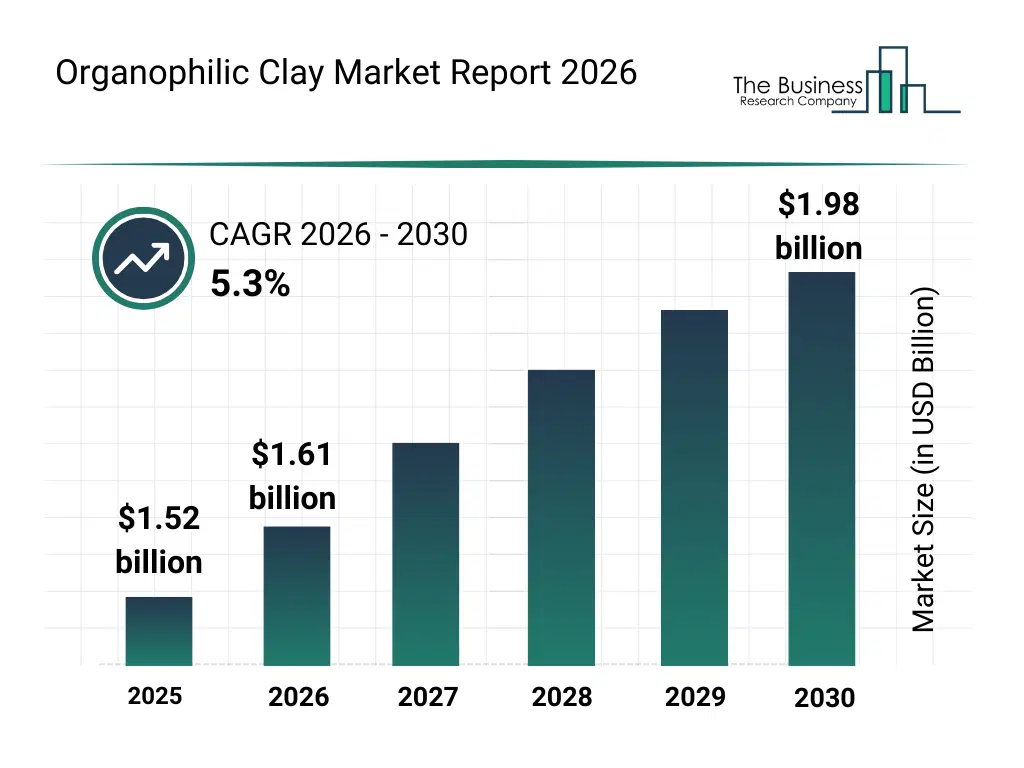
What Is The Organophilic Clay Market Size and Share 2026?
The organophilic clay market size has grown strongly in recent years. It will grow from $1.52 billion in 2025 to $1.61 billion in 2026 at a compound annual growth rate (CAGR) of 5.6%. The growth in the historic period can be attributed to oil and gas drilling growth, demand for viscosity modifiers, expansion of industrial coatings, lubricant formulation needs, clay modification technologies.What Is The Organophilic Clay Market Growth Forecast?
The organophilic clay market size is expected to see strong growth in the next few years. It will grow to $1.98 billion in 2030 at a compound annual growth rate (CAGR) of 5.3%. The growth in the forecast period can be attributed to energy exploration activities, infrastructure development, advanced coatings demand, high performance lubricants, specialty additive innovation. Major trends in the forecast period include rising use in oil based drilling fluids, expansion in paints and coatings, growing demand in lubricant applications, increased adoption in adhesives and sealants, focus on high performance rheology additives.
Global Organophilic Clay Market Segmentation
1) By Product Type: Bentonite, Attapulgite, Sepiolite, Other Product Types 2) By Organic Modifier Type: Quaternary Ammonium Salt Modified Clays, Amine-Modified Clays, Ester-Modified Clays, Bio-Based Or Low-Toxicity Organic Modifiers 3) By Application: Oil-Based Drilling Fluids, Paints and Coatings, Greases and Lubricants, Adhesives and Sealants, Inks and Printing Systems, Other Non-Aqueous Industrial Applications 4) By End-User Industry: Oil and Gas, Chemicals and Materials, Paints, Coatings & Inks, Automotive and Transportation, Construction, Marine and Offshore, Other Industrial End Users Subsegments: 1) By Bentonite: Quaternary Ammonium–Modified Organobentonite, High-Gel Strength Organobentonite, Low-Polar Or Medium-Polar System Organobentonite, High-Temperature-Resistant Organobentonite, Self-Activating Organobentonite 2) By Attapulgite: Organically Modified Attapulgite for Oil-Based Systems, Low-Shear Rheology Attapulgite, High-Suspension-Efficiency Attapulgite, Salt-Tolerant Organophilic Attapulgite 3) By Sepiolite: Organophilic Sepiolite for Non-Polar Solvents, High-Aspect-Ratio Sepiolite for Thixotropy, Thermally Stable Organophilic Sepiolite, Fine-Particle Sepiolite for Coatings and Inks 4) By Other Product Types: Engineered Organo-Clay Blends, Nano-Organophilic Clays, Bio-Modified Or Low-Toxicity Organo-Clays, Application-Specific Custom Organo-ClaysWhat Is The Driver Of The Organophilic Clay Market?
The booming construction industry is anticipated to propel the growth of the organophilic clay market in the coming years. The construction industry encompasses planning, designing, developing, and maintaining buildings, infrastructure, and other physical structures using various materials and techniques. The construction industry is expanding primarily due to rapid urbanization, which drives the demand for new residential, commercial, and infrastructure projects to accommodate growing populations and modernize cities. The expanding construction industry boosts demand for organophilic clay as it is widely used as a rheological additive in paints, sealants, and adhesives, which are essential for building and finishing structures. For instance, in November 2023, according to the International Trade Administration, a US-based government agency, the UAE's construction industry is anticipated to grow steadily over the coming five years, with annual value gains potentially reaching 4.7%. This outlook is supported by a strong pipeline of major infrastructure developments, including significant investments in transportation projects such as the $2.7 billion Sheikh Zayed double-deck road, the $11 billion Etihad Rail network, and a proposed $5.9 billion hyperloop designed to connect Dubai and Abu Dhabi. Therefore, the booming construction industry will drive the growth of the organophilic clay industry.Key Players In The Global Organophilic Clay Market
Major companies operating in the organophilic clay market are Sinochem Holdings Corporation Ltd., Schlumberger (SLB), Evonik Industries, Arkema, Clariant AG, Minerals Technologies Inc., BYK Additives & Instruments, Elementis Specialties Inc., Oil-Dri Corporation of America, Kunimine Industries Co. Ltd., Ashapura Group, Vanderbilt Minerals LLC, Laviosa Chimica Mineraria S.p.A., IDIC Specialty Drilling Chemicals, Qingdao Doeast Chemical Co. Ltd., Cutch Oil & Allied Industries, Zhejiang Camp Shinning New Material Co. Ltd., International Clay & Minerals Company (ICMC), Hangzhou Jingyi Chemical Co. Ltd., Zhejiang Qinghong New Material Co. Ltd.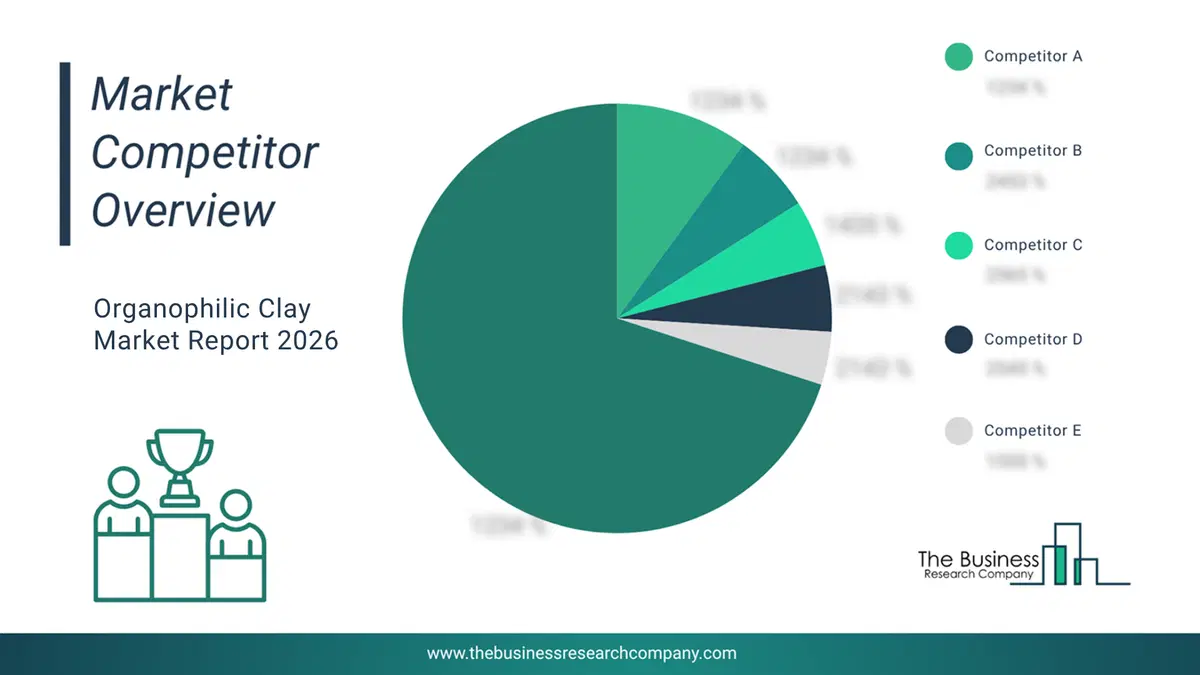
This chart is for illustrative purposes; the full report includes a detailed competitor analysis and comprehensive overview of the top 10 companies in the market.
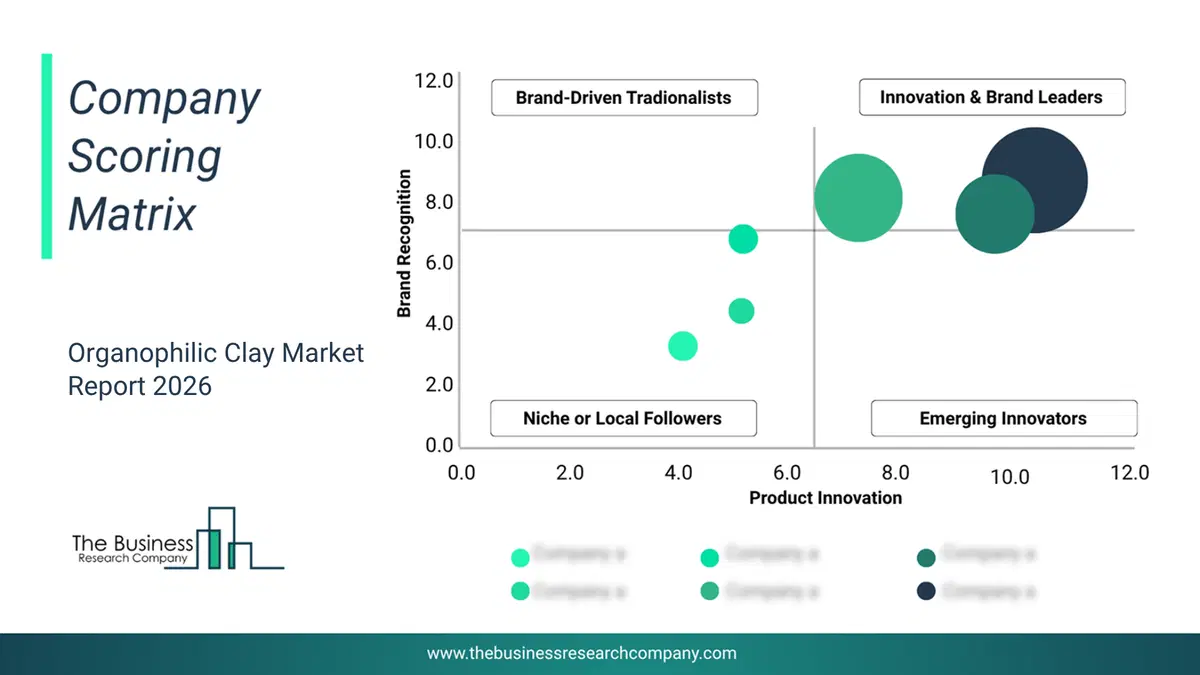
This chart maps companies by product innovation and brand strength, with bubble size indicating relative revenue, helping identify market leaders, challengers, and niche players. This is an illustrative chart; the full report provides a complete and accurate competitive analysis.
Global Organophilic Clay Market Trends and Insights
Major companies operating in the organophilic clay market are increasingly focusing on developing innovative products, such as natural clay solutions, to enhance environmental sustainability, improve performance in drilling fluids, and meet the growing demand for eco-friendly and cost-effective additives across various industries. Natural clay solutions refer to products or formulations derived from naturally occurring clay minerals such as bentonite, hectorite, or montmorillonite that have been modified or processed for specific industrial applications without harsh chemicals or synthetic additives. For instance, in May 2025, Hojun Co., Ltd, a Japan-based bentonite manufacturer, introduced Blanminerale, a clay-based skincare line designed to harness the natural mineral benefits of bentonite for healthy, radiant skin. These product lines include the BEN-GEL series, ideal for water-based formulations (O/W), offering emulsion stability, thickening, and smooth texture, and the S-BEN series, tailored for oil- and solvent-based systems (W/O), providing similar stability and skin feel enhancements.What Are Latest Mergers And Acquisitions In The Organophilic Clay Market?
In June 2024, J.M. Huber Corporation, a US-based chemical company, acquired Active Minerals International, LLC, for an undisclosed amount. This acquisition aims to strengthen Huber Engineered Materials’ specialty minerals portfolio by adding Active Minerals’ high-quality attapulgite and air-floated kaolin clay products, enhancing its industrial, agricultural, and consumer applications capabilities. Active Minerals International, LLC is a US-based industrial minerals company, specifically kaolin and gel-quality attapulgite clay minerals, including attapulgite clay.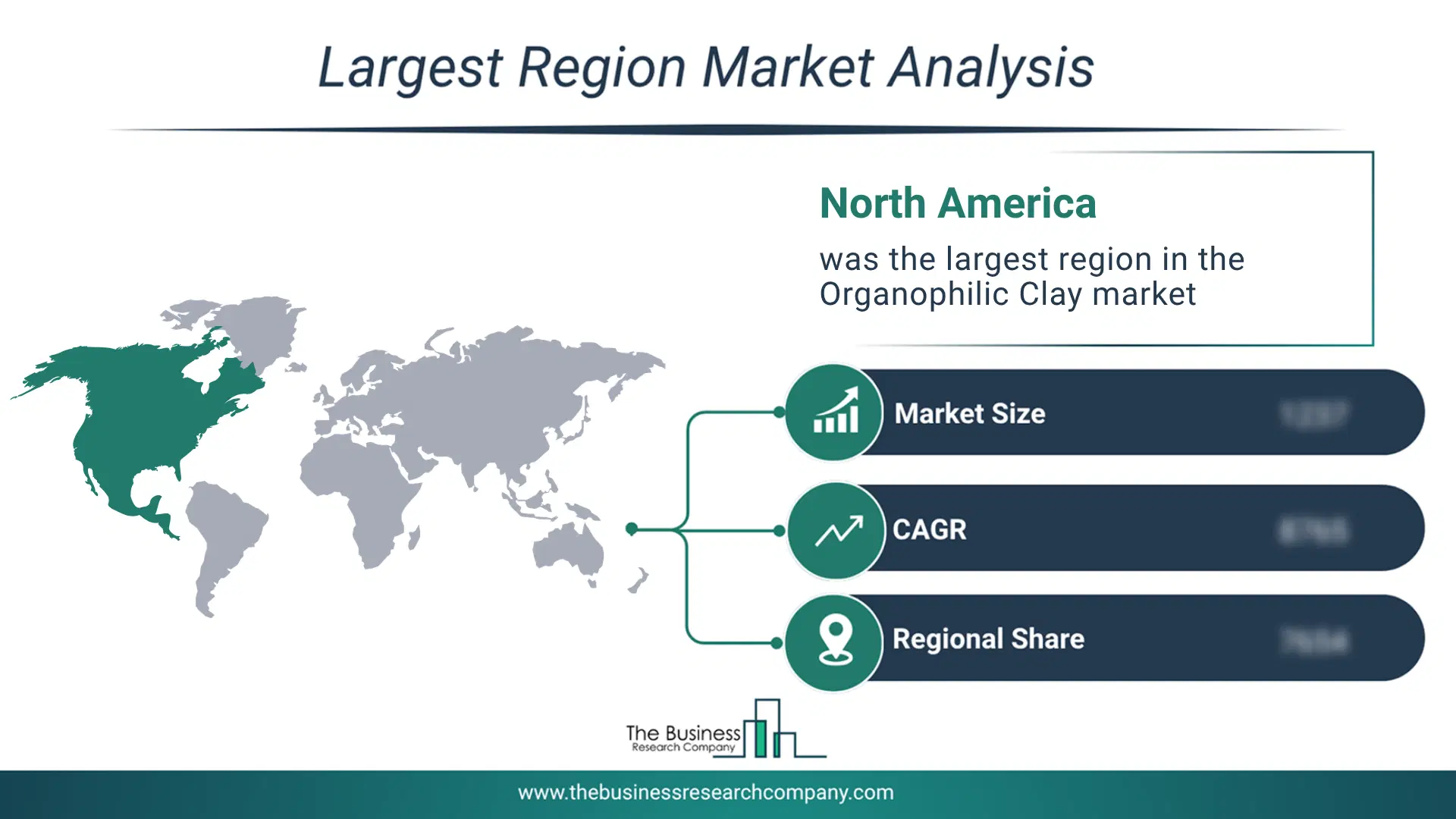
Regional Insights
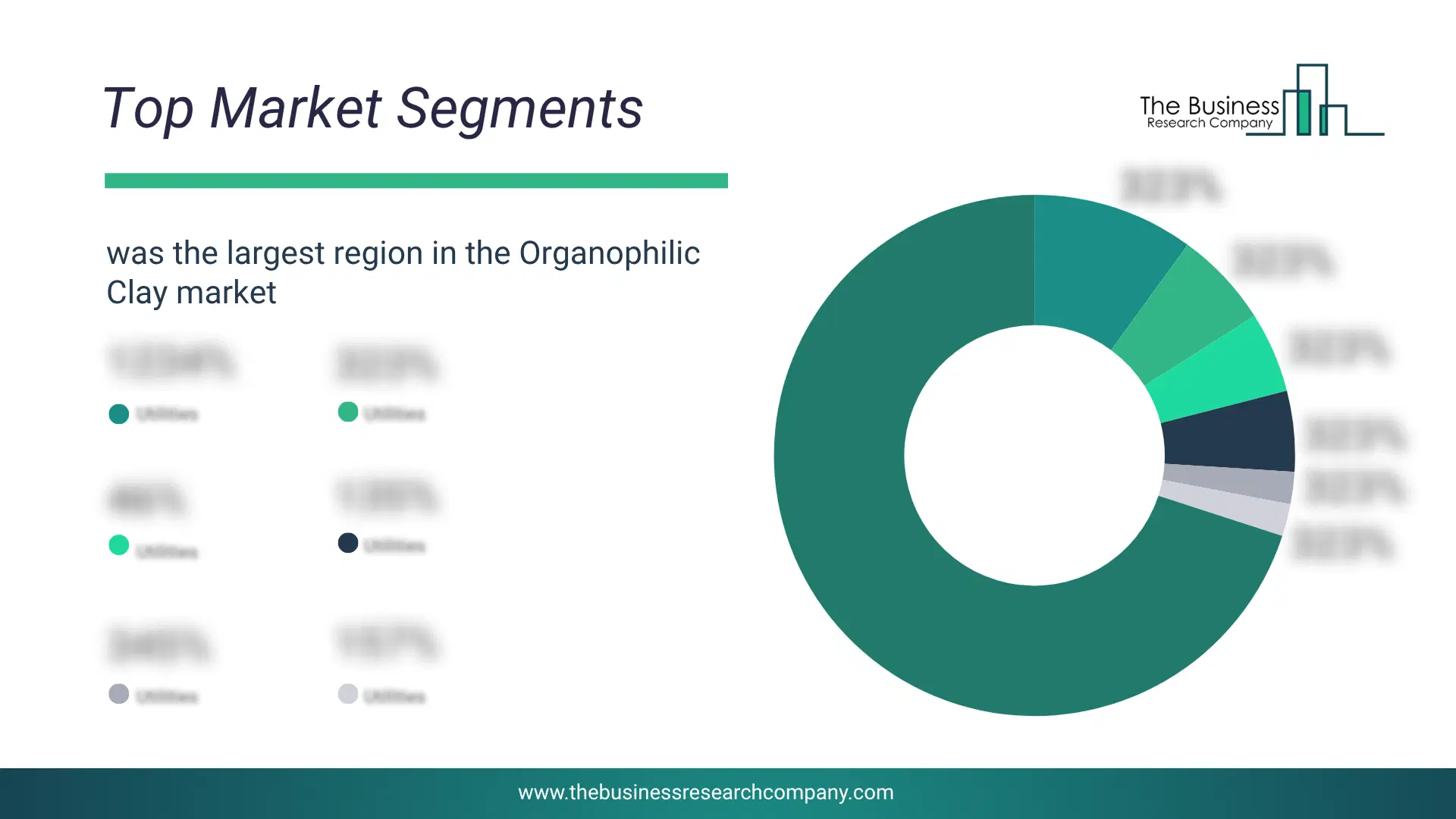
North America was the largest region in the organophilic clay market in 2025. Asia-Pacific is expected to be the fastest-growing region in the forecast period. The regions covered in this market report are Asia-Pacific, South East Asia, Western Europe, Eastern Europe, North America, South America, Middle East, Africa The countries covered in this market report are Australia, Brazil, China, France, Germany, India, Indonesia, Japan, Taiwan, Russia, South Korea, UK, USA, Canada, Italy, SpainWhat Defines the Organophilic Clay Market?
The organophilic clay market consists of sales of cement slurries, anti-settling agents, suspension stabilizers, thickening agents, anti-sagging additives, and rheology modifiers. Values in this market are ‘factory gate’ values, that is, the value of goods sold by the manufacturers or creators of the goods, whether to other entities (including downstream manufacturers, wholesalers, distributors, and retailers) or directly to end customers. The value of goods in this market includes related services sold by the creators of the goods.How is Market Value Defined and Measured?
The market value is defined as the revenues that enterprises gain from the sale of goods and/or services within the specified market and geography through sales, grants, or donations in terms of the currency (in USD unless otherwise specified). The revenues for a specified geography are consumption values that are revenues generated by organizations in the specified geography within the market, irrespective of where they are produced. It does not include revenues from resales along the supply chain, either further along the supply chain or as part of other products.
This chart presents market attractiveness based on a quantitative evaluation of growth, competition, strategic alignment, and risk, offering a clear view of opportunity areas for decision-making. This chart is for illustrative purposes; the full report contains the complete analysis.

This chart highlights the Total Addressable Market (TAM) by estimating the maximum revenue opportunity using an assumption-driven approach, supporting strategic planning and opportunity sizing across markets. The chart is illustrative; the full report provides a more comprehensive analysis.
What Key Data and Analysis Are Included in the Organophilic Clay Market Report 2026?
The organophilic clay market research report is one of a series of new reports from The Business Research Company that provides market statistics, including industry global market size, regional shares, competitors with the market share, detailed market segments, market trends and opportunities, and any further data you may need to thrive in the organophilic clay industry. The market research report delivers a complete perspective of everything you need, with an in-depth analysis of the current and future state of the industry.Organophilic Clay Market Report Forecast Analysis
| Report Attribute | Details |
|---|---|
| Market Size Value In 2026 | $1.61 billion |
| Revenue Forecast In 2030 | $1.98 billion |
| Growth Rate | CAGR of 5.6% from 2026 to 2030 |
| Base Year For Estimation | 2025 |
| Actual Estimates/Historical Data | 2020-2025 |
| Forecast Period | 2026 - 2030 |
| Market Representation | Revenue in USD Billion and CAGR from 2026 to 2030 |
| Segments Covered | Product Type, Organic Modifier Type, Application, End-User Industry |
| Regional Scope | Asia-Pacific, Western Europe, Eastern Europe, North America, South America, Middle East, Africa |
| Country Scope | The countries covered in this market report are Australia, Brazil, China, France, Germany, India, Indonesia, Japan, Taiwan, Russia, South Korea, UK, USA, Canada, Italy, Spain |
| Key Companies Profiled | Sinochem Holdings Corporation Ltd., Schlumberger (SLB), Evonik Industries, Arkema, Clariant AG, Minerals Technologies Inc., BYK Additives & Instruments, Elementis Specialties Inc., Oil-Dri Corporation of America, Kunimine Industries Co. Ltd., Ashapura Group, Vanderbilt Minerals LLC, Laviosa Chimica Mineraria S.p.A., IDIC Specialty Drilling Chemicals, Qingdao Doeast Chemical Co. Ltd., Cutch Oil & Allied Industries, Zhejiang Camp Shinning New Material Co. Ltd., International Clay & Minerals Company (ICMC), Hangzhou Jingyi Chemical Co. Ltd., Zhejiang Qinghong New Material Co. Ltd. |
| Customization Scope | Request for Customization |
| Pricing And Purchase Options | Explore Purchase Options |