
Orthopedic 3D Printing Devices Market Report 2026
Global Outlook – By Product Type (Printers, Materials, Software, Services), By Technology (Stereolithography, Fused Deposition Modeling, Selective Laser Sintering, Other Technologies), By Application (Joint Replacement, Spinal Implants, Craniomaxillofacial Implants, Dental Implants, Other Applications), By End-User (Hospitals, Ambulatory Surgical Centers, Specialty Clinics, Other End-Users) – Market Size, Trends, Strategies, and Forecast to 2030
Orthopedic 3D Printing Devices Market Overview
• Orthopedic 3D Printing Devices market size has reached to $2.24 billion in 2025 • Expected to grow to $3.75 billion in 2030 at a compound annual growth rate (CAGR) of 10.8% • Growth Driver: Increasing Prevalence Of Orthopedic Diseases Fueling The Growth Of The Market Due To Rising Aging Population And Lifestyle Factors • Market Trend: Digitally Engineered 3D-Printed Implants Accelerating Next-Generation Orthopedic Reconstruction • North America was the largest region in 2025 and Asia-Pacific is the fastest growing region.What Is Covered Under Orthopedic 3D Printing Devices Market?
Orthopedic 3D printing devices refer to medical devices created using three-dimensional printing technology specifically for orthopedic applications. These devices enable the customization of implants and prosthetics to fit individual patient's anatomy with high precision, enhancing surgical outcomes and patient comfort. Additionally, it allows for the rapid prototyping of surgical instruments and models, improving preoperative planning and reducing surgery time. The main types of products in orthopedic 3D printing devices are printers, materials, software, and services. Orthopedic 3D printers refer to specialized 3D printing devices used to create custom orthopedic implants, prosthetics, surgical instruments, and patient-specific anatomical models. It includes various technologies such as stereolithography, fused deposition modeling, selective laser sintering, and others used for various applications, including joint replacement, spinal implants, craniomaxillofacial implants, dental implants, and others. These devices cater to various end users, including hospitals, ambulatory surgical centers, specialty clinics, and others.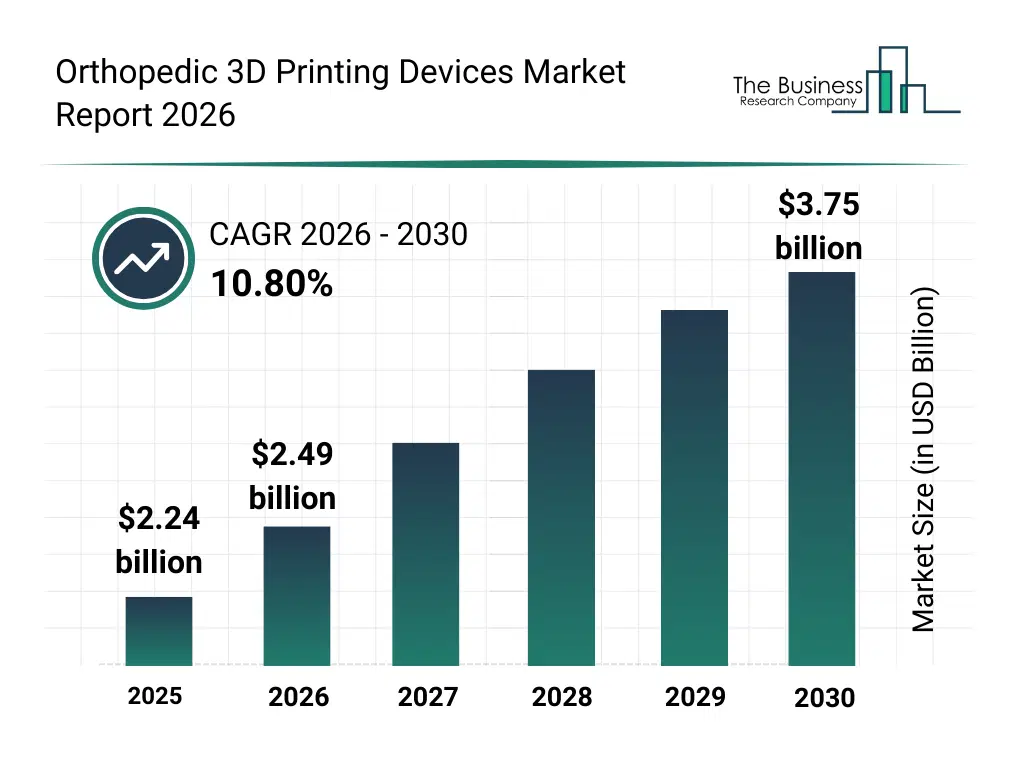
What Is The Orthopedic 3D Printing Devices Market Size and Share 2026?
The orthopedic 3D printing devices market size has grown rapidly in recent years. It will grow from $2.24 billion in 2025 to $2.49 billion in 2026 at a compound annual growth rate (CAGR) of 10.9%. The growth in the historic period can be attributed to need for personalized implants, rise in orthopedic surgeries, improvement in 3D printing accuracy, demand for surgical efficiency, expansion of specialty clinics.What Is The Orthopedic 3D Printing Devices Market Growth Forecast?
The orthopedic 3D printing devices market size is expected to see rapid growth in the next few years. It will grow to $3.75 billion in 2030 at a compound annual growth rate (CAGR) of 10.8%. The growth in the forecast period can be attributed to growth of customized joint replacements, adoption in trauma care, innovation in biomaterials, hospital-based printing labs, expansion in emerging markets. Major trends in the forecast period include custom patient-specific implant production, rapid prototyping for surgical planning, growth of on-demand manufacturing, increased use of metal 3D printing, expansion of orthopedic digital workflows.
Global Orthopedic 3D Printing Devices Market Segmentation
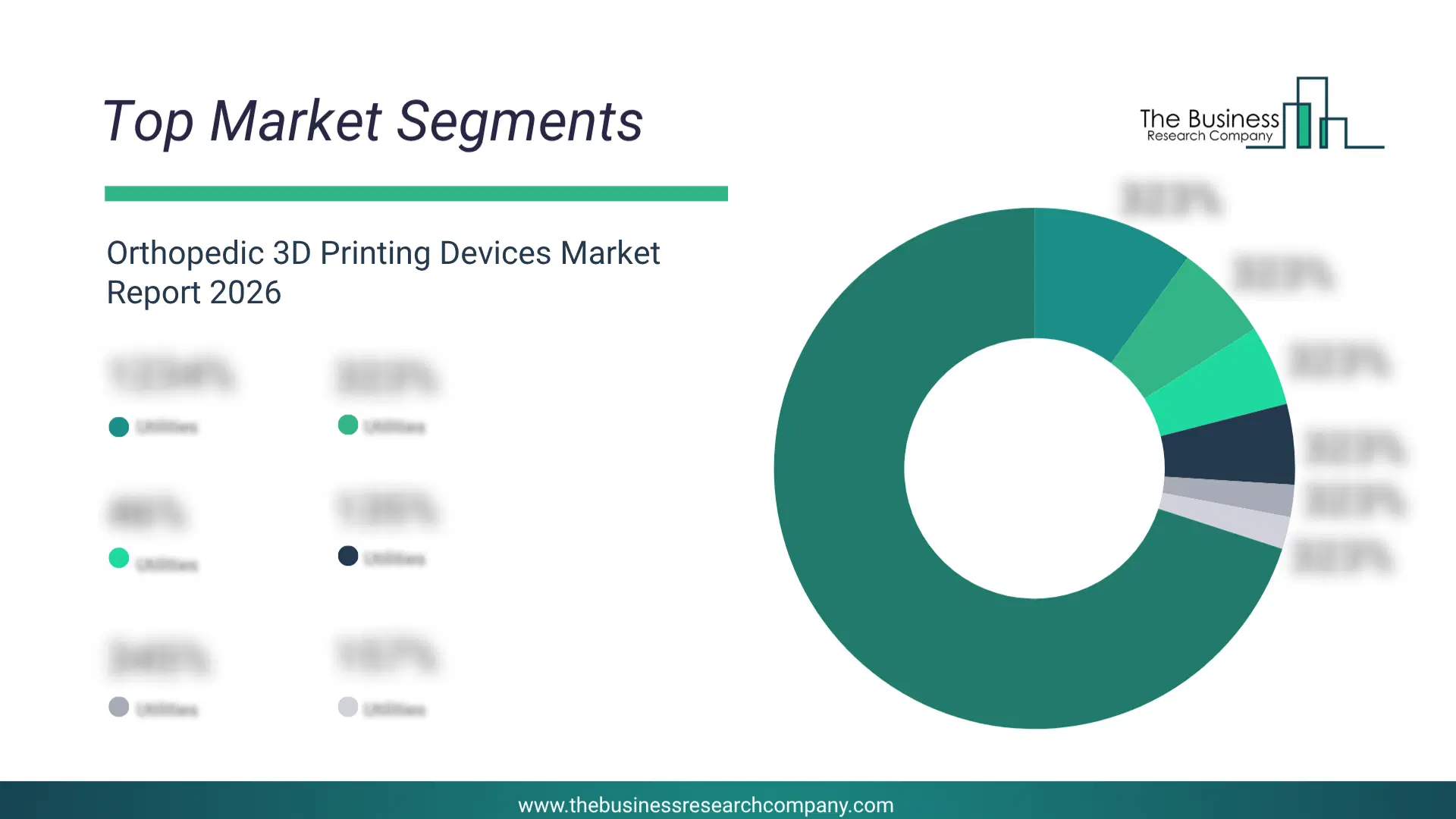
1) By Product Type: Printers, Materials, Software, Services 2) By Technology: Stereolithography, Fused Deposition Modeling, Selective Laser Sintering, Other Technologies 3) By Application: Joint Replacement, Spinal Implants, Craniomaxillofacial Implants, Dental Implants, Other Applications 4) By End-User: Hospitals, Ambulatory Surgical Centers, Specialty Clinics, Other End-Users Subsegments: 1) By Printers: Desktop 3D Printers, Industrial 3D Printers 2) By Materials: Metals, Polymers, Ceramics, Biomaterials, Composites 3) By Software: Design Software, Printing Software, Simulation Software 4) By Services: Printing Services, Post-processing Services, Consulting Services, Maintenance ServicesWhat Is The Driver Of The Orthopedic 3D Printing Devices Market?
The increasing prevalence of orthopedic diseases is expected to propel the growth of the orthopedic 3D printing devices market going forward. Orthopedic diseases refer to a group of conditions that affect the bones, joints, ligaments, tendons, and muscles, often leading to pain, disability, and decreased mobility. The increasing prevalence of orthopedic diseases is largely driven by the aging population, as age-related conditions such as osteoarthritis and osteoporosis become more common with advancing age, leading to higher rates of musculoskeletal issues. Orthopedic 3D printing devices are useful for orthopedic diseases by creating customized implants, prosthetics, and surgical guides that improve precision, enhance recovery, and provide patient-specific solutions for complex musculoskeletal conditions. For instance, in July 2025, according to the Institute for Health Transformation, an Australia-based health research institute, in 2023, Australia recorded a fracture occurring every 2.7 minutes, and this rate is projected to accelerate sharply to one fracture every 30 seconds by 2033. Therefore, the increasing prevalence of orthopedic diseases is driving the growth of the orthopedic 3D printing devices industry.Key Players In The Global Orthopedic 3D Printing Devices Market
Major companies operating in the orthopedic 3d printing devices market are Stryker Corporation, Zimmer Biomet Holding Inc., Orthofix Medical Inc., Tecomet Inc., 3D Systems Inc., Materialise NV, LimaCorporate S.p.A., Cretex Medical, SPINEART, PrinterPrezz, Oxford Performance Materials (OPM), Tangible Solutions Inc., Anatomics Pty Ltd, Osteo3D, Spentys, PEEK HEALTH S.A., Renishaw plc, EOS GmbH, GE Additive, Stratasys Ltd., Additive Orthopaedics, 4WEB Medical, Restor3d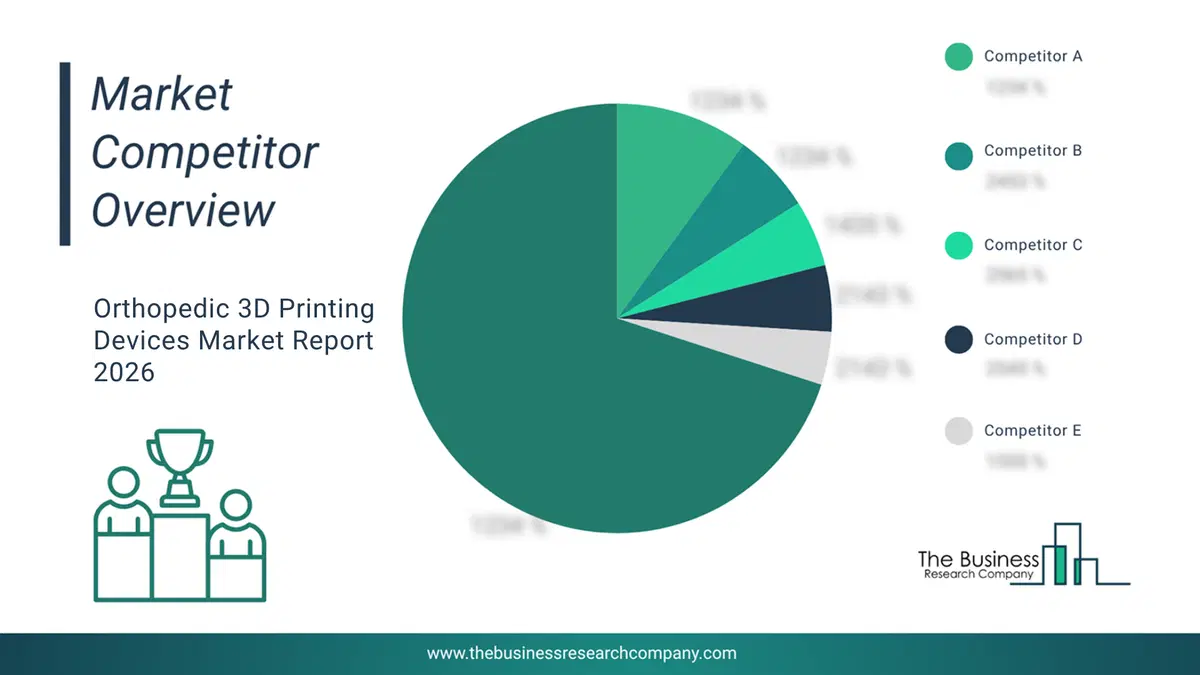
This chart is for illustrative purposes; the full report includes a detailed competitor analysis and comprehensive overview of the top 10 companies in the market.
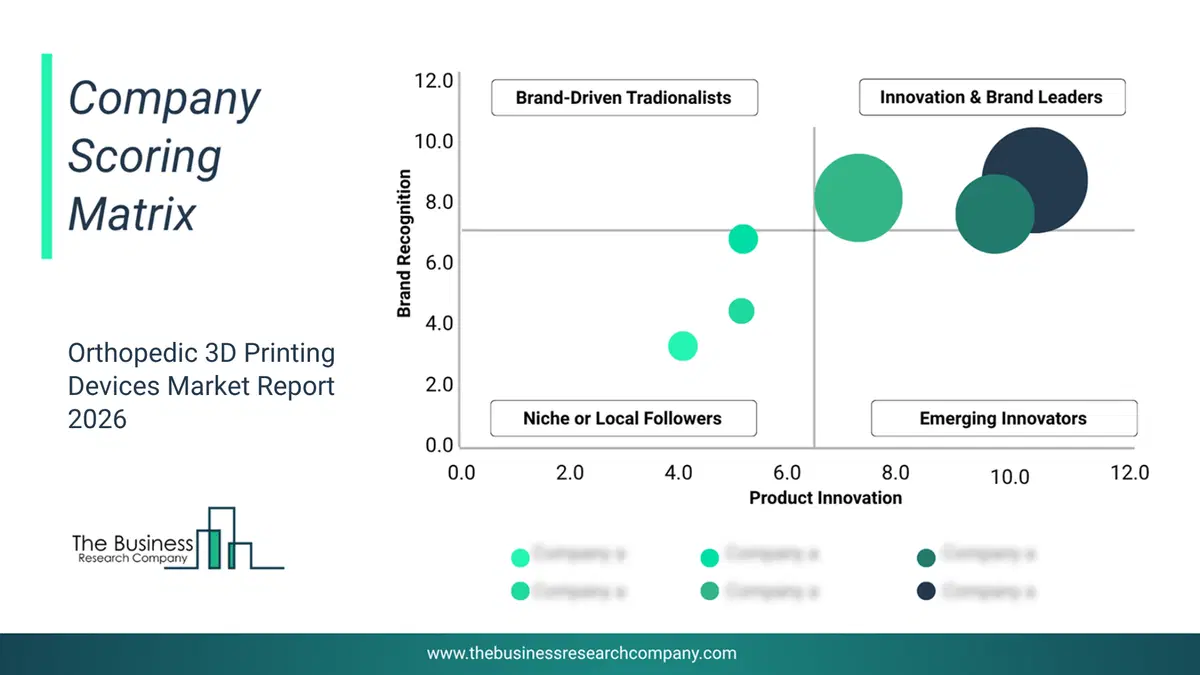
This chart maps companies by product innovation and brand strength, with bubble size indicating relative revenue, helping identify market leaders, challengers, and niche players. This is an illustrative chart; the full report provides a complete and accurate competitive analysis.
Global Orthopedic 3D Printing Devices Market Trends and Insights
Major companies operating in the orthopedic 3D printing devices market are focusing on developing technological advancements such as digitally structured 3D-printed titanium lumbar interbody systems to enhance fusion performance and better replicate natural bone biomechanics. Digitally structured 3D-printed titanium lumbar interbody systems use additive manufacturing and algorithm-driven lattice designs (such as triply periodic minimal surface and stochastic structures) to create porous cages with controlled stiffness, porosity, and architecture that promote osseointegration and more physiological load sharing. For instance, in June 2024, ZSFab Inc., a US-based 3D-printing medical device company, announced the first U.S. clinical use of its recently launched InterConnect 3D Printed Ti Lumbar Interbody System. The system’s porous titanium P-TLIF cages are engineered to mimic cancellous bone architecture, enhancing osseointegration and supporting faster, more robust lumbar fusion. Its digitally optimized lattice aims to distribute load more evenly and reduce stress on adjacent spinal segments. By enabling better biomechanical matching and bone ingrowth, the device is designed to improve long-term construct stability and patient outcomes in spinal fusion surgery.What Are Latest Mergers And Acquisitions In The Orthopedic 3D Printing Devices Market?
In January 2025, Ortho Solutions UK Limited, a UK-based medical device company, acquired Meshworks for an undisclosed amount. With this acquisition, Ortho Solutions aims to enhance its foot and ankle medical device market position by integrating Meshworks' advanced additive manufacturing expertise in custom 3D printed implants, accelerating the delivery of innovative, patient-specific orthopedic solutions for improved outcomes. Meshworks is a UK-based manufacturer of custom orthopedic implants, offers orthopedic 3D printing devices.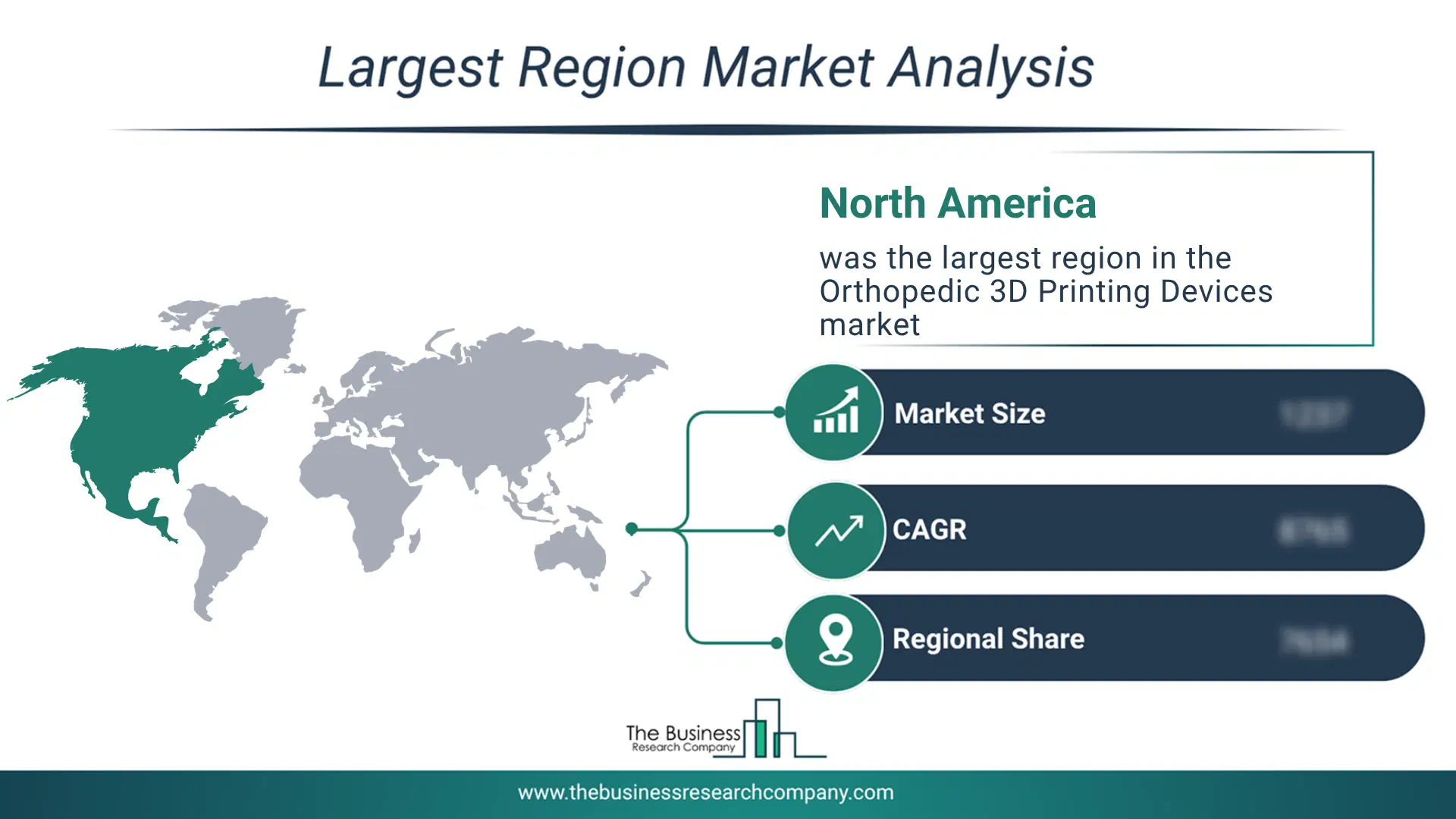
Regional Outlook
North America was the largest region in the orthopedic 3D printing devices market in 2025. Asia-Pacific is expected to be the fastest-growing region in the forecast period. The regions covered in this market report are Asia-Pacific, South East Asia, Western Europe, Eastern Europe, North America, South America, Middle East, Africa. The countries covered in this market report are Australia, Brazil, China, France, Germany, India, Indonesia, Japan, Taiwan, Russia, South Korea, UK, USA, Canada, Italy, SpainWhat Defines the Orthopedic 3D Printing Devices Market?
The orthopedic 3D printing devices market consists of sales of orthopedic braces and supports, anatomical models, surgical instruments, patient-specific anatomical models, and prosthetics. Values in this market are ‘factory gate’ values, that is, the value of goods sold by the manufacturers or creators of the goods, whether to other entities (including downstream manufacturers, wholesalers, distributors, and retailers) or directly to end customers. The value of goods in this market includes related services sold by the creators of the goods.How is Market Value Defined and Measured?
The market value is defined as the revenues that enterprises gain from the sale of goods and/or services within the specified market and geography through sales, grants, or donations in terms of the currency (in USD unless otherwise specified). The revenues for a specified geography are consumption values that are revenues generated by organizations in the specified geography within the market, irrespective of where they are produced. It does not include revenues from resales along the supply chain, either further along the supply chain or as part of other products.
This chart presents market attractiveness based on a quantitative evaluation of growth, competition, strategic alignment, and risk, offering a clear view of opportunity areas for decision-making. This chart is for illustrative purposes; the full report contains the complete analysis.

This chart highlights the Total Addressable Market (TAM) by estimating the maximum revenue opportunity using an assumption-driven approach, supporting strategic planning and opportunity sizing across markets. The chart is illustrative; the full report provides a more comprehensive analysis.
What Key Data and Analysis Are Included in the Orthopedic 3D Printing Devices Market Report 2026?
The orthopedic 3d printing devices market research report is one of a series of new reports from The Business Research Company that provides market statistics, including industry global market size, regional shares, competitors with the market share, detailed market segments, market trends and opportunities, and any further data you may need to thrive in the orthopedic 3d printing devices industry. The market research report delivers a complete perspective of everything you need, with an in-depth analysis of the current and future state of the industry.Orthopedic 3D Printing Devices Market Report Forecast Analysis
| Report Attribute | Details |
|---|---|
| Market Size Value In 2026 | $2.49 billion |
| Revenue Forecast In 2030 | $3.75 billion |
| Growth Rate | CAGR of 10.8% from 2026 to 2030 |
| Base Year For Estimation | 2025 |
| Actual Estimates/Historical Data | 2020-2025 |
| Forecast Period | 2026 - 2030 |
| Market Representation | Revenue in USD Billion and CAGR from 2026 to 2030 |
| Segments Covered | Product Type, Technology, Application, End-User |
| Regional Scope | Asia-Pacific, Western Europe, Eastern Europe, North America, South America, Middle East, Africa |
| Country Scope | The countries covered in the report are Australia, Brazil, China, France, Germany, India, Indonesia, Japan, Taiwan, Russia, South Korea, UK, USA, Canada, Italy, Spain. |
| Key Companies Profiled | Stryker Corporation, Zimmer Biomet Holding Inc., Orthofix Medical Inc., Tecomet Inc., 3D Systems Inc., Materialise NV, LimaCorporate S.p.A., Cretex Medical, SPINEART, PrinterPrezz, Oxford Performance Materials (OPM), Tangible Solutions Inc., Anatomics Pty Ltd, Osteo3D, Spentys, PEEK HEALTH S.A., Renishaw plc, EOS GmbH, GE Additive, Stratasys Ltd., Additive Orthopaedics, 4WEB Medical, Restor3d |
| Customization Scope | Request for Customization |
| Pricing And Purchase Options | Explore Purchase Options |