

Orthopedic Navigation Systems Market Report 2026
Global Outlook – By Technology (Electromagnetic Localizers, Optical Tracking, Fluoroscopy, Magnetic Resonance Imaging (MRI), Other Technologies), By Application (Knee surgery, Spine surgery, Hip surgery, Other Applications), By End Users (Hospitals, Ambulatory Surgical Centers, Other End Users) - Market Size, Trends, Strategies, and Forecast to 2030
Orthopedic Navigation Systems Market Overview
• Orthopedic Navigation Systems market size has reached to $3.46 billion in 2025 • Expected to grow to $6.96 billion in 2030 at a compound annual growth rate (CAGR) of 15% • Growth Driver: Surge In Cases of Joint Reconstruction • Market Trend: Orthopedic Navigation Leaders Advance Safer, Faster, Precision Tech With Machine Vision And Visible Light • North America was the largest region in 2025 and Asia-Pacific is the fastest growing region.What Is Covered Under Orthopedic Navigation Systems Market?
Orthopedic navigation systems refer to an advanced technology platform employed in orthopedic surgery to assist surgeons in achieving precise and accurate placement of implants, such as joint replacements or screws. These systems are used in various orthopedic procedures, including musculoskeletal trauma, spine diseases, sports injuries, degenerative diseases, and more. The main types of technologies included in orthopedic navigation systems are electromagnetic localizers, optical tracking, fluoroscopy, MRI (magnetic resonance imaging), and others. Electromagnetic localizers refer to an economical and adaptable technology employed in clinical settings for creating a free-hand three-dimensional ultrasound system. They are used for several applications, including knee surgery, spine surgery, hip surgery, and others, and are used by various end users, such as hospitals, ambulatory surgical centers, and others.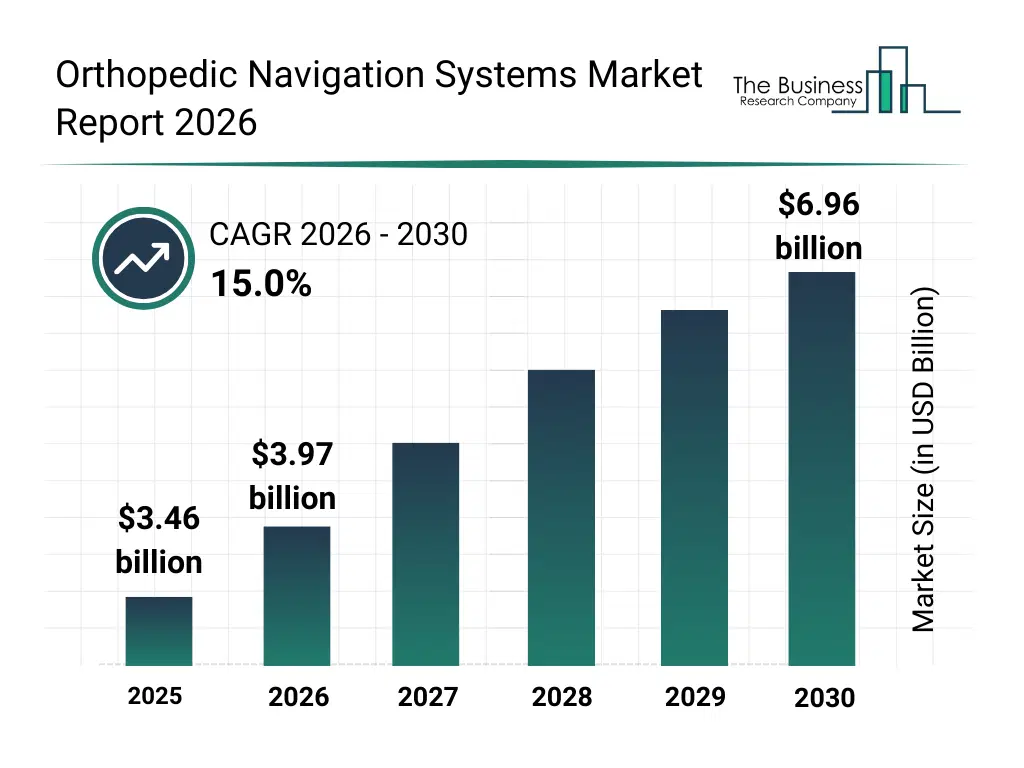
What Is The Orthopedic Navigation Systems Market Size and Share 2026?
The orthopedic navigation systems market size has grown rapidly in recent years. It will grow from $3.46 billion in 2025 to $3.97 billion in 2026 at a compound annual growth rate (CAGR) of 14.9%. The growth in the historic period can be attributed to limited accuracy and precision in traditional orthopedic surgeries, increasing prevalence of musculoskeletal disorders, rising demand for joint replacement surgeries, growing adoption of advanced imaging technologies, early investments in surgical navigation solutions by leading hospitals.What Is The Orthopedic Navigation Systems Market Growth Forecast?
The orthopedic navigation systems market size is expected to see rapid growth in the next few years. It will grow to $6.96 billion in 2030 at a compound annual growth rate (CAGR) of 15.0%. The growth in the forecast period can be attributed to rising demand for minimally invasive orthopedic procedures, increasing integration of AI and imaging with navigation systems, growing adoption of robotic-assisted surgeries, expanding hospital and surgical center infrastructure, rising focus on improving surgical outcomes and reducing complications. Major trends in the forecast period include rising adoption of computer-assisted orthopedic surgeries, increasing integration of navigation systems with robotic-assisted surgery, growing use of real-time imaging for surgical precision, rising focus on minimally invasive orthopedic procedures, increasing investment in surgeon training and navigation system education.

Global Orthopedic Navigation Systems Market Segmentation
1) By Technology: Electromagnetic Localizers, Optical Tracking, Fluoroscopy, Magnetic Resonance Imaging (MRI), Other Technologies 2) By Application: Knee surgery, Spine surgery, Hip surgery, Other Applications 3) By End Users: Hospitals, Ambulatory Surgical Centers, Other End Users Subsegments: 1) By Electromagnetic Localizers: Active Electromagnetic Localizers, Passive Electromagnetic Localizers, Hybrid Electromagnetic Localizers 2) By Optical Tracking: Infrared Optical Tracking Systems, Marker-Based Optical Tracking Systems, Markerless Optical Tracking Systems 3) By Fluoroscopy: C-Arm Fluoroscopy Systems, 3D Fluoroscopy Systems, Mobile Fluoroscopy Units 4) By Magnetic Resonance Imaging (MRI): Intraoperative MRI Systems, MRI-Based Navigation Systems, MRI-Guided Robotic Systems 5) By Other Technologies: Ultrasound-Based Navigation Systems, Robot-Assisted Navigation Systems, Computer-Assisted Surgery SystemsWhat Is The Driver Of The Orthopedic Navigation Systems Market?
A surge in cases of joint reconstruction is expected to propel the growth of the orthopedic navigation systems market going forward. Joint reconstruction is a surgical method that involves removing damaged or arthritic joint components and substituting them with artificial implants made of metal, plastic, or ceramic materials. Orthopedic navigation systems offer direction and assess several intraoperative factors during joint replacement or arthroplasty procedures. These are utilized in different types of joint reconstruction surgeries, including total knee arthroplasty, kinematic assessment, hip replacement surgery, and more. For instance, in July 2025, according to the American Joint Replacement Registry, a US-based orthopedic organization, in 2024, over 4 million hip and knee arthroplasty procedures were captured cumulatively. Therefore, the surge in cases of joint reconstruction is driving the growth of the orthopedic navigation systems industry.Key Players In The Global Orthopedic Navigation Systems Market
Major companies operating in the orthopedic navigation systems market are Medtronic Plc, Johnson & Johnson MedTech, Stryker Corporation, Zimmer Biomet Holdings Inc., Smith & Nephew PLC, NuVasive Inc., Globus Medical Inc., MicroPort Scientific Corporation, Brainlab, Amplitude Ortho SAS, Augmedics Inc., Intellijoint Surgical Inc., OrthAlign Inc., Fiagon GmbH, Orthokey Italia SRL, Image Navigation Inc., Neocis Inc., Proprio Vision, Ruthless Spine, Naviswiss AG, Exactech Inc, Arthrex Inc, Orthofix International NV, CAScination AG, THINK Surgical Inc, Renishaw PLC, Corin Group PLC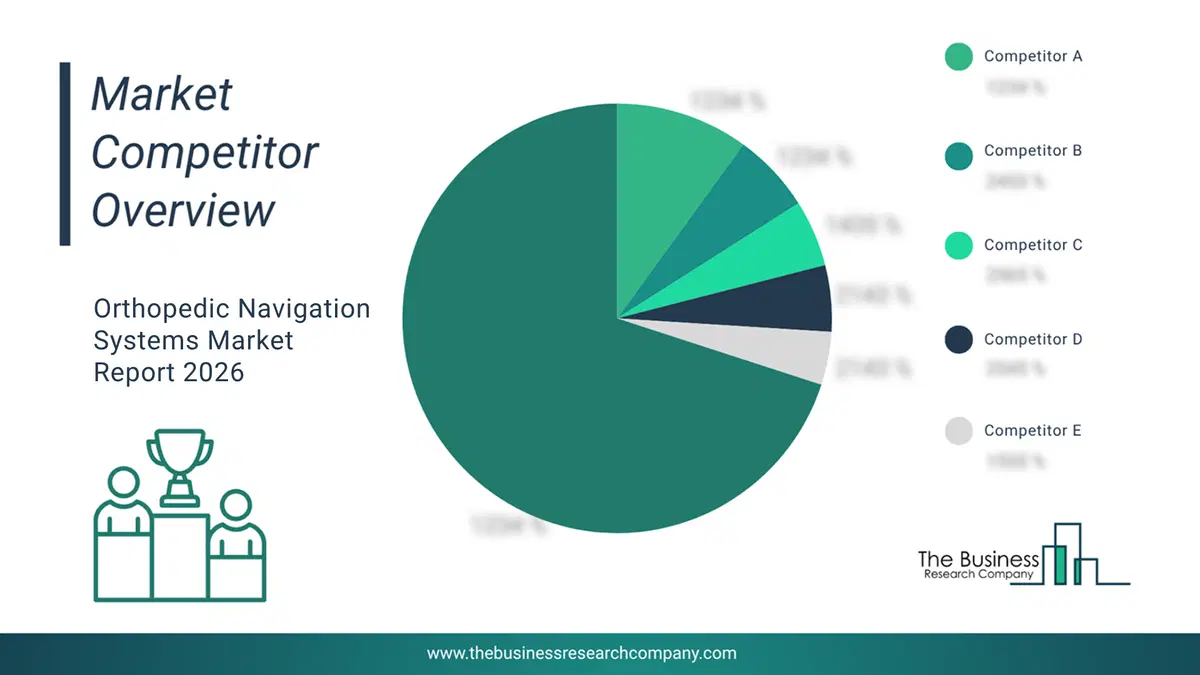
This chart is for illustrative purposes; the full report includes a detailed competitor analysis and comprehensive overview of the top 10 companies in the market.
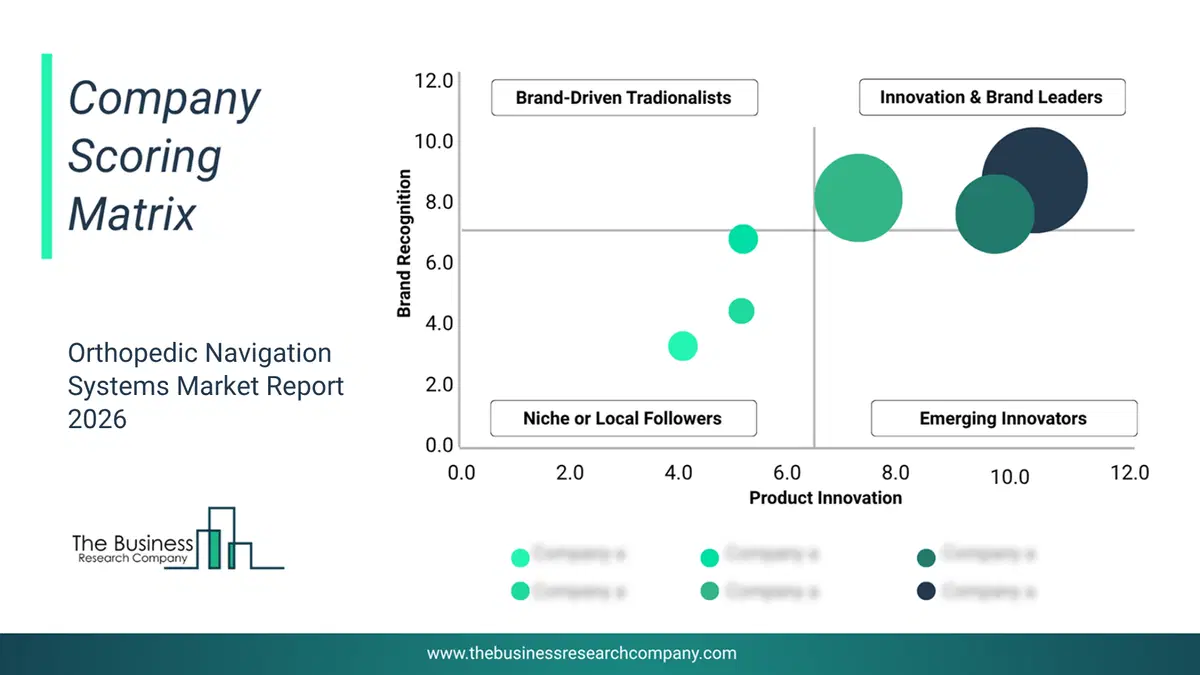
This chart maps companies by product innovation and brand strength, with bubble size indicating relative revenue, helping identify market leaders, challengers, and niche players. This is an illustrative chart; the full report provides a complete and accurate competitive analysis.
Global Orthopedic Navigation Systems Market Trends and Insights
Major companies operating in orthopedic navigation systems are increasing their focus on introducing safer, faster, and more precise surgical technologies, such as visible light and machine-vision algorithms, to gain a competitive edge in the market. The visible light and machine-vision algorithms offer accurate, real-time imaging without the limitations of traditional navigation systems. For instance, in August 2023, Orthofix, a US-based medical device company, launched its 7D FLASH Navigation Percutaneous Module 2.0, completing the first U.S. cases with enhanced planning features to better support the minimally invasive spine surgery. The 7D FLASH Navigation System enables navigated spinal fusion procedures for both open and MIS techniques, prioritizing safety, speed, and efficiency. Using visible light to quickly create 3D images, the system’s proprietary camera and machine-vision technology address common navigation challenges while reducing radiation exposure for staff and patients in open procedures.What Are Latest Mergers And Acquisitions In The Orthopedic Navigation Systems Market?
In August 2024, Zimmer Biomet, a US-based medical technology company, acquired OrthoGrid Systems, Inc. for an undisclosed amount. Through this acquisition, Zimmer Biomet aims to enhance its orthopedic navigation capabilities by integrating OrthoGrid’s AI-driven, fluoroscopy-based surgical guidance systems and expanding its portfolio of computer-assisted intraoperative solutions. OrthoGrid Systems, Inc. is a US-based company that provides real-time, AI-enabled navigation software for hip replacement and other orthopedic procedures.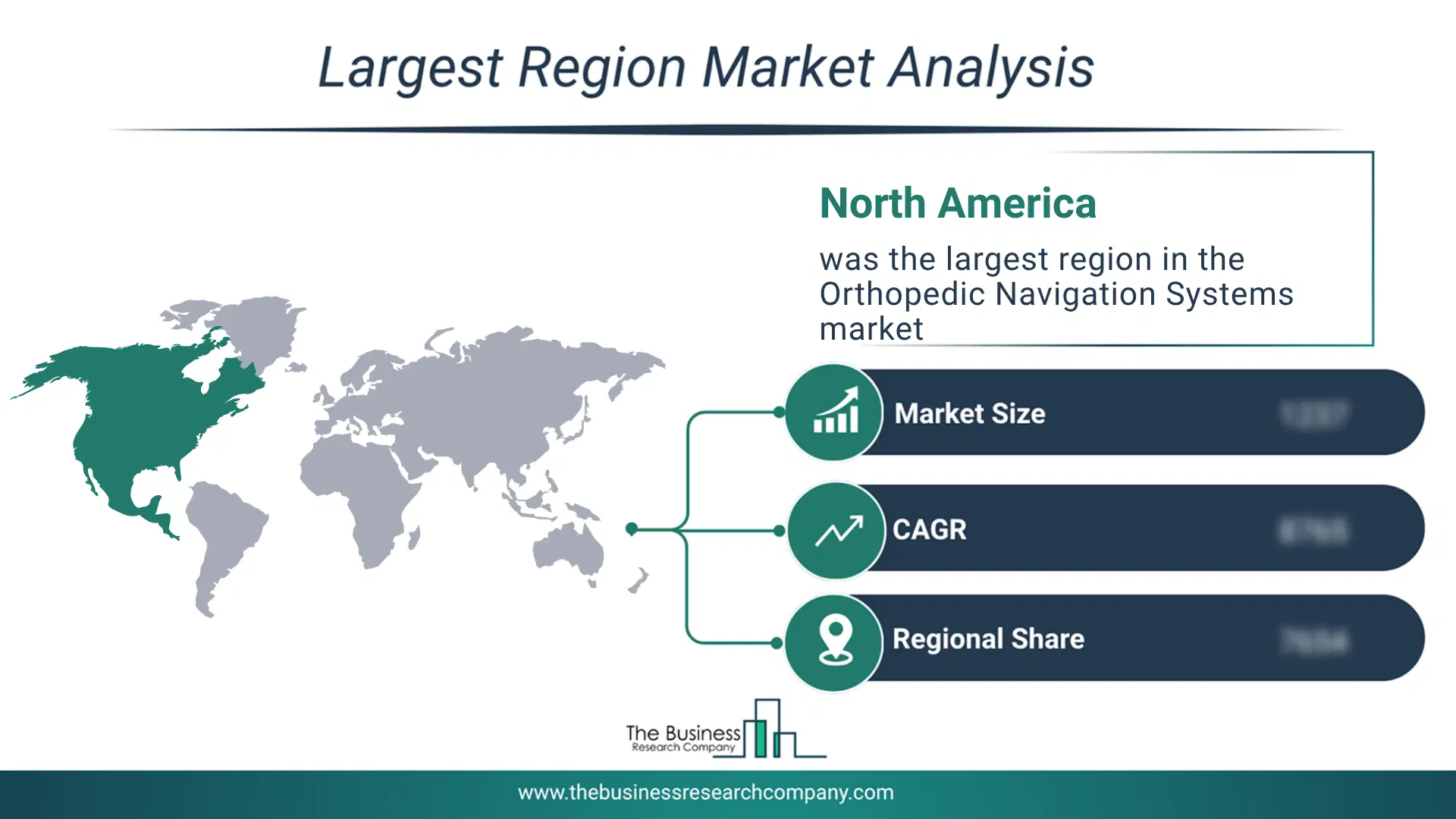
Regional Outlook
North America was the largest region in the orthopedic navigation systems market in 2025. Asia-Pacific is expected to be the fastest-growing region in the forecast period. The regions covered in this market report are Asia-Pacific, South East Asia, Western Europe, Eastern Europe, North America, South America, Middle East, Africa. The countries covered in this market report are Australia, Brazil, China, France, Germany, India, Indonesia, Japan, Taiwan, Russia, South Korea, UK, USA, Canada, Italy, Spain.What Defines the Orthopedic Navigation Systems Market?
Orthopedic navigation systems market consists of revenue earned by entities by providing real-time during surgery and stereoscopic vision. The market value includes the value of related goods sold by the service provider or included within the service offering. Orthopedic navigation systems market also includes sales of surgical navigation systems, model-based navigation systems, and commercialized orthopedic navigation systems. Values in this market are ‘factory gate’ values, that is the value of goods sold by the manufacturers or creators of the goods, whether to other entities (including downstream manufacturers, wholesalers, distributors and retailers) or directly to end customers. The value of goods in this market includes related services sold by the creators of the goods.How is Market Value Defined and Measured?
The market value is defined as the revenues that enterprises gain from the sale of goods and/or services within the specified market and geography through sales, grants, or donations in terms of the currency (in USD unless otherwise specified). The revenues for a specified geography are consumption values that are revenues generated by organizations in the specified geography within the market, irrespective of where they are produced. It does not include revenues from resales along the supply chain, either further along the supply chain or as part of other products.
This chart presents market attractiveness based on a quantitative evaluation of growth, competition, strategic alignment, and risk, offering a clear view of opportunity areas for decision-making. This chart is for illustrative purposes; the full report contains the complete analysis.

This chart highlights the Total Addressable Market (TAM) by estimating the maximum revenue opportunity using an assumption-driven approach, supporting strategic planning and opportunity sizing across markets. The chart is illustrative; the full report provides a more comprehensive analysis.
What Key Data and Analysis Are Included in the Orthopedic Navigation Systems Market Report 2026?
The orthopedic navigation systems market research report is one of a series of new reports from The Business Research Company that provides market statistics, including industry global market size, regional shares, competitors with the market share, detailed market segments, market trends and opportunities, and any further data you may need to thrive in the orthopedic navigation systems industry. The market research report delivers a complete perspective of everything you need, with an in-depth analysis of the current and future state of the industry.Orthopedic Navigation Systems Market Report Forecast Analysis
| Report Attribute | Details |
|---|---|
| Market Size Value In 2026 | $3.97 billion |
| Revenue Forecast In 2030 | $6.96 billion |
| Growth Rate | CAGR of 15% from 2026 to 2030 |
| Base Year For Estimation | 2025 |
| Actual Estimates/Historical Data | 2020-2025 |
| Forecast Period | 2026 - 2030 |
| Market Representation | Revenue in USD Billion and CAGR from 2026 to 2030 |
| Segments Covered | Technology, Application, End Users |
| Regional Scope | Asia-Pacific, Western Europe, Eastern Europe, North America, South America, Middle East, Africa |
| Country Scope | The countries covered in the report are Australia, Brazil, China, France, Germany, India, Indonesia, Japan, Taiwan, Russia, South Korea, UK, USA, Canada, Italy, Spain |
| Key Companies Profiled | Medtronic Plc, Johnson & Johnson MedTech, Stryker Corporation, Zimmer Biomet Holdings Inc., Smith & Nephew PLC, NuVasive Inc., Globus Medical Inc., MicroPort Scientific Corporation, Brainlab, Amplitude Ortho SAS, Augmedics Inc., Intellijoint Surgical Inc., OrthAlign Inc., Fiagon GmbH, Orthokey Italia SRL, Image Navigation Inc., Neocis Inc., Proprio Vision, Ruthless Spine, Naviswiss AG, Exactech Inc, Arthrex Inc, Orthofix International NV, CAScination AG, THINK Surgical Inc, Renishaw PLC, Corin Group PLC |
| Customization Scope | Request for Customization |
| Pricing And Purchase Options | Explore Purchase Options |