
Osmotic Power Market Report 2026
Global Outlook – By Product Type (Pressure Retarded Osmosis Systems, Reverse Electrodialysis Systems, Semi Permeable Membrane Modules, Osmotic Power Generators, Salinity Gradient Energy Converters), By Source (Sea Water, Seawater Reverse Osmosis Brine, Salt Dome, Hypersaline Lakes, Inland Saline Water Bodies), By Application (Shipping And Harbor Industries, Military Ships And Aircraft Carriers, Oil And Natural Gas Industries), By End User (Utility Companies, Desalination Plant Operators, Industrial Manufacturing Facilities, Government And Research Institutions, Remote Coastal Communities) – Market Size, Trends, Strategies, and Forecast to 2035
Osmotic Power Market Overview
• Osmotic Power market size has reached to $0.7 billion in 2025 • Expected to grow to $1.5 billion in 2030 at a compound annual growth rate (CAGR) of 16.5% • Growth Driver: Surge In Renewable Energy Demand Fueling The Growth Of The Market Due To Rising Electricity Consumption And The Need For Stable Clean Energy Sources • Market Trend: Innovative Technology Converts Saltwater Mixing Into Power • Europe was the largest region in 2025 and Asia-Pacific is the fastest growing region.What Is Covered Under Osmotic Power Market?
Osmotic power is a form of renewable energy generated by harnessing the pressure difference created when freshwater and seawater mix through a semi permeable membrane. It is based on the principle of Osmosis, where water naturally flows from a lower salinity solution to a higher salinity solution, creating usable energy. This process is typically implemented using technologies such as pressure retarded osmosis and reverse electrodialysis to produce electricity in a sustainable manner. The main product types of osmotic power include pressure retarded osmosis systems, reverse electrodialysis systems, semi permeable membrane modules, osmotic power generators, and salinity gradient energy converters. Pressure retarded osmosis systems refer to energy generation systems that utilize osmotic pressure differences between freshwater and saltwater to produce renewable electricity. These systems use sources such as sea water, seawater reverse osmosis brine, salt dome, hypersaline lakes and inland saline water bodies. They find application in shipping and harbor industries, military ships and aircraft carriers, oil and natural gas industries, serving end users including utility companies, desalination plant operators, industrial manufacturing facilities, government and research institutions, and remote coastal communities.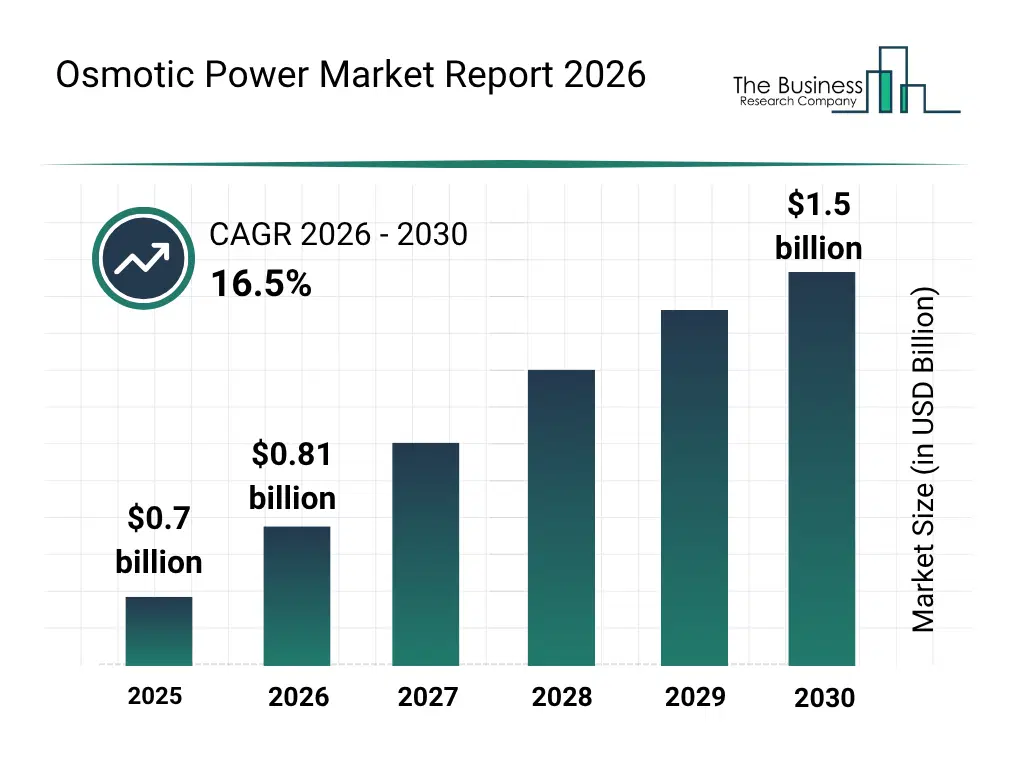
What Is The Osmotic Power Market Size and Share 2026?
The osmotic power market size has grown rapidly in recent years. It will grow from $0.7 billion in 2025 to $0.81 billion in 2026 at a compound annual growth rate (CAGR) of 16.3%. The growth in the historic period can be attributed to early research in osmosis based energy conversion, development of membrane filtration technologies from desalination industry, limited commercialization of salinity gradient power systems, high cost of membrane materials and low efficiency systems, dependence on conventional fossil fuel based coastal power generation.What Is The Osmotic Power Market Growth Forecast?
The osmotic power market size is expected to see rapid growth in the next few years. It will grow to $1.5 billion in 2030 at a compound annual growth rate (CAGR) of 16.5%. The growth in the forecast period can be attributed to advancements in high efficiency semi permeable membrane technology, increasing investment in marine renewable energy infrastructure, rising demand for decentralized and clean coastal power generation, integration of osmotic power with desalination plants, supportive government policies for blue energy development projects. Major trends in the forecast period include expansion of pressure retarded osmosis systems for large scale coastal renewable energy generation, increasing adoption of reverse electrodialysis technology for efficient salinity gradient power conversion, rising deployment of advanced semi permeable membrane materials to improve energy conversion efficiency, growth in hybrid osmotic power generators integrating renewable hybrid systems for grid stability, increasing utilization of hypersaline water sources such as brine and salt lakes for osmotic energy extraction.
Global Osmotic Power Market Segmentation
1) By Product Type: Pressure Retarded Osmosis Systems, Reverse Electrodialysis Systems, Semi Permeable Membrane Modules, Osmotic Power Generators, Salinity Gradient Energy Converters 2) By Source: Sea Water, Seawater Reverse Osmosis Brine, Salt Dome, Hypersaline Lakes, Inland Saline Water Bodies 3) By Application: Shipping And Harbor Industries, Military Ships And Aircraft Carriers, Oil And Natural Gas Industries 4) By End User: Utility Companies, Desalination Plant Operators, Industrial Manufacturing Facilities, Government And Research Institutions, Remote Coastal Communities Subsegments: 1) By Pressure Retarded Osmosis Systems: Freshwater And Seawater Systems, Brackish Water Systems, Hybrid Osmosis Systems, High Pressure Systems, Low Pressure Systems 2) By Reverse Electrodialysis Systems: Cation Exchange Membrane Systems, Anion Exchange Membrane Systems, Stack Configuration Systems, Modular Electrodialysis Units, Continuous Flow Systems 3) By Semi Permeable Membrane Modules: Hollow Fiber Membrane Modules, Flat Sheet Membrane Modules, Spiral Wound Membrane Modules, Tubular Membrane Modules, Composite Membrane Modules 4) By Osmotic Power Generators: Turbine Based Generators, Pressure Driven Generators, Electrochemical Generators, Hybrid Energy Generators, Modular Power Units 5) By Salinity Gradient Energy Converters: Membrane Based Converters, Electrochemical Converters, Capacitive Mixing Systems, Hydrogel Based Converters, Hybrid Salinity ConvertersWhat Are The Drivers Of The Osmotic Power Market?
The increasing global demand for renewable energy is expected to propel the growth of the osmotic power market going forward. Renewable energy refers to energy generated from naturally replenishing sources such as solar, wind, hydropower, and biomass. The increasing global demand for renewable energy is driven by rising electricity consumption caused by industrialization, urbanization, and the ongoing electrification of transport and infrastructure, leading to accelerated adoption of clean energy systems worldwide. Osmotic Power supports the demand for renewable energy by providing a stable and continuous source of electricity generated from salinity gradients, helping balance intermittent sources such as wind and solar power. For instance, in March 2025, according to the International Renewable Energy Agency, an UAE-based intergovernmental organization, global renewable power capacity additions reached 585 gigawatts in 2024, accounting for over 90% of total power expansion, compared to lower additions in previous years. Therefore, the increasing global demand for renewable energy is driving the growth of the osmotic power industry. The increasing electricity demand is expected to propel the growth of the osmotic power market going forward. Electricity is the flow of electric charge, typically through a conductor, used to deliver energy for powering devices and systems. Electricity demand is rising primarily due to rapid industrialization, as expanding manufacturing and production activities require increasing amounts of electrical energy to operate machinery, automation systems, and large-scale industrial processes. Higher electricity demand supports osmotic power by driving the need for steady, continuous renewable energy, encouraging adoption of salinity gradient systems that can deliver reliable baseload power alongside intermittent sources. For instance, in March 2025, according to the Energy Information Administration (EIA), a US-based federal statistical agency, the United States produced 4.43 thousand terawatt-hours (TWh) of electricity, marking a 2.8% increase over 2024, which had earlier recorded the highest annual output. Therefore, the increasing electricity demand is driving the growth of the osmotic power industry.Key Players In The Global Osmotic Power Market
Major companies operating in the osmotic power market are Acciona S.A., SUEZ S.A., Hitachi Zosen Corporation, Statkraft AS, Toyobo Co. Ltd., Gradiant Corporation, Hydranautics Inc., Aquaporin A/S, Sweetch Energy, Blue Energy Canada Inc., REDstack B.V., SaltPower ApS, AquaBattery B.V.Global Osmotic Power Market Trends and Insights
Major companies operating in the osmotic power market are focusing on developing innovative solutions, such as pressure-retarded osmosis (PRO) plants, to efficiently generate renewable electricity from the salinity gradient between freshwater and seawater while improving energy output, scalability, and commercial viability of the technology. Pressure-retarded osmosis (PRO) plants are systems that generate electricity by allowing freshwater and seawater to mix through a semipermeable membrane under pressure, harnessing the resulting osmotic flow to drive a turbine. For instance, in August 2025, Fukuoka District Waterworks Agency, a Japan-based municipal water utility, launched the Fukuoka Osmotic Power Plant, an innovative energy generation facility. The plant uses concentrated brine from desalination processes and treated wastewater streams as feedwater sources to maximize salinity differences and improve power output. Through advanced membrane modules, osmotic pressure is converted into mechanical energy that rotates turbines to generate electricity. The facility is designed to produce around 880,000 kilowatt-hours annually, enough to support desalination operations and nearby households. It offers 24-hour clean energy generation with no direct carbon emissions, helping reduce reliance on intermittent renewables.Regional Outlook/Insights
Europe was the largest region in the osmotic power market in 2025. Asia-Pacific is expected to be the fastest-growing region in the forecast period. The regions covered in this market report are Asia-Pacific, South East Asia, Western Europe, Eastern Europe, North America, South America, Middle East, Africa. The countries covered in this market report are Australia, Brazil, China, France, Germany, India, Indonesia, Japan, Taiwan, Russia, South Korea, UK, USA, Canada, Italy, Spain.What Defines the Osmotic Power Market?
The osmotic power market consists of sales of hybrid osmotic power units, modular membrane skids, brackish water energy systems, osmotic pilot plant equipment. Values in this market are ‘factory gate’ values, that is the value of goods sold by the manufacturers or creators of the goods, whether to other entities (including downstream manufacturers, wholesalers, distributors and retailers) or directly to end customers. The value of goods in this market includes related services sold by the creators of the goods.How is Market Value Defined and Measured?
The market value is defined as the revenues that enterprises gain from the sale of goods and/or services within the specified market and geography through sales, grants, or donations in terms of the currency (in USD unless otherwise specified). The revenues for a specified geography are consumption values that are revenues generated by organizations in the specified geography within the market, irrespective of where they are produced. It does not include revenues from resales along the supply chain, either further along the supply chain or as part of other products.What Key Data and Analysis Are Included in the Osmotic Power Market Report 2026?
The osmotic power market research report is one of a series of new reports from The Business Research Company that provides market statistics, including industry global market size, regional shares, competitors with the market share, detailed market segments, market trends and opportunities, and any further data you may need to thrive in the osmotic power industry. The market research report delivers a complete perspective of everything you need, with an in-depth analysis of the current and future state of the industry.Osmotic Power Market Report Forecast Analysis
| Report Attribute | Details |
|---|---|
| Market Size Value In 2026 | $0.81 billion |
| Revenue Forecast In 2035 | $1.5 billion |
| Growth Rate | CAGR of 16.5% from 2026 to 2035 |
| Base Year For Estimation | 2025 |
| Actual Estimates/Historical Data | 2020-2025 |
| Forecast Period | 2026 - 2030 - 2035 |
| Market Representation | Revenue in USD Billion and CAGR from 2026 to 2035 |
| Segments Covered | Product Type, Source, Application, End User |
| Regional Scope | Asia-Pacific, Western Europe, Eastern Europe, North America, South America, Middle East, Africa |
| Country Scope | The countries covered in the report are Australia, Brazil, China, France, Germany, India, Indonesia, Japan, Taiwan, Russia, South Korea, UK, USA, Canada, Italy, Spain. |
| Key Companies Profiled | Acciona S.A., SUEZ S.A., Hitachi Zosen Corporation, Statkraft AS, Toyobo Co. Ltd., Gradiant Corporation, Hydranautics Inc., Aquaporin A/S, Sweetch Energy, Blue Energy Canada Inc., REDstack B.V., SaltPower ApS, AquaBattery B.V. |
| Customization Scope | Request for Customization |
| Pricing And Purchase Options | Explore Purchase Options |