
Oxidative Stress Detection Market Report 2026
Global Outlook – By Product Type (Assay Kits, Reagents, Instruments), By Technology (Enzyme Linked Immunosorbent Assay, Flow Cytometry, Chromatography, Microscopy, Other Technologies), By Application (Cancer Research, Cardiovascular Diseases, Neurological Disorders, Diabetes, Aging Research, Other Chronic Diseases), By End User (Hospitals, Diagnostic Laboratories, Academic And Research, Other End Users) – Market Size, Trends, Strategies, and Forecast to 2030
Oxidative Stress Detection Market Overview
• Oxidative Stress Detection market size has reached to $3.7 billion in 2025 • Expected to grow to $5.84 billion in 2030 at a compound annual growth rate (CAGR) of 9.6% • Growth Driver: Rising Healthcare Expenditure Fueling The Growth Of The Market Due To Increasing Investments In Advanced Medical Technologies • North America was the largest region in 2025 and Asia-Pacific is the fastest growing region.What Is Covered Under Oxidative Stress Detection Market?
Oxidative stress detection refers to the process of identifying and measuring the imbalance between free radicals and antioxidants in biological systems. It involves the use of biomarkers, diagnostic tools, and analytical techniques to assess oxidative damage in cells, tissues, or bodily fluids, helping in the diagnosis and monitoring of various diseases and health conditions. The main product types of oxidative stress detection include assay kits, reagents, and instruments. Assay kits refer to ready-to-use diagnostic tools designed to measure oxidative stress biomarkers in biological samples. These products are based on technologies including enzyme linked immunosorbent assay, flow cytometry, chromatography, microscopy, and other technologies. The key applications of cancer research, cardiovascular diseases, neurological disorders, diabetes, aging research, and other chronic diseases, while the end-users hospitals, diagnostic laboratories, academic and research, and others.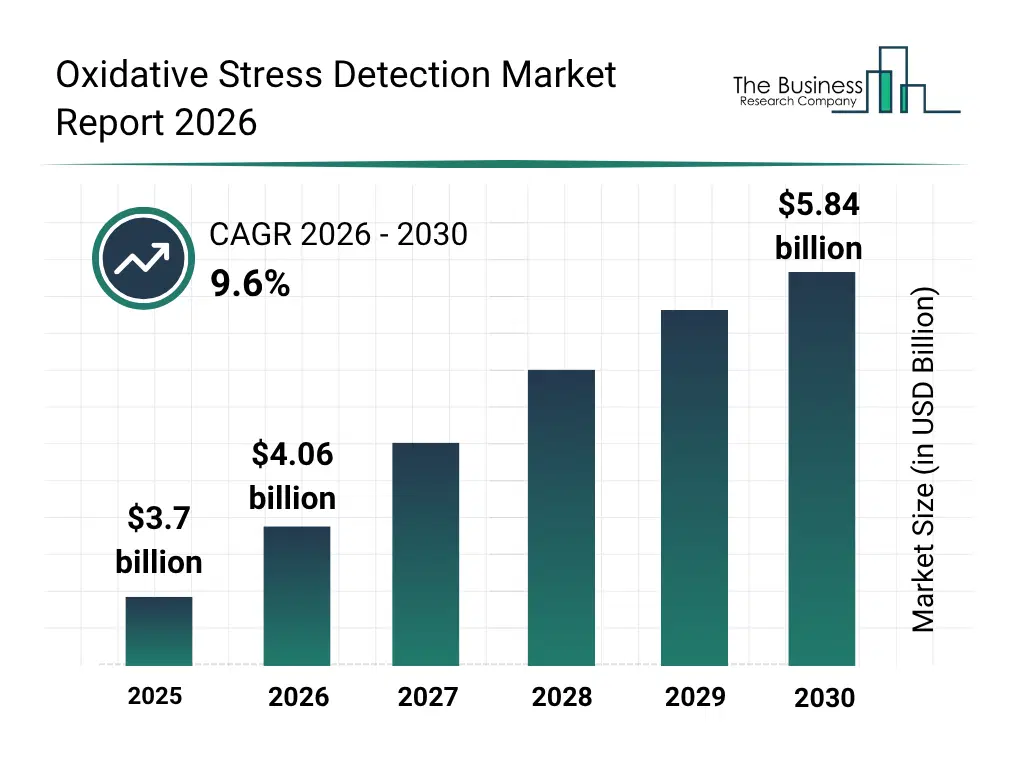
What Is The Oxidative Stress Detection Market Size and Share 2026?
The oxidative stress detection market size has grown strongly in recent years. It will grow from $3.7 billion in 2025 to $4.06 billion in 2026 at a compound annual growth rate (CAGR) of 9.7%. The growth in the historic period can be attributed to rising prevalence of chronic diseases linked to oxidative damage, increasing academic research in free radical biology, early adoption of elisa and spectrophotometric assays, expansion of diagnostic laboratory infrastructure, growing awareness of antioxidant imbalance in clinical diagnostics.What Is The Oxidative Stress Detection Market Growth Forecast?
The oxidative stress detection market size is expected to see strong growth in the next few years. It will grow to $5.84 billion in 2030 at a compound annual growth rate (CAGR) of 9.6%. The growth in the forecast period can be attributed to advancement in precision medicine and personalized diagnostics, increasing adoption of ai driven biomarker interpretation systems, rising demand for non invasive diagnostic techniques, expansion of automated and high throughput laboratory platforms, growing integration of multi omics and systems biology approaches. Major trends in the forecast period include ai enabled oxidative stress biomarker analytics for early disease prediction, integration of multi omics data for oxidative stress profiling, development of wearable biosensors for real time oxidative stress monitoring, expansion of high throughput automated oxidative stress screening platforms, adoption of cloud based clinical data platforms for biomarker interpretation.
Global Oxidative Stress Detection Market Segmentation
1) By Product Type: Assay Kits; Reagents; Instruments 2) By Technology: Enzyme Linked Immunosorbent Assay; Flow Cytometry; Chromatography; Microscopy; Other Technologies 3) By Application: Cancer Research; Cardiovascular Diseases; Neurological Disorders; Diabetes; Aging Research; Other Chronic Diseases 4) By End User: Hospitals; Diagnostic Laboratories; Academic And Research; Other End Users Subsegments: 1) By Assay Kits: Lipid Peroxidation Assay Kits; Reactive Oxygen Species Detection Assay Kits; Glutathione Assay Kits; Antioxidant Capacity Assay Kits; Protein Oxidation Assay Kits 2) By Reagents: Fluorescent Probes; Chromogenic Reagents; Enzyme Substrates; Buffer Solutions; Oxidative Stress Biomarker Reagents 3) By Instruments: Spectrophotometers; Flow Cytometers; Chromatography Systems; Fluorescence Microscopes; Microplate ReadersWhat Are The Drivers Of The Oxidative Stress Detection Market?
The rising healthcare expenditure is expected to propel the growth of the oxidative stress detection market going forward. Healthcare expenditure refers to the total amount of financial resources spent on medical services, healthcare infrastructure, medications, preventive care, and related health activities within a specific period. Healthcare expenditure is rising due to the increasing prevalence of chronic diseases, which requires long-term medical treatment, frequent hospital visits, advanced diagnostic services, and continuous patient care. Higher healthcare expenditure supports oxidative stress detection by enabling greater investment in advanced diagnostic infrastructure and biomarker testing technologies, which improves early identification and monitoring of oxidative imbalance at the cellular level. For instance, in April 2025, according to the Office for National Statistics, a UK-based government agency, healthcare spending increased by 6.5% from 2023 to 2024, higher than the 6.3% growth recorded during 2023. Therefore, the rising healthcare expenditure is driving the growth of the oxidative stress detection industry. The growth in personalized medicine is expected to propel the growth of the oxidative stress detection market going forward. Personalized medicine refers to a medical approach that uses an individual’s genetic, molecular, and clinical information to customize disease prevention, diagnosis, and treatment strategies for improved patient outcomes. Growth in personalized medicine is primarily driven by advances in genomics and molecular diagnostics, which enable healthcare providers to analyze individual genetic profiles and disease biomarkers to tailor more precise and effective treatments for each patient. Oxidative stress detection enables personalized medicine by providing precise insights into an individual’s redox balance, allowing clinicians to tailor prevention strategies, treatment selection, and dosage based on patient-specific oxidative biomarker profiles. For instance, in February 2024, the Personalized Medicine Coalition, a US-based non-profit organization, in 2023, the FDA approved 16 new personalized treatments for rare disease patients, up from six in 2022. The newly approved personalized treatments for 2023 also include seven cancer drugs and three for other diseases and conditions. Therefore, the growth in personalized medicine is driving the growth of the oxidative stress detection industry.Key Players In The Global Oxidative Stress Detection Market
Major companies operating in the oxidative stress detection market are Thermo Fisher Scientific Inc.; Merck KGaA; Agilent Technologies Inc.; Bio-Rad Laboratories Inc.; Promega Corporation; Elabscience Biotechnology Inc.; Cayman Chemical Company; RayBiotech Inc.; Creative Bioarray; Santa Cruz Biotechnology Inc.; Arbor Assays; MyBioSource Inc.; Boster Biological Technology Co. Ltd.; AAT Bioquest Inc.; Cell Biolabs Inc.; Cloud-Clone Corp.; Dojindo Molecular Technologies Inc.; Oxford Biomedical Research Inc.; Bio-Techne Corporation; Qiagen N.V.; Revvity Inc.; Sartorius AG; Randox Laboratories Ltd.What Are Latest Mergers And Acquisitions In The Oxidative Stress Detection Market?
In September 2025, Lumiquick Diagnostics Inc., a US-based diagnostics company, acquired AOXRE for an undisclosed amount. With this acquisition, Lumiquick Diagnostics aims to strengthen its oxidative stress diagnostics portfolio and expand its capabilities in biomarker assay technologies and redox balance testing solutions for clinical and research applications. Aoxre LLC is a US-based company that provides oxidative stress detection products and assay kits.Regional Outlook
North America was the largest region in the oxidative stress detection market in 2025. Asia-Pacific is expected to be the fastest-growing region in the forecast period. The regions covered in this market report are Asia-Pacific, South East Asia, Western Europe, Eastern Europe, North America, South America, Middle East, Africa. The countries covered in this market report are Australia, Brazil, China, France, Germany, India, Indonesia, Japan, Taiwan, Russia, South Korea, UK, USA, Canada, Italy, Spain.What Defines the Oxidative Stress Detection Market?
The oxidative stress detection market consists of revenues earned by entities by providing services such as biomarker analysis, reactive oxygen species (ROS) measurement, antioxidant capacity testing, oxidative damage assessment, and diagnostic laboratory testing. The market value includes the value of related goods sold by the service provider or included within the service offering. The oxidative stress detection market also includes sales of antioxidant capacity testing kits, oxidative damage biomarkers analyzers, and fluorescence-based detection probes. Values in this market are ‘factory gate’ values, that is the value of goods sold by the manufacturers or creators of the goods, whether to other entities (including downstream manufacturers, wholesalers, distributors and retailers) or directly to end customers. The value of goods in this market includes related services sold by the creators of the goods.How is Market Value Defined and Measured?
The market value is defined as the revenues that enterprises gain from the sale of goods and/or services within the specified market and geography through sales, grants, or donations in terms of the currency (in USD unless otherwise specified). The revenues for a specified geography are consumption values that are revenues generated by organizations in the specified geography within the market, irrespective of where they are produced. It does not include revenues from resales along the supply chain, either further along the supply chain or as part of other products.What Key Data and Analysis Are Included in the Oxidative Stress Detection Market Report 2026?
The oxidative stress detection market research report is one of a series of new reports from The Business Research Company that provides market statistics, including industry global market size, regional shares, competitors with the market share, detailed market segments, market trends and opportunities, and any further data you may need to thrive in the oxidative stress detection industry. The market research report delivers a complete perspective of everything you need, with an in-depth analysis of the current and future state of the industry.Oxidative Stress Detection Market Report Forecast Analysis
| Report Attribute | Details |
|---|---|
| Market Size Value In 2026 | $4.06 billion |
| Revenue Forecast In 2030 | $5.84 billion |
| Growth Rate | CAGR of 9.6% from 2026 to 2030 |
| Base Year For Estimation | 2025 |
| Actual Estimates/Historical Data | 2020-2025 |
| Forecast Period | 2026 - 2030 |
| Market Representation | Revenue in USD Billion and CAGR from 2026 to 2030 |
| Segments Covered | Product Type, Technology, Application, End User |
| Regional Scope | Asia-Pacific, Western Europe, Eastern Europe, North America, South America, Middle East, Africa |
| Country Scope | The countries covered in the report are Australia, Brazil, China, France, Germany, India, ... |
| Key Companies Profiled | Thermo Fisher Scientific Inc.; Merck KGaA; Agilent Technologies Inc.; Bio-Rad Laboratories Inc.; Promega Corporation; Elabscience Biotechnology Inc.; Cayman Chemical Company; RayBiotech Inc.; Creative Bioarray; Santa Cruz Biotechnology Inc.; Arbor Assays; MyBioSource Inc.; Boster Biological Technology Co. Ltd.; AAT Bioquest Inc.; Cell Biolabs Inc.; Cloud-Clone Corp.; Dojindo Molecular Technologies Inc.; Oxford Biomedical Research Inc.; Bio-Techne Corporation; Qiagen N.V.; Revvity Inc.; Sartorius AG; Randox Laboratories Ltd. |
| Customization Scope | Request for Customization |
| Pricing And Purchase Options | Explore Purchase Options |