
Packaged Food Shelf Life Testing Market Report 2026
Global Outlook – By Parameter (Microbial Contamination, Rancidity, Nutrient Stability, Organoleptic Properties, Other Parameters), By Food Tested (Packaged Food, Beverages, Bakery And Confectionery Products, Meat And Meat Products, Dairy Products And Desserts, Processed Fruits And Vegetables, Other Food Tested), By Technology (Equipment And Kit-Based, Manual Tests), By Method (Real-Time Shelf Life Testing, Accelerated Shelf-Life Testing) – Market Size, Trends, Strategies, and Forecast to 2030
Packaged Food Shelf Life Testing Market Overview
• Packaged Food Shelf Life Testing market size has reached to $5.71 billion in 2025 • Expected to grow to $9.06 billion in 2030 at a compound annual growth rate (CAGR) of 9.6% • Growth Driver: Rising Foodborne Illnesses Fuel Growth Of Packaged The Shelf-Life Testing Market • Market Trend: Revolutionizing Baked Goods With Enhanced Texture, Freshness, And Shelf Life • Europe was the largest region in 2025 and Asia-Pacific is the fastest growing region.What Is Covered Under Packaged Food Shelf Life Testing Market?
Packaged food shelf-life testing refers to the assessment of how long a food product maintains its quality and safety under specific storage conditions. It is used to determine the expiration date, ensure compliance with regulatory standards, and guide consumers on optimal usage for freshness. This testing helps manufacturers manage inventory and reduce food waste effectively. The parameter of packaged food shelf-life testing is microbial contamination, rancidity, nutrient stability, organoleptic properties, and others. Microbial contamination refers to the non-intended or accidental introduction of infectious material such as bacteria, yeast, mold, fungi, virus, prions, protozoa, or their toxins and by-products. The types of food tested are packaged food, beverages, bakery and confectionery products, meat and meat products, dairy products and desserts, processed fruits and vegetables, others with equipment and kit-based, and manual tests technology and real-time shelf life testing, and accelerated shelf-life testing methods.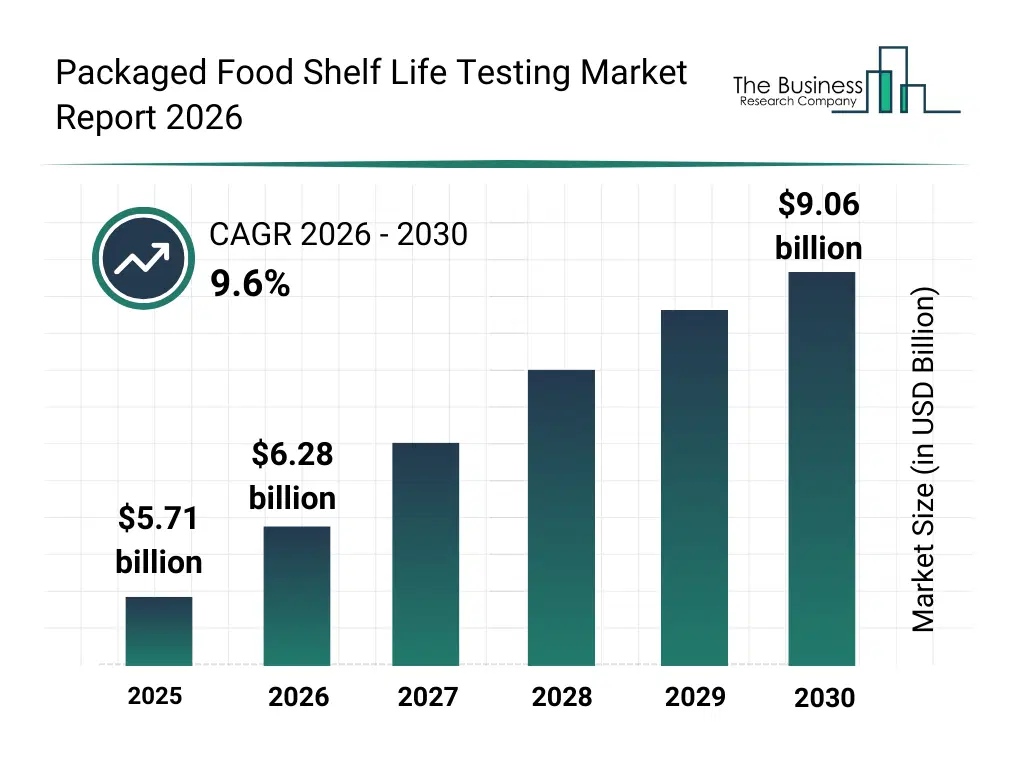
What Is The Packaged Food Shelf Life Testing Market Size and Share 2026?
The packaged food shelf life testing market size has grown strongly in recent years. It will grow from $5.71 billion in 2025 to $6.28 billion in 2026 at a compound annual growth rate (CAGR) of 9.9%. The growth in the historic period can be attributed to rising packaged food consumption, increasing food safety awareness, government enforcement of quality standards, growth in food manufacturing, early development of testing laboratories.What Is The Packaged Food Shelf Life Testing Market Growth Forecast?
The packaged food shelf life testing market size is expected to see strong growth in the next few years. It will grow to $9.06 billion in 2030 at a compound annual growth rate (CAGR) of 9.6%. The growth in the forecast period can be attributed to increasing regulatory compliance stringency, rising demand for extended food shelf life, growth of global packaged food trade, expansion of quality assurance practices, increasing investment in food testing infrastructure. Major trends in the forecast period include growing focus on food quality and safety validation, increasing demand for accurate shelf life determination, rising emphasis on regulatory food compliance testing, growing adoption of scientific food freshness assessment, increasing expansion of packaged and processed food testing.
Global Packaged Food Shelf Life Testing Market Segmentation
1) By Parameter: Microbial Contamination, Rancidity, Nutrient Stability, Organoleptic Properties, Other Parameters 2) By Food Tested: Packaged Food, Beverages, Bakery And Confectionery Products, Meat And Meat Products, Dairy Products And Desserts, Processed Fruits And Vegetables, Other Food Tested 3) By Technology: Equipment And Kit-Based, Manual Tests 4) By Method: Real-Time Shelf Life Testing, Accelerated Shelf-Life Testing Subsegments: 1) By Microbial Contamination: Total Plate Count (TPC), Yeast And Mold Count, Pathogen Testing, Shelf Life Of Probiotic Products 2) By Rancidity: Peroxide Value (PV), Acid Value (AV), Free Fatty Acids (FFA), Thiobarbituric Acid Reactive Substances (TBARS) 3) By Nutrient Stability: Vitamin Stability, Mineral Stability, Protein Integrity, Fatty Acid Profile 4) By Organoleptic Properties: Taste Testing, Aroma Assessment, Texture Evaluation, Color Analysis 5) By Other Parameters: Packaging Integrity Testing, Moisture Content Analysis, PH Level Testing, Sensory Evaluation MethodsWhat Is The Driver Of The Packaged Food Shelf Life Testing Market?
The increasing incidence of foodborne illnesses is expected to propel the growth of the packaged food shelf-life testing market going forward. Foodborne illnesses refer to illnesses caused by the consumption of contaminated food or beverages. Packaged food shelf-life testing plays an important role in preventing foodborne illnesses by ensuring that products remain safe for consumption over their designated storage periods, mitigating the risk of microbial contamination, and safeguarding consumer health through the maintenance of quality and safety standards. For instance, in August 2023, according to the Centers for Disease Control and Prevention, a US-based government agency, an estimated 48 million people got sick from a foodborne illness, 128, 000 were hospitalized, and 3, 000 died in the United States. Therefore, the increasing incidence of foodborne illnesses is driving the growth of the packaged food shelf-life testing market.Key Players In The Global Packaged Food Shelf Life Testing Market
Major companies operating in the packaged food shelf life testing market report are SGS SA, AES Laboratories Pvt. Ltd., Agrifood Technology, ALS Ltd., AsureQuality Limited, Bureau Veritas, EMSL Analytical Inc., Eurofins Scientific SE, Intertek Group PLC, Mérieux NutriSciences Corp., Premium Analytical Services, RJ Hill Laboratories, SCS Global Services, Symbio Laboratories Pty. Ltd., Microbac Laboratories Inc., Silliker Inc., Covance Inc., TÜV SÜD AG, NSF International, Underwriters Laboratories LLC, DNV GL, Lloyd's Register Group Limited, Kiwa NV, Q Laboratories Inc., Romer Labs Diagnostic GmbH, 3M Food Safety, Accugen Laboratories Inc., Advanced Analytical Testing Laboratories Inc., Analytical Food Laboratories, Bio-Rad Laboratories Inc., CEM Corporation, Certified Laboratories Inc., Charles River Laboratories International Inc., EAG Laboratories
This chart is for illustrative purposes; the full report includes a detailed competitor analysis and comprehensive overview of the top 10 companies in the market.
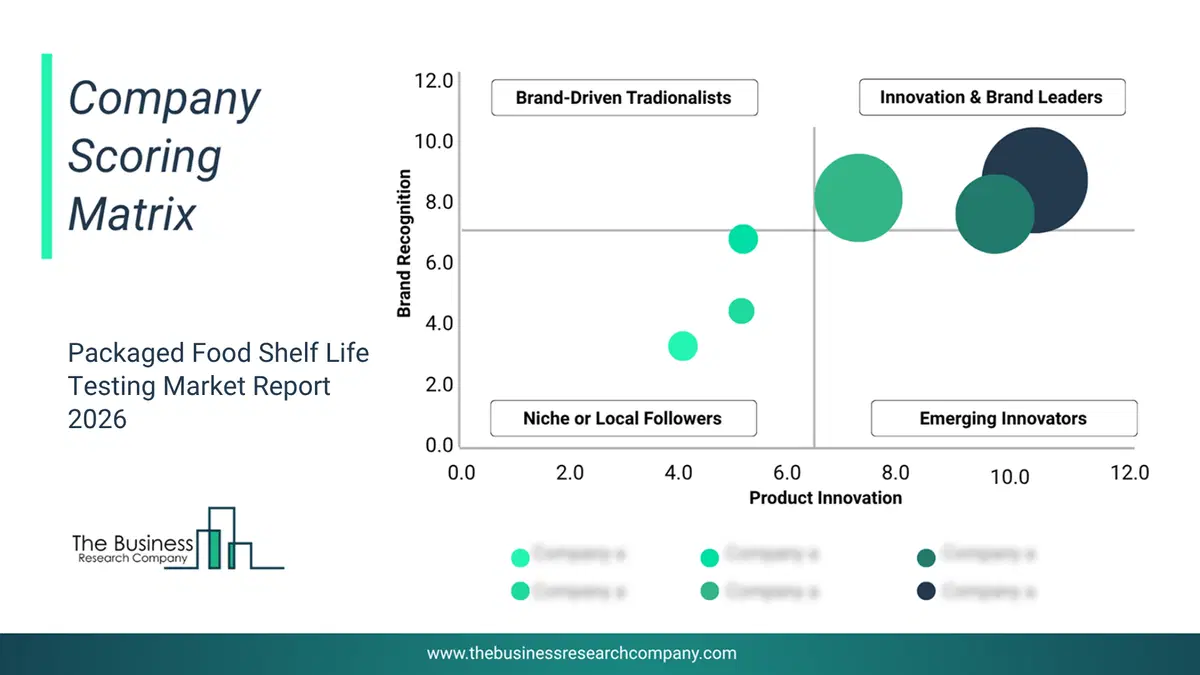
This chart maps companies by product innovation and brand strength, with bubble size indicating relative revenue, helping identify market leaders, challengers, and niche players. This is an illustrative chart; the full report provides a complete and accurate competitive analysis.
Global Packaged Food Shelf Life Testing Market Trends and Insights
Major companies operating in the packaged food shelf-life testing market are increasing their focus on introducing advanced solutions, such as Novamyl BestBite, to gain a competitive edge in the market. Novamyl BestBite is an enzyme solution designed to enhance the texture, freshness, and shelf life of baked goods by optimizing starch conversion for improved quality and consumer appeal. For instance, in May 2023, Novozymes, a Denmark-based biotechnology company, launched Novamyl BestBite. Adding Novamyl BestBite to the baking process creates baked goods that are fresher than fresh and increases the product's shelf life without compromising the consumer's eating experience. This innovative enzymatic baking ingredient helps to reduce food waste in the industry by extending the shelf life of baked products. The focus on fresh texture and recipe optimization in Novamyl BestBite allows producers to reduce their dependency on added sugars in their products. This provides a no-compromise solution for enhancing the characteristics of baked goods while extending their shelf life.What Are Latest Mergers And Acquisitions In The Packaged Food Shelf Life Testing Market?
In October 2024, Mérieux NutriSciences, a US-based food safety company, acquired the food testing business of Bureau Veritas for EUR 360 million. Mérieux NutriSciences aims to enhance its global presence and capabilities in food safety and quality, promoting safer and more sustainable food systems worldwide. Bureau Veritas is a France-based certification company specialized testing services, including shelf-life testing for packaged food products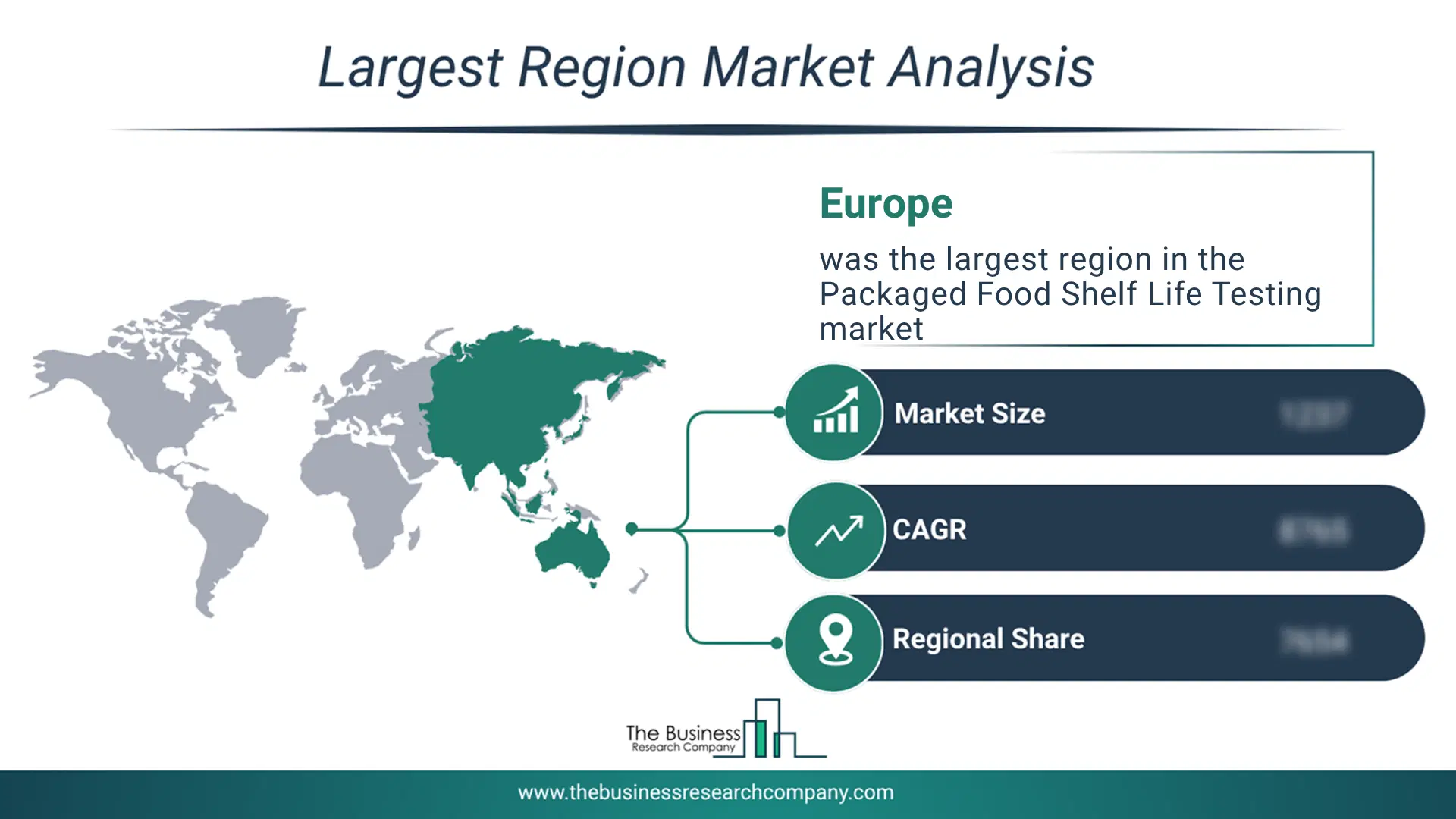
Regional Outlook
Europe was the largest region in the packaged food shelf-life testing market in 2025. Asia-Pacific is expected to be the fastest-growing region in the forecast period. The regions covered in this market report are Asia-Pacific, South East Asia, Western Europe, Eastern Europe, North America, South America, Middle East, Africa. The countries covered in this market report are Australia, Brazil, China, France, Germany, India, Indonesia, Japan, Taiwan, Russia, South Korea, UK, USA, Canada, Italy, SpainWhat Defines the Packaged Food Shelf Life Testing Market?
The packaged food shelf-life testing market includes revenues earned by entities by testing bacterial contamination, food additives, acidity, and pH value in packed food or beverages using static testing methods. The market value includes the value of related goods sold by the service provider or included within the service offering. Only goods and services traded between entities or sold to end consumers are included.How is Market Value Defined and Measured?
The market value is defined as the revenues that enterprises gain from the sale of goods and/or services within the specified market and geography through sales, grants, or donations in terms of the currency (in USD unless otherwise specified). The revenues for a specified geography are consumption values that are revenues generated by organizations in the specified geography within the market, irrespective of where they are produced. It does not include revenues from resales along the supply chain, either further along the supply chain or as part of other products.
This chart presents market attractiveness based on a quantitative evaluation of growth, competition, strategic alignment, and risk, offering a clear view of opportunity areas for decision-making. This chart is for illustrative purposes; the full report contains the complete analysis.

This chart highlights the Total Addressable Market (TAM) by estimating the maximum revenue opportunity using an assumption-driven approach, supporting strategic planning and opportunity sizing across markets. The chart is illustrative; the full report provides a more comprehensive analysis.
What Key Data and Analysis Are Included in the Packaged Food Shelf Life Testing Market Report 2026?
The packaged food shelf life testing market research report is one of a series of new reports from The Business Research Company that provides market statistics, including industry global market size, regional shares, competitors with the market share, detailed market segments, market trends and opportunities, and any further data you may need to thrive in the packaged food shelf life testing industry. The market research report delivers a complete perspective of everything you need, with an in-depth analysis of the current and future state of the industry.Packaged Food Shelf Life Testing Market Report Forecast Analysis
| Report Attribute | Details |
|---|---|
| Market Size Value In 2026 | $6.28 billion |
| Revenue Forecast In 2030 | $9.06 billion |
| Growth Rate | CAGR of 9.9% from 2026 to 2030 |
| Base Year For Estimation | 2025 |
| Actual Estimates/Historical Data | 2020-2025 |
| Forecast Period | 2026 - 2030 - 2030 |
| Market Representation | Revenue in USD Billion and CAGR from 2026 to 2030 |
| Segments Covered | Parameter, Food Tested, Technology, Method |
| Regional Scope | Asia-Pacific, Western Europe, Eastern Europe, North America, South America, Middle East, Africa |
| Country Scope | The countries covered in the report are Australia, Brazil, China, France, Germany, India, Indonesia, Japan, Taiwan, Russia, South Korea, UK, USA, Canada, Italy, Spain. |
| Key Companies Profiled | SGS SA, AES Laboratories Pvt. Ltd., Agrifood Technology, ALS Ltd., AsureQuality Limited, Bureau Veritas, EMSL Analytical Inc., Eurofins Scientific SE, Intertek Group PLC, Mérieux NutriSciences Corp., Premium Analytical Services, RJ Hill Laboratories, SCS Global Services, Symbio Laboratories Pty. Ltd., Microbac Laboratories Inc., Silliker Inc., Covance Inc., TÜV SÜD AG, NSF International, Underwriters Laboratories LLC, DNV GL, Lloyd's Register Group Limited, Kiwa NV, Q Laboratories Inc., Romer Labs Diagnostic GmbH, 3M Food Safety, Accugen Laboratories Inc., Advanced Analytical Testing Laboratories Inc., Analytical Food Laboratories, Bio-Rad Laboratories Inc., CEM Corporation, Certified Laboratories Inc., Charles River Laboratories International Inc., EAG Laboratories |
| Customization Scope | Request for Customization |
| Pricing And Purchase Options | Explore Purchase Options |