

Packaged Water Treatment Market Report 2026
Global Outlook – By System Type (Containerized Systems, Skid Mounted Systems, Modular Systems, Mobile Treatment Systems, Compact Integrated Systems), By Technology (Membrane Filtration, Disinfection Systems, Clarification And Sedimentation, Biological Treatment, Sludge Treatment), By Application (Municipal Drinking Water Supply, Industrial Process Water Treatment, Effluent And Sewage Treatment, Remote And Rural Water Supply, Emergency And Disaster Relief), By End User (Municipal Governments And Utilities, Oil And Gas Sector, Construction And Mining Camps, Military And Defense, Hotels Resorts And Institutions, Food And Beverage Industry) – Market Size, Trends, Strategies, and Forecast to 2030
Packaged Water Treatment Market Overview
• Packaged Water Treatment market size has reached to $29.72 billion in 2025 • Expected to grow to $51.43 billion in 2030 at a compound annual growth rate (CAGR) of 11.5% • Growth Driver: Surge In Water Scarcity Fueling The Growth Of The Market Due To Rising Demand And Limited Freshwater Availability • Market Trend: Smart Water Purification Systems Emphasize Reduced Footprint And Improved Recovery Efficiency • Asia-Pacific was the largest region and fastest growing region.What Is Covered Under Packaged Water Treatment Market?
Packaged water treatment refers to pre-engineered and factory-assembled systems designed to treat water using compact, integrated units. These systems are built to perform multiple treatment processes such as filtration, sedimentation, and disinfection within a single standardized package. Packaged water treatment systems are typically used to provide efficient and reliable water purification where space, time, or infrastructure for conventional treatment systems is limited. The main system types of packaged water treatment include containerized systems, skid mounted systems, modular systems, mobile treatment systems, and compact integrated systems. Containerized systems refer to self-contained water treatment units housed within standardized containers that enable rapid deployment, easy transportation, and efficient water purification across diverse locations. These systems utilize technologies such as membrane filtration, disinfection systems, clarification and sedimentation, biological treatment, and sludge treatment. The various applications involved are municipal drinking water supply, industrial process water treatment, effluent and sewage treatment, remote and rural water supply, and emergency and disaster relief, and they are used by several end users such as municipal governments and utilities, oil and gas sector, construction and mining camps, military and defense, hotels resorts and institutions, and food and beverage industry.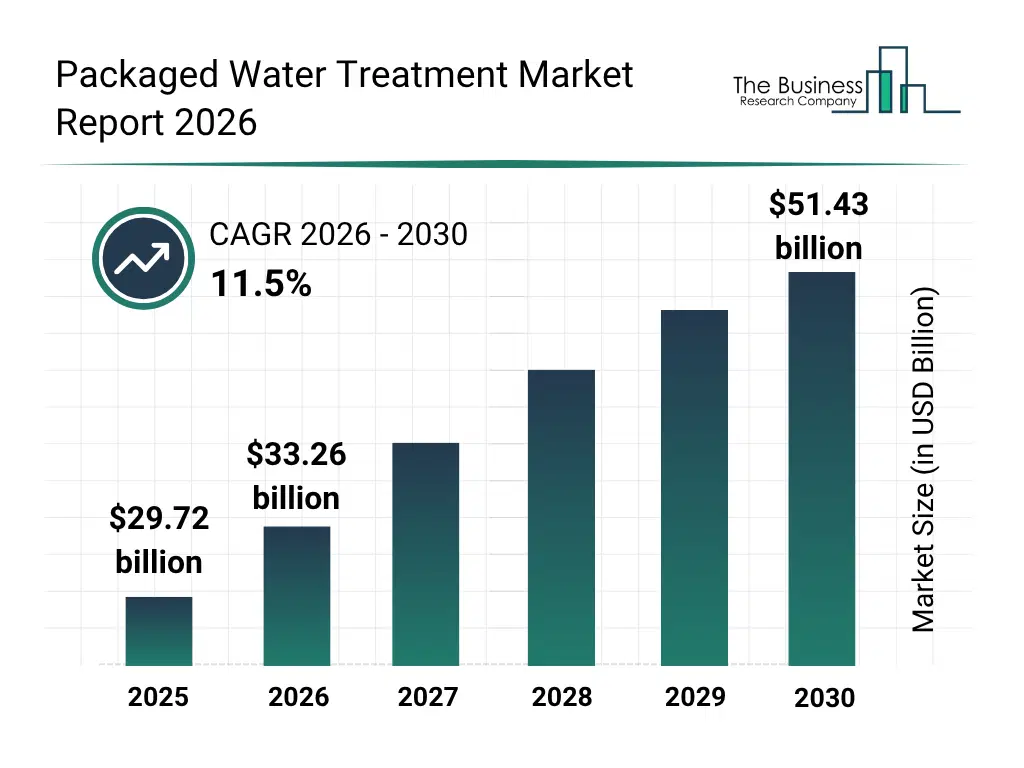
What Is The Packaged Water Treatment Market Size and Share 2026?
The packaged water treatment market size has grown rapidly in recent years. It will grow from $29.72 billion in 2025 to $33.26 billion in 2026 at a compound annual growth rate (CAGR) of 11.9%. The growth in the historic period can be attributed to increasing demand for safe drinking water, growing industrial water treatment requirements, rising urbanization and infrastructure development, expanding investments in municipal water projects, increasing concerns over water scarcity.What Is The Packaged Water Treatment Market Growth Forecast?
The packaged water treatment market size is expected to see rapid growth in the next few years. It will grow to $51.43 billion in 2030 at a compound annual growth rate (CAGR) of 11.5%. The growth in the forecast period can be attributed to growing demand for decentralized water infrastructure, increasing investment in sustainable water management, rising adoption of advanced membrane technologies, expanding emergency water treatment deployments, increasing industrial wastewater reuse initiatives. Major trends in the forecast period include increasing adoption of compact and modular water treatment systems, growing demand for rapid deployment water purification solutions, rising preference for energy-efficient water treatment equipment, expansion of decentralized water treatment installations, increasing focus on low-maintenance integrated treatment systems.
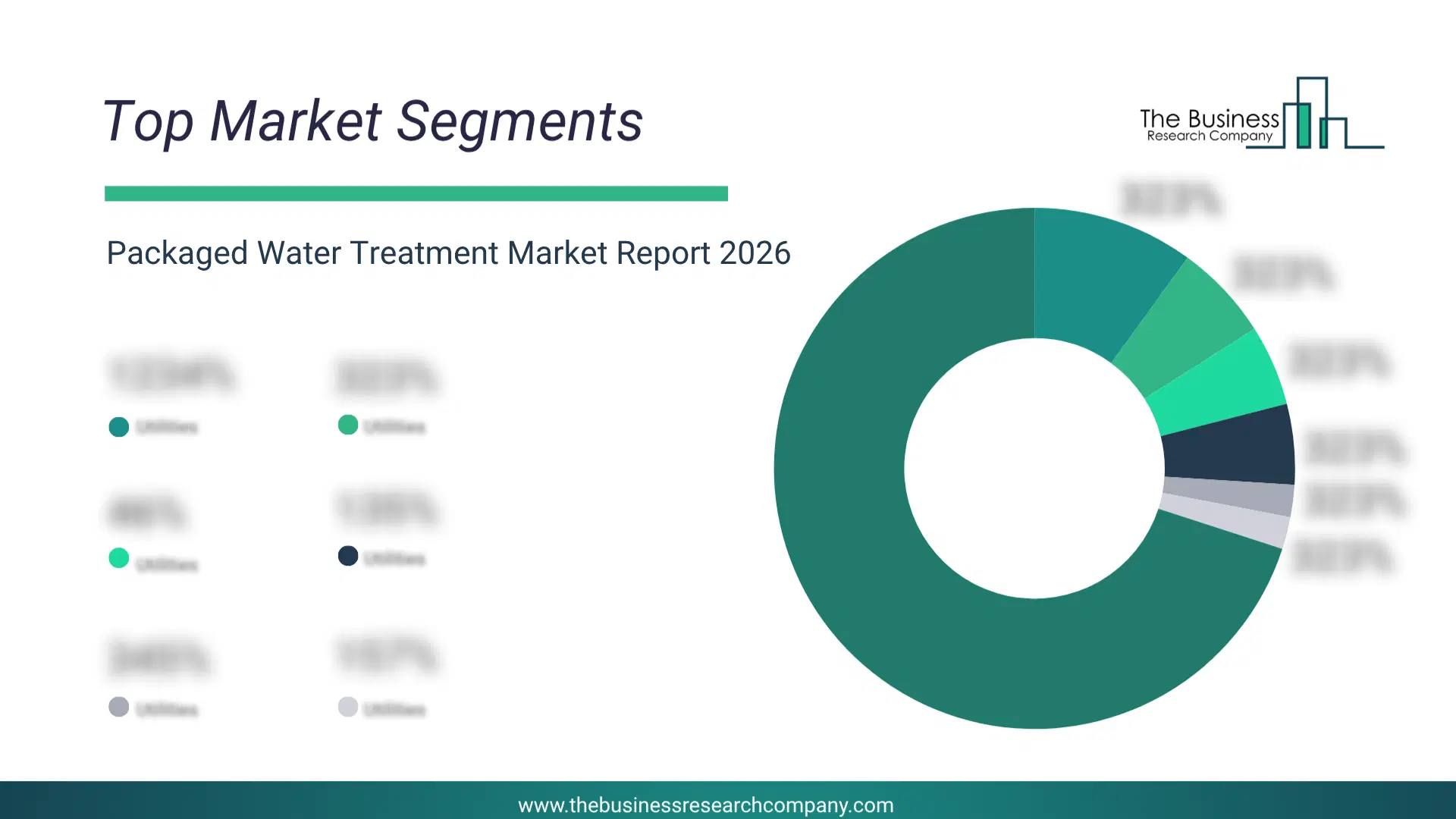
Global Packaged Water Treatment Market Segmentation
2) By Technology: Membrane Filtration, Disinfection Systems, Clarification And Sedimentation, Biological Treatment, Sludge Treatment 3) By Application: Municipal Drinking Water Supply, Industrial Process Water Treatment, Effluent And Sewage Treatment, Remote And Rural Water Supply, Emergency And Disaster Relief 4) By End User: Municipal Governments And Utilities, Oil And Gas Sector, Construction And Mining Camps, Military And Defense, Hotels Resorts And Institutions, Food And Beverage Industry Subsegments: 1) By Containerized Systems: Standard Containerized Units, High Capacity Containerized Units, Custom Engineered Containerized Units 2) By Skid Mounted Systems: Compact Skid Units, High Flow Skid Units, Field Assembled Skid Units 3) By Modular Systems: Pre Engineered Modular Units, Expandable Modular Units, Process Based Modular Units 4) By Mobile Treatment Systems: Trailer Mounted Systems, Vehicle Based Treatment Systems, Rapid Deployment Systems 5) By Compact Integrated Systems: All In One Integrated Systems, Space Optimized Integrated Systems, Multi Barrier Integrated SystemsWhat Is The Driver Of The Packaged Water Treatment Market?
The rising water scarcity is expected to propel the growth of the packaged water treatment market going forward. Water scarcity refers to the condition where the demand for freshwater exceeds its available supply or where water resources are insufficient to meet human and environmental needs. The rising water scarcity is driven by increasing freshwater demand, as population growth and higher water consumption are putting pressure on limited surface and groundwater supplies, leading to shortages in many regions. Packaged water treatment helps water scarcity by enabling efficient on-site purification and reuse of available water sources, thereby reducing dependence on fresh water supplies and improving access to safe water in water-stressed regions. For instance, in November 2024, according to the United Nations Educational, Scientific, and Cultural Organization, a France-based non-profit organization, roughly half of the world’s population experiences severe water scarcity for at least part of the year, and millions lack access to safely managed water resources. With 3.6 billion people currently facing water shortages, projected to exceed 5 billion by 2050. Therefore, the rising water scarcity is driving the growth of the packaged water treatment industry.Key Players In The Global Packaged Water Treatment Market
Major companies operating in the packaged water treatment market are Veolia Environnement S.A., Pentair plc, Aquatech International LLC, Fluence Corporation Limited, Ion Exchange Ltd., Smith & Loveless Inc., SWA Water Australia, Bio-Microbics Inc., Organica Water Inc., Hydro-Dyne Engineering, Osmoflo Holdings Pty Ltd., De.mem Limited, Membratec SA, Ecologix Environmental Systems, Lenntech B.V., SFC Environmental Technologies, BioKube, Global Treat Inc., Pollution Control Systems Inc., Westech Engineering Inc., Aqua Clear Water Treatment Specialists, Pure Aqua Inc., Kanadevia Corporation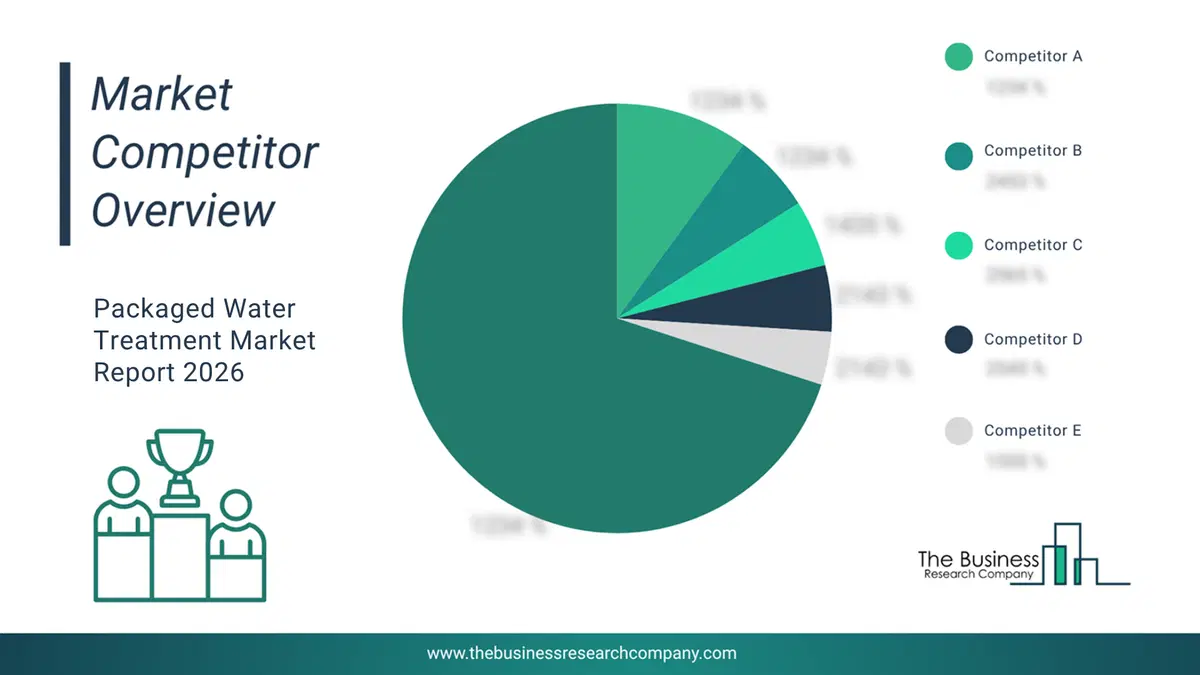
This chart is for illustrative purposes; the full report includes a detailed competitor analysis and comprehensive overview of the top 10 companies in the market.
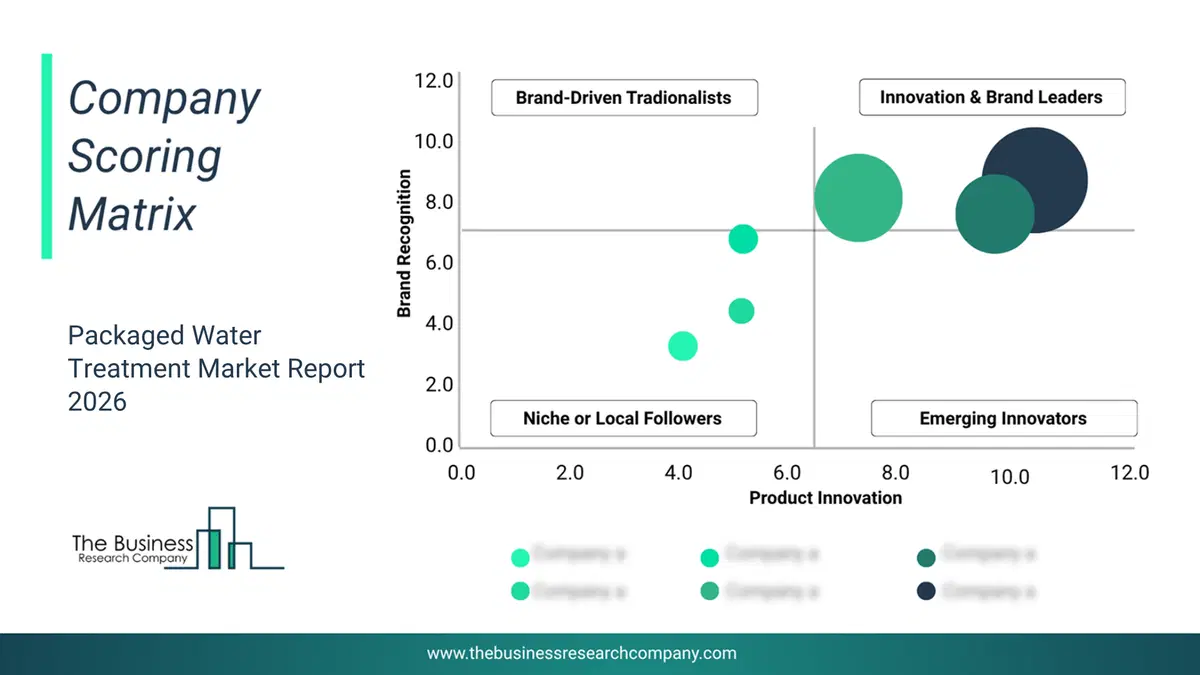
This chart maps companies by product innovation and brand strength, with bubble size indicating relative revenue, helping identify market leaders, challengers, and niche players. This is an illustrative chart; the full report provides a complete and accurate competitive analysis.
Global Packaged Water Treatment Market Trends and Insights
Major companies operating in the packaged water treatment market are increasingly prioritizing advanced compact purification systems, such as residential packaged water treatment systems, to enhance water efficiency, reduce system footprint, and improve ease of maintenance in residential applications. Residential packaged water treatment systems are compact, pre-engineered water purification units designed for homes to remove contaminants, improve water quality, and provide safe, clean water for drinking and household use. For instance, in November 2023, EcoWater Systems, a US-based water treatment company, launched eFlow, a tankless reverse osmosis system for homeowners. It is designed to deliver on-demand purified water without the use of a storage tank. The system features a compact design, improved water recovery efficiency, and advanced multi-stage filtration, enabling household users to access high-quality drinking water while reducing water wastage, minimizing installation space requirements, and improving overall system hygiene and performance.What Are Latest Mergers And Acquisitions In The Packaged Water Treatment Market?
In August 2024, Alantech Industrial Solutions, an India-based provider of specialized packaged and containerized water treatment solutions, partnered with Al Shalal Pure Drinking Water LLC to deliver a turnkey bottled water treatment plant using advanced RO-based technology. Through this partnership, Alantech Industrial Solutions enabled Al Shalal Pure Drinking Water LLC to enhance its bottled water production efficiency by deploying an advanced packaged and containerized RO-based water treatment system. Al Shalal Pure Drinking Water LLC is a UAE-based manufacturer of premium bottled drinking water.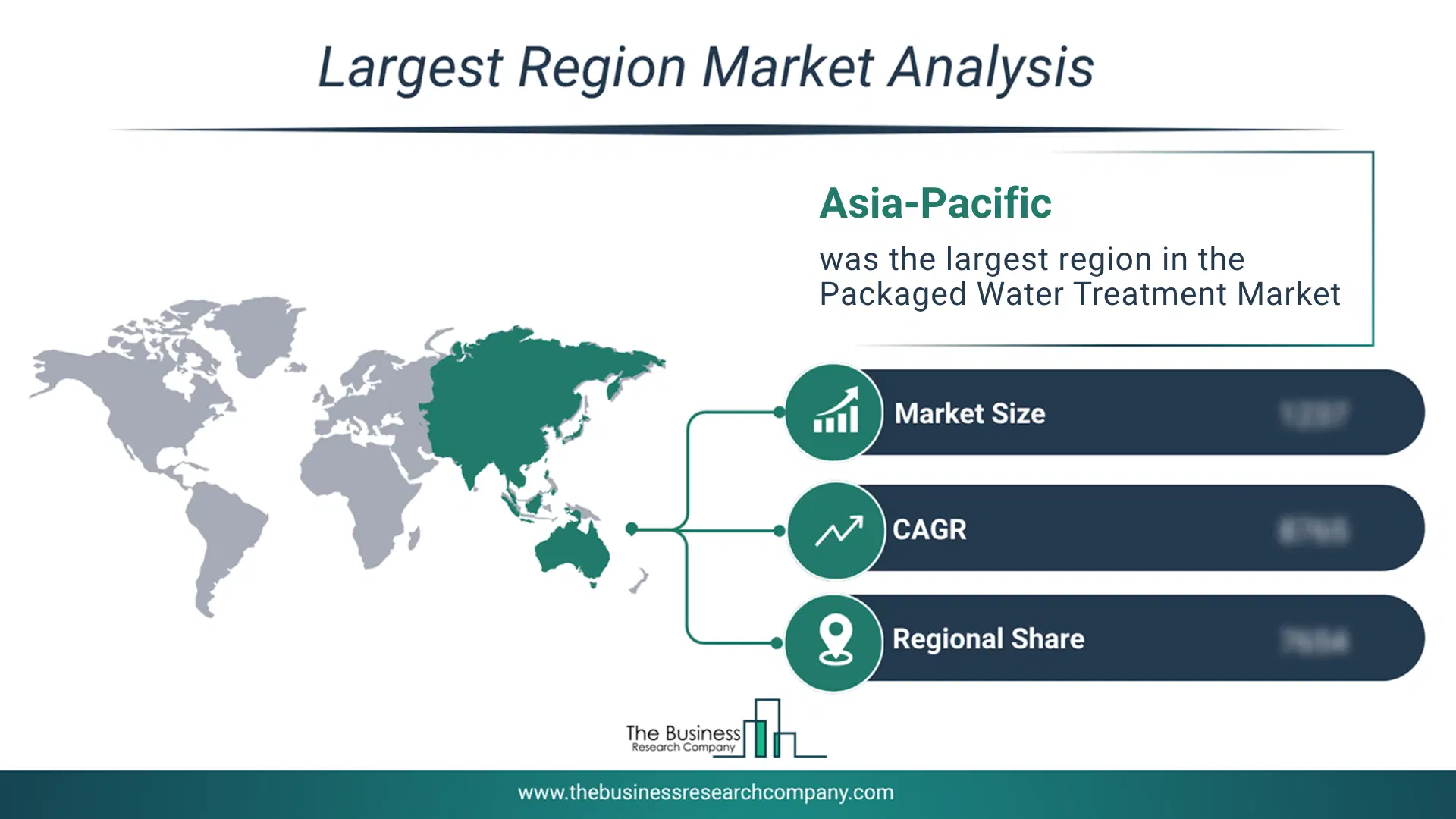
Regional Outlook/Insights
Asia-Pacific was the largest region in the packaged water treatment market in 2025. Asia-Pacific is expected to be the fastest-growing region in the forecast period. The regions covered in this market report are Australia, Brazil, China, France, Germany, India, Indonesia, Japan, Taiwan, Russia, South Korea, UK, USA, Canada, Italy, Spain.What Defines the Packaged Water Treatment Market?
The packaged water treatment market consists of revenues earned by entities by providing services such as upgrade and retrofit services, sludge management services, and training and support services. The market value includes the value of related goods sold by the service provider or included within the service offering. The packaged water treatment market also includes sales of safety compliance manuals, emergency response cards, and insurance policy binders. Values in this market are ‘factory gate’ values, that is, the value of goods sold by the manufacturers or creators of the goods, whether to other entities (including downstream manufacturers, wholesalers, distributors, and retailers) or directly to end customers. The value of goods in this market includes related services sold by the creators of the goods.How is Market Value Defined and Measured?
The market value is defined as the revenues that enterprises gain from the sale of goods and/or services within the specified market and geography through sales, grants, or donations in terms of the currency (in USD unless otherwise specified). The revenues for a specified geography are consumption values that are revenues generated by organizations in the specified geography within the market, irrespective of where they are produced. It does not include revenues from resales along the supply chain, either further along the supply chain or as part of other products.
This chart presents market attractiveness based on a quantitative evaluation of growth, competition, strategic alignment, and risk, offering a clear view of opportunity areas for decision-making. This chart is for illustrative purposes; the full report contains the complete analysis.

This chart highlights the Total Addressable Market (TAM) by estimating the maximum revenue opportunity using an assumption-driven approach, supporting strategic planning and opportunity sizing across markets. The chart is illustrative; the full report provides a more comprehensive analysis.
What Key Data and Analysis Are Included in the Packaged Water Treatment Market Report 2026?
The packaged water treatment market research report is one of a series of new reports from The Business Research Company that provides packaged water treatment market statistics, including packaged water treatment industry global market size, regional shares, competitors with a packaged water treatment market share, detailed packaged water treatment market segments, market trends and opportunities, and any further data you may need to thrive in the packaged water treatment industry. This packaged water treatment market research report delivers a complete perspective of everything you need, with an in-depth analysis of the current and future scenario of the industry.Packaged Water Treatment Market Report Forecast Analysis
| Report Attribute | Details |
|---|---|
| Market Size Value In 2026 | $33.26 billion |
| Revenue Forecast In 2030 | $51.43 billion |
| Growth Rate | CAGR of 11.5% from 2026 to 2030 |
| Base Year For Estimation | 2025 |
| Actual Estimates/Historical Data | 2020-2025 |
| Forecast Period | 2026 - 2030 |
| Market Representation | Revenue in USD Billion and CAGR from 2026 to 2030 |
| Segments Covered | System Type, Technology, Application, End User |
| Regional Scope | Asia-Pacific, Western Europe, Eastern Europe, North America, South America, Middle East, Africa |
| Country Scope | The countries covered in the report are Australia, Brazil, China, France, Germany, India, Indonesia, Japan, Taiwan, Russia, South Korea, UK, USA, Canada, Italy, Spain. |
| Key Companies Profiled | Veolia Environnement S.A., Pentair plc, Aquatech International LLC, Fluence Corporation Limited, Ion Exchange Ltd., Smith & Loveless Inc., SWA Water Australia, Bio-Microbics Inc., Organica Water Inc., Hydro-Dyne Engineering, Osmoflo Holdings Pty Ltd., De.mem Limited, Membratec SA, Ecologix Environmental Systems, Lenntech B.V., SFC Environmental Technologies, BioKube, Global Treat Inc., Pollution Control Systems Inc., Westech Engineering Inc., Aqua Clear Water Treatment Specialists, Pure Aqua Inc., Kanadevia Corporation |
| Customization Scope | Request for Customization |
| Pricing And Purchase Options | Explore Purchase Options |