
Pancreatic Stone Protein Testing Market Report 2026
Global Outlook – By Product Type (Assay Kits, Instruments, Reagents, Other Product Types), By Technology (Immunoassay Based Testing, Enzyme-Linked Immunosorbent Assay Based Testing, Rapid Diagnostic Technologies, Other Technologies), By Sample Type (Blood, Serum, Plasma, Other Sample Types), By Application (Sepsis Diagnosis, Pancreatitis Diagnosis, Other Applications), By End User (Hospitals, Diagnostic Laboratories, Research Institutes, Other End Users) – Market Size, Trends, Strategies, and Forecast to 2035
Pancreatic Stone Protein Testing Market Overview
• Pancreatic Stone Protein Testing market size has reached to $1.22 billion in 2025 • Expected to grow to $1.77 billion in 2030 at a compound annual growth rate (CAGR) of 7.8% • Growth Driver: The Rise In Hospital-Acquired Infections The Growth Of The Market Due To Increasing Antimicrobial Resistance And The Growing Burden Of Healthcare-Associated Infections • Market Trend: Breakthrough In Ultra-Fast Immunoassay Technology Enhances Critical Care Diagnosis • North America was the largest region in 2025 and Asia-Pacific is the fastest growing region.What Is Covered Under Pancreatic Stone Protein Testing Market?
Pancreatic stone protein (PSP) testing is a laboratory blood test that measures the level of pancreatic stone protein, a biomarker produced by the pancreas and other tissues during physiological stress or cellular dysfunction. It is used to assess changes in pancreatic stone protein concentration as an indicator of systemic inflammatory response and tissue stress in the body. The main product types of pancreatic stone protein testing include assay kits, instruments, reagents, and other product types. Assay kits refer to pre-packaged diagnostic tools used to detect and quantify pancreatic stone protein levels in clinical samples for disease assessment. The different technologies include immunoassay based testing, enzyme-linked immunosorbent assay based testing, rapid diagnostic technologies, and other technologies and the various sample types include blood, serum, plasma, and other sample types. The various applications involved are sepsis diagnosis, pancreatitis diagnosis, and other applications, and they are used by several end users such as hospitals, diagnostic laboratories, research institutes, and other end users.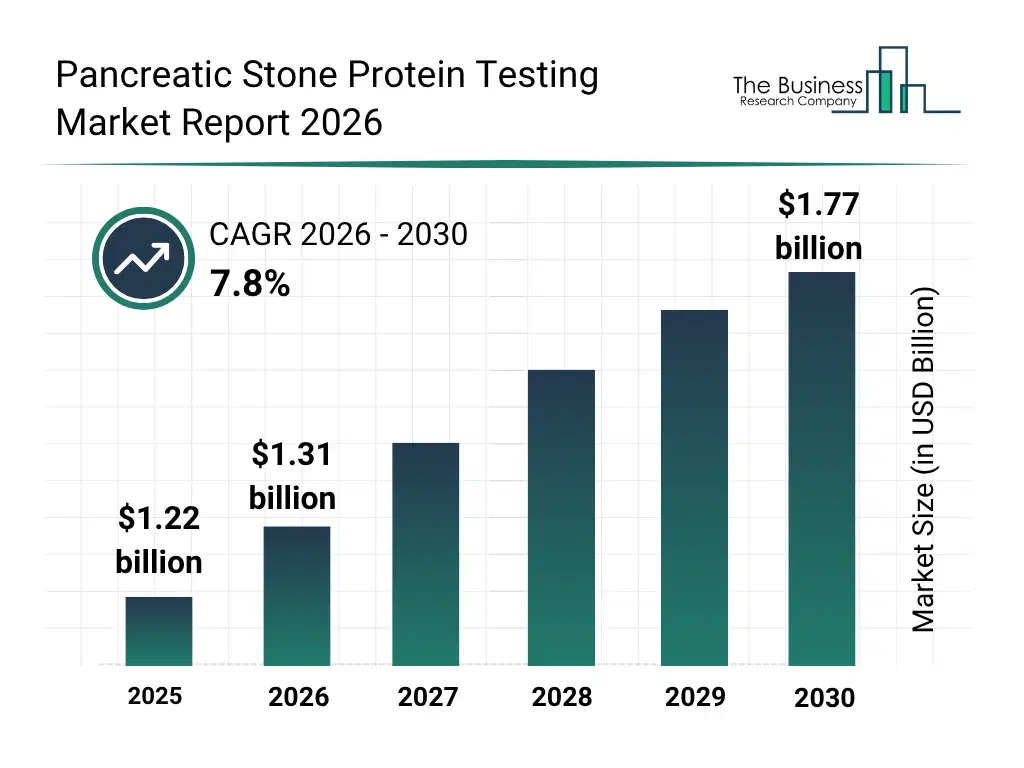
What Is The Pancreatic Stone Protein Testing Market Size and Share 2026?
The pancreatic stone protein testing market size has grown strongly in recent years.It will grow from $1.22 billion in 2025 to $1.31 billion in 2026 at a compound annual growth rate (CAGR) of 7.5%. The growth in the historic period can be attributed to increasing incidence of sepsis and critical care conditions, rising awareness of early disease biomarker testing, expansion of hospital laboratory infrastructure, growth in immunoassay diagnostic adoption, increasing clinical research on pancreatic and inflammatory biomarkers.What Is The Pancreatic Stone Protein Testing Market Growth Forecast?
The pancreatic stone protein testing market size is expected to see strong growth in the next few years.It will grow to $1.77 billion by 2030 at a compound annual growth rate (CAGR) of 7.8%. The growth in the forecast period can be attributed to rising demand for early sepsis detection tools, increasing adoption of point of care diagnostic testing, growth in precision medicine and biomarker-based diagnostics, expansion of automated laboratory systems, rising investment in critical care diagnostic innovation.Major trends in the forecast period include rising adoption of pancreatic stone protein testing as an early biomarker for sepsis and systemic inflammation detection, increasing use of immunoassay based diagnostic platforms for rapid PSP quantification, growing integration of PSP testing into critical care and emergency diagnostics workflows, expansion of point of care testing devices enabling faster PSP measurement in hospitals, rising demand for multiplex biomarker panels combining PSP with other inflammatory indicators.
Global Pancreatic Stone Protein Testing Market Segmentation
1) By Product Type: Assay Kits, Instruments, Reagents, Other Product Types 2) By Technology: Immunoassay Based Testing, Enzyme-Linked Immunosorbent Assay Based Testing, Rapid Diagnostic Technologies, Other Technologies 3) By Sample Type: Blood, Serum, Plasma, Other Sample Types 4) By Application: Sepsis Diagnosis, Pancreatitis Diagnosis, Other Applications 5) By End User: Hospitals, Diagnostic Laboratories, Research Institutes, Other End Users Subsegments: 1) By Assay Kits: Enzyme Linked Immunosorbent Assay Kits, Chemiluminescence Immunoassay Kits, Fluorescence Immunoassay Kits, Rapid Diagnostic Test Kits, Multiplex Assay Kits 2) By Instruments: Immunoassay Analyzers, Clinical Chemistry Analyzers, Automated Laboratory Analyzers, Point Of Care Testing Devices, Microplate Readers 3) By Reagents: Antibodies, Calibrators, Controls, Buffers, Substrates 4) By Other Product Types: Sample Collection Kits, Quality Control Materials, Diagnostic Consumables, Laboratory Accessories, Data Management SoftwareWhat Are The Drivers Of The Pancreatic Stone Protein Testing Market?
The rising incidence of hospital-acquired infections is expected to propel the growth of the pancreatic stone protein testing industry going forward.Hospital-acquired infections (HAIs) refer to infections that a patient develops while receiving medical care in a hospital or healthcare facility, which were not present or incubating at the time of admission.The rising incidence of hospital-acquired infections is primarily driven by increasing antimicrobial resistance, where microorganisms evolve to withstand commonly used antibiotics, making infections harder to treat and control within healthcare settings.Pancreatic stone protein testing helps in hospital-acquired infections by enabling early detection of infection and sepsis risk, allowing timely intervention and improved patient management in hospital settings.For instance, in November 2024, according to the Australian Institute of Health and Welfare, an Australia-based government agency, hospital-acquired complications (HACs) were recorded in 115,000 public hospitalizations (2.0%) and 34,200 private hospitalizations (0.8%) in 2022–23, with healthcare-associated infections accounting for the largest share (37%), followed by delirium (13%) and cardiac complications (12%).Therefore, rising incidence of hospital-acquired infections drives the growth of the pancreatic stone protein testing industry. The expansion of point-of-care testing (POCT) is expected to propel the growth of the pancreatic stone protein testing industry going forward.Point-of-care testing (POCT) refers to medical diagnostic testing performed at or near the site of patient care, enabling rapid results and immediate clinical decision-making without the need for centralized laboratory facilities.The expansion of point-of-care testing is driven by the growing demand for faster diagnostic results, advancements in portable diagnostic technologies, and the increasing need for efficient patient management in emergency and critical care settings.Pancreatic stone protein testing supports point-of-care testing by enabling rapid detection of infection and sepsis risk, facilitating timely clinical intervention and improving patient outcomes in hospitals and intensive care units.For instance, in March 2025, according to the American Association for Clinical Chemistry (AACC), a US-based scientific society focused on clinical laboratory science, the adoption of point-of-care diagnostic testing in hospitals and outpatient settings increased by 12.4% in 2024 compared to the previous year, driven by rising demand for rapid and decentralized diagnostic solutions.Therefore, the expansion of point-of-care testing (POCT) is driving the growth of the pancreatic stone protein testing industry.Key Players In The Global Pancreatic Stone Protein Testing Market
Major companies operating in the pancreatic stone protein testing market are Cusabio Technology Llc, Fapon Biotech Inc, BioVendor Laboratorní medicína a. s, RayBiotech Life Inc, Creative Diagnostics Inc, Abnova Corporation, Abionic SA, LASCCO SA, Abbexa LtdGlobal Pancreatic Stone Protein Testing Market Trends and Insights
Major companies operating in the pancreatic stone protein testing market are focusing on developing innovative platforms, such as ultra-rapid point-of-care immunoassay platforms, to enable early and accurate sepsis detection, improve clinical decision-making speed, and reduce patient mortality in critical care settings. Ultra-rapid point-of-care immunoassay platforms are diagnostic systems that quickly detect specific biomarkers in a patient’s sample at or near the bedside using antibody-based reactions, delivering results within minutes instead of hours or days. For instance, in October 2024, Abionic SA, a Switzerland-based in vitro diagnostics company, received approval from the U. S. Food and Drug Administration (FDA) for its IVD CAPSULE Pancreatic Stone Protein (PSP) test. The test is designed for rapid, near-patient detection of PSP levels, enabling early identification of sepsis in critically ill patients. It is based on ultra-rapid point-of-care immunoassay platforms, which allow biomarker detection at the bedside using antibody-based reactions with results delivered within minutes.Regional Insights
North America was the largest region in the pancreatic stone protein testing market in 2025. Asia-Pacific is expected to be the fastest-growing region in the forecast period. The regions covered in this market report are Asia-Pacific, South East Asia, Western Europe, Eastern Europe, North America, South America, Middle East and Africa. The countries covered in this market report are Australia, Brazil, China, France, Germany, India, Indonesia, Japan, Taiwan, Russia, South Korea, UK, USA, Canada, Italy, Spain.What Defines the Pancreatic Stone Protein Testing Market?
The pancreatic stone protein (PSP) testing market consists of revenues earned by entities by providing services such as clinical diagnostic testing services, sepsis risk assessment services, point-of-care testing services, laboratory biomarker analysis services, and monitoring and disease progression services. The market value includes the value of related goods sold by the service provider or included within the service offering. The pancreatic stone protein (PSP) testing market also includes sales of diagnostic software platforms, quality control (QC) materials, sample collection and stabilization tubes, internal quality assurance (IQA) software tools, biomarker data analytics platforms, and pre-analytical sample processing consumables. Values in this market are ‘factory gate’ values, that is, the value of goods sold by the manufacturers or creators of the goods, whether to other entities (including downstream manufacturers, wholesalers, distributors and retailers) or directly to end customers. The value of goods in this market includes related services sold by the creators of the goods.What is the Market Assessment and Strategic Outlook for the Pancreatic Stone Protein Testing Industry?
The pancreatic stone protein testing market research report is one of a series of new reports from The Business Research Company that provides market statistics, including industry global market size, regional shares, competitors with the market share, detailed market segments, market trends and opportunities, and any further data you may need to thrive in the pancreatic stone protein testing industry. The market research report delivers a complete perspective of everything you need, with an in-depth analysis of the current and future state of the industry.What is the Market Assessment and Strategic Outlook for the Pancreatic Stone Protein Testing Market Report 2026?
The pancreatic stone protein testing market research report is one of a series of new reports from The Business Research Company that provides pancreatic stone protein testing market statistics, including pancreatic stone protein testing industry global market size, regional shares, competitors with a pancreatic stone protein testing market share, detailed pancreatic stone protein testing market segments, market trends and opportunities, and any further data you may need to thrive in the pancreatic stone protein testing industry. This pancreatic stone protein testing market research report delivers a complete perspective of everything you need, with an in-depth analysis of the current and future scenario of the industry.Pancreatic Stone Protein Testing Market Report Forecast Analysis
| Report Attribute | Details |
|---|---|
| Market Size Value In 2026 | $1.31 billion |
| Revenue Forecast In 2035 | $1.77 billion |
| Growth Rate | CAGR of 7.8% from 2026 to 2035 |
| Base Year For Estimation | 2025 |
| Actual Estimates/Historical Data | 2020-2025 |
| Forecast Period | 2026 - 2030 - 2035 |
| Market Representation | Revenue in USD Billion and CAGR from 2026 to 2035 |
| Segments Covered | Product Type, Technology, Sample Type, Application, End User |
| Regional Scope | Asia-Pacific, Western Europe, Eastern Europe, North America, South America, Middle East, Africa |
| Country Scope | The countries covered in the report are Australia, Brazil, China, France, Germany, India, Indonesia, Japan, Taiwan, Russia, South Korea, UK, USA, Canada, Italy, Spain. |
| Key Companies Profiled | Cusabio Technology Llc, Fapon Biotech Inc, BioVendor Laboratorní medicína a. s, RayBiotech Life Inc, Creative Diagnostics Inc, Abnova Corporation, Abionic SA, LASCCO SA, Abbexa Ltd |
| Customization Scope | Request for Customization |
| Pricing And Purchase Options | Explore Purchase Options |