

Para-Xylene Market Report 2026
Global Outlook – By Production Process (Catalytic Reforming, Toluene Disproportionation, Steam Cracking, Other Production Processes), By Distribution Channel (Direct Sales, Distributors And Traders, Online Procurement Platforms), By Application (Purified Terephthalic Acid, Dimethyl Terephthalate, Solvents, Other Applications), By End Use Industry (Textiles, Packaging, Plastics, Automotive, Other End Use Industries) – Market Size, Trends, Strategies, and Forecast to 2030
Para-Xylene Market Overview
• Para-Xylene market size has reached to $55.15 billion in 2025 • Expected to grow to $77.42 billion in 2030 at a compound annual growth rate (CAGR) of 6.9% • Growth Driver: Growing Demand For Polyester Fibers Driving The Market Growth Due To Rising Textile And Packaging Applications • Market Trend: Bio-Derived Aromatic Feedstocks Enable Next-Generation Sustainable Polyester Production • Asia-Pacific was the largest region and fastest growing region.What Is Covered Under Para-Xylene Market?
Para-xylene is a colorless, flammable aromatic hydrocarbon and one of the three xylene isomers, distinguished by two methyl groups positioned opposite each other on a benzene ring. It is mainly used as a feedstock for producing terephthalic acid (PTA) and dimethyl terephthalate (DMT), which are key intermediates in the manufacture of polyester fibers and PET plastics. It is typically obtained from petroleum naphtha through catalytic reforming and is separated from mixed xylene streams using industrial separation and purification processes. The main production processes of para-xylene include catalytic reforming, toluene disproportionation, steam cracking, and other production processes. Catalytic reforming refers to a petroleum refining process in which naphtha is converted into aromatic hydrocarbons, including para-xylene, through catalytic reactions under high temperature and pressure. These products are distributed through direct sales, distributors and traders, and online procurement platforms. They are used in applications including purified terephthalic acid, dimethyl terephthalate, solvents, and others and serve end-use industries including textiles, packaging, plastics, automotive, and others.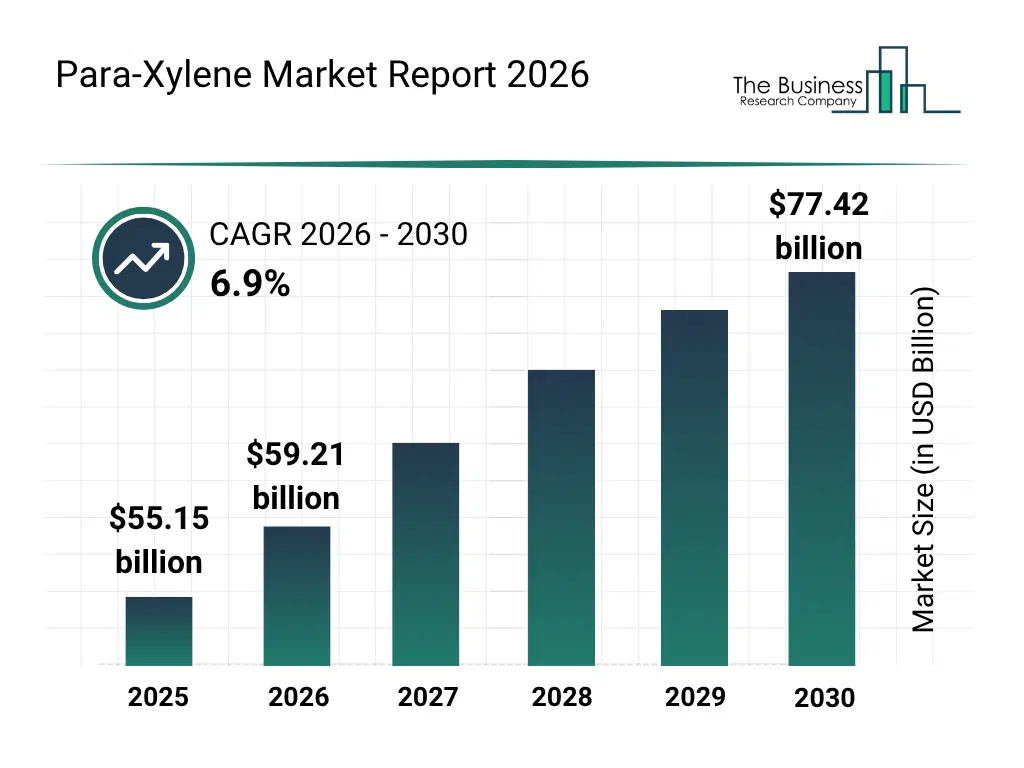
What Is The Para-Xylene Market Size and Share 2026?
The para-xylene market size has grown strongly in recent years. It will grow from $55.15 billion in 2025 to $59.21 billion in 2026 at a compound annual growth rate (CAGR) of 7.4%. The growth in the historic period can be attributed to growing demand for polyester fibers, increasing PET packaging consumption, expansion of global petrochemical production capacity, rising textile manufacturing activities, increasing consumption of purified terephthalic acid.What Is The Para-Xylene Market Growth Forecast?
The para-xylene market size is expected to see strong growth in the next few years. It will grow to $77.42 billion in 2030 at a compound annual growth rate (CAGR) of 6.9%. The growth in the forecast period can be attributed to growing demand for sustainable PET packaging, increasing investments in bio based para xylene production, expanding polyester demand from automotive applications, rising capacity additions in integrated refinery complexes, increasing demand for high performance packaging materials. Major trends in the forecast period include increasing expansion of purified terephthalic acid production capacity, growing demand for high purity para xylene feedstock, rising investments in integrated aromatics production facilities, expanding petrochemical refinery capacity across emerging economies, increasing adoption of bio based para xylene production processes.
Global Para-Xylene Market Segmentation
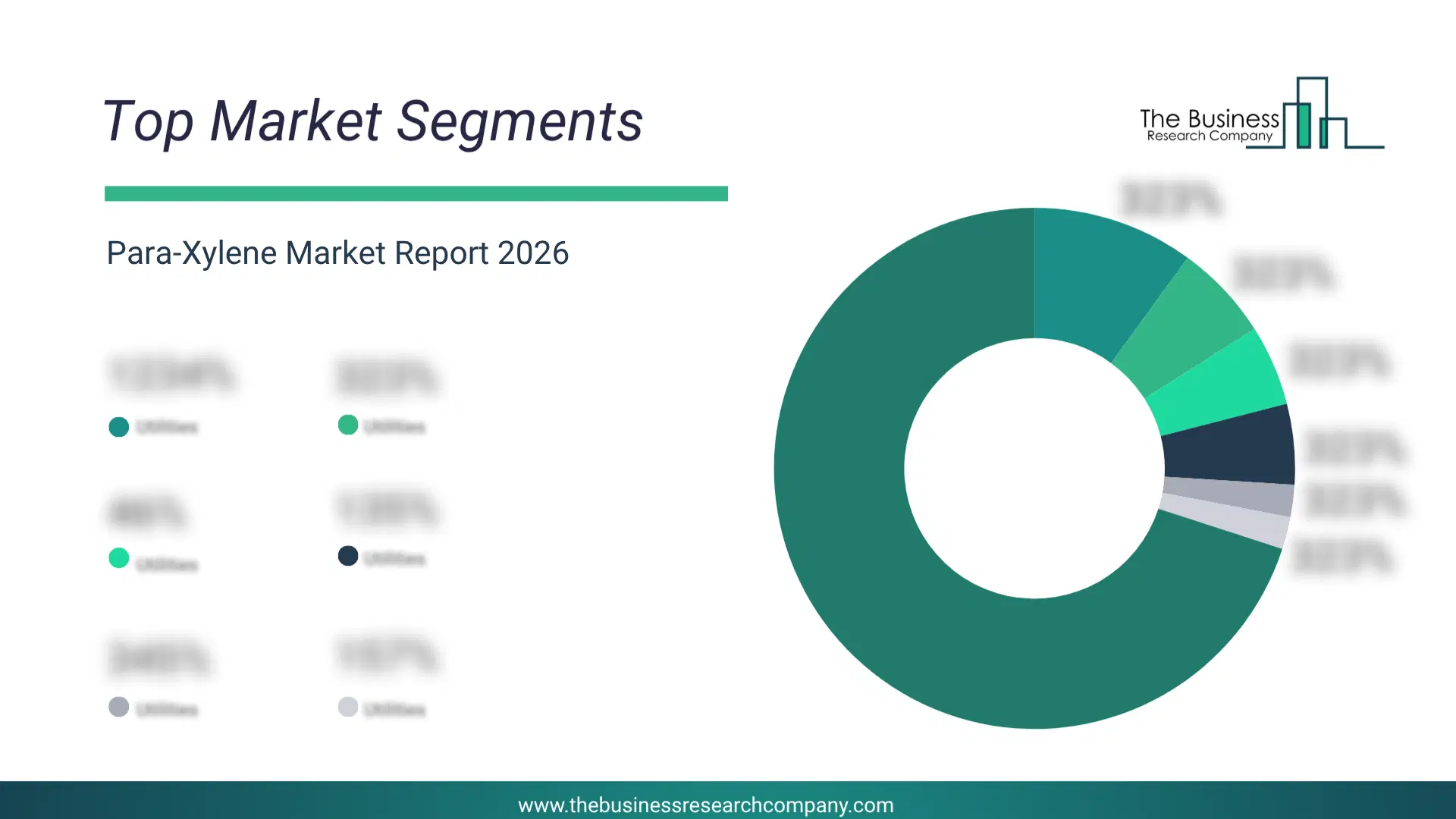
2) By Distribution Channel: Direct Sales, Distributors And Traders, Online Procurement Platforms 3) By Application: Purified Terephthalic Acid, Dimethyl Terephthalate, Solvents, Other Applications 4) By End Use Industry: Textiles, Packaging, Plastics, Automotive, Other End Use Industries Subsegments: 1) By Catalytic Reforming: Continuous Catalytic Reforming Processes, Semi Regenerative Catalytic Reforming Processes, Platinum Based Catalytic Reforming Processes, Naphtha Feed Catalytic Reforming Processes 2) By Toluene Disproportionation: Catalytic Toluene Disproportionation Processes, Hydrogen Assisted Toluene Disproportionation Processes, High Selectivity Toluene Disproportionation Processes, Integrated Aromatics Conversion Processes 3) By Steam Cracking: Naphtha Steam Cracking Processes, Ethane Steam Cracking Processes, Propane Steam Cracking Processes, Mixed Feed Steam Cracking Processes 4) By Other Production Processes: Xylene Isomerization Processes, Methanol To Aromatics Processes, Coal Based Aromatics Production Processes, Bio Based Para Xylene Production ProcessesWhat Is The Driver Of The Para-Xylene Market?
The growing demand for polyester fibers is expected to propel the growth of the para-xylene market going forward. Polyester fibers are synthetic fibers widely used in textiles, apparel, home furnishings, and industrial applications due to their durability, affordability, and resistance to shrinking and wrinkling. Demand for polyester fibers is rising due to the fast-fashion industry, where brands produce large volumes of low-cost, rapidly changing clothing collections, and polyester is preferred as it is cheap, durable, easy to manufacture at scale, and suitable for rapid mass production. Para-xylene serves as a key feedstock for purified terephthalic acid (PTA), enabling the production of durable, lightweight, and high-strength polyester fibers used across textile applications. For instance, in September 2025, according to the Textile Exchange, a US-based non-profit organization, in terms of volume, polyester fiber production increased from approximately 71 million tonnes in 2023 to around 78 million tonnes in 2024. Therefore, the growing demand for polyester fibers is driving the growth of the para-xylene industry.Key Players In The Global Para-Xylene Market
Major companies operating in the para-xylene market are ExxonMobil Corporation, Saudi Basic Industries Corporation, PetroChina Company Limited, Reliance Industries Limited, China Petroleum & Chemical Corporation, SK Innovation Co. Ltd., Hengli Petrochemical Co. Ltd., Formosa Chemicals & Fibre Corporation, Indian Oil Corporation Limited, Mitsubishi Chemical Group Corporation, Idemitsu Kosan Co. Ltd., Lotte Chemical Corporation, Indorama Ventures Public Company Limited, GS Caltex Corporation, Alpek S.A.B. de C.V., Hanwha TotalEnergies Petrochemical Co. Ltd., Zhejiang Petrochemical Co. Ltd., Petroliam Nasional Berhad, CPC Corporation Taiwan, Chevron Phillips Chemical Company LLC, Rongsheng Petrochemical Co. Ltd.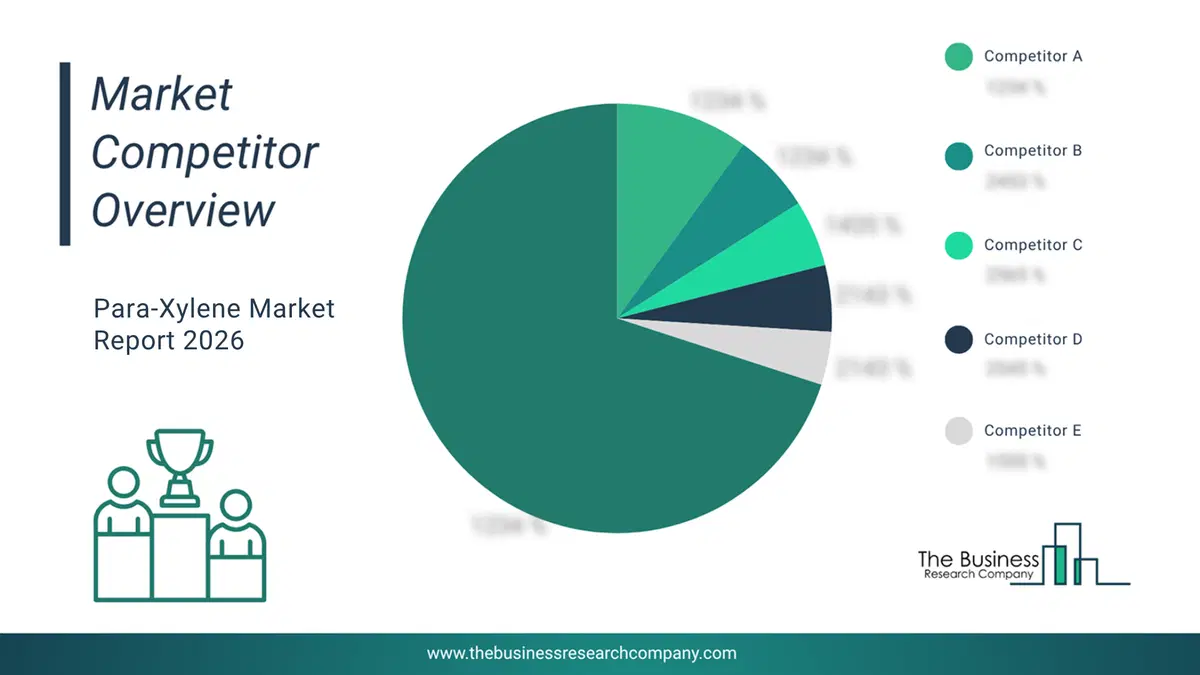
This chart is for illustrative purposes; the full report includes a detailed competitor analysis and comprehensive overview of the top 10 companies in the market.
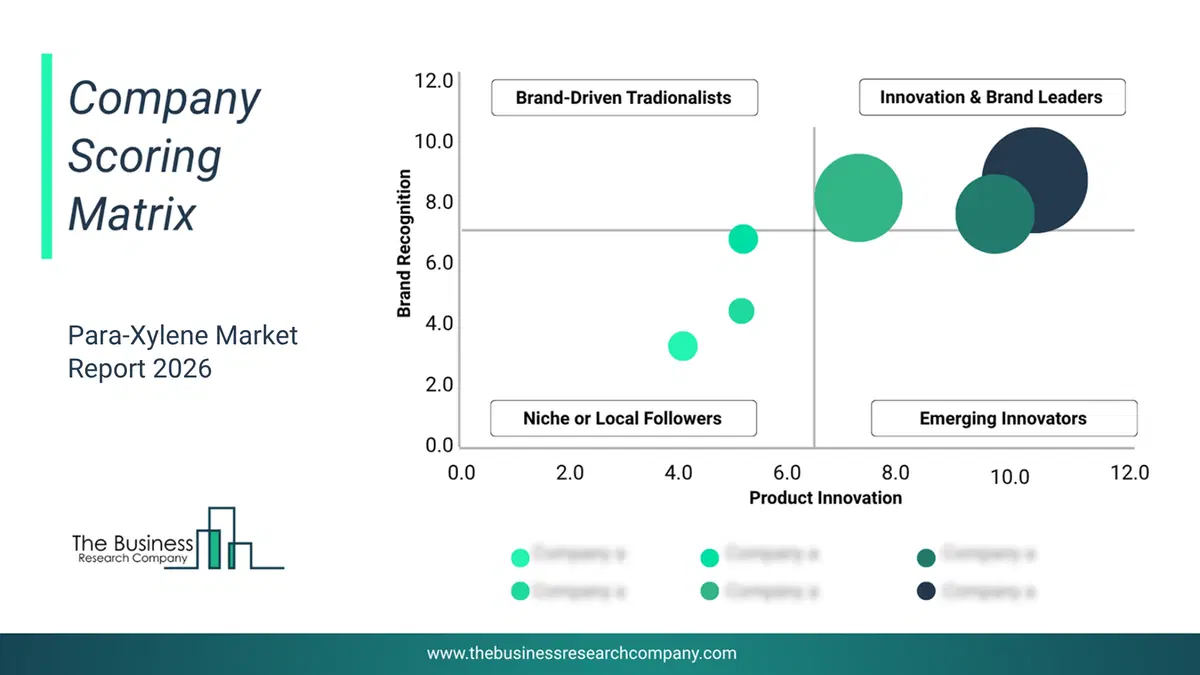
This chart maps companies by product innovation and brand strength, with bubble size indicating relative revenue, helping identify market leaders, challengers, and niche players. This is an illustrative chart; the full report provides a complete and accurate competitive analysis.
Global Para-Xylene Market Trends and Insights
Major companies operating in the para-xylene market are focusing on developing sustainable bio-based para-xylene solutions to reduce carbon emissions, decrease dependence on virgin petroleum feedstocks, and support circular packaging initiatives. Bio-paraxylene refers to para-xylene produced from renewable biomass resources such as used cooking oil, which can be converted into terephthalic acid (TPA) for the production of PET resin. For instance, in October 2024, Suntory Group, a Japan-based beverage manufacturer, introduced the world’s first commercial PET bottles utilizing bio-paraxylene derived from used cooking oil. The initiative is part of a large-scale collaboration involving companies such as ENEOS Corporation, Mitsubishi Corporation, Neste, Mitsui Chemicals, Indorama Ventures, and Iwatani Corporation to establish a fully integrated bio-based supply chain. In this system, used cooking oil is converted into bio-naphtha, which is then processed into bio-paraxylene and ultimately used to produce PET resin for beverage packaging. The resulting PET bottles significantly reduce CO₂ emissions compared to conventional petroleum-based PET bottles while maintaining full compatibility with existing recycling and bottle-to-bottle circular systems.What Are Latest Mergers And Acquisitions In The Para-Xylene Market?
In January 2024, Idemitsu Kosan Co., Ltd., a Japan-based manufacturer and supplier of para-xylene, partnered with Oriental Petrochemical Taiwan (OPTC) and Marubeni Corporation to establish a supply chain for biomass-based purified terephthalic acid (PTA) using biomass naphtha as a feedstock. Through this collaboration, companies aim to commercialize bio-based PTA production in Taiwan starting in 2024, enable the production of bio-based paraxylene (PX) and PTA through a mass balance approach, and support the development of low-carbon PET plastics for packaging applications such as beverage bottles. Oriental Petrochemical Taiwan is a Taiwan-based petrochemical producer under the Far Eastern New Century Group, and Marubeni Corporation is a Japan-based trading and investment conglomerate involved in global supply chain management.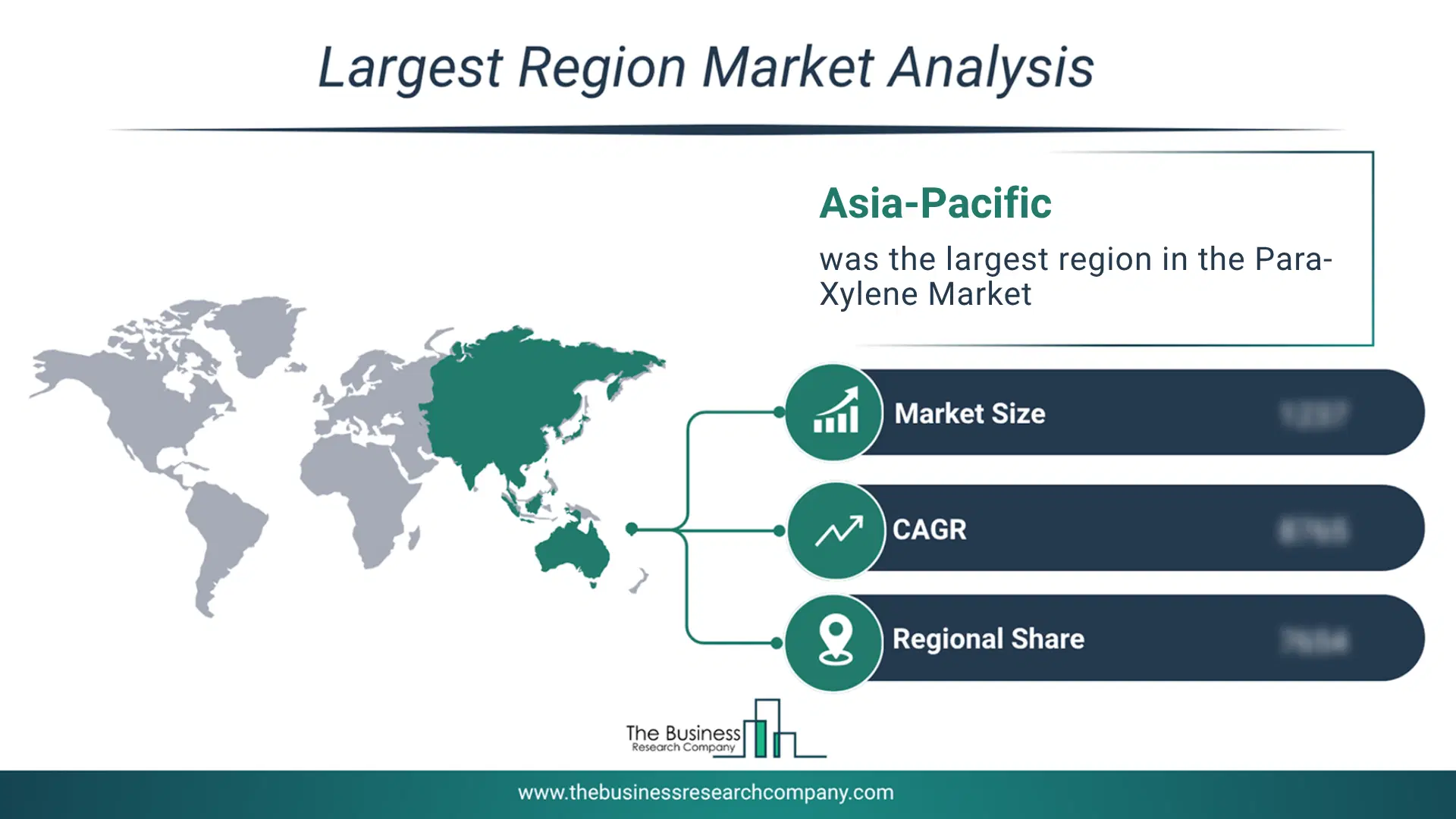
Regional Outlook/Insights
Asia-Pacific was the largest region in the para-xylene market in 2025. Asia-Pacific is expected to be the fastest-growing region in the forecast period. The regions covered in this market report are Asia-Pacific, South East Asia, Western Europe, Eastern Europe, North America, South America, Middle East, Africa. The countries covered in this market report are Australia, Brazil, China, France, Germany, India, Indonesia, Japan, Taiwan, Russia, South Korea, UK, USA, Canada, Italy, Spain.What Defines the Para-Xylene Market?
The para-xylene market consists of sales of polyethylene terephthalate (PET) resins, PET bottles, films, and polyester-based textiles. Values in this market are ‘factory gate’ values, that is, the value of goods sold by the manufacturers or creators of the goods, whether to other entities (including downstream manufacturers, wholesalers, distributors, and retailers) or directly to end customers. The value of goods in this market includes related services sold by the creators of the goods.How is Market Value Defined and Measured?
The market value is defined as the revenues that enterprises gain from the sale of goods and/or services within the specified market and geography through sales, grants, or donations in terms of the currency (in USD unless otherwise specified). The revenues for a specified geography are consumption values that are revenues generated by organizations in the specified geography within the market, irrespective of where they are produced. It does not include revenues from resales along the supply chain, either further along the supply chain or as part of other products.
This chart presents market attractiveness based on a quantitative evaluation of growth, competition, strategic alignment, and risk, offering a clear view of opportunity areas for decision-making. This chart is for illustrative purposes; the full report contains the complete analysis.

This chart highlights the Total Addressable Market (TAM) by estimating the maximum revenue opportunity using an assumption-driven approach, supporting strategic planning and opportunity sizing across markets. The chart is illustrative; the full report provides a more comprehensive analysis.
What Key Data and Analysis Are Included in the Para-Xylene Market Report 2026?
The para-xylene market research report is one of a series of new reports from The Business Research Company that provides para-xylene market statistics, including para-xylene industry global market size, regional shares, competitors with a para-xylene market share, detailed para-xylene market segments, market trends and opportunities, and any further data you may need to thrive in the para-xylene industry. This para-xylene market research report delivers a complete perspective of everything you need, with an in-depth analysis of the current and future scenario of the industry.Para-Xylene Market Report Forecast Analysis
| Report Attribute | Details |
|---|---|
| Market Size Value In 2026 | $59.21 billion |
| Revenue Forecast In 2030 | $77.42 billion |
| Growth Rate | CAGR of 6.9% from 2026 to 2030 |
| Base Year For Estimation | 2025 |
| Actual Estimates/Historical Data | 2020-2025 |
| Forecast Period | 2026 - 2030 |
| Market Representation | Revenue in USD Billion and CAGR from 2026 to 2030 |
| Segments Covered | Production Process, Distribution Channel, Application, End Use Industry |
| Regional Scope | Asia-Pacific, Western Europe, Eastern Europe, North America, South America, Middle East, Africa |
| Country Scope | The countries covered in the report are Australia, Brazil, China, France, Germany, India, Indonesia, Japan, Taiwan, Russia, South Korea, UK, USA, Canada, Italy, Spain. |
| Key Companies Profiled | ExxonMobil Corporation, Saudi Basic Industries Corporation, PetroChina Company Limited, Reliance Industries Limited, China Petroleum & Chemical Corporation, SK Innovation Co. Ltd., Hengli Petrochemical Co. Ltd., Formosa Chemicals & Fibre Corporation, Indian Oil Corporation Limited, Mitsubishi Chemical Group Corporation, Idemitsu Kosan Co. Ltd., Lotte Chemical Corporation, Indorama Ventures Public Company Limited, GS Caltex Corporation, Alpek S.A.B. de C.V., Hanwha TotalEnergies Petrochemical Co. Ltd., Zhejiang Petrochemical Co. Ltd., Petroliam Nasional Berhad, CPC Corporation Taiwan, Chevron Phillips Chemical Company LLC, Rongsheng Petrochemical Co. Ltd. |
| Customization Scope | Request for Customization |
| Pricing And Purchase Options | Explore Purchase Options |