

Particle Counters Market Report 2026
Global Outlook – By Type (Airborne Particle Counters, Portable, Remote, Handheld, Condensation Or Ultrafine, Liquid Particle Counters, Online Or Inline, Offline), By Application (Cleanroom Monitoring, Drinking Water Contamination Monitoring, Aerosol Monitoring And Research, Indoor Air Quality Monitoring, Contamination Monitoring Of Liquids, Chemical Contamination Monitoring, Other Applications), By Distribution Channel (Direct, Indirect), By End User (Life Sciences And Medical Device Industry, Semiconductor Industry, Automotive Industry, Aerospace Industry, Food And Beverage Industry, Other End Users) – Market Size, Trends, Strategies, and Forecast to 2030
Particle Counters Market Overview
• Particle Counters market size has reached to $0.63 billion in 2025 • Expected to grow to $1.09 billion in 2030 at a compound annual growth rate (CAGR) of 11.2% • Growth Driver: Indoor Air Pollution is Propel The Growth Of The Particle Counters Market • Market Trend: Innovative Solutions Transforming Particle Counters Market • North America was the largest region in 2025 and Asia-Pacific is the fastest growing region.What Is Covered Under Particle Counters Market?
Particle counters are instruments used to detect, count, and sometimes size particles suspended in air, liquids, or gases. They are vital in various industries, including pharmaceuticals, cleanrooms, environmental monitoring, and industrial processes. Particle counters provide crucial data for ensuring product quality, assessing air and water cleanliness, and monitoring workplace safety standards. The main types of particle counters are airborne particle counters, portable, remote, handheld, condensation or ultrafine, liquid particle counters, online or inline, and offline. Airborne particle counters are devices that measure the concentration and size of particles suspended in the air to assess air quality. Applications include cleanroom monitoring, drinking water contamination detection, aerosol research, indoor air quality assessment, and liquid and chemical contamination monitoring, distributed through both direct and indirect channels. End users encompass the life sciences and medical device industries, semiconductor industry, automotive industry, aerospace industry, food and beverage industry, and others.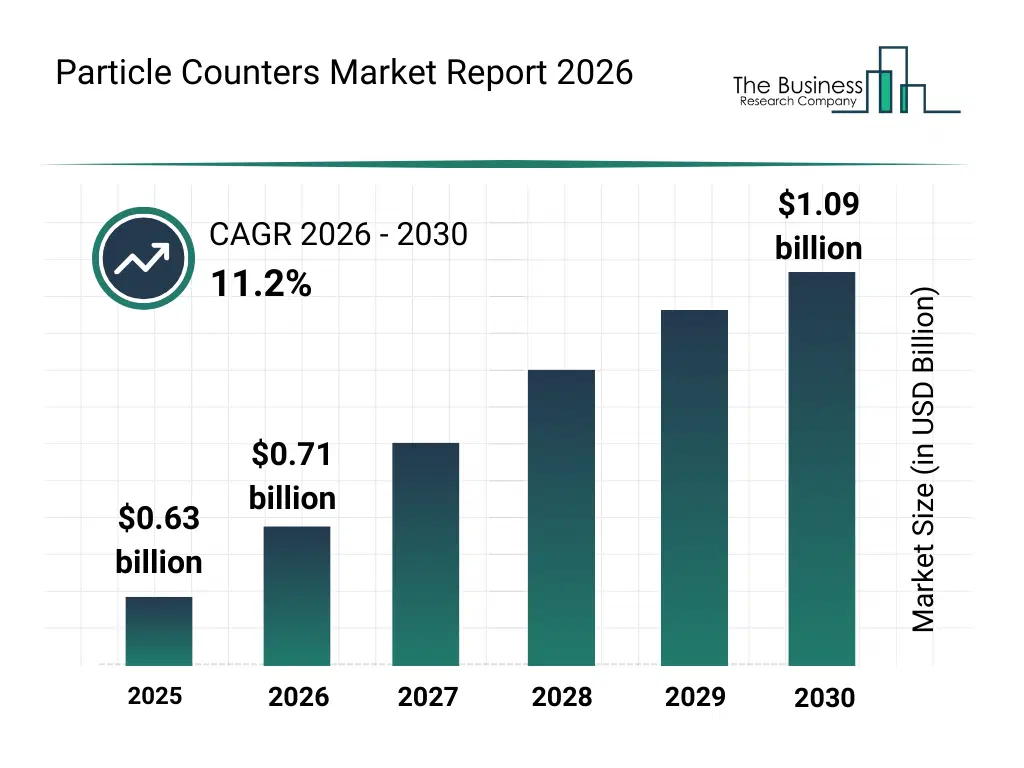
What Is The Particle Counters Market Size and Share 2026?
The particle counters market size has grown rapidly in recent years. It will grow from $0.63 billion in 2025 to $0.71 billion in 2026 at a compound annual growth rate (CAGR) of 12.5%. The growth in the historic period can be attributed to growth of pharmaceutical manufacturing, expansion of semiconductor fabrication plants, implementation of cleanroom standards, increased focus on workplace safety, adoption of contamination control practices.What Is The Particle Counters Market Growth Forecast?
The particle counters market size is expected to see rapid growth in the next few years. It will grow to $1.09 billion in 2030 at a compound annual growth rate (CAGR) of 11.2%. The growth in the forecast period can be attributed to stricter regulatory compliance requirements, growth in biologics and vaccine production, increasing investment in semiconductor fabs, rising demand for indoor air quality monitoring, advancements in sensor and optics technology. Major trends in the forecast period include rising adoption of continuous particle monitoring, growth in portable and handheld particle counters, increasing demand for ultrafine particle detection, expansion of particle counters in cleanroom compliance, demand for high accuracy and real time data logging.Tariff Impact On Particle Counters Market
Tariffs have impacted the particle counters market by increasing the cost of imported optical components, sensors, lasers, and electronic modules used in precision measurement instruments. Higher duties have raised procurement and manufacturing costs for cleanroom monitoring, life sciences, and semiconductor applications, particularly in Asia Pacific, North America, and Europe. These cost pressures have affected pricing and slowed upgrades for smaller laboratories and facilities. At the same time, tariffs have encouraged local manufacturing of analytical instruments and strengthened regional supply chains for particle counting solutions.
Global Particle Counters Market Segmentation
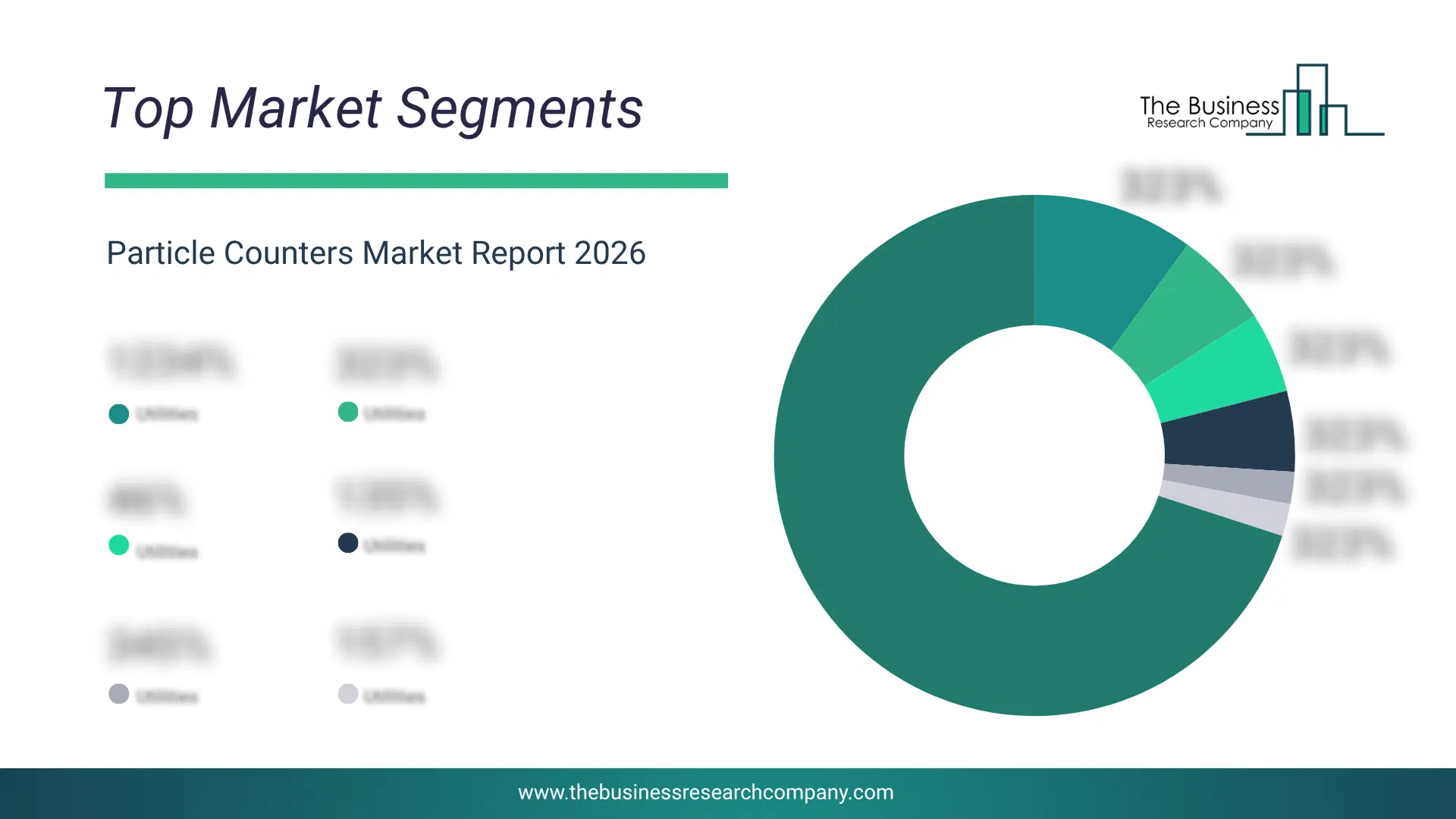
1) By Type: Airborne Particle Counters, Portable, Remote, Handheld, Condensation Or Ultrafine, Liquid Particle Counters, Online Or Inline, Offline 2) By Application: Cleanroom Monitoring, Drinking Water Contamination Monitoring, Aerosol Monitoring And Research, Indoor Air Quality Monitoring, Contamination Monitoring Of Liquids, Chemical Contamination Monitoring, Other Applications 3) By Distribution Channel: Direct, Indirect 4) By End User: Life Sciences And Medical Device Industry, Semiconductor Industry, Automotive Industry, Aerospace Industry, Food And Beverage Industry, Other End Users Subsegments: 1) By Airborne Particle Counters: Fixed Airborne Particle Counters, Portable Airborne Particle Counters 2) By Portable: Battery-Powered Particle Counters, Rechargeable Portable Particle Counters 3) By Remote: Remote Monitoring Systems, Wired Remote Particle Counters 4) By Handheld: Small Handheld Particle Counters, Ergonomically Designed Handheld Counters 5) By Condensation Or Ultrafine: Condensation Particle Counters (CPC), Ultrafine Particle Counters 6) By Liquid Particle Counters: Laboratory Liquid Particle Counters, Industrial Liquid Particle Counters 7) By Online Or Inline: Continuous Online Particle Counters, Integrated Inline Particle Counters 8) By Offline: Laboratory-Grade Offline Particle Counters, Portable Offline Particle CountersWhat Is The Driver Of The Particle Counters Market?
The rising indoor air pollution is expected to propel the growth of the particle counters market going forward. Indoor air pollution refers to the presence of pollutants in the air inside homes, offices, schools, and other buildings. Indoor air pollution is rising due to several reasons, including increased use of synthetic building materials and furnishings, increased use of household chemicals, and increased use of combustion appliances. Particle counters help monitor indoor air pollution by measuring the concentration and size distribution of airborne particles, aiding in identifying potential sources and assessing air quality. For instance, in July 2023, according to the Environmental Protection Agency, a US-based government agency, Americans typically spend about 90 percent of their time indoors, where concentrations of certain pollutants can often be 2 to 5 times higher than levels found outdoors. Therefore, rising indoor air pollution is driving the growth of the particle counters industry.Key Players In The Global Particle Counters Market
Major companies operating in the particle counters market are Sartorius AG, Entegris Inc., FLIR Systems Inc., Beckman Coulter Life Sciences, TSI Incorporated, RION Co. Ltd., Particle Measuring Systems, Setra Systems Inc., Kanomax USA Inc., Met One Instruments Inc., Lighthouse Worldwide Solutions, Klotz GmbH, PCE Instruments, Climet Instruments Company, Testo SE & Co. KGaA, Aeroqual Ltd, Chemtrac Inc., GrayWolf Sensing Solutions, Hal Technology LLC, Spectrex Corporation, Trotec GmbH & Co. KG
This chart is for illustrative purposes; the full report includes a detailed competitor analysis and comprehensive overview of the top 10 companies in the market.
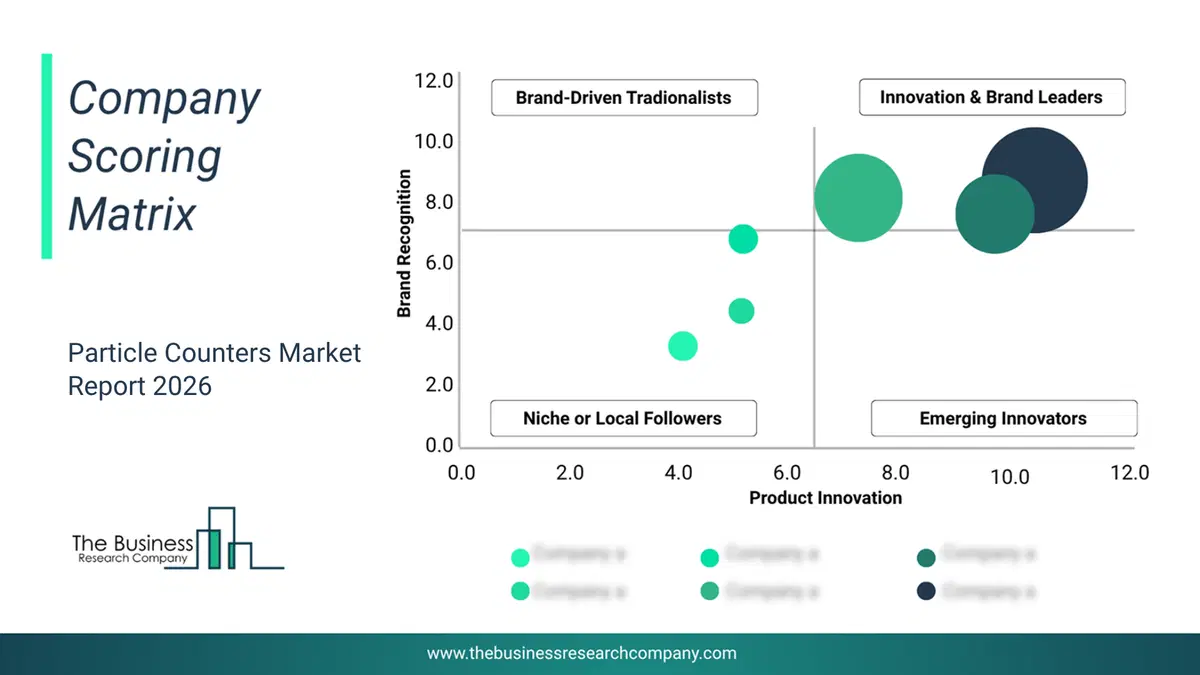
This chart maps companies by product innovation and brand strength, with bubble size indicating relative revenue, helping identify market leaders, challengers, and niche players. This is an illustrative chart; the full report provides a complete and accurate competitive analysis.
Global Particle Counters Market Trends and Insights
Major companies operating in the particle counters market are focused on developing advanced solutions, such as portable particle counters, to ensure the accuracy and reliability of measurement instruments and equipment. A portable particle counter is a device used to measure and count the number of airborne particles in a specific environment, often for cleanroom monitoring and classification. For instance, in February 2023, TSI, a US-based company, launched the AeroTrak+ Portable Particle Counter, designed to simplify and enhance the reliability of cleanroom particle counting. This new instrument assists technicians with cleanroom classification, monitoring, and root-cause investigations. The AeroTrak+ Portable Particle Counters adhere to global regulatory guidelines and international standards, including ISO 14644-1:2015, ISO 21501-4:2018, EU GMP Annex 1 (2008 and 2022), and China GMP, ensuring straightforward cleanroom classification testing.What Are Latest Mergers And Acquisitions In The Particle Counters Market?
In October 2023, Particle Measuring Systems Inc., a US-based manufacturer of particle counters and monitoring systems, acquired Environmental Monitoring Services Irl. Limited and EMS Particle Solutions Ltd. for an undisclosed amount. The acquisition supports PMS's strategy to be direct in every major geographical market, enhancing customer support and service with advanced contamination monitoring and control solutions. Environmental Monitoring Services Irl. Limited is an Ireland-based provider of cleanroom monitoring and control solutions such as particle counters, and EMS Particle Solutions Ltd. is an Ireland-based provider of cleanroom monitoring and control solutions and services.
Regional Outlook
North America was the largest region in the particle counters market in 2025. Asia-Pacific is expected to be the fastest-growing region in the forecast period. The regions covered in this market report are Asia-Pacific, South East Asia, Western Europe, Eastern Europe, North America, South America, Middle East, Africa The countries covered in this market report are Australia, Brazil, China, France, Germany, India, Indonesia, Japan, Taiwan, Russia, South Korea, UK, USA, Canada, Italy, Spain.What Defines the Particle Counters Market?
The particle counters market consists of sales of scanning mobility particle sizers (SMPS), beta attenuation mass monitors (BAM), impactor particle counters, optical particle counters (OPC), and electrical particle counters. Values in this market are ‘factory gate’ values, that is the value of goods sold by the manufacturers or creators of the goods, whether to other entities (including downstream manufacturers, wholesalers, distributors and retailers) or directly to end customers. The value of goods in this market includes related services sold by the creators of the goods.How is Market Value Defined and Measured?
The market value is defined as the revenues that enterprises gain from the sale of goods and/or services within the specified market and geography through sales, grants, or donations in terms of the currency (in USD unless otherwise specified). The revenues for a specified geography are consumption values that are revenues generated by organizations in the specified geography within the market, irrespective of where they are produced. It does not include revenues from resales along the supply chain, either further along the supply chain or as part of other products.
This chart presents market attractiveness based on a quantitative evaluation of growth, competition, strategic alignment, and risk, offering a clear view of opportunity areas for decision-making. This chart is for illustrative purposes; the full report contains the complete analysis.

This chart highlights the Total Addressable Market (TAM) by estimating the maximum revenue opportunity using an assumption-driven approach, supporting strategic planning and opportunity sizing across markets. The chart is illustrative; the full report provides a more comprehensive analysis.
What Key Data and Analysis Are Included in the Particle Counters Market Report 2026?
The particle counters market research report is one of a series of new reports from The Business Research Company that provides market statistics, including industry global market size, regional shares, competitors with the market share, detailed market segments, market trends and opportunities, and any further data you may need to thrive in the particle counters industry. The market research report delivers a complete perspective of everything you need, with an in-depth analysis of the current and future state of the industry.Particle Counters Market Report Forecast Analysis
| Report Attribute | Details |
|---|---|
| Market Size Value In 2026 | $0.71 billion |
| Revenue Forecast In 2030 | $1.09 billion |
| Growth Rate | CAGR of 11.2% from 2026 to 2030 |
| Base Year For Estimation | 2025 |
| Actual Estimates/Historical Data | 2020-2025 |
| Forecast Period | 2026 - 2030 |
| Market Representation | Revenue in USD Billion and CAGR from 2026 to 2030 |
| Segments Covered | Type, Application, Distribution Channel, End User |
| Regional Scope | Asia-Pacific, Western Europe, Eastern Europe, North America, South America, Middle East, Africa |
| Key Companies Profiled | Sartorius AG, Entegris Inc., FLIR Systems Inc., Beckman Coulter Life Sciences, TSI Incorporated, RION Co. Ltd., Particle Measuring Systems, Setra Systems Inc., Kanomax USA Inc., Met One Instruments Inc., Lighthouse Worldwide Solutions, Klotz GmbH, PCE Instruments, Climet Instruments Company, Testo SE & Co. KGaA, Aeroqual Ltd, Chemtrac Inc., GrayWolf Sensing Solutions, Hal Technology LLC, Spectrex Corporation, Trotec GmbH & Co. KG |
| Customization Scope | Request for Customization |
| Pricing And Purchase Options | Explore Purchase Options |