
Particulate Soot Sensor Market Report 2026
Global Outlook – By Product Type (Resistive Soot Sensors, Conductive Soot Sensors, Capacitive Soot Sensors, Other Product Types ), By Fuel Type (Diesel Engines, Gasoline Direct Injection (GDI) Engines ), By Technology (Regeneration Type, Non-Regeneration Type ), By Sales Channel (Original Equipment Manufacturer (OEM), Aftermarket ), By Application (Passenger Vehicles, Commercial Vehicles, Off-Highway Vehicles, Other Applications ) – Market Size, Trends, Strategies, and Forecast to 2030
Particulate Soot Sensor Market Overview
• Particulate Soot Sensor market size has reached to $1.76 billion in 2025 • Expected to grow to $2.69 billion in 2030 at a compound annual growth rate (CAGR) of 9% • Growth Driver: Surge In Rising Demand For Diesel Vehicles Fueling The Growth Of The Market Due To Increasing Fleet Expansion • Market Trend: Advancements In Real-Time Particulate Soot Monitoring For Enhanced Air Quality Control • Europe was the largest region in 2025 and Asia-Pacific is the fastest growing region.What Is Covered Under Particulate Soot Sensor Market?
A particulate soot sensor is a device used in diesel engines to detect and measure the concentration of soot particles in the exhaust gas. It helps to monitor engine emissions and help control particulate matter to comply with environmental regulations. The sensor works by detecting the accumulation of soot on a sensing element, often using resistive or optical methods, and sends this data to the engine control unit. The main product types of particulate soot sensors include resistive soot sensors, conductive soot sensors, capacitive soot sensors, and other product types. Resistive soot sensors refer to devices that measure soot accumulation in exhaust systems to optimize engine performance and reduce emissions. The different types of fuel are used in diesel engines and gasoline direct injection (GDI) engines and utilize technologies such as regeneration type and non-regeneration type. They are distributed through original equipment manufacturers (OEM) and aftermarket channels and the various applications involved are passenger vehicles, commercial vehicles, off-highway vehicles, and other applications.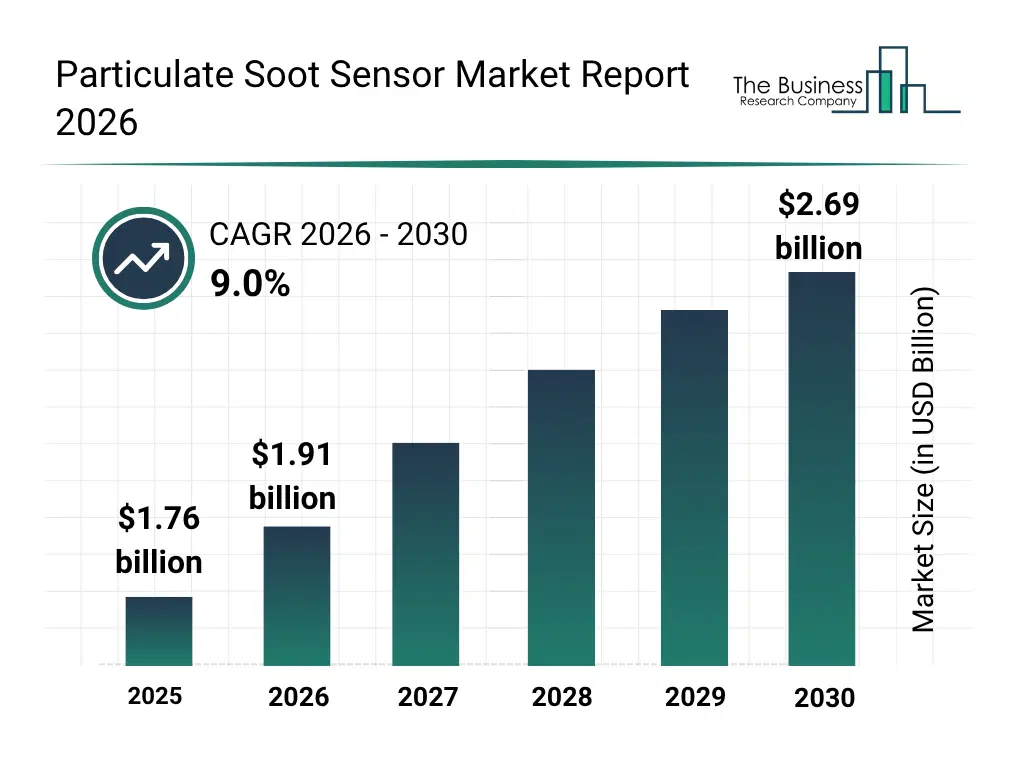
What Is The Particulate Soot Sensor Market Size and Share 2026?
The particulate soot sensor market size has grown strongly in recent years. It will grow from $1.76 billion in 2025 to $1.91 billion in 2026 at a compound annual growth rate (CAGR) of 8.7%. The growth in the historic period can be attributed to growing environmental regulations on diesel emissions, increasing diesel vehicle production, adoption of particulate matter monitoring systems, expansion of commercial vehicle fleets, rising awareness of air pollution impact.What Is The Particulate Soot Sensor Market Growth Forecast?
The particulate soot sensor market size is expected to see strong growth in the next few years. It will grow to $2.69 billion by 2030 at a compound annual growth rate (CAGR) of 9.0%. The growth in the forecast period can be attributed to stricter global emission norms, increasing deployment of electric and hybrid vehicles with diesel engines, advancements in sensor technologies, growing aftermarket adoption of emission monitoring solutions, rising focus on IoT-enabled vehicle diagnostics. Major trends in the forecast period include rising demand for advanced diesel engine emission monitoring, increasing adoption of resistive and conductive soot sensors, integration of soot sensors with engine control units, expansion of soot sensor applications in commercial and off-highway vehicles, focus on compliance with stricter environmental regulations.
Global Particulate Soot Sensor Market Segmentation
1) By Product Type: Resistive Soot Sensors, Conductive Soot Sensors, Capacitive Soot Sensors, Other Product Types 2) By Fuel Type: Diesel Engines, Gasoline Direct Injection (GDI) Engines 3) By Technology: Regeneration Type, Non-Regeneration Type 4) By Sales Channel: Original Equipment Manufacturer (OEM), Aftermarket 5) By Application: Passenger Vehicles, Commercial Vehicles, Off-Highway Vehicles, Other Applications Subsegments: 1) By Resistive Soot Sensors: Planar Resistive Soot Sensors, Interdigital Electrode Resistive Soot Sensors, Ceramic Based Resistive Soot Sensors, Metal Oxide Resistive Soot Sensors 2) By Conductive Soot Sensors: Electrode Bridge Conductive Soot Sensors, Carbon Deposition Conductive Soot Sensors, Multi Electrode Conductive Soot Sensors, High Temperature Conductive Soot Sensors 3) By Capacitive Soot Sensors: Interdigitated Capacitive Soot Sensors, Ceramic Capacitive Soot Sensors, Insulated Electrode Capacitive Soot Sensors, Thin Film Capacitive Soot Sensors 4) By Other Product Types: Optical Particulate Matter Sensors, Photoacoustic Soot Sensors, Radio Frequency Based Soot Sensors, Laser Scattering Particulate SensorsWhat Is The Driver Of The Particulate Soot Sensor Market?
The rising demand for diesel vehicles is expected to propel the growth of the particulate soot sensors market going forward. Diesel vehicles are internal combustion engine vehicles that use diesel fuel and operate with higher torque efficiency and longer driving range compared to many alternative powertrains. The demand for diesel vehicles is rising due to increasing commercial transportation needs as businesses seek more fuel-efficient, high-torque vehicles for long-distance hauling and logistics operations. Particulate soot sensors support diesel vehicles by monitoring and detecting soot levels in the exhaust system, ensuring optimal engine performance and compliance with emission standards. They help reduce environmental impact and improve fuel efficiency by enabling precise regeneration of diesel particulate filters, enhancing vehicle reliability and longevity. For instance, in January 2024, according to the Bureau of Infrastructure and Transport Research Economics, an Australia-based government body, diesel-powered motor vehicles accounted for 29.0 per cent of the total fleet, up from 28.3 per cent in 2023. Therefore, the rising demand for diesel vehicles is expected to drive the growth of the particulate soot sensors industry.Key Players In The Global Particulate Soot Sensor Market
Major companies operating in the particulate soot sensor market are Robert Bosch GmbH, Denso Corporation, Continental AG, Weichai Power Co. Ltd., Tenneco Inc., Infineon Technologies AG, STMicroelectronics N.V., TE Connectivity Ltd., Emerson Electric Co., Vitesco Technologies Group AG, Sensata Technologies Holding PLC, NGK Insulators Ltd., PHINIA Inc., HORIBA Ltd, SICK AG, TT Electronics plc, CTS Corporation, Hitachi Astemo Ltd., Amphenol Advanced Sensors.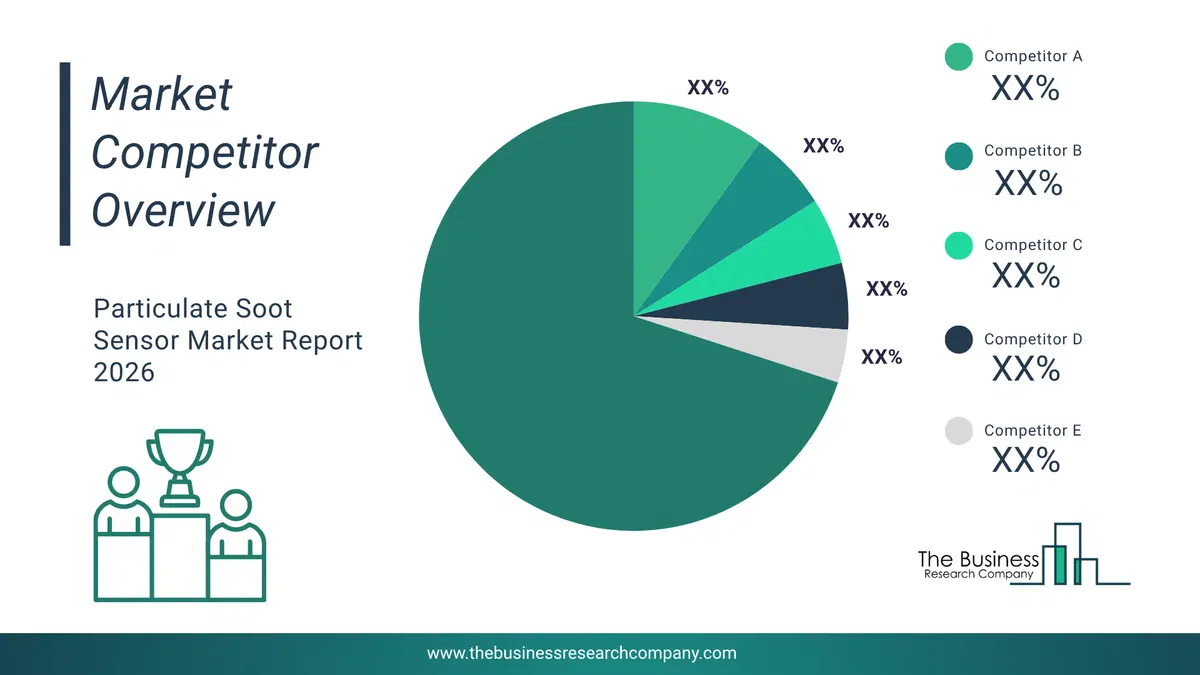
This chart is for illustrative purposes; the full report includes a detailed competitor analysis and comprehensive overview of the top 10 companies in the market.
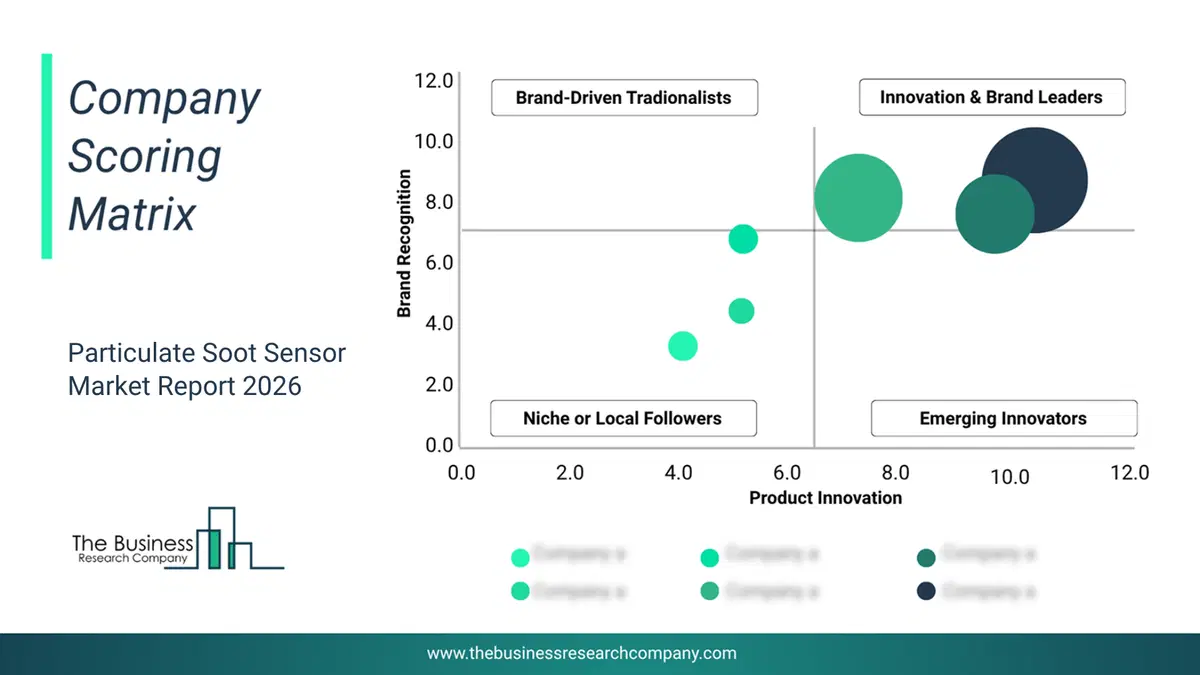
This chart maps companies by product innovation and brand strength, with bubble size indicating relative revenue, helping identify market leaders, challengers, and niche players. This is an illustrative chart; the full report provides a complete and accurate competitive analysis.
Global Particulate Soot Sensor Market Trends and Insights
Major companies operating in the particulate soot sensor market are focusing on integrating innovative products such as, high-precision real-time particulate monitoring sensors to enhance emission detection accuracy and meet increasingly stringent environmental regulations. High-precision real-time particulate monitoring sensors are advanced devices that continuously measure fine particulate matter and soot with high accuracy, helping ensure regulatory compliance, optimize performance, and reduce harmful emissions through immediate detection and response. For instance, in November 2025, the Massachusetts Department of Environmental Protection, a US-based state environmental regulatory agency, launched two new air monitoring stations to strengthen statewide air quality surveillance. These stations integrate high-precision real-time particulate monitoring sensors capable of continuously detecting PM2.5 and other soot-related pollutants generated from transportation corridors and industrial facilities. The systems feature automated sampling mechanisms, advanced optical and gravimetric measurement technologies, and digital communication platforms that enable real-time data transmission to centralized environmental monitoring networks. Equipped with high-precision real-time particulate monitoring sensors, the newly deployed stations provide enhanced measurement accuracy, improved spatial pollution tracking, and faster response to emission spikes compared to traditional periodic sampling and laboratory-based analysis methods.What Are Latest Mergers And Acquisitions In The Particulate Soot Sensor Market?
In February 2023, ION Science Ltd., a UK-based gas detection company that specializes in providing sensors for particulate matter, partnered with Groupe TERA to introduce the NextPM particulate matter (PM) sensor. With this partnership, ION Science Ltd. and Groupe TERA aim to provide ultra-precise PM1, PM2.5, and PM10 measurements for industrial, environmental, and smart city applications, enhancing air quality monitoring, safety, and compliance with local and international standards. Groupe TERA is a France-based air quality measurement company that specializes in real-time air quality measurement, sensor development, and environmental data analysis.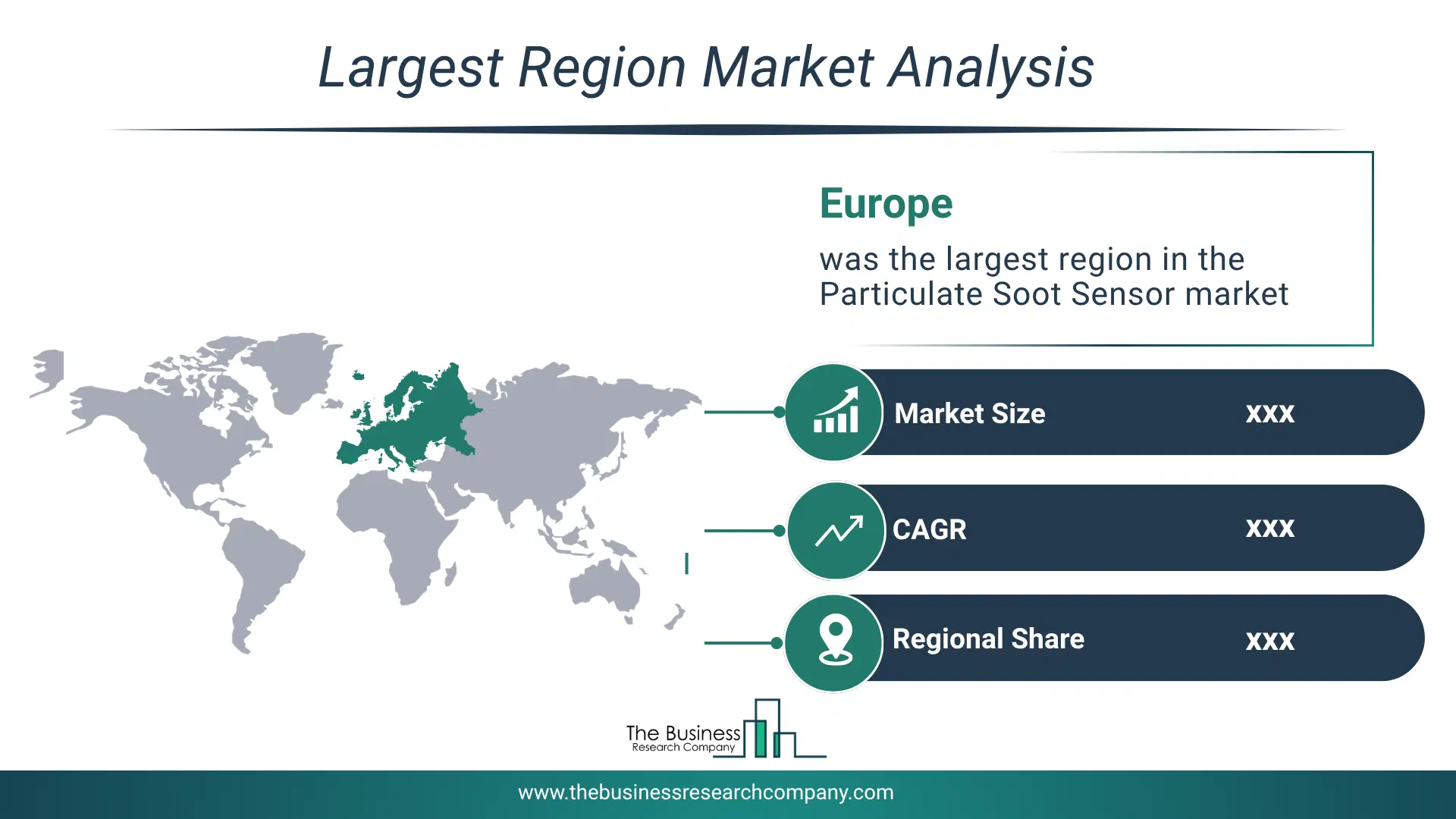
Regional Insights
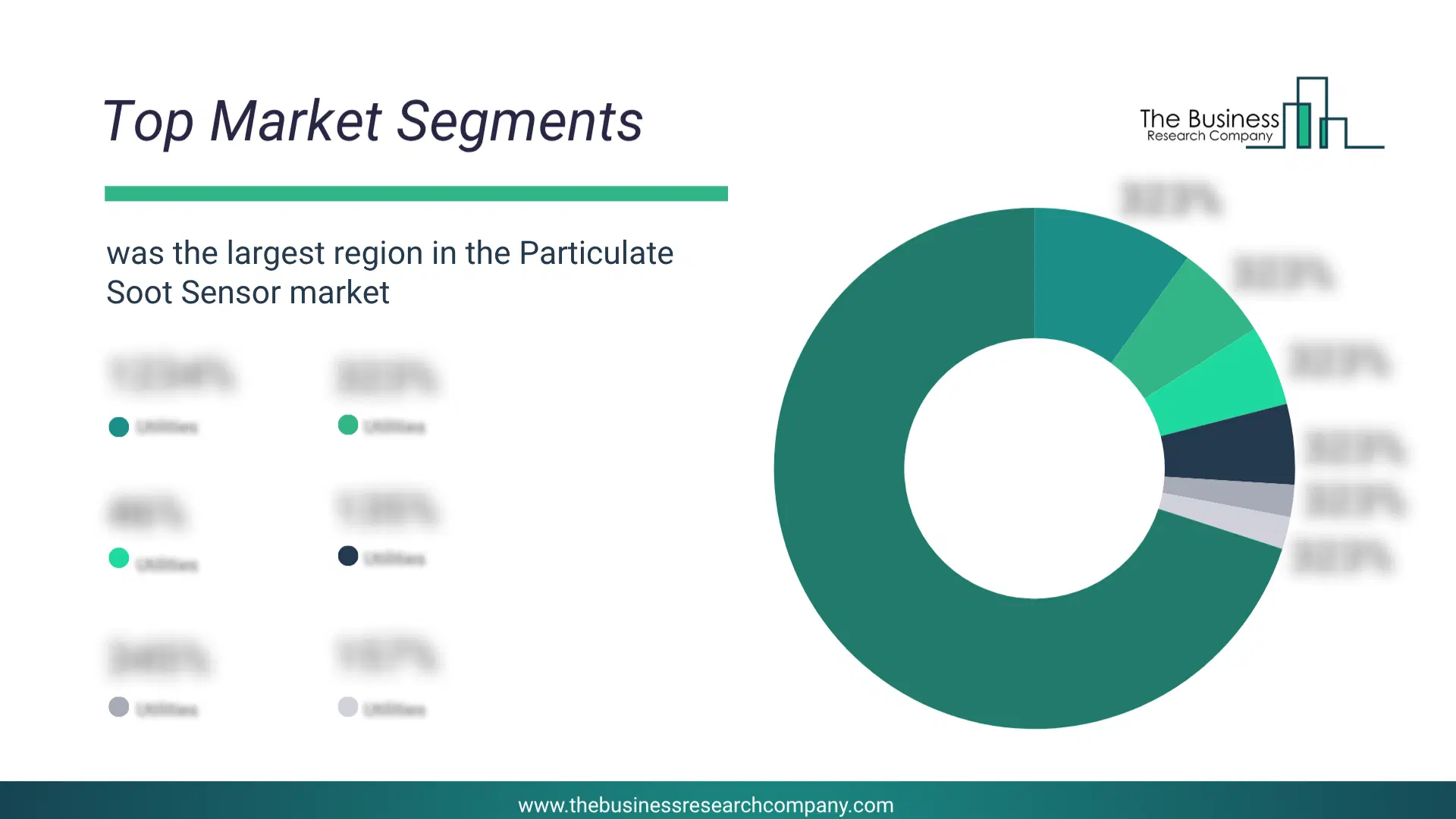
Europe was the largest region in the particulate soot sensor market in 2025. Asia-Pacific is expected to be the fastest-growing region in the forecast period. The regions covered in this market report are Asia-Pacific, South East Asia, Western Europe, Eastern Europe, North America, South America, Middle East, Africa. The countries covered in this market report are Australia, Brazil, China, France, Germany, India, Indonesia, Japan, Taiwan, Russia, South Korea, UK, USA, Canada, Italy, Spain.What Defines the Particulate Soot Sensor Market?
The particulate soot sensor market consists of sales of optical or laser soot sensors, radio-frequency (RF) or electromagnetic soot sensors, and hybrid or advanced nanomaterial-based sensors. Values in this market are ‘factory gate’ values, that is, the value of goods sold by the manufacturers or creators of the goods, whether to other entities (including downstream manufacturers, wholesalers, distributors, and retailers) or directly to end customers. The value of goods in this market includes related services sold by the creators of the goods.How is Market Value Defined and Measured?
The market value is defined as the revenues that enterprises gain from the sale of goods and/or services within the specified market and geography through sales, grants, or donations in terms of the currency (in USD unless otherwise specified). The revenues for a specified geography are consumption values that are revenues generated by organizations in the specified geography within the market, irrespective of where they are produced. It does not include revenues from resales along the supply chain, either further along the supply chain or as part of other products.
This chart presents market attractiveness based on a quantitative evaluation of growth, competition, strategic alignment, and risk, offering a clear view of opportunity areas for decision-making. This chart is for illustrative purposes; the full report contains the complete analysis.

This chart highlights the Total Addressable Market (TAM) by estimating the maximum revenue opportunity using an assumption-driven approach, supporting strategic planning and opportunity sizing across markets. The chart is illustrative; the full report provides a more comprehensive analysis.
What Key Data and Analysis Are Included in the Particulate Soot Sensor Market Report 2026?
The particulate soot sensor market research report is one of a series of new reports from The Business Research Company that provides market statistics, including industry global market size, regional shares, competitors with the market share, detailed market segments, market trends and opportunities, and any further data you may need to thrive in the particulate soot sensor industry. The market research report delivers a complete perspective of everything you need, with an in-depth analysis of the current and future state of the industry.Particulate Soot Sensor Market Report Forecast Analysis
| Report Attribute | Details |
|---|---|
| Market Size Value In 2026 | $1.91 billion |
| Revenue Forecast In 2030 | $2.69 billion |
| Growth Rate | CAGR of 8.7% from 2026 to 2030 |
| Base Year For Estimation | 2025 |
| Actual Estimates/Historical Data | 2020-2025 |
| Forecast Period | 2026 - 2030 |
| Market Representation | Revenue in USD Billion and CAGR from 2026 to 2030 |
| Segments Covered | Product Type, Fuel Type, Technology, Sales Channel, Application |
| Regional Scope | Asia-Pacific, Western Europe, Eastern Europe, North America, South America, Middle East, Africa |
| Country Scope | The countries covered in the report are Australia, Brazil, China, France, Germany, India, Indonesia, Japan, Taiwan, Russia, South Korea, UK, USA, Canada, Italy, Spain. |
| Key Companies Profiled | Robert Bosch GmbH, Denso Corporation, Continental AG, Weichai Power Co. Ltd., Tenneco Inc., Infineon Technologies AG, STMicroelectronics N.V., TE Connectivity Ltd., Emerson Electric Co., Vitesco Technologies Group AG, Sensata Technologies Holding PLC, NGK Insulators Ltd., PHINIA Inc., HORIBA Ltd, SICK AG, TT Electronics plc, CTS Corporation, Hitachi Astemo Ltd., Amphenol Advanced Sensors. |
| Customization Scope | Request for Customization |
| Pricing And Purchase Options | Explore Purchase Options |