
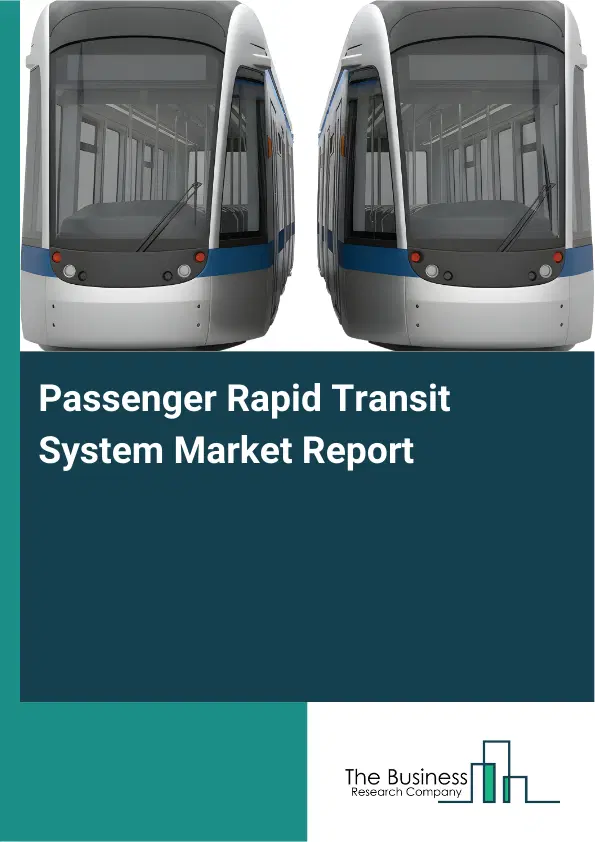
Passenger Rapid Transit System Market Report 2026
Global Outlook – By Type (Monorail; Duorail; Automated Guide Way Transit Or Maglev; Other Types), By Component (Hardware; Software; Services), By Application (Airports; Urban Transit; Amusement Parks; Commercial Center; Other Applications) – Market Size, Trends, Strategies, and Forecast to 2030
Passenger Rapid Transit System Market Overview
• Passenger Rapid Transit System market size has reached to $61.79 billion in 2025 • Expected to grow to $86.91 billion in 2030 at a compound annual growth rate (CAGR) of 7% • Growth Driver: Impact Of Population Growth And Urbanization On The Market Due To Increasing Demand For Efficient Urban Mobility • Market Trend: Advancements In Zero-Carbon Mobility And Smart Rail Technology Shaping The Future Of Passenger Rapid Transit • Asia-Pacific was the largest region and fastest growing region.What Is Covered Under Passenger Rapid Transit System Market?
The passenger rapid transit system refers to high-speed, high-capacity public transportation networks such as metro, light rail, and monorail systems designed for urban mobility. It provides frequent and efficient services to move large volumes of passengers across cities. These systems typically operate on exclusive tracks or lanes to avoid traffic congestion and ensure timely transit. The main types of passenger rapid transit systems are monorail, duorail, automated guideway transit or maglev, and others. A monorail is a transportation system that operates on a single elevated track, commonly used for urban transit, airports, and amusement parks. Its components consist of hardware, software, and services serving the applications, such as airports, urban transit, amusement parks, commercial centers, and more.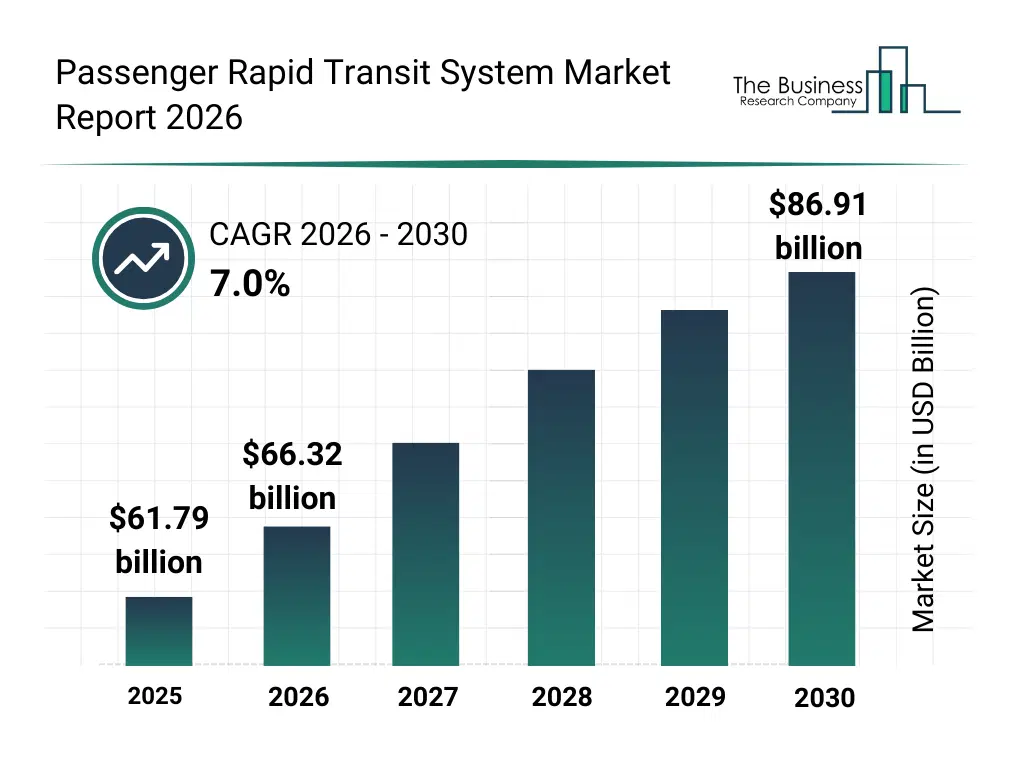
What Is The Passenger Rapid Transit System Market Size and Share 2026?
The passenger rapid transit system market size has grown strongly in recent years. It will grow from $61.79 billion in 2025 to $66.32 billion in 2026 at a compound annual growth rate (CAGR) of 7.3%. The growth in the historic period can be attributed to expansion of urban population density, increasing government investment in public transport, rising traffic congestion in metropolitan areas, adoption of rail-based transit solutions, growth of airport transit connectivity.What Is The Passenger Rapid Transit System Market Growth Forecast?
The passenger rapid transit system market size is expected to see strong growth in the next few years. It will grow to $86.91 billion in 2030 at a compound annual growth rate (CAGR) of 7.0%. The growth in the forecast period can be attributed to increasing investments in smart city infrastructure, rising demand for low-emission public transport, expansion of autonomous train operations, growing integration of digital passenger information systems, increasing focus on transit system modernization. Major trends in the forecast period include increasing deployment of fully automated transit systems, rising demand for high-capacity urban rail networks, growing integration of smart signaling and control systems, expansion of energy-efficient transit technologies, enhanced focus on passenger safety and comfort.
Global Passenger Rapid Transit System Market Segmentation
1) By Type: Monorail, Duorail, Automated Guide Way Transit Or Maglev, Other Types 2) By Component: Hardware, Software, Services 3) By Application: Airports, Urban Transit, Amusement Parks, Commercial Center, Other Applications Subsegments: 1) By Monorail: Straddle Type Monorail, Suspended Type Monorail 2) By Duorail: Dual-Track Duorail, Single-Track Duorail 3) By Automated Guide Way Transit (AGT) Or Maglev: Electromagnetic Levitation (Maglev), Non-Propulsion-Based Systems (AGT), Electro-dynamic Levitation (Maglev), Propulsion-Based Systems (AGT) 4) By Other Types: Cable Cars, Hybrid Systems, Personal Rapid Transit (PRT) SystemsWhat Is The Driver Of The Passenger Rapid Transit System Market?
The increasing population and rapid urbanization are expected to propel the growth of the passenger rapid transit system market going forward. Population and rapid urbanization refer to the simultaneous increase in the number of people and the swift migration from rural to urban areas, resulting in expanding cities and changing socio-economic dynamics. Economic opportunity drives increasing population and rapid urbanization, as people migrate to cities in search of better jobs, higher wages, and improved access to services. The passenger rapid transit (PRT) system supports increasing population and rapid urbanization by providing efficient, reliable, and accessible transportation, enabling easier movement within growing urban areas and promoting the development of new urban zones. For instance, in 2024, according to the United Nations Population Fund, a US-based human rights group, more than half of the world's population now lives in urban areas, with projections suggesting this will rise to around 5 billion by 2030, largely in Africa and Asia. Therefore, the increasing population and rapid urbanization are driving the growth of the passenger rapid transit system industry.Key Players In The Global Passenger Rapid Transit System Market
Major companies operating in the passenger rapid transit system market are CRRC Corporation Limited, Mitsubishi Heavy Industries Ltd., Alstom SA, Kawasaki Heavy Industries Ltd., Siemens Mobility GmbH, Keolis Group, Transmashholding, Stadler Rail AG, Construcciones y Auxiliar de Ferrocarriles S.A., RATP Dev, ComfortDelGro Corporation Limited, Vectus Intelligent Transport Solutions, Hitachi Rail Limited, Titagarh Rail Systems Limited, Doppelmayr Cable Car, 2getthere Technologies B.V., Transdev Group, Ultra Global PRT, skyTran Inc., POMA Group
This chart is for illustrative purposes; the full report includes a detailed competitor analysis and comprehensive overview of the top 10 companies in the market.
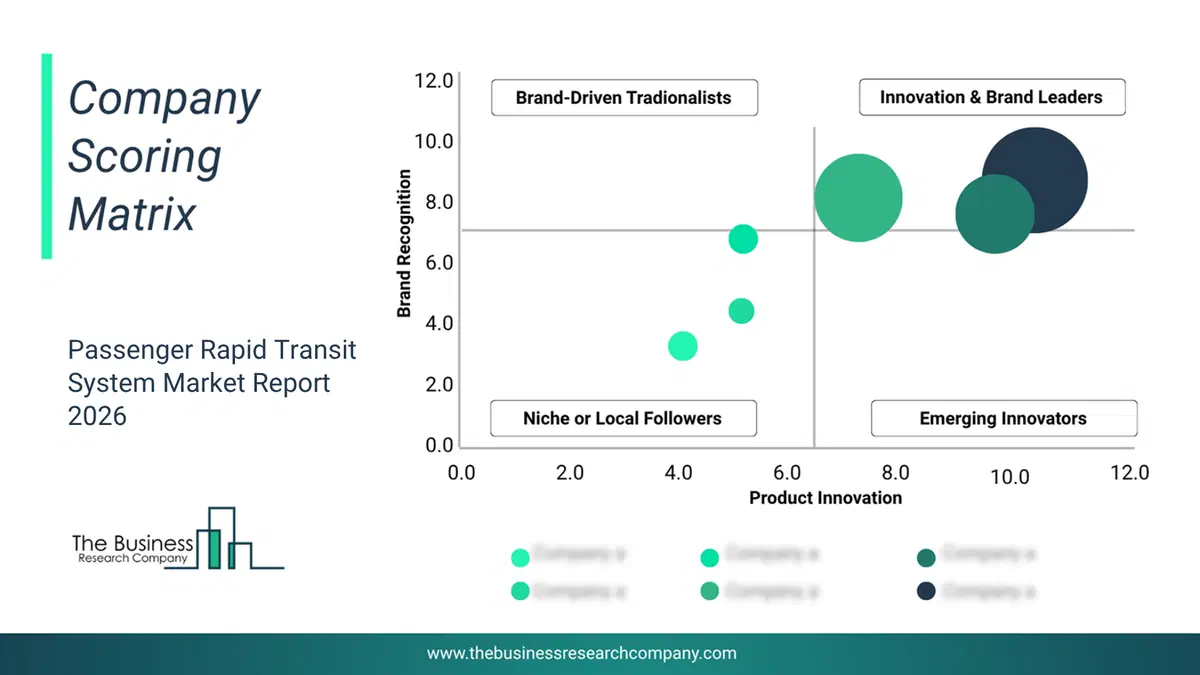
This chart maps companies by product innovation and brand strength, with bubble size indicating relative revenue, helping identify market leaders, challengers, and niche players. This is an illustrative chart; the full report provides a complete and accurate competitive analysis.
Global Passenger Rapid Transit System Market Trends and Insights
Major companies operating in the passenger rapid transit system market are focusing on developing innovative technologies such as zero-carbon mobility and smart rail technology to improve the overall performance and sustainability of transit networks. Zero-carbon mobility involves transportation systems powered by sustainable energy sources to eliminate emissions, while smart rail technology uses digital innovations such as AI, IoT, and data analytics to improve operational efficiency, safety, and user experience in rail networks. For instance, in September 2024, CRRC Corporation Limited, a China-based manufacturer of machinery and equipment, launched eco-friendly and intelligent passenger transport solutions. It reduces carbon emissions and enhances efficiency through renewable energy and smart technologies. They offer cleaner, safer, and more energy-efficient travel while improving passenger comfort and urban transit flexibility.What Are Latest Mergers And Acquisitions In The Passenger Rapid Transit System Market?
In May 2025, Hitachi Rail, a Japan-based rail solutions provider, acquired Thales’ Ground Transportation Systems (GTS) business for $1,952.7 million (€1,660 million). With this acquisition, Hitachi Rail aims to strengthen its digital rail signaling and transportation systems portfolio, expand its global footprint in urban and mainline rail markets, and enhance its capabilities in advanced signaling, communications, and traffic management solutions. Thales’ Ground Transportation Systems is a France-based provider of rail signaling, train control, and integrated transportation solutions for metro, mainline, and freight rail networks.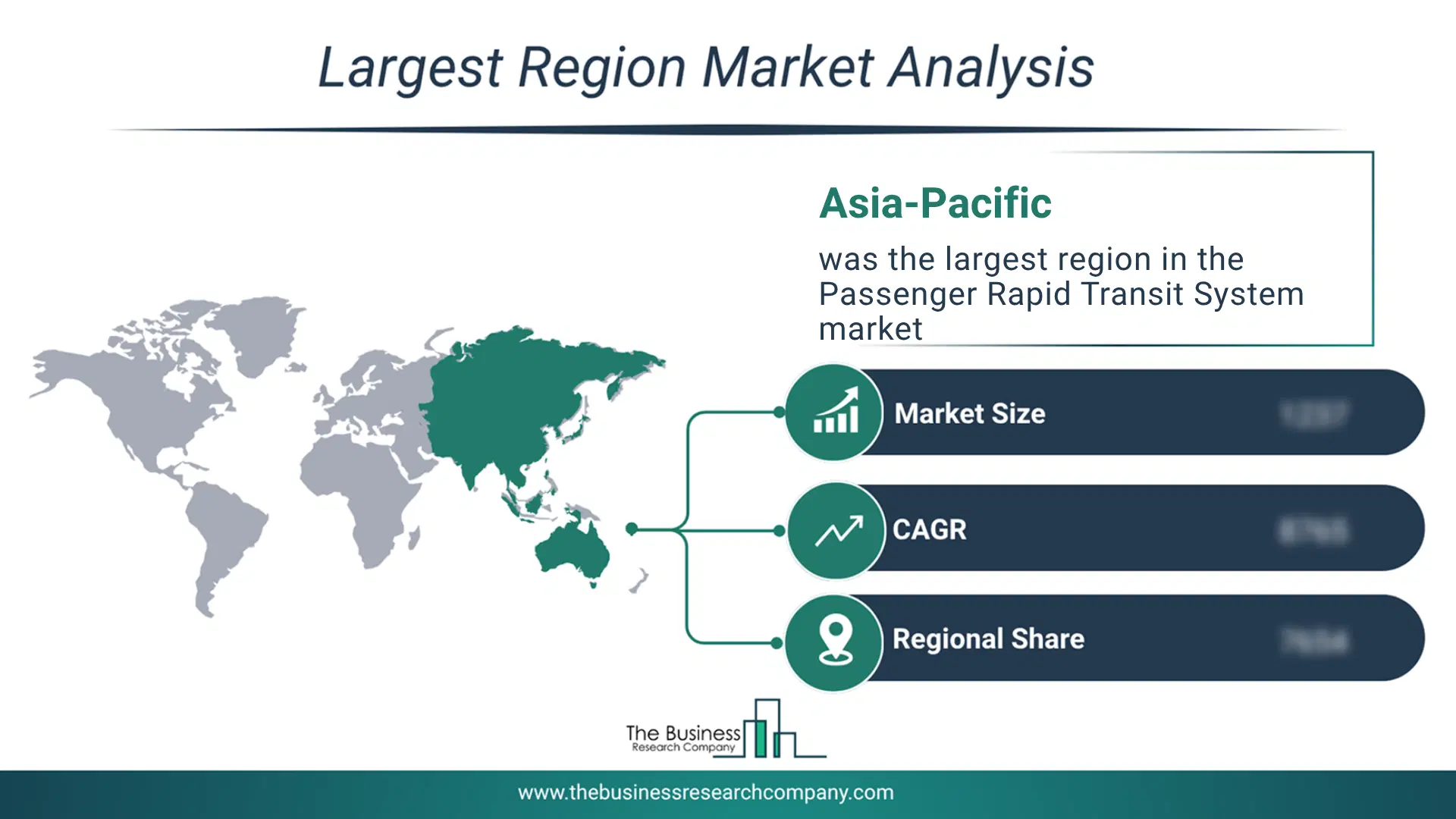
Regional Outlook
Asia-Pacific was the largest region in the passenger rapid transit system market in 2025, and it is expected to be the fastest-growing region in the forecast period. The regions covered in this market report are Asia-Pacific, South East Asia, Western Europe, Eastern Europe, North America, South America, Middle East, Africa. The countries covered in this market report are Australia; Brazil; China; France; Germany; India; Indonesia; Japan; Taiwan; Russia; South Korea; UK; USA; Canada; Italy; Spain.What Defines the Passenger Rapid Transit System Market?
The passenger rapid transit system market includes revenues earned by entities by providing services such as on-demand ride services, ticketing and fare collection, and safety and security monitoring. The market value includes the value of related goods sold by the service provider or included within the service offering. The passenger rapid transit system market also includes sales of automated people movers, monorails, and commuter trains. Values in this market are ‘factory gate’ values, that is the value of goods sold by the manufacturers or creators of the goods, whether to other entities (including downstream manufacturers, wholesalers, distributors and retailers) or directly to end customers. The value of goods in this market includes related services sold by the creators of the goods.How is Market Value Defined and Measured?
The market value is defined as the revenues that enterprises gain from the sale of goods and/or services within the specified market and geography through sales, grants, or donations in terms of the currency (in USD unless otherwise specified). The revenues for a specified geography are consumption values that are revenues generated by organizations in the specified geography within the market, irrespective of where they are produced. It does not include revenues from resales along the supply chain, either further along the supply chain or as part of other products.
This chart presents market attractiveness based on a quantitative evaluation of growth, competition, strategic alignment, and risk, offering a clear view of opportunity areas for decision-making. This chart is for illustrative purposes; the full report contains the complete analysis.

This chart highlights the Total Addressable Market (TAM) by estimating the maximum revenue opportunity using an assumption-driven approach, supporting strategic planning and opportunity sizing across markets. The chart is illustrative; the full report provides a more comprehensive analysis.
What Key Data and Analysis Are Included in the Passenger Rapid Transit System Market Report 2026?
The passenger rapid transit system market research report is one of a series of new reports from The Business Research Company that provides market statistics, including Market Report 2026?global market size, regional shares, competitors with the market share, detailed market segments, market trends and opportunities, and any further data you may need to thrive in the passenger rapid transit system Market Report 2026? The market research report delivers a complete perspective of everything you need, with an in-depth analysis of the current and future state of the Market Report 2026?Passenger Rapid Transit System Market Report Forecast Analysis
| Report Attribute | Details |
|---|---|
| Market Size Value In 2026 | $66.32 billion |
| Revenue Forecast In 2030 | $86.91 billion |
| Growth Rate | CAGR of 7.3% from 2026 to 2030 |
| Base Year For Estimation | 2025 |
| Actual Estimates/Historical Data | 2020-2025 |
| Forecast Period | 2026 - 2030 - 2030 |
| Market Representation | Revenue in USD Billion and CAGR from 2026 to 2030 |
| Segments Covered | Type, Component, Application |
| Regional Scope | Asia-Pacific, Western Europe, Eastern Europe, North America, South America, Middle East, Africa |
| Country Scope | The countries covered in the report are Australia, Brazil, China, France, Germany, India, Indonesia, Japan, Taiwan, Russia, South Korea, UK, USA, Canada, Italy, Spain. |
| Key Companies Profiled | CRRC Corporation Limited, Mitsubishi Heavy Industries Ltd., Alstom SA, Kawasaki Heavy Industries Ltd., Siemens Mobility GmbH, Keolis Group, Transmashholding, Stadler Rail AG, Construcciones y Auxiliar de Ferrocarriles S.A., RATP Dev, ComfortDelGro Corporation Limited, Vectus Intelligent Transport Solutions, Hitachi Rail Limited, Titagarh Rail Systems Limited, Doppelmayr Cable Car, 2getthere Technologies B.V., Transdev Group, Ultra Global PRT, skyTran Inc., POMA Group |
| Customization Scope | Request for Customization |
| Pricing And Purchase Options | Explore Purchase Options |