

Passive Optical Network Equipment Market Report 2026
Global Outlook – By Component (Wavelength Division Multiplexer And De-Multiplexer, Optical Filters, Optical Power Splitters, Optical Cables, Optical Line Terminal (OLT), Optical Network Terminal (ONT)), By Structure (Ethernet Passive Optical Network (EPON) Equipment, Gigabit Passive Optical Network (GPON) Equipment), By Application (Fiber To The Home (FTTH), Fiber To The Building (FTTB), Fiber To The Curb (FTTC), Other Applications), By End-use (Residential, Commercial, Industrial, Government And Education) – Market Size, Trends, Strategies, and Forecast to 2030
Passive Optical Network Equipment Market Overview
• Passive Optical Network Equipment market size has reached to $23.3 billion in 2025 • Expected to grow to $38.45 billion in 2030 at a compound annual growth rate (CAGR) of 10.5% • Growth Driver: Rising Demand For High-speed Broadband Networks Growth In Passive Optical Network (PON) Equipment • Market Trend: Advancements In Fiber Optic Technologies In Passive Optical Network (PON) Equipment • North America was the largest region in 2025 and Asia-Pacific is the fastest growing region.What Is Covered Under Passive Optical Network Equipment Market?
Passive optical network (PON) equipment refers to the components and devices used in a passive optical network, which is a fiber-optic telecommunications technology for delivering broadband network access to end-users. PONs use point-to-multipoint topology and optical splitters to transmit signals in both the upstream and downstream directions. The main types of passive optical network equipment are wavelength division multiplexers and demultiplexers, optical filters, optical power splitters, optical cables, optical line terminal (OLT), and optical network terminal (ONT). Wavelength division multiplexer and demultiplexer (WDM) refers to a technology used in optical fiber communications to enable the simultaneous transmission of multiple optical signals over a single fiber optic cable. The various structures include ethernet passive optical network (EPON) equipment and gigabit passive optical network (GPON) equipment. These are utilized in various applications, primarily fiber to the home (FTTH), fiber to the building (FTTB), fiber to the curb (FTTC), and others, and are used by various end users, including residential, commercial, industrial, and government and education.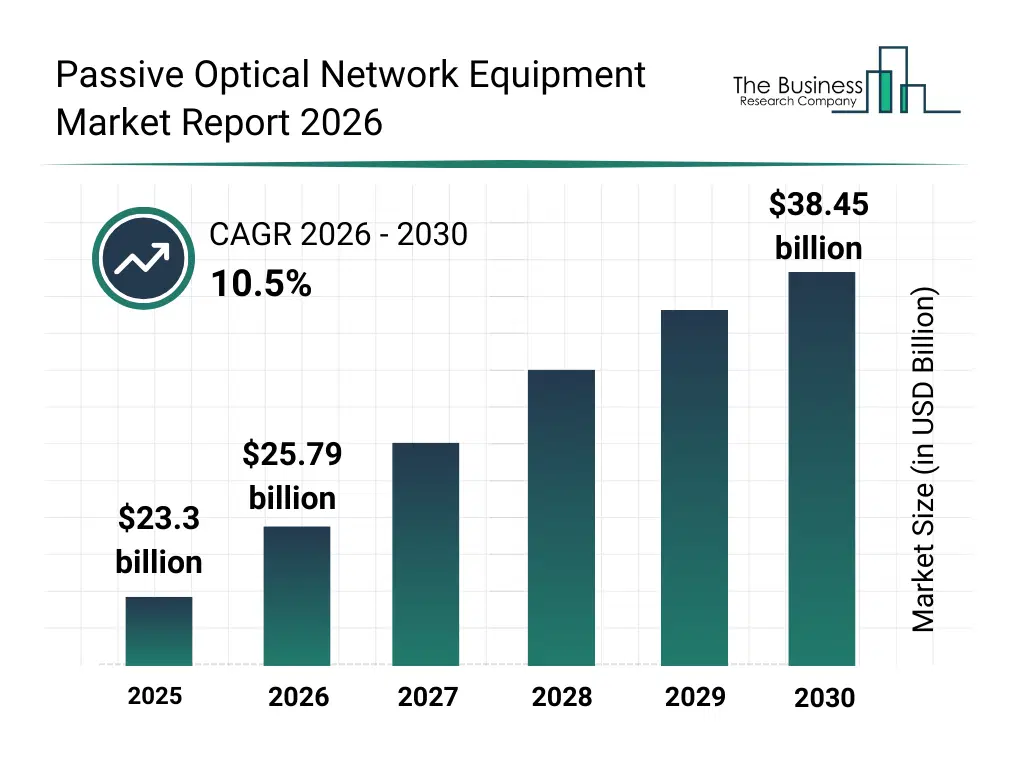
What Is The Passive Optical Network Equipment Market Size and Share 2026?
The passive optical network equipment market size has grown rapidly in recent years. It will grow from $23.3 billion in 2025 to $25.79 billion in 2026 at a compound annual growth rate (CAGR) of 10.7%. The growth in the historic period can be attributed to limited broadband infrastructure, rising demand for high-speed internet, early adoption of fiber optic technologies, growth in residential broadband, increasing commercial connectivity needs.What Is The Passive Optical Network Equipment Market Growth Forecast?
The passive optical network equipment market size is expected to see rapid growth in the next few years. It will grow to $38.45 billion in 2030 at a compound annual growth rate (CAGR) of 10.5%. The growth in the forecast period can be attributed to expansion of ftth and fttb networks, deployment of gpon and epon solutions, adoption of advanced wavelength division multiplexing, growth in government and industrial fiber applications, increasing demand for high-speed and reliable broadband. Major trends in the forecast period include deployment of gpon and epon olts, integration of optical network terminals (ont), fiber-to-the-home (ftth) implementation, use of coarse and dense wavelength division multiplexers, advanced optical power splitters and filters.
Global Passive Optical Network Equipment Market Segmentation
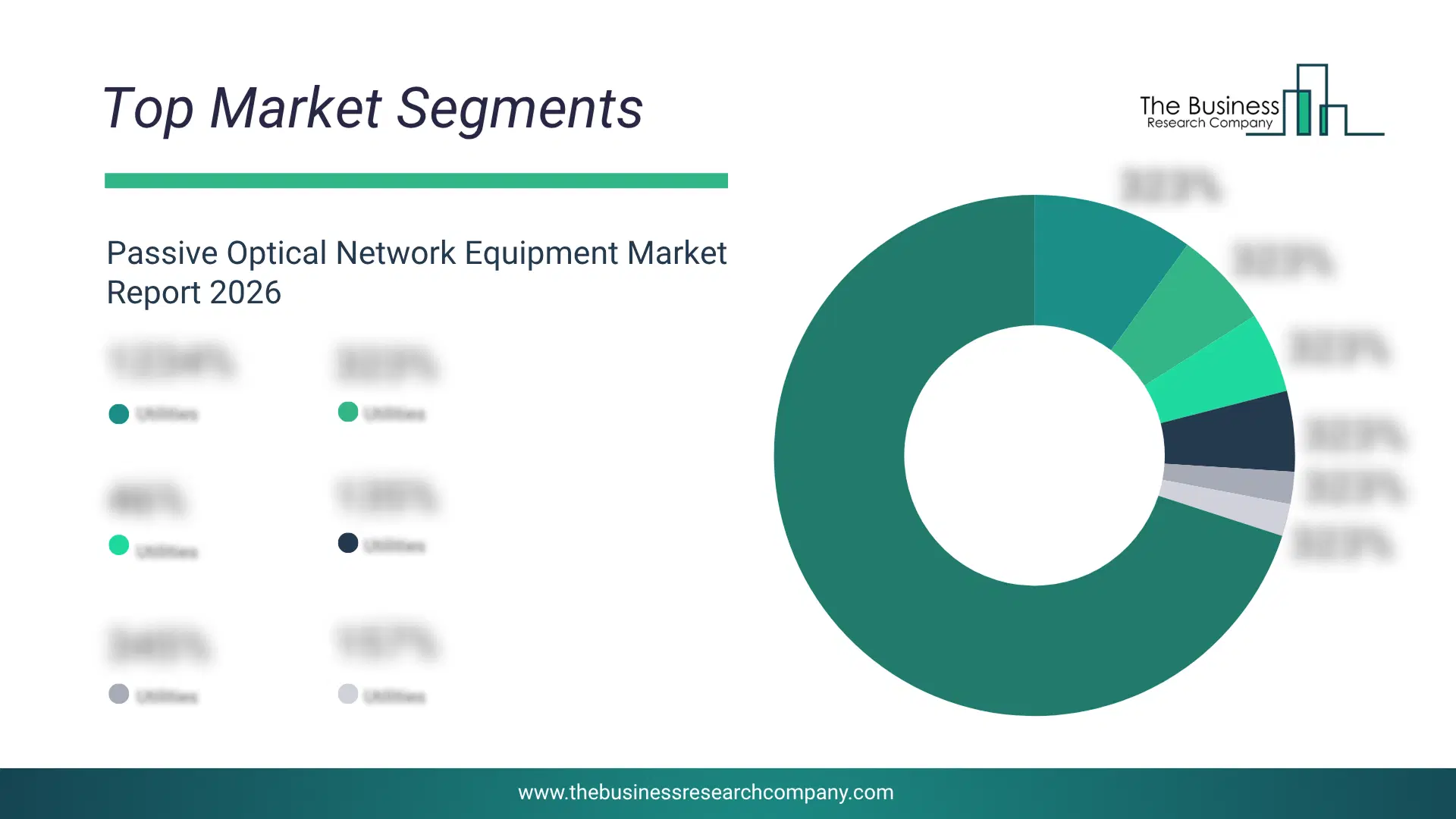
1) By Component: Wavelength Division Multiplexer And De-Multiplexer, Optical Filters, Optical Power Splitters, Optical Cables, Optical Line Terminal (OLT), Optical Network Terminal (ONT) 2) By Structure: Ethernet Passive Optical Network (EPON) Equipment, Gigabit Passive Optical Network (GPON) Equipment 3) By Application: Fiber To The Home (FTTH), Fiber To The Building (FTTB), Fiber To The Curb (FTTC), Other Applications 4) By End-use: Residential, Commercial, Industrial, Government And Education Subsegments: 1) By Wavelength Division Multiplexer and De-Multiplexer: Coarse Wavelength Division Multiplexer (CWDM), Dense Wavelength Division Multiplexer (DWDM) 2) By Optical Filters: Bandpass Filters, Edge Filters, Gain Flattening Filters 3) By Optical Power Splitters: Fused Biconical Taper (FBT) Splitters, Planar Lightwave Circuit (PLC) Splitters 4) By Optical Cables: Single-Mode Fiber, Multi-Mode Fiber 5) By Optical Line Terminal (OLT): GPON OLT, EPON OLT, WDM-PON OLT 6) By Optical Network Terminal (ONT): GPON ONT, EPON ONT, XGS-PON ONTWhat Is The Driver Of The Passive Optical Network Equipment Market?
The rising demand for high-speed broadband networks is expected to propel the growth of the passive optical network (PON) equipment market going forward. High-speed broadband networks refer to infrastructure and technologies that enable fast and reliable internet access by transmitting large volumes of data at high speed. The demand for high-speed broadband is increasing due to greater reliance on digital services, remote work, online education, and a growing number of connected devices across modern lifestyles. The PON equipment market supports this trend by delivering efficient fiber-optic infrastructure and components that enable service providers to upgrade network capacity, extend coverage, and improve data transmission speeds. For instance, in July 2023, according to the OECD, fixed broadband subscriptions in December 2023 reached 0.4965 billion across member countries, with high-quality ultra-fast “Gigabit” offers tripling to 14% of fixed subscriptions, and mobile broadband subscriptions rising to 1.86 billion by December 2023 Therefore, the rising demand for high-speed broadband networks is driving the growth of the passive optical network equipment industry.Key Players In The Global Passive Optical Network Equipment Market
Major companies operating in the passive optical network equipment market are Verizon Communications Inc.; AT & T Inc.; Huawei Technologies Co. Ltd.; Intel Corporation; Cisco Systems Inc.; Qualcomm Incorporated; Mitsubishi Electric Corporation; Broadcom Ltd.; Fujitsu Limited; Telefonaktiebolaget LM Ericsson; Nokia Corporation; NEC Corp.; ZTE Corp.; NXP Semiconductors; Motorola Solutions; Marvell Technology Group; FiberHome Telecommunication Technologies Co. Ltd.; Realtek Semiconductor Corp.; Molex LLC; Tellabs Inc.; Zyxel Communications Corp.; Adtran Inc.; Calix Inc.; Dasan Zhone Solutions; Allied Telesis Inc; Ubiquoss Inc; Alphion India Pvt. Ltd
This chart is for illustrative purposes; the full report includes a detailed competitor analysis and comprehensive overview of the top 10 companies in the market.
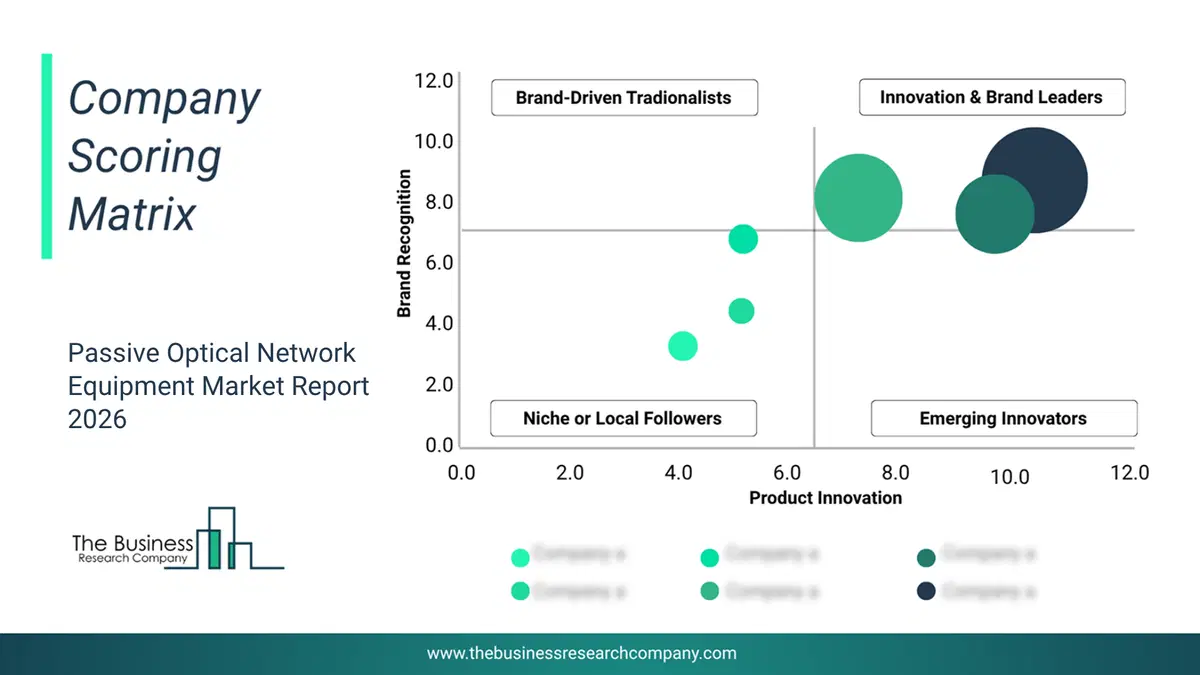
This chart maps companies by product innovation and brand strength, with bubble size indicating relative revenue, helping identify market leaders, challengers, and niche players. This is an illustrative chart; the full report provides a complete and accurate competitive analysis.
Global Passive Optical Network Equipment Market Trends and Insights
Major companies operating in the passive optical network equipment market are focused on developing innovative network solutions, such as XGS-PON (10 gigabit symmetrical passive optical network), to strengthen performance, expand bandwidth capacity, and gain a competitive edge. XGS-PON is an advanced passive optical network standard that enables symmetrical data transmission at speeds of 10 gigabits per second (Gbps), supporting high-speed connectivity for residential, commercial, and wireless backhaul applications. For instance, in February 2024, Precision Optical Technologies Inc., a US-based system engineering and integration company specializing in optical networking products, announced the availability of Open Path, a turnkey solution designed to support a more open and interoperable passive optical network (PON) ecosystem. Open Path simplifies and accelerates PON deployments for multiple system operators (MSOs), service providers, and access network operators by offering a flexible, future-ready platform that supports XGS-PON technologies. The solution enables the convergence of residential, commercial, and wireless services onto a single infrastructure while allowing operators to reuse existing optical distribution network (ODN) resources, reducing deployment complexity and overall costs.What Are Latest Mergers And Acquisitions In The Passive Optical Network Equipment Market?
In April 2024, Belden Inc., a US-based network infrastructure and connectivity solutions company, acquired Precision Optical Technologies, Inc. for approximately US $0.29 billion. Through this acquisition, Belden aims to expand its fiber-infrastructure and broadband solutions portfolio integrating Precision Optical’s optical transceivers and passive optical network (PON) components to serve service providers, telcos, data centres and enterprise customers. Precision Optical Technologies is a US-based supplier of value-added optical transceivers and firmware/software for fiber-optic networks.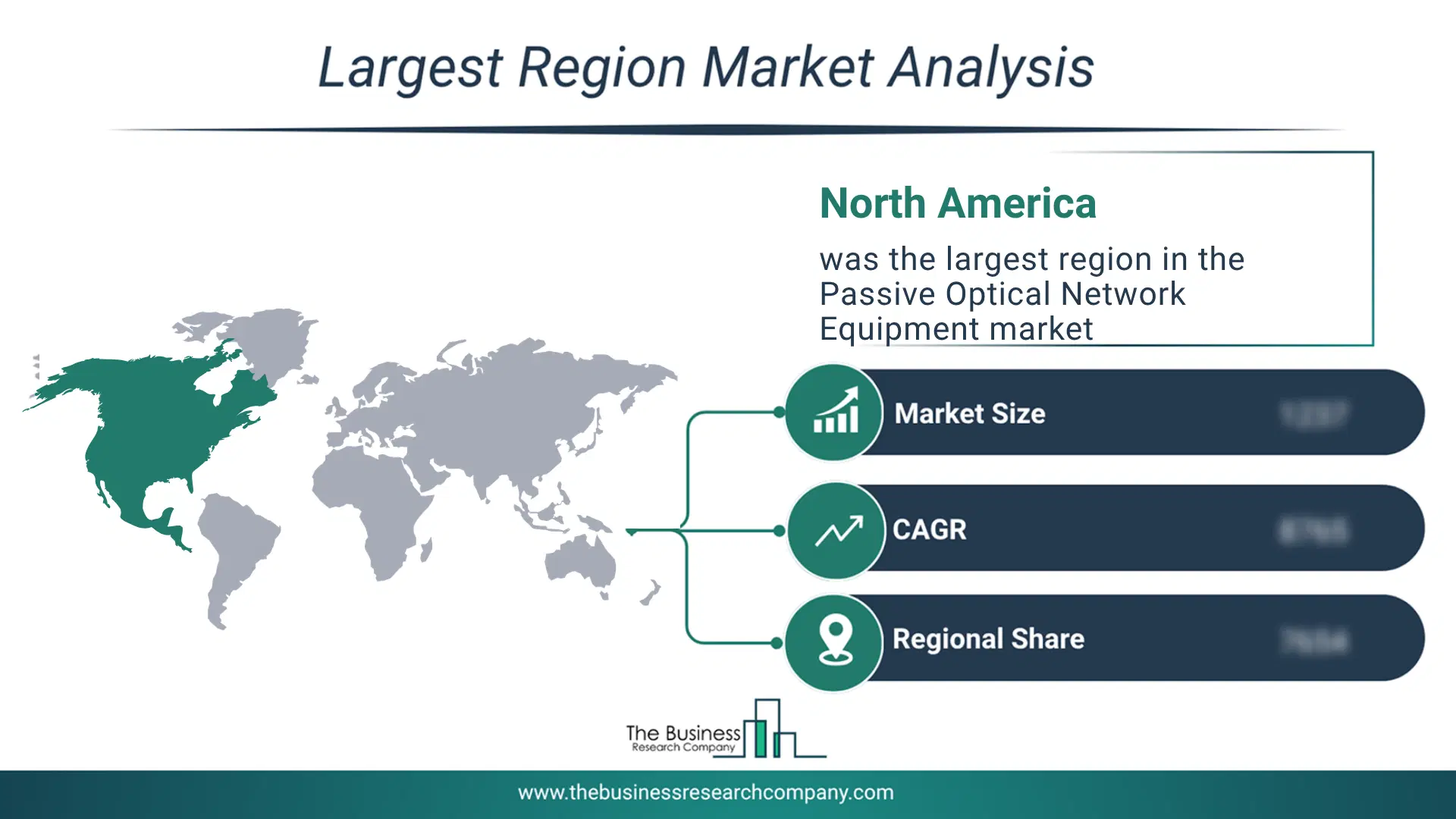
Regional Insights
North America was the largest region in the passive optical network equipment market in 2025. Asia-Pacific is expected to be the fastest-growing region in the forecast period. The regions covered in this market report are Asia-Pacific, South East Asia, Western Europe, Eastern Europe, North America, South America, Middle East, Africa. The countries covered in this market report are Australia, Brazil, China, France, Germany, India, Indonesia, Japan, Taiwan, Russia, South Korea, UK, USA, Canada, Italy, SpainWhat Defines the Passive Optical Network Equipment Market?
The passive optical network equipment market consists of revenues earned by entities by providing services such as installation services, network optimization, troubleshooting, ongoing support, and remote management and monitoring. The market value includes the value of related goods sold by the service provider or included within the service offering. The passive optical network equipment market also includes sales of optical connectors and adapters, wavelength division multiplexing (WDM) components, optical distribution frames, and measurement equipment. Values in this market are ‘factory gate’ values, that is the value of goods sold by the manufacturers or creators of the goods, whether to other entities (including downstream manufacturers, wholesalers, distributors and retailers) or directly to end customers. The value of goods in this market includes related services sold by the creators of the goods.How is Market Value Defined and Measured?
The market value is defined as the revenues that enterprises gain from the sale of goods and/or services within the specified market and geography through sales, grants, or donations in terms of the currency (in USD unless otherwise specified). The revenues for a specified geography are consumption values that are revenues generated by organizations in the specified geography within the market, irrespective of where they are produced. It does not include revenues from resales along the supply chain, either further along the supply chain or as part of other products.
This chart presents market attractiveness based on a quantitative evaluation of growth, competition, strategic alignment, and risk, offering a clear view of opportunity areas for decision-making. This chart is for illustrative purposes; the full report contains the complete analysis.

This chart highlights the Total Addressable Market (TAM) by estimating the maximum revenue opportunity using an assumption-driven approach, supporting strategic planning and opportunity sizing across markets. The chart is illustrative; the full report provides a more comprehensive analysis.
What Key Data and Analysis Are Included in the Passive Optical Network Equipment Market Report 2026?
The passive optical network equipment market research report is one of a series of new reports from The Business Research Company that provides market statistics, including industry global market size, regional shares, competitors with the market share, detailed market segments, market trends and opportunities, and any further data you may need to thrive in the passive optical network equipment industry. The market research report delivers a complete perspective of everything you need, with an in-depth analysis of the current and future state of the industry.Passive Optical Network Equipment Market Report Forecast Analysis
| Report Attribute | Details |
|---|---|
| Market Size Value In 2026 | $25.79 billion |
| Revenue Forecast In 2030 | $38.45 billion |
| Growth Rate | CAGR of 10.5% from 2026 to 2030 |
| Base Year For Estimation | 2025 |
| Actual Estimates/Historical Data | 2020-2025 |
| Forecast Period | 2026 - 2030 |
| Market Representation | Revenue in USD Billion and CAGR from 2026 to 2030 |
| Segments Covered | Component, Structure, Application, End-use |
| Regional Scope | Asia-Pacific, Western Europe, Eastern Europe, North America, South America, Middle East, Africa |
| Country Scope | The Countries Covered In This Market Report Are Australia, Brazil, China, France, Germany, India, Indonesia, Japan, Taiwan, Russia, South Korea, Uk, Usa, Canada, Italy, Spain. |
| Key Companies Profiled | Verizon Communications Inc., AT & T Inc., Huawei Technologies Co. Ltd., Intel Corporation, Cisco Systems Inc., Qualcomm Incorporated, Mitsubishi Electric Corporation, Broadcom Ltd., Fujitsu Limited, Telefonaktiebolaget LM Ericsson, Nokia Corporation, NEC Corp., ZTE Corp., NXP Semiconductors, Motorola Solutions, Marvell Technology Group, FiberHome Telecommunication Technologies Co. Ltd., Realtek Semiconductor Corp., Molex LLC, Tellabs Inc., Zyxel Communications Corp., Adtran Inc., Calix Inc., Dasan Zhone Solutions, Allied Telesis Inc, Ubiquoss Inc, Alphion India Pvt. Ltd |
| Customization Scope | Request for Customization |
| Pricing And Purchase Options | Explore Purchase Options |