

Pathology Slide Quality Control Artificial Intelligence (AI) Market Report 2026
Global Outlook – By Component (Software, Hardware, Services), By Deployment Mode (On-Premises, Cloud-Based), By Application (Quality Assurance Tools (Dedicated Quality Control), Pre-Analytic Quality Control, Analytic Quality Control, Post-Analytic Quality Control, Workflow Management), By End User (Hospitals, Diagnostic Laboratories, Research Institutes, Academic Centers, Other End Users) – Market Size, Trends, Strategies, and Forecast to 2030
Pathology Slide Quality Control Artificial Intelligence (AI) Market Overview
• Pathology Slide Quality Control Artificial Intelligence (AI) market size has reached to $0.53 billion in 2025 • Expected to grow to $1.38 billion in 2030 at a compound annual growth rate (CAGR) of 21% • Growth Driver: Growing Diagnostic Volumes Fueling The Growth Of The Market Due To Rising Demand For Efficient And Accurate Disease Detection • Market Trend: Technological Development In AI-powered Automated Quality Control For Enhanced Digital Pathology Workflows • North America was the largest region in 2025 and Asia-Pacific is the fastest growing region.What Is Covered Under Pathology Slide Quality Control Artificial Intelligence (AI) Market?
Pathology slide quality control artificial intelligence refers to software systems that use advanced algorithms and machine learning techniques to automatically evaluate digital pathology slides for issues such as focus errors, staining variation, artifacts, and tissue coverage before diagnostic review. It is used to ensure consistent slide quality, reduce manual review workload, prevent diagnostic delays, and improve accuracy and efficiency in pathology workflows. The main components of pathology slide quality control artificial intelligence (AI) include software, hardware, and services. Software refers to AI-driven platforms designed to automate the evaluation of pathology slides, detect errors, and ensure consistent quality across pre-analytic, analytic, and post-analytic processes. Different deployment modes include on-premises and cloud-based. Multiple applications cover quality assurance tools (dedicated quality control), pre-analytic quality control, analytic quality control, post-analytic quality control, and workflow management, and they are used by several end-users comprise hospitals, diagnostic laboratories, research institutes, academic centers, and others.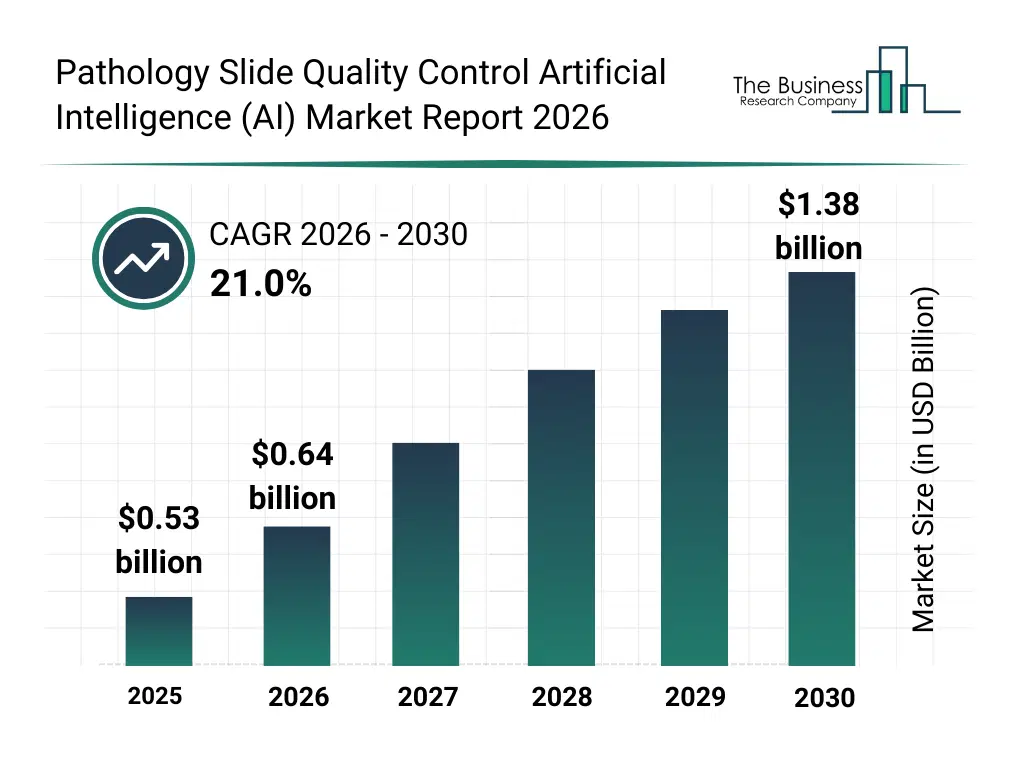
What Is The Pathology Slide Quality Control Artificial Intelligence (AI) Market Size and Share 2026?
The pathology slide quality control artificial intelligence market size has grown exponentially in recent years. It will grow from $0.53 billion in 2025 to $0.64 billion in 2026 at a compound annual growth rate (CAGR) of 21.3%. The growth in the historic period can be attributed to increasing adoption of digital pathology, growing need for accurate diagnostics, rising demand for workflow automation, expansion of laboratory infrastructure, and increasing focus on quality assurance.What Is The Pathology Slide Quality Control Artificial Intelligence (AI) Market Growth Forecast?
The pathology slide quality control artificial intelligence market size is expected to see exponential growth in the next few years. It will grow to $1.38 billion in 2030 at a compound annual growth rate (CAGR) of 21.0%. The growth in the forecast period can be attributed to growing integration of artificial intelligence in pathology, rising investments in artificial intelligence (AI)-based quality control, increasing regulatory support for digital pathology, expansion of cloud-based pathology platforms, and growing adoption of telepathology solutions. Major trends in the forecast period include technology advancements in slide scanning, innovations in artificial intelligence (AI)-based image analysis, developments in automated tissue quality assessment, research and developments in artifact detection, and advancements in stain and section quality evaluation.
Global Pathology Slide Quality Control Artificial Intelligence (AI) Market Segmentation
1) By Component: Software, Hardware, Services 2) By Deployment Mode: On-Premises, Cloud-Based 3) By Application: Quality Assurance Tools (Dedicated Quality Control), Pre-Analytic Quality Control, Analytic Quality Control, Post-Analytic Quality Control, Workflow Management 4) By End User: Hospitals, Diagnostic Laboratories, Research Institutes, Academic Centers, Other End Users Subsegments: 1) By Software: Image Analysis Algorithms, Slide Quality Scoring Tools, Workflow Management Systems, Data Integration Platforms, Cloud Deployment Platforms 2) By Hardware: Digital Slide Scanners, Imaging Workstations, High Resolution Camera Systems, Computational Processing Units, Data Storage Servers 3) By Services: Installation Services, System Integration Services, Technical Support Services, Training And Education Services, Maintenance And Upgradation ServicesWhat Is The Driver Of The Pathology Slide Quality Control Artificial Intelligence (AI) Market?
The expansion of diagnostic testing volumes is expected to propel the growth of the pathology slide quality control artificial intelligence (AI) market going forward. Growing diagnostic volumes refer to the increasing number of medical tests and tissue analyses performed to detect diseases, driven by aging populations and expanded screening programs. Advancements in digital pathology support the management of growing diagnostic volumes, as they necessitate automated tools to maintain accuracy and efficiency in high-throughput environments. Pathology slide quality control artificial intelligence (AI) helps create reliable diagnostic workflows by using machine learning algorithms to automatically identify errors, artifacts, and anomalies in digital slide images before pathologist review. For instance, according to NHS England, the UK-based publicly funded healthcare system, an average of 2.4 million diagnostic tests were delivered per month during 2024/25, representing an 8% increase compared to the previous year. Therefore, the expansion of diagnostic testing volumes is driving the growth of the pathology slide quality control artificial intelligence (AI) industry.Key Players In The Global Pathology Slide Quality Control Artificial Intelligence (AI) Market
Major companies operating in the pathology slide quality control artificial intelligence (AI) market are F. Hoffmann-La Roche Ltd., Philips Healthcare, Leica Biosystems GmbH, XIFIN Inc., Stratipath Inc., PathAI Inc., Owkin Inc., Lunit Inc., Paige.AI Inc., Proscia Inc., Visiopharm A/S, Indica Labs Inc., Inspirata Inc., PreciseDx Inc., Aiforia Technologies Oyj, Ibex Medical Analytics Ltd., Deep Bio Inc., Nucleai Ltd., AIRA Matrix Inc., HistoIndex Pte Ltd., Techcyte Inc.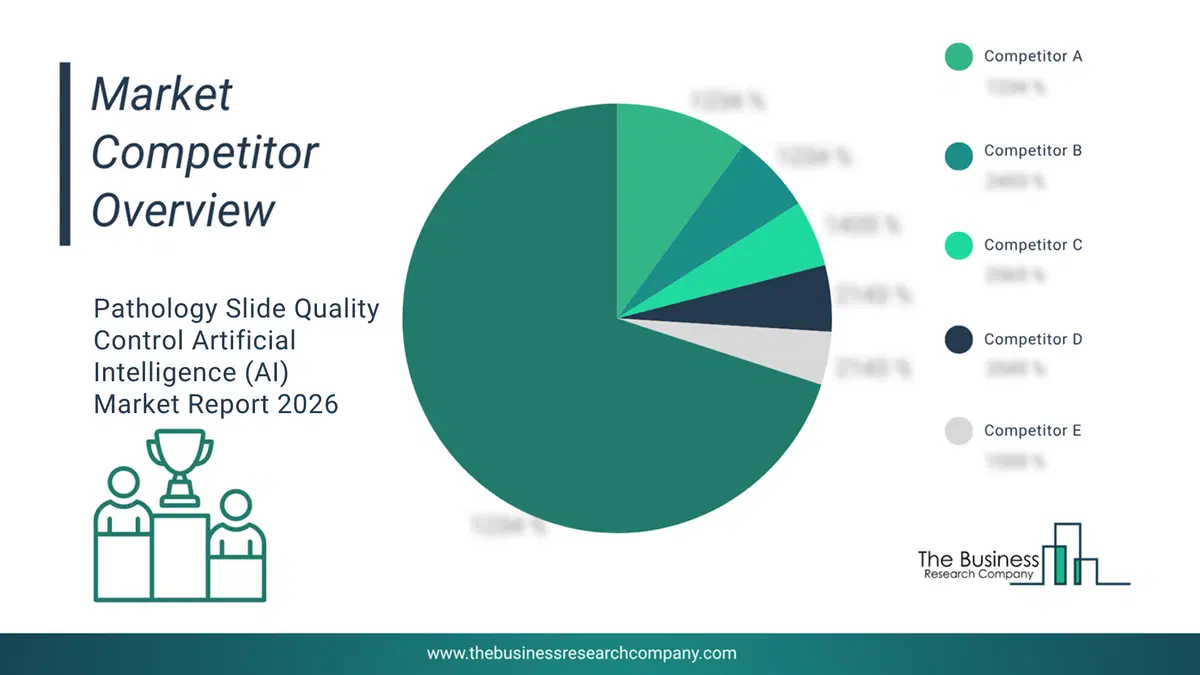
This chart is for illustrative purposes; the full report includes a detailed competitor analysis and comprehensive overview of the top 10 companies in the market.
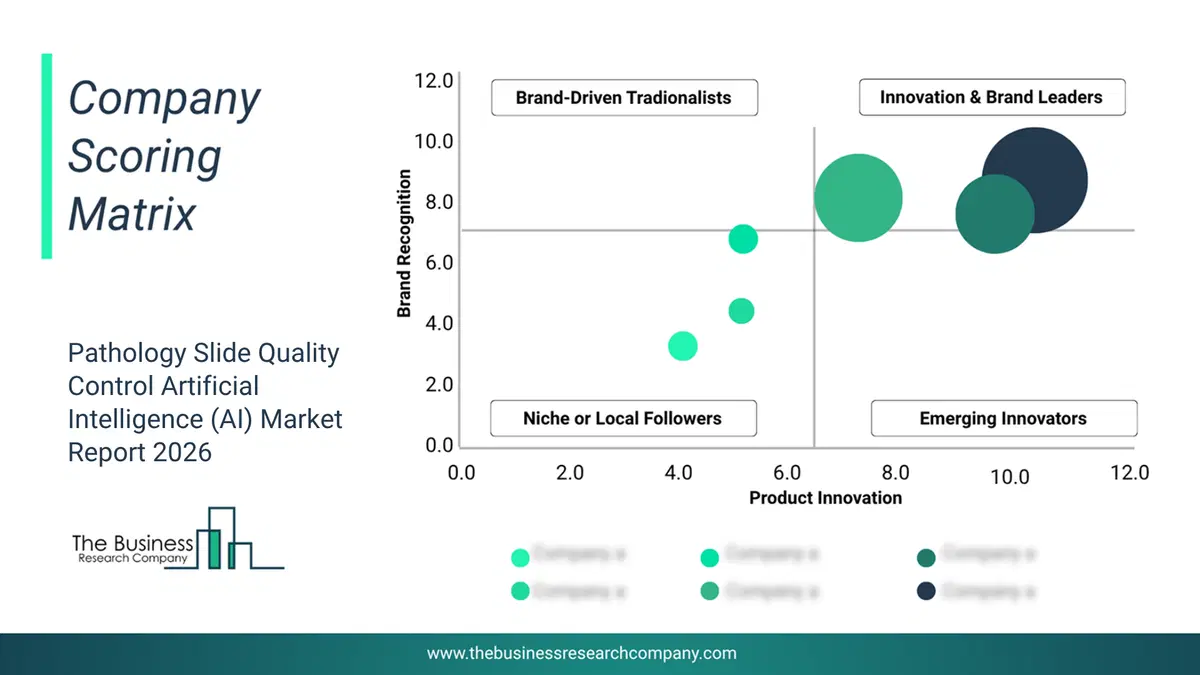
This chart maps companies by product innovation and brand strength, with bubble size indicating relative revenue, helping identify market leaders, challengers, and niche players. This is an illustrative chart; the full report provides a complete and accurate competitive analysis.
Global Pathology Slide Quality Control Artificial Intelligence (AI) Market Trends and Insights
Major companies operating in the pathology slide quality control artificial intelligence (AI) market are focusing on technological development, such as launching AI-powered automated quality control solutions integrated into digital pathology workflows. These technologies utilize deep learning algorithms to automatically identify and flag artifacts, out-of-focus regions, and other quality issues in whole-slide images before pathologist review, thereby reducing manual workload, minimizing diagnostic errors, and ensuring high-quality inputs for subsequent analysis. For instance, in March 2023, Aiosyn B.V., a Netherlands-based medical software company developing AI-powered pathology solutions, launched AiosynQC, an AI-powered automated quality control solution. This modular software integrates with existing digital pathology systems to detect and highlight out-of-focus regions and other artifacts in hematoxylin and eosin (H&E) stained slide images, facilitating a more efficient and accurate quality review process for research and diagnostic laboratories.What Are Latest Mergers And Acquisitions In The Pathology Slide Quality Control Artificial Intelligence (AI) Market?
In August 2025, Tempus AI Inc., a US-based technology company specializing in artificial intelligence for precision medicine, acquired Paige for approximately $81.25 million. With this acquisition, Tempus AI Inc. sought to expand its digital pathology portfolio and strengthen its market position in AI-driven precision medicine by integrating Paige's extensive dataset of millions of digitized pathology slides and advanced AI applications into its multimodal data library. Paige is a US-based AI company specializing in digital pathology solutions and clinical AI applications for cancer diagnosis and treatment planning.
Regional Insights
North America was the largest region in the pathology slide quality control artificial intelligence market in 2025. Asia-Pacific is expected to be the fastest-growing region in the forecast period. The regions covered in this market report are Asia-Pacific, South East Asia, Western Europe, Eastern Europe, North America, South America, Middle East, Africa. The countries covered in this market report are Australia, Brazil, China, France, Germany, India, Indonesia, Japan, Taiwan, Russia, South Korea, UK, USA, Canada, Italy, Spain.What Defines the Pathology Slide Quality Control Artificial Intelligence (AI) Market?
The pathology slide quality control artificial intelligence market consists of revenues earned by entities by providing services such as automated slide quality assessment, focus and blur detection, staining consistency evaluation, artifact identification, and pre-diagnostic slide validation. The market value includes the value of related goods sold by the service provider or included within the service offering. The pathology slide quality control artificial intelligence market also includes sales of artificial intelligence-powered quality control software, digital pathology analysis platforms, slide assessment algorithms, workflow integration tools, and quality reporting modules. Values in this market are ‘factory gate’ values, that is, the value of goods sold by the manufacturers or creators of the goods, whether to other entities (including downstream manufacturers, wholesalers, distributors, and retailers) or directly to end customers. The value of goods in this market includes related services sold by the creators of the goods.How is Market Value Defined and Measured?
The market value is defined as the revenues that enterprises gain from the sale of goods and/or services within the specified market and geography through sales, grants, or donations in terms of the currency (in USD unless otherwise specified). The revenues for a specified geography are consumption values that are revenues generated by organizations in the specified geography within the market, irrespective of where they are produced. It does not include revenues from resales along the supply chain, either further along the supply chain or as part of other products.
This chart presents market attractiveness based on a quantitative evaluation of growth, competition, strategic alignment, and risk, offering a clear view of opportunity areas for decision-making. This chart is for illustrative purposes; the full report contains the complete analysis.

This chart highlights the Total Addressable Market (TAM) by estimating the maximum revenue opportunity using an assumption-driven approach, supporting strategic planning and opportunity sizing across markets. The chart is illustrative; the full report provides a more comprehensive analysis.
What Key Data and Analysis Are Included in the Pathology Slide Quality Control Artificial Intelligence (AI) Market Report 2026?
The pathology slide quality control artificial intelligence (ai) market research report is one of a series of new reports from The Business Research Company that provides market statistics, including industry global market size, regional shares, competitors with the market share, detailed market segments, market trends and opportunities, and any further data you may need to thrive in the pathology slide quality control artificial intelligence (ai) industry. The market research report delivers a complete perspective of everything you need, with an in-depth analysis of the current and future state of the industry.Pathology Slide Quality Control Artificial Intelligence (AI) Market Report Forecast Analysis
| Report Attribute | Details |
|---|---|
| Market Size Value In 2026 | $0.64 billion |
| Revenue Forecast In 2030 | $1.38 billion |
| Growth Rate | CAGR of 21% from 2026 to 2030 |
| Base Year For Estimation | 2025 |
| Actual Estimates/Historical Data | 2020-2025 |
| Forecast Period | 2026 - 2030 |
| Market Representation | Revenue in USD Billion and CAGR from 2026 to 2030 |
| Segments Covered | Component, Deployment Mode, Application, End User |
| Regional Scope | Asia-Pacific, Western Europe, Eastern Europe, North America, South America, Middle East, Africa |
| Country Scope | The Countries Covered In This Market Report Are Australia, Brazil, China, France, Germany, India, Indonesia, Japan, Taiwan, Russia, South Korea, Uk, Usa, Canada, Italy, Spain. |
| Key Companies Profiled | F. Hoffmann-La Roche Ltd., Philips Healthcare, Leica Biosystems GmbH, XIFIN Inc., Stratipath Inc., PathAI Inc., Owkin Inc., Lunit Inc., Paige.AI Inc., Proscia Inc., Visiopharm A/S, Indica Labs Inc., Inspirata Inc., PreciseDx Inc., Aiforia Technologies Oyj, Ibex Medical Analytics Ltd., Deep Bio Inc., Nucleai Ltd., AIRA Matrix Inc., HistoIndex Pte Ltd., Techcyte Inc. |
| Customization Scope | Request for Customization |
| Pricing And Purchase Options | Explore Purchase Options |