
Patient Digital Twin Platform Market Report 2026
Global Outlook – By Component (Software, Services), By Clinical Application (Sepsis Early Warning, Cardiovascular Surgical Planning, Oncology Treatment Response Prediction, Intensive Care Unit Patient Monitoring, Rare Disease Phenotyping), By Data Input Source (Electronic Health Records, Wearable And Continuous Monitoring Devices, Medical Imaging, Genomics And Multi Omics, Laboratory And Pathology Results), By Deployment Mode (Cloud Based, On Premises, Hybrid), By End User (Hospital Systems, Medical Device Companies, Pharmaceutical Clinical Trials, Insurers And Payers) – Market Size, Trends, Strategies, and Forecast to 2030
Patient Digital Twin Platform Market Overview
• Patient Digital Twin Platform market size has reached to $3.01 billion in 2025 • Expected to grow to $13.28 billion in 2030 at a compound annual growth rate (CAGR) of 34.5% • Growth Driver: Growth Of Personalized Medicine Driving The Market Growth Due To Advancements In Precision Healthcare And Data-Driven Treatment Approaches • Market Trend: Innovation In Digital Twin Technologies For Advanced Patient-Specific Medical Simulation And Treatment Planning • Asia-Pacific was the largest region and fastest growing region.What Is Covered Under Patient Digital Twin Platform Market?
Patient digital twin platform refers to a healthcare technology system that creates a dynamic virtual representation of an individual patient by integrating multi-source health data such as clinical records, imaging outputs, wearable sensor data, and biological information. It uses artificial intelligence, simulation models, and advanced analytics to replicate physiological conditions, monitor health status, and predict disease progression and treatment responses in a virtual environment. It is designed to enable data-driven clinical insights, personalized care planning, and predictive healthcare decision-making. The main components of patient digital twin platform include software and services. Software refers to digital platforms that create and continuously update virtual representations of individual patients by integrating clinical, physiological, imaging, and genomic data to support personalized healthcare decision-making. These platforms are used for clinical applications including sepsis early warning, cardiovascular surgical planning, oncology treatment response prediction, intensive care unit patient monitoring, and rare disease phenotyping and integrate data from electronic health records, wearable and continuous monitoring devices, medical imaging, genomics and multi omics, and laboratory and pathology results. They are deployed through cloud based, on premises, and hybrid models and are utilized by end users including hospital systems, medical device companies, pharmaceutical clinical trials, and insurers and payers.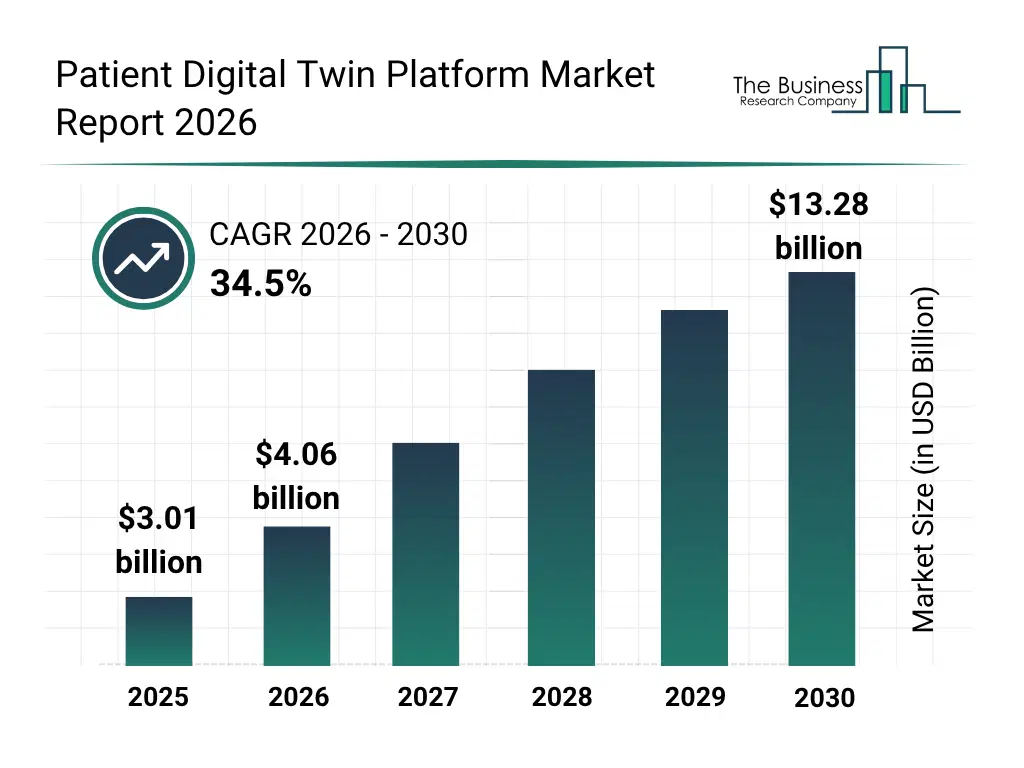
What Is The Patient Digital Twin Platform Market Size and Share 2026?
The patient digital twin platform market size has grown exponentially in recent years. It will grow from $3.01 billion in 2025 to $4.06 billion in 2026 at a compound annual growth rate (CAGR) of 34.9%. The growth in the historic period can be attributed to growing adoption of electronic health records, rising prevalence of chronic diseases, increasing healthcare digitalization, expanding use of wearable health monitoring devices, advancements in medical imaging technologies.What Is The Patient Digital Twin Platform Market Growth Forecast?
The patient digital twin platform market size is expected to see exponential growth in the next few years. It will grow to $13.28 billion in 2030 at a compound annual growth rate (CAGR) of 34.5%. The growth in the forecast period can be attributed to expanding adoption of precision medicine, increasing integration of genomics and multi omics data, rising investment in AI-enabled healthcare platforms, growing demand for predictive and preventive healthcare, increasing adoption of virtual clinical trials. Major trends in the forecast period include growing adoption of patient-specific predictive disease modeling, increasing use of virtual clinical simulation for treatment planning, rising integration of multi-source healthcare data platforms, expansion of personalized patient monitoring and longitudinal health tracking, increasing use of digital twin platforms in clinical research and drug development.
Global Patient Digital Twin Platform Market Segmentation
2) By Clinical Application: Sepsis Early Warning, Cardiovascular Surgical Planning, Oncology Treatment Response Prediction, Intensive Care Unit Patient Monitoring, Rare Disease Phenotyping 3) By Data Input Source: Electronic Health Records, Wearable And Continuous Monitoring Devices, Medical Imaging, Genomics And Multi Omics, Laboratory And Pathology Results 4) By Deployment Mode: Cloud Based, On Premises, Hybrid 5) By End User: Hospital Systems, Medical Device Companies, Pharmaceutical Clinical Trials, Insurers And Payers Subsegments: 1) By Software: Patient Digital Twin Modeling Software, Clinical Simulation And Predictive Analytics Software, Personalized Treatment Planning Software, Healthcare Data Integration And Visualization Software 2) By Services: Implementation And Integration Services, Consulting And Digital Twin Strategy Services, Training And Support Services, Managed Patient Digital Twin Platform ServicesWhat Are The Drivers Of The Patient Digital Twin Platform Market?
The growth of personalized medicine is expected to propel the growth of the patient digital twin platform market going forward. Personalized medicine is a healthcare approach that tailors medical treatments, interventions, and preventive strategies to an individual’s unique genetic makeup, lifestyle, environmental factors, and health data. The adoption of personalized medicine is increasing due to advancements in genomics, as improved genetic sequencing technologies enable healthcare providers to identify individual genetic variations, predict disease risks, and develop targeted treatments tailored to each patient's unique biological profile. Patient digital twin platforms enable personalized medicine by integrating clinical, genetic, and real-time health data into virtual patient models, allowing healthcare providers to predict treatment outcomes and deliver more precise, individualized care. For instance, in February 2024, according to the Personalized Medicine Coalition, a US-based non-profit organization, in 2023, the FDA approved 16 new personalized therapies for patients with rare diseases, marking a substantial rise from the six approvals recorded in 2022. Therefore, the growth of personalized medicine is driving the growth of the patient digital twin platform industry. The increasing adoption of electronic health records is expected to propel the growth of the patient digital twin platform market going forward. Electronic health records refer to digital systems that capture, store, and exchange patient health information across healthcare providers to support clinical decision-making and care coordination. The adoption of electronic health records is increasing due to healthcare systems prioritizing interoperability requirements and regulatory mandates that push providers toward digitized, standardized patient data management. Patient digital twin platform leverages electronic health records (EHRs) to integrate patient data into dynamic virtual models, enabling predictive analytics, personalized treatment, real-time monitoring, and improved clinical decision-making. For instance, in July 2024, according to the European Commission, a Belgium-based organization, the Digital Decade e Health Indicator Study found that EU average access to electronic health records (EHR) via online portals rose to 79%, up from 72% in 2022. Therefore, the increasing adoption of electronic health records is driving the growth of patient digital twin platform industry.Key Players In The Global Patient Digital Twin Platform Market
Major companies operating in the patient digital twin platform market are Microsoft Corporation, International Business Machines Corporation, NVIDIA Corporation, Oracle Corporation, Siemens Healthineers AG, Koninklijke Philips N.V., GE HealthCare Technologies Inc., Atos SE, Dassault Systèmes SE, SAS Institute Inc., ANSYS Inc., CitiusTech Healthcare Technology Private Limited, Medidata Solutions Inc., Altair Engineering Inc., Brainlab AG, Twin Health Inc., Owkin Inc., Recursion Pharmaceuticals Inc., Unlearn AI Inc., PrediSurge SAS, Virtonomy GmbH, 4DMedical Limited.
This chart is for illustrative purposes; the full report includes a detailed competitor analysis and comprehensive overview of the top 10 companies in the market.
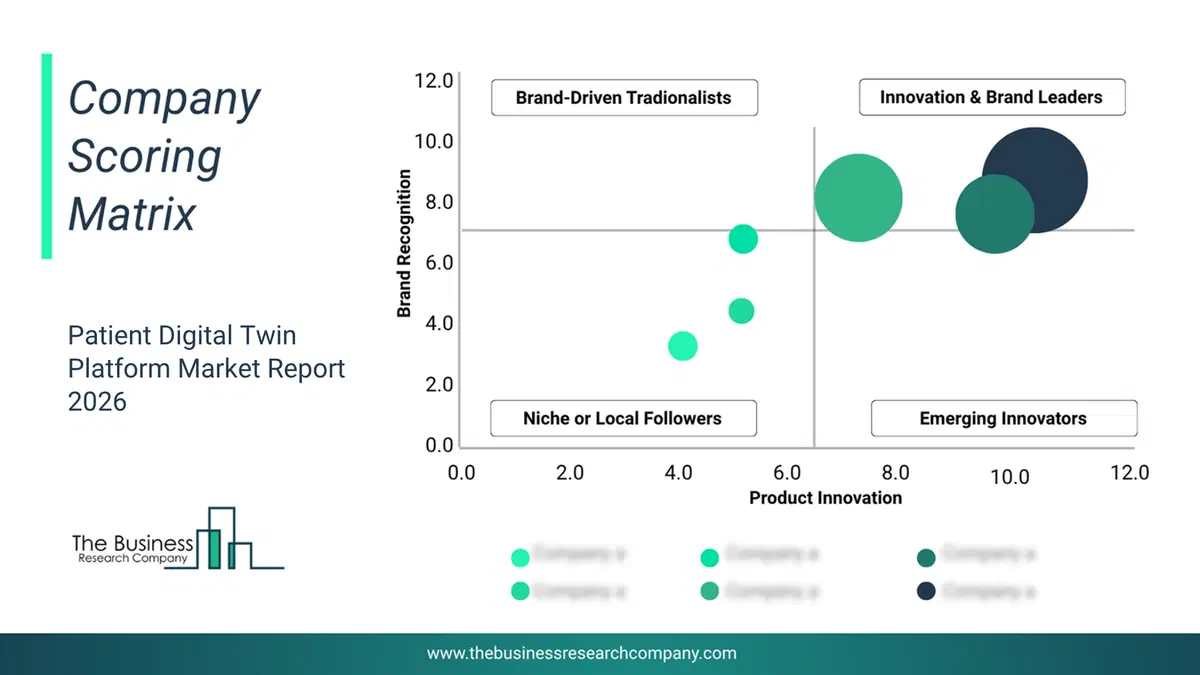
This chart maps companies by product innovation and brand strength, with bubble size indicating relative revenue, helping identify market leaders, challengers, and niche players. This is an illustrative chart; the full report provides a complete and accurate competitive analysis.
Global Patient Digital Twin Platform Market Trends and Insights
Major companies operating in the patient digital twin platform market are focusing on developing innovative solutions, such as AI-powered medical digital twin simulation platforms, to enhance precision medicine, improve clinical decision-making, and enable personalized treatment planning. AI-powered medical digital twin simulation platforms are healthcare systems that use AI, medical imaging, and 3D modeling to create real-time virtual replicas of patients, and they help clinicians by enabling disease simulation, treatment planning, and surgical guidance, improving diagnostic accuracy, reducing risks, and supporting personalized precision medicine. For instance, in March 2024, MEDICAL IP Co. Ltd., a South Korea-based medical AI and digital twin solutions company, unveiled its MEDIP AI digital twin simulation platform at NVIDIA GTC 2024, which leverages NVIDIA Omniverse to generate real-time 3D virtual models of patient anatomy from CT, MRI, and X-ray imaging data. The platform enables functions such as virtual surgery simulation, blood flow dynamics visualization, and AR/VR-based anatomical exploration, supporting medical education, treatment planning, and personalized healthcare delivery. This innovation reflects the growing adoption of patient-specific digital twin technologies aimed at advancing precision medicine and improving healthcare outcomes.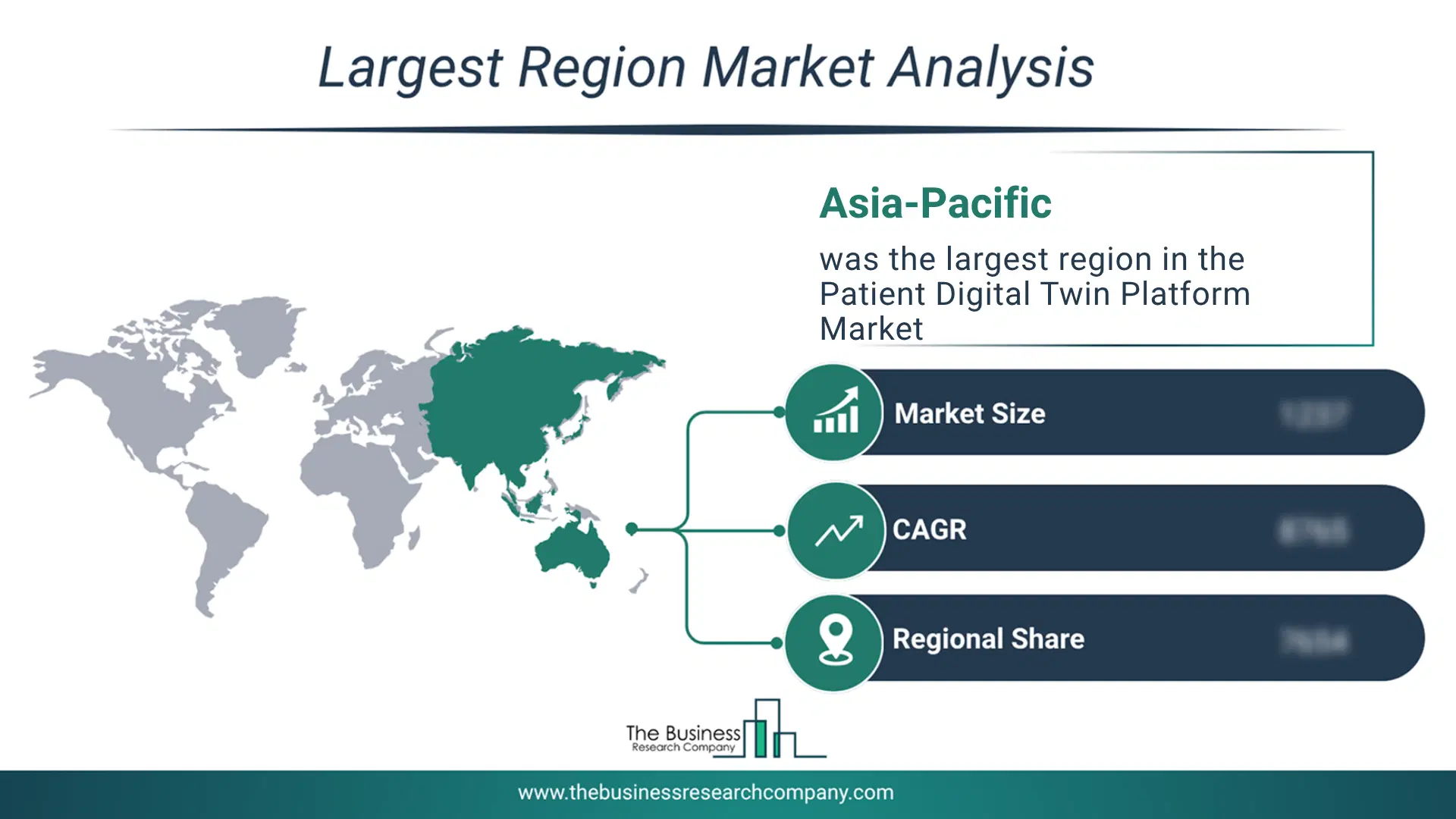
Regional Outlook/Insights
Asia-Pacific was the largest region in the patient digital twin platform market in 2025. Asia-Pacific is expected to be the fastest-growing region in the forecast period. The regions covered in this market report are Asia-Pacific, South East Asia, Western Europe, Eastern Europe, North America, South America, Middle East, Africa. The countries covered in this market report are Australia, Brazil, China, France, Germany, India, Indonesia, Japan, Taiwan, Russia, South Korea, UK, USA, Canada, Italy, Spain.What Defines the Patient Digital Twin Platform Market?
The patient digital twin platform market includes revenues earned by entities by providing services such as platform development, system deployment, AI model training, predictive analytics, healthcare data integration, simulation-based modeling, and cloud-based digital health infrastructure services. The market value includes the value of related goods sold by the service provider or included within the service offering. Only goods and services traded between entities or sold to end consumers are included.How is Market Value Defined and Measured?
The market value is defined as the revenues that enterprises gain from the sale of goods and/or services within the specified market and geography through sales, grants, or donations in terms of the currency (in USD unless otherwise specified). The revenues for a specified geography are consumption values that are revenues generated by organizations in the specified geography within the market, irrespective of where they are produced. It does not include revenues from resales along the supply chain, either further along the supply chain or as part of other products.
This chart presents market attractiveness based on a quantitative evaluation of growth, competition, strategic alignment, and risk, offering a clear view of opportunity areas for decision-making. This chart is for illustrative purposes; the full report contains the complete analysis.

This chart highlights the Total Addressable Market (TAM) by estimating the maximum revenue opportunity using an assumption-driven approach, supporting strategic planning and opportunity sizing across markets. The chart is illustrative; the full report provides a more comprehensive analysis.
What Key Data and Analysis Are Included in the Patient Digital Twin Platform Market Report 2026?
The patient digital twin platform market research report is one of a series of new reports from The Business Research Company that provides patient digital twin platform market statistics, including patient digital twin platform industry global market size, regional shares, competitors with a patient digital twin platform market share, detailed patient digital twin platform market segments, market trends and opportunities, and any further data you may need to thrive in the patient digital twin platform industry. This patient digital twin platform market research report delivers a complete perspective of everything you need, with an in-depth analysis of the current and future scenario of the industry.Patient Digital Twin Platform Market Report Forecast Analysis
| Report Attribute | Details |
|---|---|
| Market Size Value In 2026 | $4.06 billion |
| Revenue Forecast In 2030 | $13.28 billion |
| Growth Rate | CAGR of 34.5% from 2026 to 2030 |
| Base Year For Estimation | 2025 |
| Actual Estimates/Historical Data | 2020-2025 |
| Forecast Period | 2026 - 2030 |
| Market Representation | Revenue in USD Billion and CAGR from 2026 to 2030 |
| Segments Covered | Component, Clinical Application, Data Input Source, Deployment Mode, End User |
| Regional Scope | Asia-Pacific, Western Europe, Eastern Europe, North America, South America, Middle East, Africa |
| Country Scope | The countries covered in the report are Australia, Brazil, China, France, Germany, India, Indonesia, Japan, Taiwan, Russia, South Korea, UK, USA, Canada, Italy, Spain. |
| Key Companies Profiled | Microsoft Corporation, International Business Machines Corporation, NVIDIA Corporation, Oracle Corporation, Siemens Healthineers AG, Koninklijke Philips N.V., GE HealthCare Technologies Inc., Atos SE, Dassault Systèmes SE, SAS Institute Inc., ANSYS Inc., CitiusTech Healthcare Technology Private Limited, Medidata Solutions Inc., Altair Engineering Inc., Brainlab AG, Twin Health Inc., Owkin Inc., Recursion Pharmaceuticals Inc., Unlearn AI Inc., PrediSurge SAS, Virtonomy GmbH, 4DMedical Limited. |
| Customization Scope | Request for Customization |
| Pricing And Purchase Options | Explore Purchase Options |