
Payment Card Issuance Software Market Report 2026
Global Outlook – By Component (Software, Services), By Technology Adoption (Legacy Technologies, Emerging Technologies), By Deployment Mode (On-Premises, Cloud), By Enterprise Size (Small And Medium Enterprises, Large Enterprises), By End-User (Banks, Financial Institutions, Retail, Government, Other End-Users) – Market Size, Trends, Strategies, and Forecast to 2030
Payment Card Issuance Software Market Overview
• Payment Card Issuance Software market size has reached to $2.07 billion in 2025 • Expected to grow to $3.53 billion in 2030 at a compound annual growth rate (CAGR) of 11.2% • Growth Driver: Increasing Digitization Of Banking Services Fueling The Growth Of The Market Due To Rising Demand For Secure And Real-Time Digital Transactions • Market Trend: Technological Advancements In Cloud-Native Payment Processing Systems Fuels The Market Growth Due To Enhanced Scalability, Speed, And Real-Time Card Management Capabilities • North America was the largest region in 2025 and Aisa-Pacific is the fastest growing region.Market Gains By 2030 – Top Opportunities By Segment
Market Gain identifies the most promising market opportunities by highlighting the segments or products expected to generate the highest incremental revenue growth over the next five years.
What Is Covered Under Payment Card Issuance Software Market?
Payment card issuance software refers to a digital platform that enables banks, fintechs, and card issuers to design, personalize, issue, and manage debit, credit, or prepaid cards either physically or digitally. This software integrates with core banking systems and payment networks to streamline the end-to-end card lifecycle. It is widely used to accelerate card delivery, enhance security, and reduce operational costs in the payment industry. The main components of payment card issuance software are software and services. Software refers to the core platforms that banks and card issuers use to design, personalize, activate, and manage payment cards, digital or physical. The different technology adoptions include legacy technologies and emerging technologies with various deployment modes, such as on-premises and cloud. The different enterprise sizes include small and medium enterprises and large enterprises and are used by several end-users, including banks, financial institutions, retail, government, and others.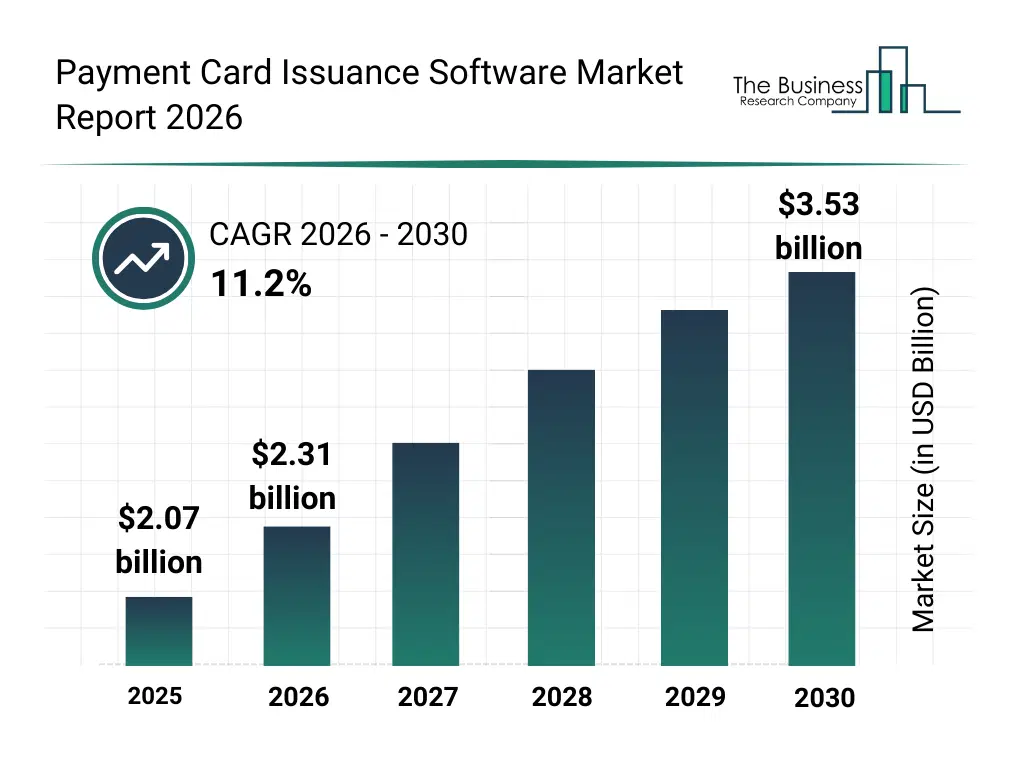
What Is The Payment Card Issuance Software Market Size and Share 2026?
The payment card issuance software market size has grown rapidly in recent years. It will grow from $2.07 billion in 2025 to $2.31 billion in 2026 at a compound annual growth rate (CAGR) of 11.6%. The growth in the historic period can be attributed to expansion of electronic payment adoption, growth of banking digitization initiatives, increasing issuance of debit and prepaid cards, rising fintech platform adoption, demand for faster card delivery.What Is The Payment Card Issuance Software Market Growth Forecast?
The payment card issuance software market size is expected to see rapid growth in the next few years. It will grow to $3.53 billion in 2030 at a compound annual growth rate (CAGR) of 11.2%. The growth in the forecast period can be attributed to increasing demand for embedded finance solutions, rising adoption of cloud-native banking software, expansion of digital wallets and virtual cards, growing focus on real-time fraud analytics, increased regulatory compliance automation. Major trends in the forecast period include increasing adoption of instant digital card issuance, rising demand for cloud-based card management platforms, growing integration with core banking and payment networks, expansion of virtual and tokenized card offerings, enhanced focus on fraud prevention and compliance automation.
Global Payment Card Issuance Software Market Segmentation
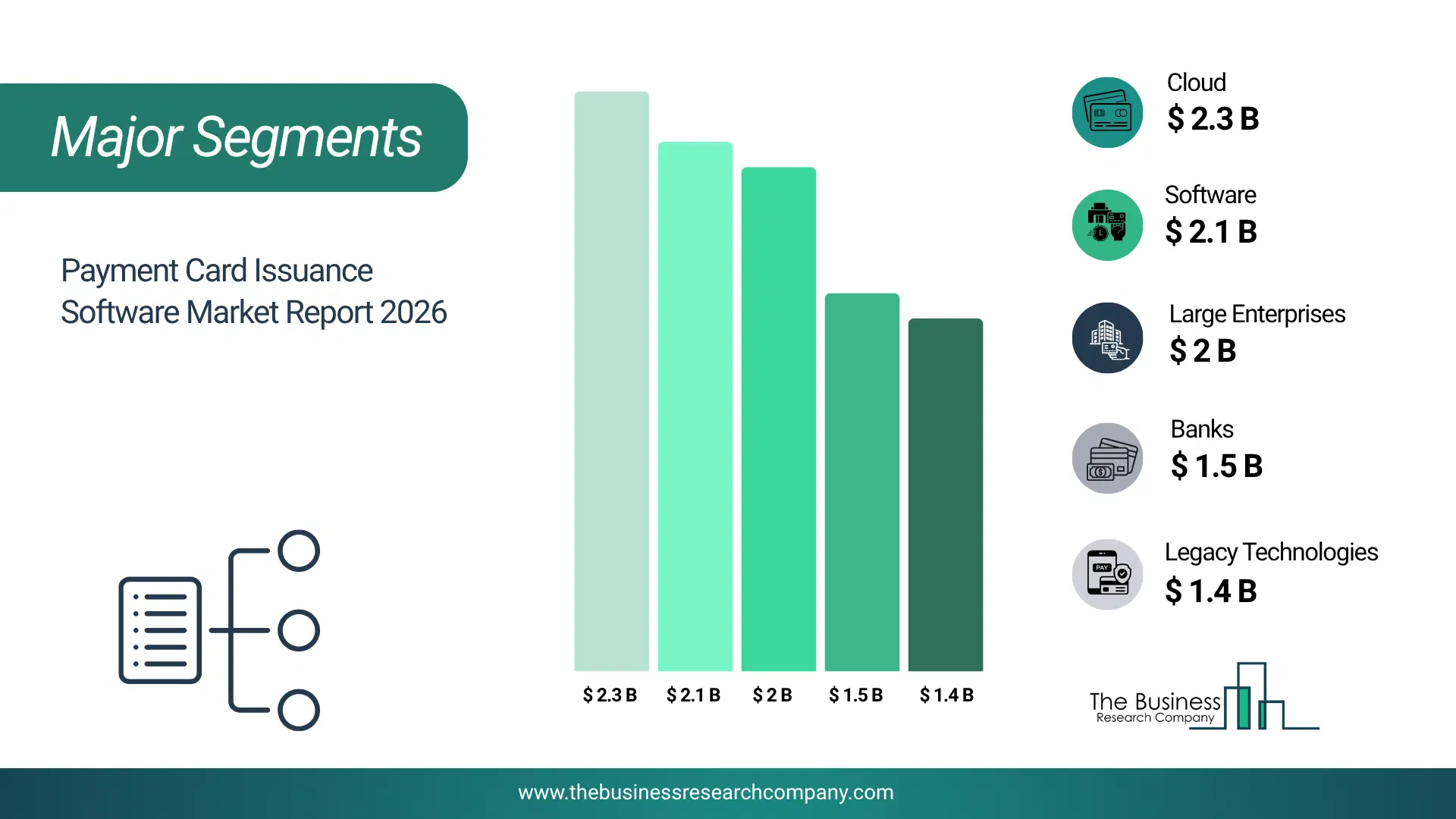
1) By Component: Software, Services 2) By Technology Adoption: Legacy Technologies, Emerging Technologies 3) By Deployment Mode: On-Premises, Cloud 4) By Enterprise Size: Small And Medium Enterprises, Large Enterprises 5) By End-User: Banks, Financial Institutions, Retail, Government, Other End-Users Subsegments: 1) By Software: Card Management Software, Card Printing Software, Card Personalization Software, Europay, MasterCard, And Visa Card Issuance Software, Instant Issuance Software, Central Issuance Software, Digital Card Issuance Platforms 2) By Services: Consulting Services, Integration And Deployment Services, Support And Maintenance Services, Managed Services, Training And Education Services The top segments in the payment card issuance software market will be: • Large Enterprises will reach $2028.54 Million by 2030. • Cloud will reach $2311.75 Million by 2030. • Software will reach $2113.99 Million by 2030. • Legacy Technologies will reach $1446.55 Million by 2030. • Banks will reach $1530 Million by 2030.What Is The Driver Of The Payment Card Issuance Software Market?
The increasing digitization of banking services is expected to propel the growth of the payment card issuance software market going forward. Digitization of banking services refers to the transformation of traditional banking operations into digital formats, enabling customers to access financial services through online and mobile platforms with greater convenience, speed, and security. The rise in digitization of banking services is due to increasing consumer demand for convenient, real-time, and contactless financial transactions across mobile and online platforms. Digitization of banking services supports the growth of payment card issuance software by increasing the demand for secure, automated, and real-time issuance of physical and virtual cards to enable seamless digital transactions. For instance, in July 2024, according to Banque de France, a France-based central bank, the total number of non-cash payments in the euro area rose by 6.6%, reaching 71.2 billion in the second half of 2023, compared to the same period in 2022. Therefore, the increasing digitization of banking services is driving the growth of the payment card issuance software industry.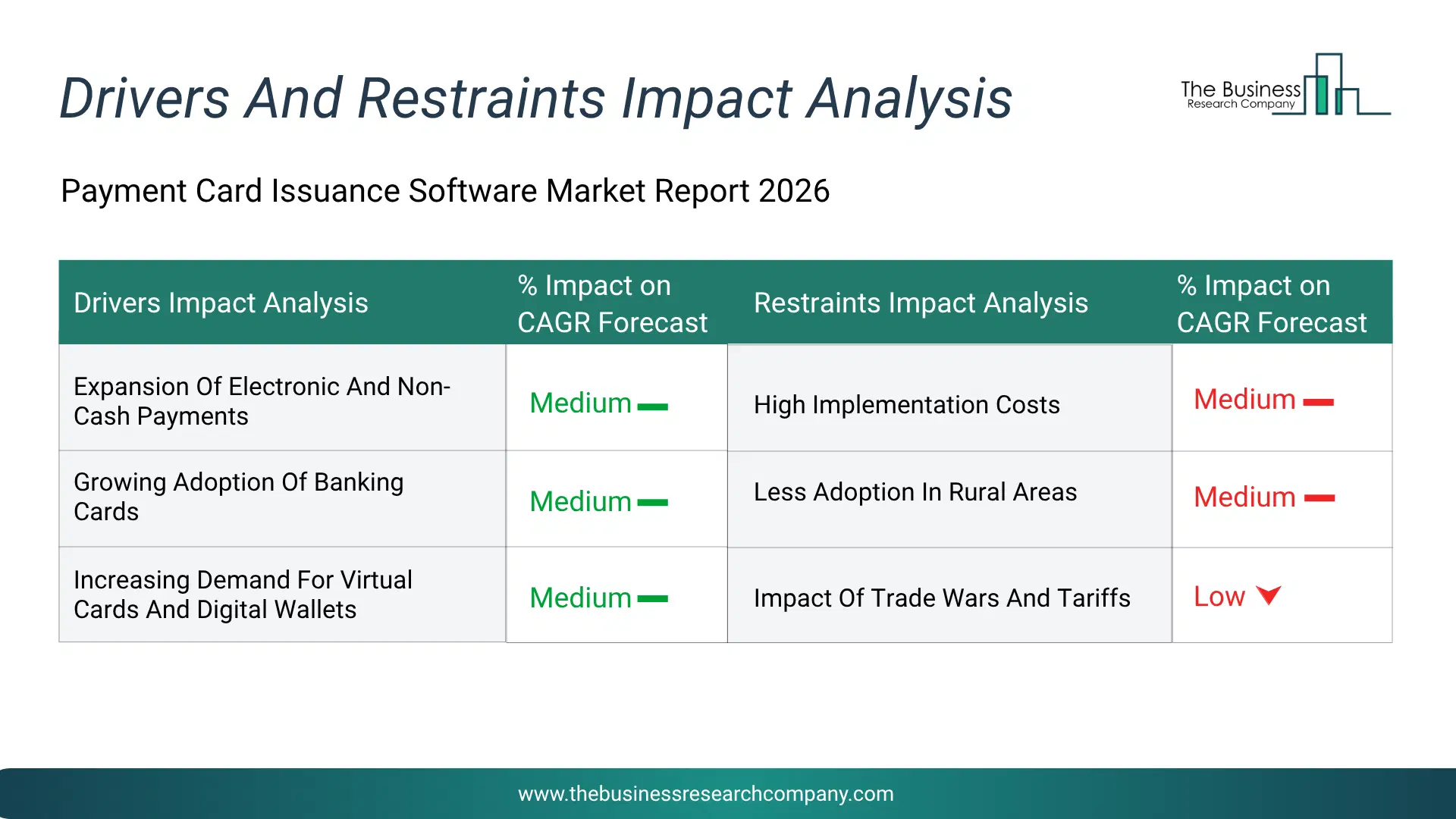
Infographic Chart Showing Key Market Drivers Analysis And Restraints For Payment Card Issuance Software Market
The chart presents an impact analysis of key drivers and restraints, quantifying their relative influence on the market's growth rate and helping assess the balance between growth enablers and limiting factors. This chart offers a high-level perspective; the full report contains more detailed insights.
How Will The Drivers Impact Growth In The Global Payment Card Issuance Software Market?
• Expansion Of Electronic And Non-Cash Payments (Medium) – During the forecast period, the expansion of electronic and non-cash payments is expected to propel expansion in the payment card issuance software market. The shift from cash to digital payments, including point-of-sale transactions, online purchases and peer-to-peer transfers, requires robust software to issue, activate and manage electronic payment instruments. Financial institutions and payment processors rely on automated systems to ensure seamless integration with digital infrastructure and maintain real-time transaction security. As businesses and consumers increasingly adopt non-cash methods, platforms that support multi-channel payment issuance, instant provisioning and compliance with regulatory standards become critical for smooth operations. The expansion of electronic and non-cash payments growth contribution during the forecast period in 2025 is 1.5%. • Growing Adoption Of Banking Cards (Medium) – During the forecast period, the growing adoption of banking cards is expected to propel expansion in the payment card issuance software market. With a growing number of consumers holding multiple banking cards for credit, debit and prepaid purposes, institutions must efficiently manage issuance, lifecycle and personalized settings for each cardholder. Advanced software enables banks to handle bulk issuance, card replacements and customized reward programs while maintaining strong security protocols. This streamlines operational workflows, reduces manual errors and enhances customer satisfaction, making digital card management solutions an integral component for institutions serving a diverse cardholder base. The growing adoption of banking cards growth contribution during the forecast period in 2025 is 1.3%. • Increasing Demand For Virtual Cards And Digital Wallets (Medium) – During the forecast period, the increasing demand for virtual cards and digital wallets is expected to propel expansion in the payment card issuance software market. The popularity of virtual cards and mobile wallets necessitates platforms capable of generating instant digital credentials, managing tokenization and linking them to user accounts securely. Consumers increasingly prefer contactless and app-based payment options, prompting financial entities to adopt automated issuance and monitoring systems. These platforms facilitate seamless integration with e-commerce, fintech apps and loyalty programs, while providing real-time reporting, fraud prevention and personalized controls, thereby supporting widespread adoption of digital-first payment methods. The increasing demand for virtual cards and digital wallets growth contribution during the forecast period in 2025 is 1.0%. • Surge In Financial Literacy (Low) – During the forecast period, the surge in financial literacy is expected to propel the expansion in the payment card issuance software market. As individuals gain a stronger understanding of financial concepts, budgeting and credit management, they are more likely to use debit, credit and prepaid cards for daily transactions. This financial awareness encourages banks and fintechs to streamline issuance processes, offering secure and user-friendly solutions that support efficient card management. Enhanced literacy also drives demand for value-added features such as spending analytics, rewards tracking and fraud alerts, making card issuance platforms more essential for financial institutions to meet informed consumer expectations. The surge in financial literacy growth contribution during the forecast period in 2025 is 0.5%.How Will The Restraints Impact Growth In The Global Payment Card Issuance Software Market?
• High Implementation Costs (Medium) – During the forecast period, high implementation costs are restricting the growth of the payment card issuance software market. Deploying advanced payment card issuance solutions involves significant upfront investments in software licensing, hardware, integration with banking systems and staff training. Smaller banks and emerging fintechs often face budget constraints, making it challenging to implement comprehensive platforms with features like instant issuance, personalization and fraud management. Ongoing maintenance, security updates and compliance adaptations further add to expenses, limiting adoption among cost-sensitive institutions. Growth affected by the high implementation costs during the forecast period in 2025 is -1.5%. • Less Adoption In Rural Areas (Medium) – During the forecast period, less adoption in rural areas are restricting the growth of the payment card issuance software market. Limited digital infrastructure and lower awareness of electronic payment options in rural and semi-urban regions reduce the penetration of card-based solutions. Financial institutions may hesitate to extend advanced issuance capabilities to these areas due to low transaction volumes and limited internet connectivity. As a result, deployment of sophisticated card management platforms remains concentrated in urban centers, slowing broader uptake across underserved regions. Growth affected by the less adoption in rural areas during the forecast period in 2025 is -1.0%. • Impact Of Trade Wars And Tariffs (Medium) – During the forecast period, the impact of trade wars and tariffs is restricting the growth of the payment card issuance software market. Trade tensions, tariffs and import restrictions on hardware components such as card printers, smart chips and secure terminals increase costs for financial institutions and service providers. Supply chain disruptions can delay deployment and limit access to advanced card technologies. Such geopolitical and economic factors compel organizations to either absorb higher expenses or postpone technology upgrades, affecting the speed and scale of digital card issuance initiatives. Growth affected by the impact of trade wars and tariffs during the forecast period in 2025 is -0.3%.Key Players In The Global Payment Card Issuance Software Market
Major companies operating in the payment card issuance software market are SAP SE, TietoEVRY Corporation, Stripe Inc., ACI Worldwide Inc., Galileo Financial Technologies Inc., Entrust Corporation, Marqeta Inc., Pleo Solutions ApS, Clai Payments AB, Nium Pte. Ltd., MagTek Inc., OpenWay Group, CoreCard Software LLC, TAS Group S.p.A., High Tech Payment Systems Group, Silverlake Symmetri Sdn Bhd, Bento for Business Inc., Harland Clarke Holdings Corp., HST Payment Group Ltd., BankWorld, Matica Technologies AG, NBS Technologies Limited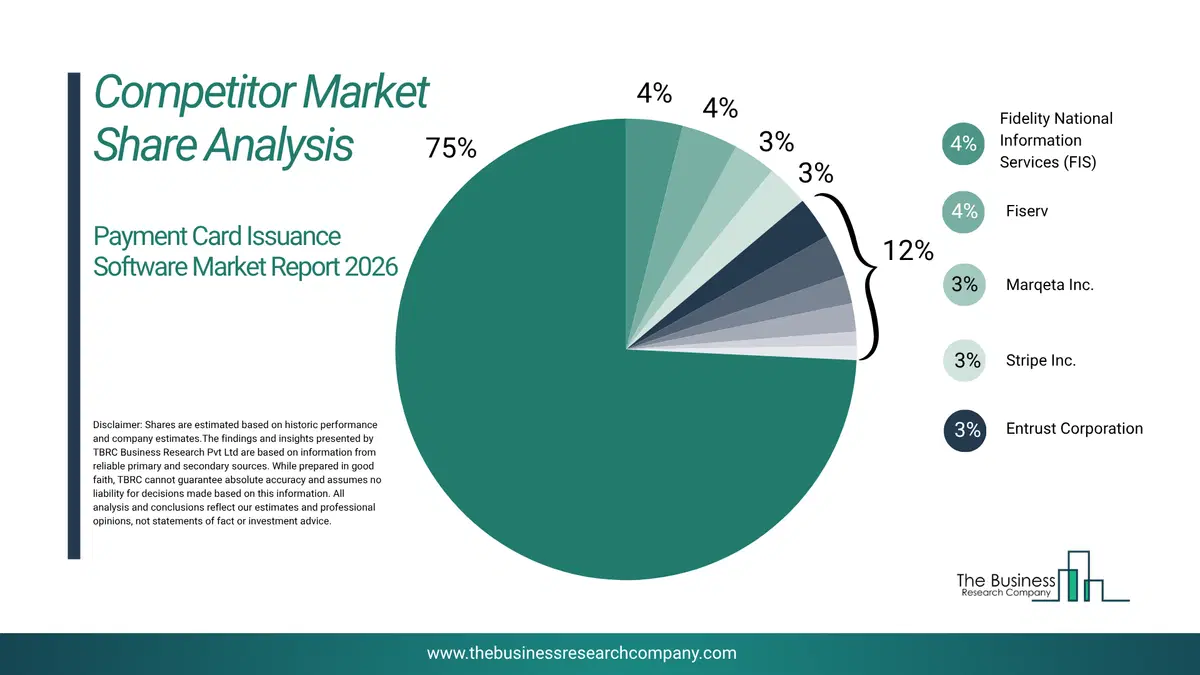
This chart is for illustrative purposes; the full report includes a detailed competitor analysis and comprehensive overview of the top 10 companies in the market.
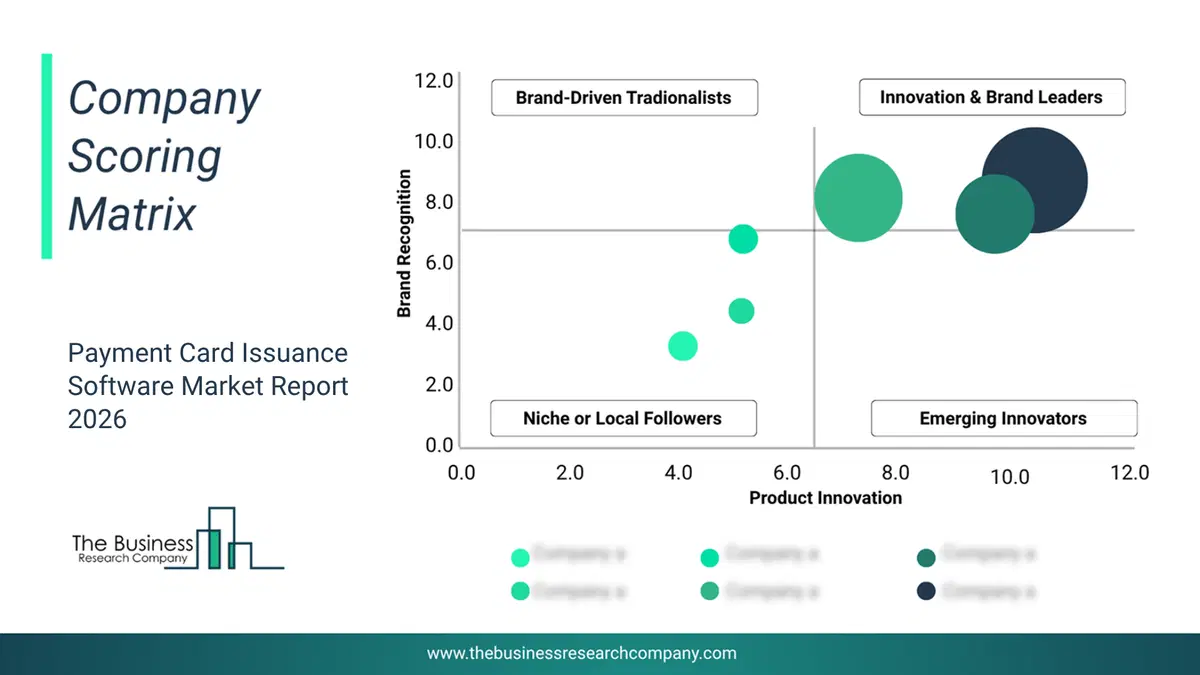
This chart maps companies by product innovation and brand strength, with bubble size indicating relative revenue, helping identify market leaders, challengers, and niche players. This is an illustrative chart; the full report provides a complete and accurate competitive analysis.
Global Payment Card Issuance Software Market Trends and Insights
Major companies operating in the payment card issuance software market are focusing on developing advanced solutions, such as cloud-native payment processing systems, to enhance scalability, speed, and flexibility in issuing and managing payment cards. Cloud-native payment processing platforms refer to systems that are built and deployed entirely in cloud environments, using microservices architecture and containerization to enable real-time scalability, high availability, and seamless integration with digital banking services. For instance, in February 2024, Thought Machine, a UK-based cloud banking technology company, launched Vault Payments, a cloud-native card and payment processing platform designed to advance modern payment card processing capabilities. Vault payments builds on Thought Machine’s core banking platform by introducing a highly flexible and programmable payments engine that allows banks to issue, process, and manage payment cards in real time across multiple schemes and geographies. This new platform offers high performance and customization while catering to the needs of traditional banks, fintechs, and digital-first challengers, allowing them to design differentiated card products and services. It supports integration with various card networks, real-time payment rails, and fraud prevention tools, making it suitable for global financial institutions seeking modern, secure payment infrastructure. By combining modular architecture with operational speed and flexibility, Vault Payments delivers a versatile solution for transforming the digital card issuance and processing landscape.What Are Latest Mergers And Acquisitions In The Payment Card Issuance Software Market?
In February 2023, Marqeta, Inc., a US-based financial technology company, acquired Power Finance for $275 million. With this acquisition, Marqeta aimed to expand its card-issuance technology stack by integrating Power’s customizable credit-card program management capabilities, enabling faster deployment of modern credit products for banks and fintechs. Power Finance, Inc. is a US-based financial technology company that specializes in building configurable credit-card issuance software and APIs that allow businesses to design, launch, and manage credit card programs.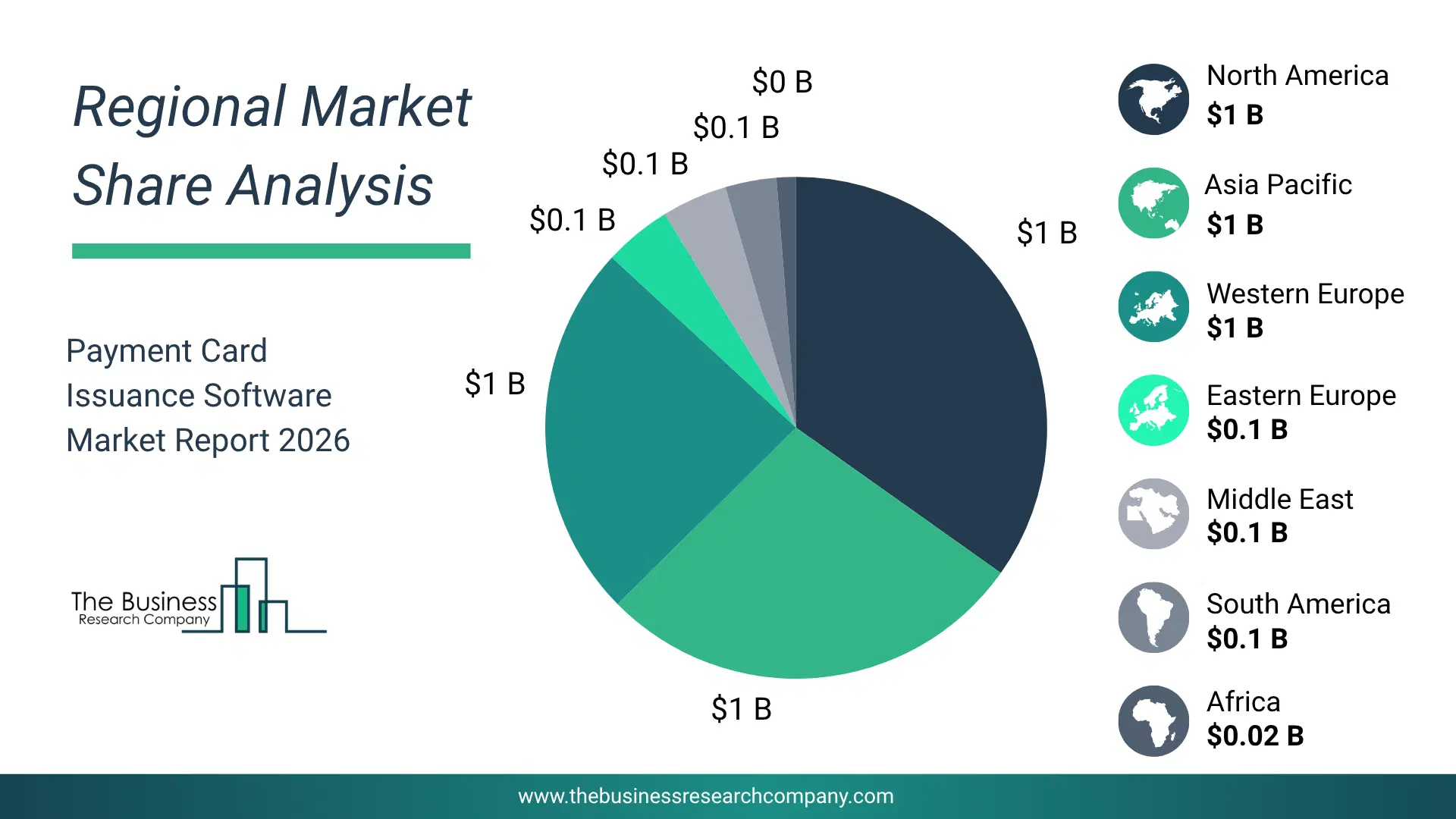
Regional Outlook
North America was the largest region in the payment card issuance software market in 2025. Asia Pacific is expected to be the fastest-growing region in the forecast period. The regions covered in this market report are Asia-Pacific, South East Asia, Western Europe, Eastern Europe, North America, South America, Middle East, Africa. The countries covered in this market report are Australia, Brazil, China, France, Germany, India, Indonesia, Japan, Taiwan, Russia, South Korea, UK, USA, Canada, Italy, Spain.What Defines the Payment Card Issuance Software Market?
The payment card issuance software market consists of revenues earned by entities by providing services such as digital and physical card issuance services, instant card issuance services, and core banking system integration services. The market value includes the value of related goods sold by the service provider or included within the service offering. The payment card issuance software market also includes sales of card printers, card embossers, card encoders, and card lamination machines. Values in this market are ‘factory gate’ values; that is, the value of goods sold by the manufacturers or creators of the goods, whether to other entities (including downstream manufacturers, wholesalers, distributors, and retailers) or directly to end customers. The value of goods in this market includes related services sold by the creators of the goods.How is Market Value Defined and Measured?
The market value is defined as the revenues that enterprises gain from the sale of goods and/or services within the specified market and geography through sales, grants, or donations in terms of the currency (in USD unless otherwise specified). The revenues for a specified geography are consumption values that are revenues generated by organizations in the specified geography within the market, irrespective of where they are produced. It does not include revenues from resales along the supply chain, either further along the supply chain or as part of other products.
This chart presents market attractiveness based on a quantitative evaluation of growth, competition, strategic alignment, and risk, offering a clear view of opportunity areas for decision-making. This chart is for illustrative purposes; the full report contains the complete analysis.

This chart highlights the Total Addressable Market (TAM) by estimating the maximum revenue opportunity using an assumption-driven approach, supporting strategic planning and opportunity sizing across markets. The chart is illustrative; the full report provides a more comprehensive analysis.
What Key Data and Analysis Are Included in the Payment Card Issuance Software Market Report 2026?
The payment card issuance software market research report is one of a series of new reports from The Business Research Company that provides market statistics, including Market Report 2026?global market size, regional shares, competitors with the market share, detailed market segments, market trends and opportunities, and any further data you may need to thrive in the payment card issuance software Market Report 2026? The market research report delivers a complete perspective of everything you need, with an in-depth analysis of the current and future state of the Market Report 2026?Payment Card Issuance Software Market Report Forecast Analysis
| Report Attribute | Details |
|---|---|
| Market Size Value In 2026 | $2.31 billion |
| Revenue Forecast In 2030 | $3.53 billion |
| Growth Rate | CAGR of 11.6% from 2026 to 2030 |
| Base Year For Estimation | 2025 |
| Actual Estimates/Historical Data | 2020-2025 |
| Forecast Period | 2026 - 2030 - 2035 |
| Market Representation | Revenue in USD Billion and CAGR from 2026 to 2030 |
| Segments Covered | Component, Technology Adoption, Deployment Mode, Enterprise Size, End-User |
| Regional Scope | Asia-Pacific, Western Europe, Eastern Europe, North America, South America, Middle East, Africa |
| Country Scope | The countries covered in the report are Australia, Brazil, China, France, Germany, India, Indonesia, Japan, Taiwan, Russia, South Korea, UK, USA, Canada, Italy, Spain. |
| Key Companies Profiled | SAP SE, TietoEVRY Corporation, Stripe Inc., ACI Worldwide Inc., Galileo Financial Technologies Inc., Entrust Corporation, Marqeta Inc., Pleo Solutions ApS, Clai Payments AB, Nium Pte. Ltd., MagTek Inc., OpenWay Group, CoreCard Software LLC, TAS Group S.p.A., High Tech Payment Systems Group, Silverlake Symmetri Sdn Bhd, Bento for Business Inc., Harland Clarke Holdings Corp., HST Payment Group Ltd., BankWorld, Matica Technologies AG, NBS Technologies Limited |
| Customization Scope | Request for Customization |
| Pricing And Purchase Options | Explore Purchase Options |