

Pediatric Growth Hormone Deficiency Market Report 2026
Global Outlook – By Etiology Type (Congenital GH Deficiency, Acquired GH Deficiency, Idiopathic GH deficiency), By Product (Recombinant Human Growth Hormone (rhGH), Human Growth Hormone (HGH) Analogs, Long-Acting Growth Hormones), By Route Of Administration (Subcutaneous, Intramuscular, Oral), By Distribution Channel (Hospital Pharmacies, Retail Pharmacies, Online Pharmacies), By Application (Growth Hormone Deficiency, Idiopathic Short Stature, Turner Syndrome, Small For Gestational Age, Prader Willi Syndrome, Other Applications) - Market Size, Trends, Strategies, and Forecast to 2030
Pediatric Growth Hormone Deficiency Market Overview
• Pediatric Growth Hormone Deficiency market size has reached to $4.15 billion in 2025 • Expected to grow to $6.32 billion in 2030 at a compound annual growth rate (CAGR) of 8.7% • Growth Driver: Rising Pediatric Disease Prevalence Drives Growth In Market • Market Trend: A Long-Acting Once-Weekly Treatment For Pediatric Growth Hormone Deficiency • North America was the largest region in 2025 and Asia-Pacific is the fastest growing region.What Is Covered Under Pediatric Growth Hormone Deficiency Market?
Pediatric growth hormone deficiency (PGHD) is a condition where the pituitary gland produces insufficient growth hormone, leading to slow growth, short stature, and delayed puberty. It can be congenital or acquired, and treatment typically involves recombinant human growth hormone (rhGH) therapy to support normal development. The main types of pediatric growth hormone deficiency are congenital GH deficiency, acquired GH deficiency, and idiopathic GH deficiency. Congenital growth hormone deficiency (GHD) is a rare medical condition in which the body is unable to produce sufficient growth hormone (GH) from birth. It includes various product types, including recombinant human growth hormone (rhGH), human growth hormone (hGH) analogs, and long-acting growth hormones, administered through various routes, including subcutaneous, intramuscular, and oral. It is distributed through hospital pharmacies, retail pharmacies, and online pharmacies for various applications, including growth hormone deficiency, idiopathic short stature, turner syndrome, small for gestational age, prader-willi syndrome, and others.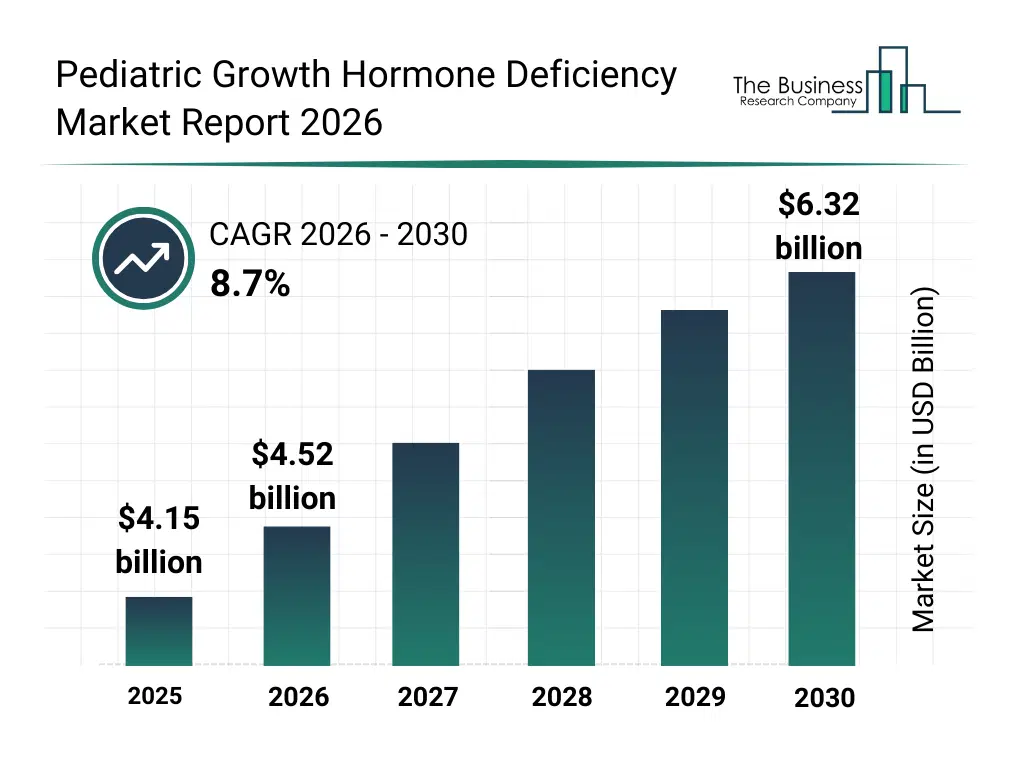
What Is The Pediatric Growth Hormone Deficiency Market Size and Share 2026?
The pediatric growth hormone deficiency market size has grown strongly in recent years. It will grow from $4.15 billion in 2025 to $4.52 billion in 2026 at a compound annual growth rate (CAGR) of 9.0%. The growth in the historic period can be attributed to limited awareness of gh deficiency, reliance on conventional therapies, fragmented pediatric endocrinology care, minimal use of digital monitoring, low adoption of long-acting gh formulations.What Is The Pediatric Growth Hormone Deficiency Market Growth Forecast?
The pediatric growth hormone deficiency market size is expected to see strong growth in the next few years. It will grow to $6.32 billion in 2030 at a compound annual growth rate (CAGR) of 8.7%. The growth in the forecast period can be attributed to growing adoption of rhgh therapy, increasing development of long-acting gh analogs, rising focus on personalized treatment plans, increasing integration of digital patient monitoring solutions, growing regulatory support for pediatric endocrine therapies. Major trends in the forecast period include increasing adoption of recombinant human growth hormone therapy, rising use of long-acting growth hormones, growing integration of digital tools for patient monitoring, increasing implementation of ai-based diagnostic and treatment planning, rising focus on precision medicine approaches in pediatric gh deficiency.
Global Pediatric Growth Hormone Deficiency Market Segmentation
1) By Etiology Type: Congenital GH Deficiency, Acquired GH Deficiency, Idiopathic GH deficiency 2) By Product: Recombinant Human Growth Hormone (rhGH), Human Growth Hormone (HGH) Analogs, Long-Acting Growth Hormones 3) By Route Of Administration: Subcutaneous, Intramuscular, Oral 4) By Distribution Channel: Hospital Pharmacies, Retail Pharmacies, Online Pharmacies 5) By Application: Growth Hormone Deficiency, Idiopathic Short Stature, Turner Syndrome, Small For Gestational Age, Prader Willi Syndrome, Other Applications Subsegments: 1) By Congenital GH Deficiency: Isolated GH Deficiency, Combined Pituitary Hormone Deficiency 2) By Acquired GH Deficiency: GH Deficiency Due To Pituitary Tumors, GH Deficiency Due To Brain Injury, GH Deficiency Due To Radiation Therapy 3) By Idiopathic GH Deficiency: Primary Idiopathic GH Deficiency, Secondary Idiopathic GH DeficiencyWhat Is The Driver Of The Pediatric Growth Hormone Deficiency Market?
An increasing prevalence of pediatric diseases is expected to propel the growth of the pediatric growth hormone deficiency market going forward. Pediatric diseases refer to medical conditions or illnesses that primarily affect children, ranging from infancy to adolescence. The increase in pediatric diseases is largely due to environmental factors, better detection methods, lifestyle changes, genetic predispositions, and rising rates of chronic conditions and allergies among children. Pediatric diseases can contribute to pediatric growth hormone deficiency (GHD) by affecting the hypothalamus or pituitary gland, which are responsible for producing growth hormone. For instance, in August 2024, according to the United Nations Children's Fund (UNICEF), a US-based government organization, reported that globally, about 1.1 million children and adolescents aged 0–19 years have type 1 diabetes and need insulin daily to survive; many who live in low- and middle-income countries do not have access to lifesaving care and treatment for this debilitating and often fatal disease. Therefore, the increasing prevalence of pediatric diseases is driving the growth of the pediatric growth hormone deficiency industry.Key Players In The Global Pediatric Growth Hormone Deficiency Market
Major companies operating in the pediatric growth hormone deficiency market are Pfizer Inc., Eli Lilly and Company, Novo Nordisk A/S, Genentech Inc., Merck KGaA Darmstadt Germany, Ipsen Pharma, Ferring Pharmaceuticals, OPKO Health Inc., Ascendis Pharma A/S, Versartis Inc., LG Chem Ltd., GeneScience Pharmaceuticals Co Ltd, Biopartners GmbH, JHM Biopharma, JCR Pharmaceuticals Co Ltd, Samsung Bioepis, Intas Pharmaceuticals Ltd, BioMarin Pharmaceutical Inc, Abbott Laboratories, Amgen Inc, Chugai Pharmaceutical Co Ltd, Sanofi S A, AnkeBio Co Ltd, Zhongshan Sinobioway Hygene Biomedicine Co Ltd.
This chart is for illustrative purposes; the full report includes a detailed competitor analysis and comprehensive overview of the top 10 companies in the market.
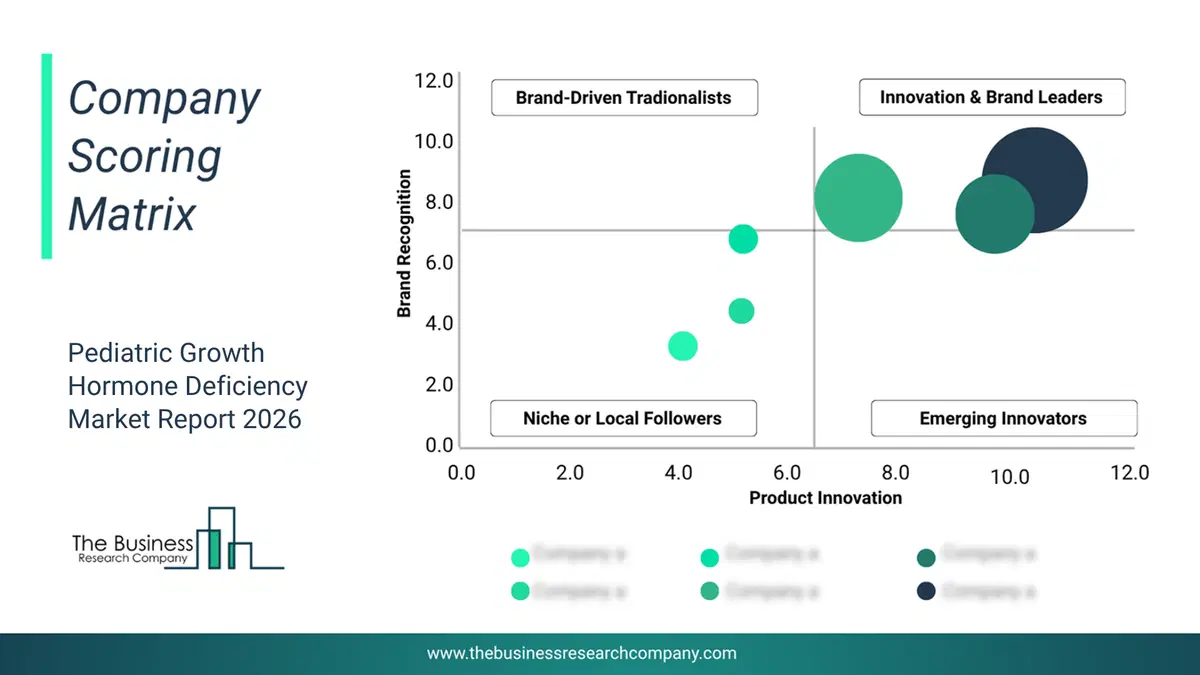
This chart maps companies by product innovation and brand strength, with bubble size indicating relative revenue, helping identify market leaders, challengers, and niche players. This is an illustrative chart; the full report provides a complete and accurate competitive analysis.
Global Pediatric Growth Hormone Deficiency Market Trends and Insights
Major companies operating in the pediatric growth hormone deficiency market are focusing on developing innovative solutions, such as long-acting, once-weekly human growth hormone analogs, to improve patient compliance and convenience. A long-acting, once-weekly human growth hormone (HGH) analog refers to a modified version of the natural human growth hormone that has been engineered to have a longer duration of action in the body. For example, in June 2023, Pfizer Inc., a US-based pharmaceutical company, and OPKO Health Inc., a US-based medication company, jointly announced NGENLA (somatrogon-ghla), a once-weekly human growth hormone analog for treating pediatric patients aged three years and older with growth failure due to inadequate secretion of endogenous growth hormone approved by the Food and Drug Administration, a US-based government agency. This innovative therapy aims to improve patient compliance by reducing the frequency of injections, as traditional treatments typically require daily doses. Clinical trials have shown that NGENLA delivers similar efficacy to daily growth hormone treatments, offering a more convenient and manageable option for children and their families.What Are Latest Mergers And Acquisitions In The Pediatric Growth Hormone Deficiency Market?
In December 2024, Double Point Ventures, a US-based venture capital fund, acquired Lumos Pharma for $38 million. With this acquisition, DPV aims to accelerate the development of Lumos' lead therapeutic candidate, LUM-201, and expand its portfolio of treatments for rare diseases. Lumos Pharma is a US-based biopharmaceutical company that focuses on developing treatments for rare diseases, particularly those associated with growth hormone deficiencies.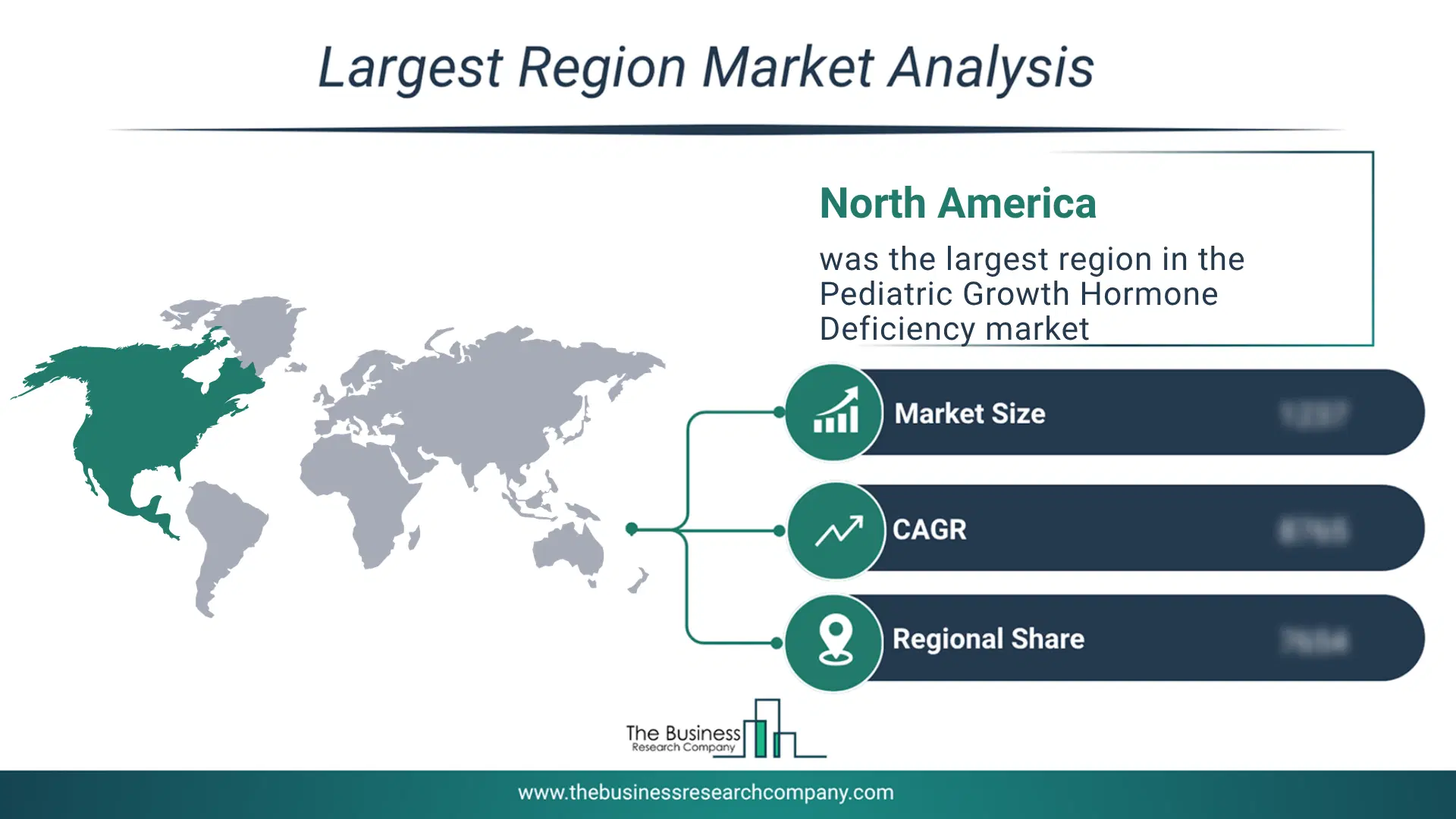
Regional Outlook
North America was the largest region in the pediatric growth hormone deficiency market in 2025. Asia-Pacific is expected to be the fastest-growing region in the forecast period. The regions covered in this market report are Asia-Pacific, South East Asia, Western Europe, Eastern Europe, North America, South America, Middle East, Africa. The countries covered in this market report are Australia, Brazil, China, France, Germany, India, Indonesia, Japan, Taiwan, Russia, South Korea, UK, USA, Canada, Italy, Spain.What Defines the Pediatric Growth Hormone Deficiency Market?
The pediatric growth hormone deficiency market consists of sales of synthetic growth hormone, growth hormone releasing hormone, and long-acting growth hormone therapies. Values in this market are ‘factory gate’ values, that is, the value of goods sold by the manufacturers or creators of the goods, whether to other entities (including downstream manufacturers, wholesalers, distributors, and retailers) or directly to end customers. The value of goods in this market includes related services sold by the creators of the goods.How is Market Value Defined and Measured?
The market value is defined as the revenues that enterprises gain from the sale of goods and/or services within the specified market and geography through sales, grants, or donations in terms of the currency (in USD unless otherwise specified). The revenues for a specified geography are consumption values that are revenues generated by organizations in the specified geography within the market, irrespective of where they are produced. It does not include revenues from resales along the supply chain, either further along the supply chain or as part of other products.
This chart presents market attractiveness based on a quantitative evaluation of growth, competition, strategic alignment, and risk, offering a clear view of opportunity areas for decision-making. This chart is for illustrative purposes; the full report contains the complete analysis.

This chart highlights the Total Addressable Market (TAM) by estimating the maximum revenue opportunity using an assumption-driven approach, supporting strategic planning and opportunity sizing across markets. The chart is illustrative; the full report provides a more comprehensive analysis.
What Key Data and Analysis Are Included in the Pediatric Growth Hormone Deficiency Market Report 2026?
The pediatric growth hormone deficiency market research report is one of a series of new reports from The Business Research Company that provides market statistics, including industry global market size, regional shares, competitors with the market share, detailed market segments, market trends and opportunities, and any further data you may need to thrive in the pediatric growth hormone deficiency industry. The market research report delivers a complete perspective of everything you need, with an in-depth analysis of the current and future state of the industry.Pediatric Growth Hormone Deficiency Market Report Forecast Analysis
| Report Attribute | Details |
|---|---|
| Market Size Value In 2026 | $4.52 billion |
| Revenue Forecast In 2030 | $6.32 billion |
| Growth Rate | CAGR of 8.7% from 2026 to 2030 |
| Base Year For Estimation | 2025 |
| Actual Estimates/Historical Data | 2020-2025 |
| Forecast Period | 2026 - 2030 |
| Market Representation | Revenue in USD Billion and CAGR from 2026 to 2030 |
| Segments Covered | Etiology Type, Product, Route Of Administration, Distribution Channel, Application |
| Regional Scope | Asia-Pacific, Western Europe, Eastern Europe, North America, South America, Middle East, Africa |
| Country Scope | The countries covered in the report are Australia, Brazil, China, France, Germany, India, Indonesia, Japan, Taiwan, Russia, South Korea, UK, USA, Canada, Italy, Spain |
| Key Companies Profiled | Pfizer Inc., Eli Lilly and Company, Novo Nordisk A/S, Genentech Inc., Merck KGaA Darmstadt Germany, Ipsen Pharma, Ferring Pharmaceuticals, OPKO Health Inc., Ascendis Pharma A/S, Versartis Inc., LG Chem Ltd., GeneScience Pharmaceuticals Co Ltd, Biopartners GmbH, JHM Biopharma, JCR Pharmaceuticals Co Ltd, Samsung Bioepis, Intas Pharmaceuticals Ltd, BioMarin Pharmaceutical Inc, Abbott Laboratories, Amgen Inc, Chugai Pharmaceutical Co Ltd, Sanofi S A, AnkeBio Co Ltd, Zhongshan Sinobioway Hygene Biomedicine Co Ltd. |
| Customization Scope | Request for Customization |
| Pricing And Purchase Options | Explore Purchase Options |