
Contact Us
  Search
The Business Research Company Logo
Peptide Therapeutics Contract Active Pharmaceutical Ingredient (API) Manufacturing Global Market Opportunities And Strategies To 2035
Published :June 2026
Pages :221
Format :PDF
Delivery Time :2-3 Business Days
Why 2-3 days? We update the report with the latest data and news before delivery. Let us know if you need us to expedite.
Report Price :$4,490.00

Peptide Therapeutics Contract Active Pharmaceutical Ingredient (API) Manufacturing Global Market Opportunities And Strategies To 2035

By Scale Of Operation (Preclinical Or Clinical, Commercial), By Synthesis Method (Non Chemical Synthesis, Chemical Synthesis), By Enterprise Type (Large Enterprise, Small And Medium Enterprises), And By Region, Opportunities And Strategies – Global Forecast To 2035

Peptide Therapeutics Contract Active Peptide Therapeutics Contract API Manufacturing Market Definition

Peptide Therapeutics Contract Active Peptide therapeutics contract API manufacturing refers to outsourced, specialized services that produce peptide-based active pharmaceutical ingredients for drug developers and pharmaceutical companies. These services typically include solid-phase or liquid-phase peptide synthesis, purification, characterization, scale-up, and GMP-compliant manufacturing to meet regulatory requirements for clinical and commercial use. The primary purpose of contract peptide API manufacturing is to enable reliable, high-quality, and scalable production of peptide drugs without requiring in-house manufacturing infrastructure. The peptide therapeutics contract API manufacturing market consists of sales, by entities (organizations, sole traders, or partnerships), of peptide therapeutics contract API manufacturing that used by pharmaceutical companies during drug development and commercial production. During the preclinical and clinical phases, peptide APIs are used for early research, toxicology testing, and clinical trial supplies.
Peptide Therapeutics Contract Active Pharmaceutical Ingredient (API) Manufacturing Global Market Opportunities And Strategies To 2035
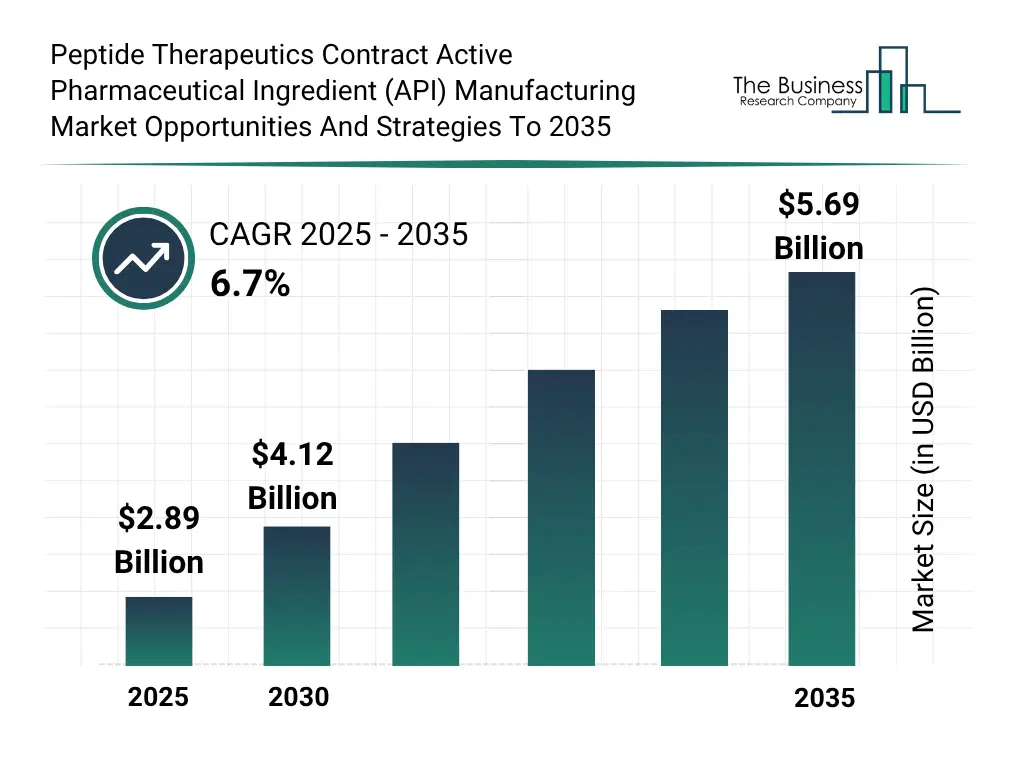
 Market Size and growth rate 2026 to 2030: Graph

Peptide Therapeutics Contract Active Pharmaceutical Ingredient (API) Manufacturing Market Size

The global peptide therapeutics contract active pharmaceutical ingredient (API) manufacturing market reached a value of nearly $2,890.0 million in 2025, having grown at a compound annual growth rate (CAGR) of 8.0% since 2020. The market is expected to grow from $2,890.0 million in 2025 to $4,123.1 million in 2030 at a rate of 7.4%. The market is then expected to grow at a CAGR of 6.7% from 2030 and reach $5,694.9 million in 2035. Growth in the historic period resulted from shift towards expansion of clinical trials and robust therapeutic pipeline, shift toward personalized and precision medicine, rising research and development (R&D) spending in life sciences and stringent regulatory and GMP compliance requirements. Factors that negatively affected growth in the historic period were high manufacturing and operational costs, limited availability of skilled workforce. Going forward, rising prevalence of chronic and metabolic diseases, growing adoption of peptide therapeutics, expanding biopharmaceutical industry and greater use of peptides in specialty care will drive the growth. Factors that could hinder the growth of the peptide therapeutics contract active pharmaceutical ingredient (API) manufacturing market in the future include capacity and scalability limitations, dependence on specialized raw materials and impact of trade war and tariff.
Research Expert

Book your 30 minutes free consultation with our research experts

Peptide Therapeutics Contract Active Pharmaceutical Ingredient (API) Manufacturing Market Segmentation

The peptide therapeutics contract API manufacturing market is segmented by scale of operation, by synthesis method and by enterprise type.

By Scale Of Operation –
The peptide therapeutics contract API manufacturing market is segmented by scale of operation into:
    • a) Preclinical Or Clinical
    • b) Commercial
The commercial market was the largest segment of the peptide therapeutics contract active pharmaceutical ingredient (API) manufacturing market segmented by scale of operation, accounting for 80.0% or $2,313.3 million of the total in 2025. Going forward, the preclinical or clinical segment is expected to be the fastest growing segment in the peptide therapeutics contract active pharmaceutical ingredient (API) manufacturing market segmented by scale of operation, at a CAGR of 7.8% during 2025-2030.

By Synthesis Method –
The peptide therapeutics contract API manufacturing market is segmented by synthesis method into:
    • a) Non Chemical Synthesis
    • b) Chemical Synthesis
The chemical synthesis was the largest segment of the peptide therapeutics contract active pharmaceutical ingredient (API) manufacturing market segmented by synthesis method, accounting for 83.3% or $2,407.9 million of the total in 2025. Going forward, the non chemical synthesis segment is expected to be the fastest growing segment in the peptide therapeutics contract active pharmaceutical ingredient (API) manufacturing market segmented by synthesis method, at a CAGR of 8.7% during 2025-2030.

By Enterprise Type –
The peptide therapeutics contract API manufacturing market is segmented by enterprise type into:
    • a) Large Enterprise
    • b) Small And Medium Enterprises
The large enterprise market was the largest segment of the peptide therapeutics contract active pharmaceutical ingredient (API) manufacturing market segmented by enterprise type, accounting for 66.7% or $1,929.1 million of the total in 2025. Going forward, the small and medium enterprises segment is expected to be the fastest growing segment in the peptide therapeutics contract active pharmaceutical ingredient (API) manufacturing market segmented by enterprise type, at a CAGR of 8.6% during 2025-2030.

By Geography - The peptide therapeutics contract API manufacturing market is segmented by geography into:
      o Asia Pacific
      • China
      • India
      • Japan
      • Australia
      • Indonesia
      • South Korea
      o North America
      • USA
      • Canada
      o South America
      • Brazil
      o Western Europe
      • France
      • Germany
      • UK
      • Italy
      • Spain
      o Eastern Europe
      • Russia
      o Middle East
      o Africa
North America was the largest region in the peptide therapeutics contract active pharmaceutical ingredient (API) manufacturing market, accounting for 8.1% or $1,057.9 million of the total in 2025. It was followed by Asia Pacific, Western Europe and then the other regions. Going forward, the fastest-growing regions in the peptide therapeutics contract active pharmaceutical ingredient (API) manufacturing market will be Asia Pacific and Africa where growth will be at CAGRs of 8.7% and 8.3% respectively. These will be followed by Eastern Europe and Middle East where the markets are expected to grow at CAGRs of 8.2% and 7.9% respectively.

Peptide Therapeutics Contract Active Pharmaceutical Ingredient (API) Manufacturing Market Competitive Landscape

Major Competitors are:

  • Bachem Group
  • PolyPeptide Group
  • CordenPharma International GmbH
  • Ambiopharm Inc.
  • WuXi AppTec Co. Ltd.
  • Other Competitors Include:

  • Piramal Pharma Solutions (PPS)
  • Asymchem Laboratories (Tianjin) Co Ltd.
  • Cambrex Corporation
  • GenScript Biotech Corporation
  • BioDuro LLC
  • Thermo Fisher Scientific
  • Shanghai ChemPartner Co., Ltd.
  • Syngene International Limited
  • Auspep
  • Chinese Peptide Company Ltd.
  • CPC Scientific
  • ScinoPharm Taiwan, Ltd.
  • Lonza Australia
  • IDT Australia
  • SK pharmteco
  • Eli Lilly and Company
  • Anthem Biosciences Ltd
  • Neuland Laboratories Ltd
  • Sinopep-Allsino Biopharmaceutical Co., Ltd.
  • Zhejiang Jiuzhou Pharmaceutical Co Ltd
  • PeptiStar Inc.
  • Fujimoto Chemicals Co., Ltd.
  • The Merck Group
  • Leadgene Biomedical
  • Lonza Group
  • APD Pharmaceutical
  • NeoBioLab Co., Ltd.
  • Apical Scientific Sdn Bhd
  • Hybio Pharmaceutical Co. Ltd
  • Senn Chemicals
  • Apex Biotechnology Corporation
  • Big Bear Pharmaceutical Co., Ltd.
  • Huarong Pharm
  • Bristo Pharmaceutical Company Canada
  • CEM Corporation
  • AnaSpec Inc.
  • CSBio
  • Patheon
  • Dalton Pharma Services
  • Canada Peptide
  • Therapure BioPharma Inc.
  • BCN Peptides
  • Axplora
  • Olon S.p.A.
  • Azenta Life Sciences
  • Aspen Pharmacare
  • Eva Pharma
  • Emzor Pharmaceuticals
  • Fidson Healthcare Plc
  • Peptide Therapeutics Contract Active Pharmaceutical Ingredient (API) Manufacturing Market Drivers

    The key drivers of the peptide therapeutics contract API manufacturing market include: Rising Prevalence Of Chronic And Metabolic Diseases The rising prevalence of chronic and metabolic diseases is driving demand for dark factories. Many chronic conditions require long-term, targeted, and biologically specific treatments, which aligns well with peptide-based drug modalities. As pharmaceutical and biotechnology companies expand their development programs to address growing patient populations, the need for reliable and scalable peptide API supply increases across preclinical, clinical, and commercial stages. This growth places pressure on internal manufacturing resources, encouraging sponsors to rely on specialized CDMOs that possess established peptide synthesis, purification, and GMP compliance capabilities. As disease prevalence rises, development portfolios become broader and more complex, reinforcing sustained outsourcing demand for high-quality peptide APIs that can support multiple programs simultaneously while meeting stringent regulatory requirements. The rising prevalence of chronic and metabolic diseases growth contribution during the forecast period in 2025 is 1.5%.

    Peptide Therapeutics Contract Active Pharmaceutical Ingredient (API) Manufacturing Market Restraints

    The key restraints on the peptide therapeutics contract API manufacturing market include: Capacity And Scalability Limitations The capacity and scalability limitations remains a significant barrier to market expansion. Peptide manufacturing infrastructure involves capital-intensive synthesis reactors, purification systems, and controlled production environments that cannot be easily or rapidly expanded. As a result, CDMOs may face constraints in scaling production volumes, especially when multiple clients require simultaneous scale-up or commercial supply. Limited scalability can lead to longer lead times, delayed project transitions from clinical to commercial stages, and prioritization challenges among customers. These constraints reduce flexibility for pharmaceutical developers and can discourage outsourcing if manufacturers are unable to guarantee timely capacity availability, thereby slowing overall market growth. Growth affected by capacity and scalability limitations during the forecast period in 2025 is -2.0%.

    Need data on a specific region in this market?

    Opportunities And Recommendations In The Peptide Therapeutics Contract Active Pharmaceutical Ingredient (API) Manufacturing Market

    Opportunities – The top opportunities in the peptide therapeutics contract active pharmaceutical ingredient (API) manufacturing market segmented by scale of operation will arise in the commercial segment, which will gain $3,284.2 million of global annual sales by 2030. The top opportunities in the peptide therapeutics contract active pharmaceutical ingredient (API) manufacturing market segmented by synthesis method will arise in the chemical synthesis segment, which will gain $3,391.8 million of global annual sales by 2030. The top opportunities in the peptide therapeutics contract active pharmaceutical ingredient (API) manufacturing market segmented by enterprise type will arise in the large enterprise segment, which will gain $2,674.3 million of global annual sales by 2030. The peptide therapeutics contract active pharmaceutical ingredient (API) manufacturing market size will gain the most in the USA at $351.6 million. Recommendations- To take advantage of the opportunities, The Business Research Company recommends the peptide therapeutics contract active pharmaceutical ingredient (API) manufacturing companies to focus on expanding flexible early-stage manufacturing capabilities, focus on scaling commercial-grade peptide API manufacturing capacity, focus on adopting integrated end-to-end peptide API manufacturing platforms, focus on advancing high-purity solid-phase peptide synthesis (SPPS) capabilities, focus on adopting hybrid peptide synthesis approaches, focus on strengthening GMP-compliant peptide API production, focus on expanding commercial-scale peptide API manufacturing, focus on expanding non-chemical peptide API manufacturing, expand in emerging markets, continue to focus on developed markets, focus on value-based and tiered pricing strategies, focus on targeted scientific marketing and thought leadership, focus on strategic client engagement and relationship marketing and focus on supporting small and medium enterprise clients.
    Chat with us