

Peripheral Nerve Repair Devices Market Report 2026
Global Outlook – By Type (Nerve Grafts, Nerve Protectors, Nerve Conduit), By Application (Extremity Trauma, Breast Neurotization, Carpal And Cubital Tunnel Revision, Oral And Maxillofacial), By End-User (Hospitals, Ambulatory Surgical Centers, Clinics) – Market Size, Trends, Strategies, and Forecast to 2030
Peripheral Nerve Repair Devices Market Overview
• Peripheral Nerve Repair Devices market size has reached to $6.67 billion in 2025 • Expected to grow to $9.96 billion in 2030 at a compound annual growth rate (CAGR) of 8.3% • Growth Driver: Rising Prevalence Of Neurological Disorders Driving Growth In Market • Market Trend: Next-Generation Sutureless Nerve Repair Systems Enhancing Surgical Efficiency • Asia-Pacific was the largest region in 2025 and North America is the fastest growing region.What Is Covered Under Peripheral Nerve Repair Devices Market?
Peripheral nerve repair devices are medical tools and implants designed to restore the function of damaged or severed peripheral nerves. These devices, including nerve conduits, wraps, and grafts, support nerve regeneration by providing a scaffold for growth and protecting the repair site to facilitate recovery. The main types of peripheral nerve repair devices are nerve grafts, nerve protectors, and nerve conduits. Nerve grafts involve using a segment of nerve tissue to repair or replace damaged nerves, facilitating the reconnection and regrowth of nerve fibers. It can be used for various applications such as extremity trauma, breast neurotization, carpal and cubital tunnel revision, and oral and maxillofacial, catering to various end users such as hospitals, ambulatory surgical centers, and clinics.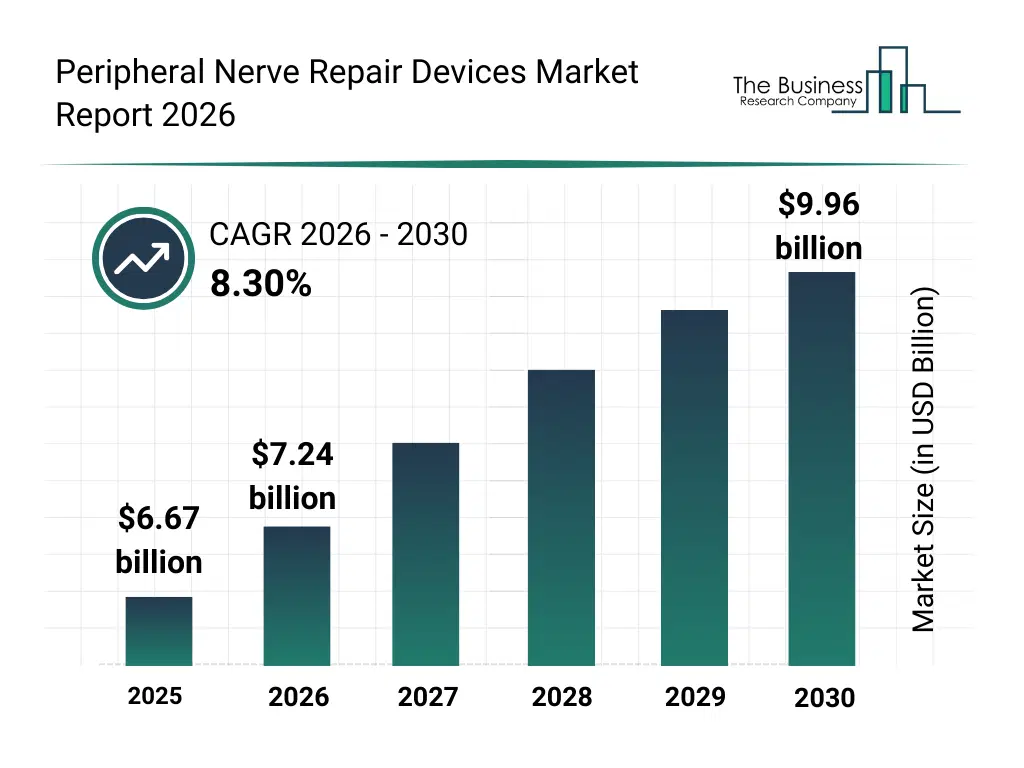
What Is The Peripheral Nerve Repair Devices Market Size and Share 2026?
The peripheral nerve repair devices market size has grown strongly in recent years. It will grow from $6.67 billion in 2025 to $7.24 billion in 2026 at a compound annual growth rate (CAGR) of 8.5%. The growth in the historic period can be attributed to increase in trauma injuries, growth in reconstructive surgeries, adoption of nerve grafting, orthopedic surgery expansion, microsurgical advancements.What Is The Peripheral Nerve Repair Devices Market Growth Forecast?
The peripheral nerve repair devices market size is expected to see strong growth in the next few years. It will grow to $9.96 billion in 2030 at a compound annual growth rate (CAGR) of 8.3%. The growth in the forecast period can be attributed to bioengineered nerve scaffolds, regenerative medicine growth, aging population nerve disorders, robotic-assisted surgeries, innovation in synthetic grafts. Major trends in the forecast period include biodegradable nerve conduits, advanced nerve regeneration materials, minimally invasive nerve repair, customized nerve graft solutions, improved surgical handling designs.
Global Peripheral Nerve Repair Devices Market Segmentation
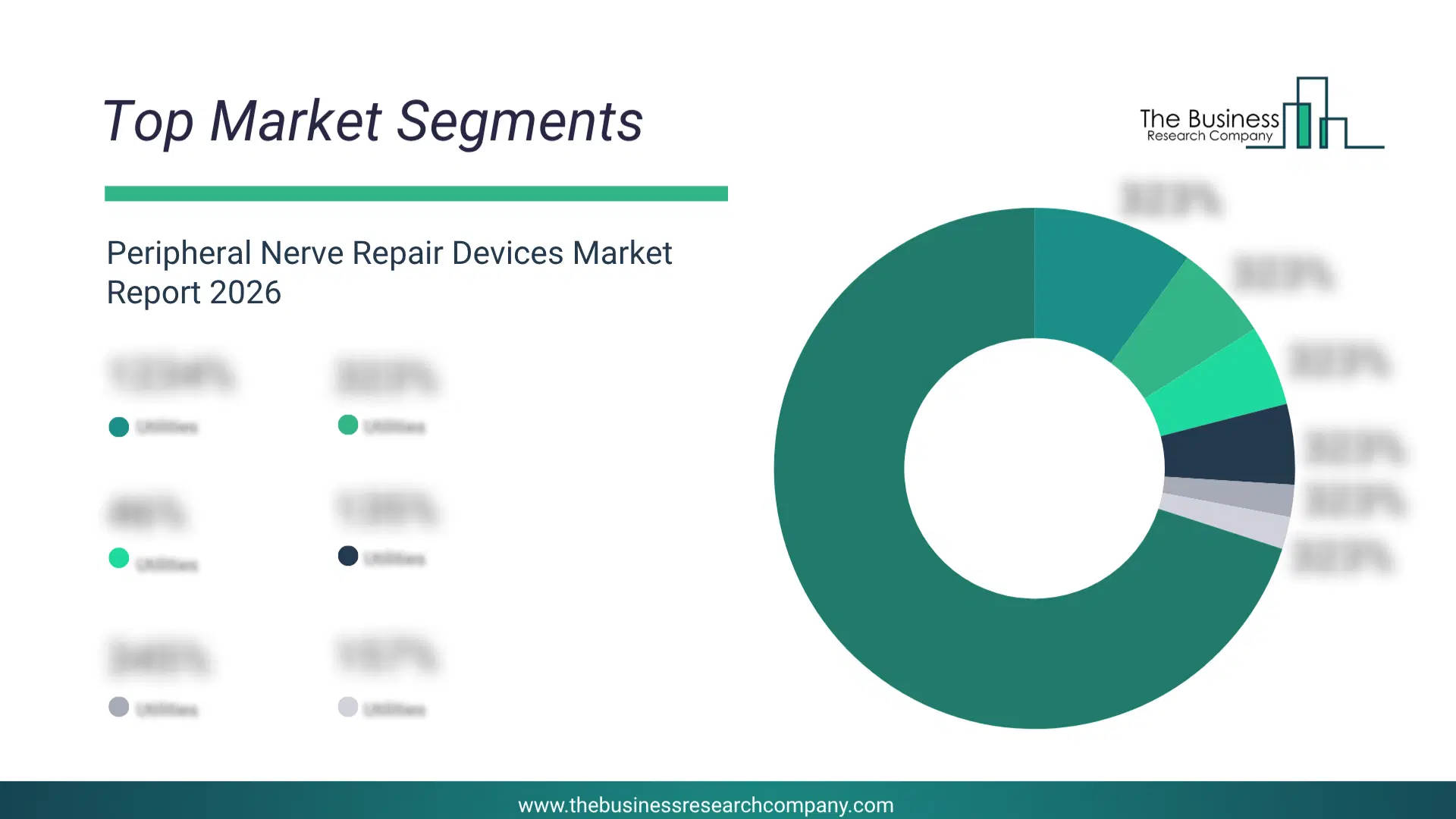
1) By Type: Nerve Grafts, Nerve Protectors, Nerve Conduit 2) By Application: Extremity Trauma, Breast Neurotization, Carpal And Cubital Tunnel Revision, Oral And Maxillofacial 3) By End-User: Hospitals, Ambulatory Surgical Centers, Clinics Subsegments: 1) By Nerve Grafts: Autografts, Allografts, Xenografts, Synthetic Nerve Grafts 2) By Nerve Protectors: Nerve Wrapping Devices, Nerve Repair Gels And Films, Nerve Protection Matrices, Biodegradable Nerve Protectors 3) By Nerve Conduit: Hollow Nerve Conduits, Collagen-Based Nerve Conduits, Silicone-Based Nerve Conduits, Tubular Nerve Conduits, Biodegradable Nerve ConduitsWhat Is The Driver Of The Peripheral Nerve Repair Devices Market?
The increasing prevalence of neurological disorders is expected to propel the growth of the peripheral nerve repair devices market going forward. Neurological disorders are a group of conditions that affect the brain, spinal cord, and nerves, leading to issues with movement, cognition, and other functions of the nervous system. The rising prevalence of neurological disorders is driven by an aging population, better diagnostic methods, environmental factors, genetic predispositions, and lifestyle choices such as poor diet and lack of exercise. Peripheral nerve repair devices aid in neurological disorders by promoting nerve regeneration, improving function, and enhancing healing through methods like electrical stimulation and bioactive materials. For instance, in May 2024, according to the Alzheimer's Society, a UK-based dementia charity, in 2024, approximately one million people in the UK are living with some form of dementia, a number expected to increase to 1.4 million by 2040. Therefore, the increasing prevalence of neurological disorders is driving the growth of the peripheral nerve repair devices industry.Key Players In The Global Peripheral Nerve Repair Devices Market
Major companies operating in the peripheral nerve repair devices market are Abbott Laboratories Inc., Medtronic Plc, Stryker Corporation, Baxter International Inc., Boston Scientific Corporation, Terumo Corporation, Teleflex Incorporated, Integra LifeSciences Holdings Corporation, LivaNova PLC, Nevro Corp., KLS Martin Group, Axonics Modulation Technologies Inc., Axogen Corporation, Toyobo Co. Ltd., NeuroPace Inc., SPR Therapeutics Inc., Biotronik, Neuraptive Therapeutics Inc., Synovis Micro Companies Alliance Inc., Synapse Biomedical Inc.
This chart is for illustrative purposes; the full report includes a detailed competitor analysis and comprehensive overview of the top 10 companies in the market.
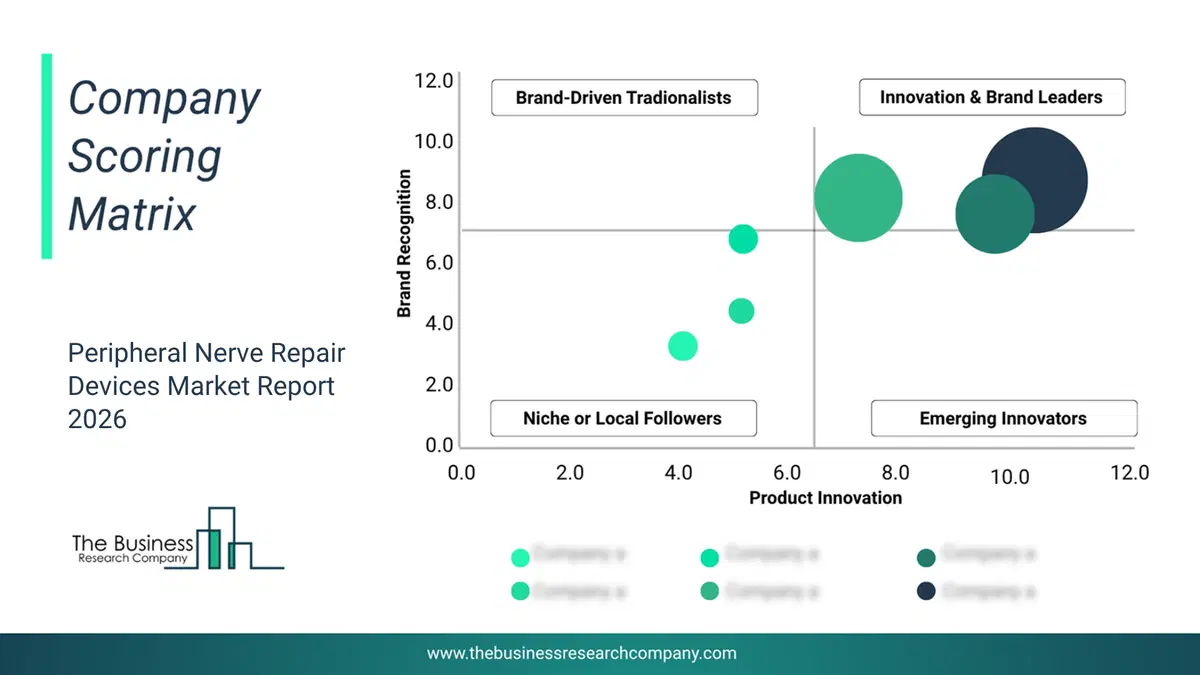
This chart maps companies by product innovation and brand strength, with bubble size indicating relative revenue, helping identify market leaders, challengers, and niche players. This is an illustrative chart; the full report provides a complete and accurate competitive analysis.
Global Peripheral Nerve Repair Devices Market Trends and Insights
Major companies operating in the peripheral nerve repair devices market are prioritizing innovation, such as sutureless nerve-coaptation technologies, to improve surgical efficiency and nerve-regeneration outcomes. Sutureless nerve-coaptation devices enable alignment and fixation of severed nerve ends without microsutures by using microhooks, adhesives, or mechanical clips to reduce trauma and shorten operative time. For instance, in June 2024, BioCircuit Technologies, a US-based medical device company, announced the first human implants of Nerve Tape, a sutureless nerve-repair device that uses a resorbable SIS backing embedded with nitinol microhooks to enable rapid, precise coaptation of peripheral nerves and simplify repair procedures. This innovation is designed to reduce the technical complexity and time required for nerve repair, offering surgeons a more consistent method compared to traditional suturing techniques. The early clinical use of Nerve Tape also highlights growing advancements in regenerative technologies aimed at improving functional recovery in patients with peripheral nerve injuries.What Are Latest Mergers And Acquisitions In The Peripheral Nerve Repair Devices Market?
In January 2024, RTI Surgical, a US-based contract development and manufacturing organization (CDMO), acquired Cook Biotech Incorporated for an undisclosed amount. With this acquisition, RTI Surgical aims to expand its regenerative-medicine and biomaterials capabilities and broaden its soft-tissue product portfolio. Cook Biotech inc. is a US–based company, develops porcine small intestinal submucosa (SIS) extracellular-matrix products used in peripheral nerve repair and other soft-tissue reconstruction applications.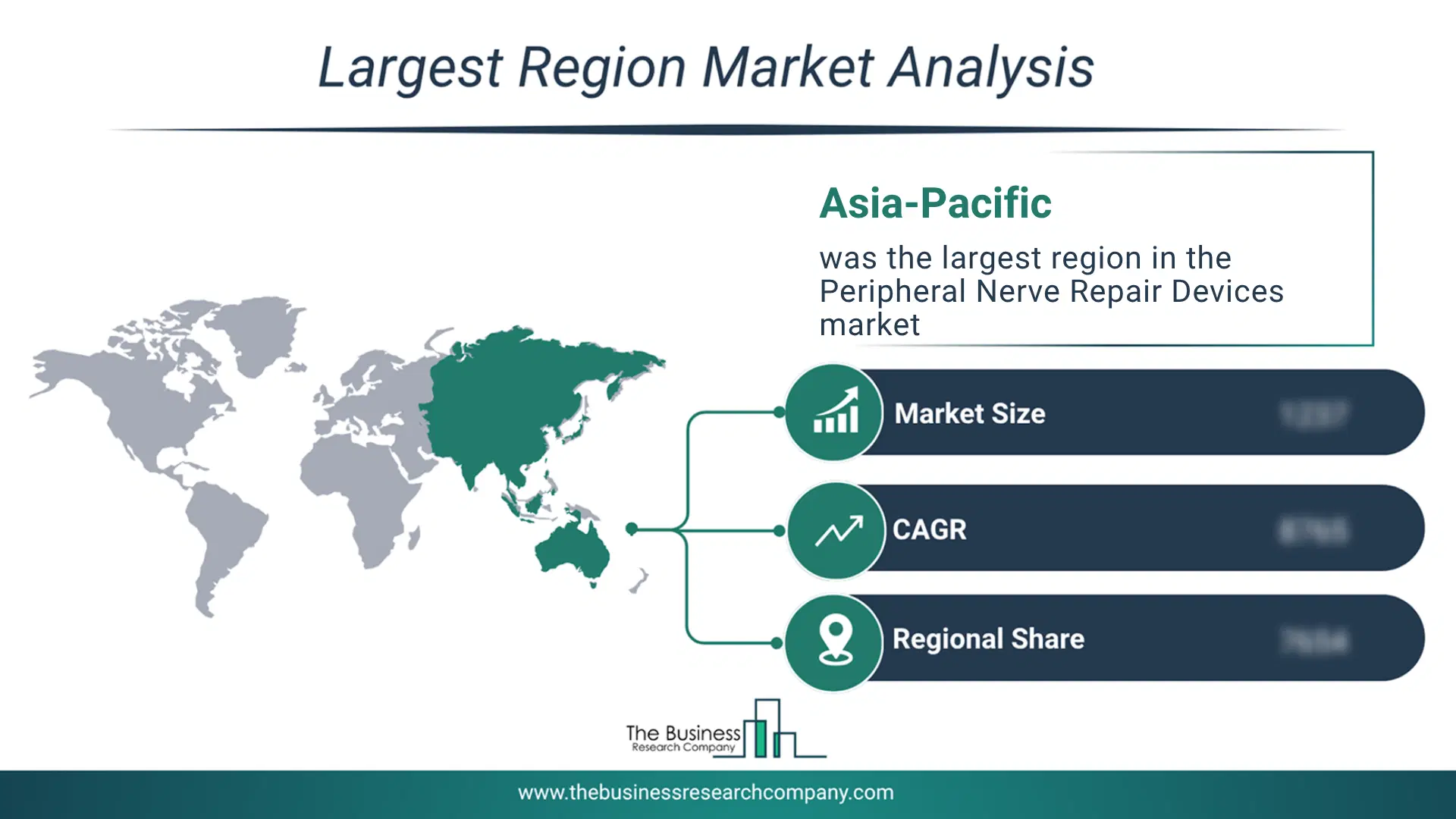
Regional Outlook
Asia-Pacific was the largest region in the peripheral nerve repair devices market in 2025. North America is expected to be the fastest-growing region in the forecast period. The regions covered in this market report are Asia-Pacific, South East Asia, Western Europe, Eastern Europe, North America, South America, Middle East, Africa. The countries covered in this market report are Australia, Brazil, China, France, Germany, India, Indonesia, Japan, Taiwan, Russia, South Korea, UK, USA, Canada, Italy, SpainWhat Defines the Peripheral Nerve Repair Devices Market?
The peripheral nerve repair devices market consists of sales of products including nerve conduits, nerve wraps, nerve grafts, and synthetic nerve scaffolds. Values in this market are ‘factory gate’ values, that is, the value of goods sold by the manufacturers or creators of the goods, whether to other entities (including downstream manufacturers, wholesalers, distributors, and retailers) or directly to end customers. The value of goods in this market includes related services sold by the creators of the goods.How is Market Value Defined and Measured?
The market value is defined as the revenues that enterprises gain from the sale of goods and/or services within the specified market and geography through sales, grants, or donations in terms of the currency (in USD unless otherwise specified). The revenues for a specified geography are consumption values that are revenues generated by organizations in the specified geography within the market, irrespective of where they are produced. It does not include revenues from resales along the supply chain, either further along the supply chain or as part of other products.
This chart presents market attractiveness based on a quantitative evaluation of growth, competition, strategic alignment, and risk, offering a clear view of opportunity areas for decision-making. This chart is for illustrative purposes; the full report contains the complete analysis.

This chart highlights the Total Addressable Market (TAM) by estimating the maximum revenue opportunity using an assumption-driven approach, supporting strategic planning and opportunity sizing across markets. The chart is illustrative; the full report provides a more comprehensive analysis.
What Key Data and Analysis Are Included in the Peripheral Nerve Repair Devices Market Report 2026?
The peripheral nerve repair devices market research report is one of a series of new reports from The Business Research Company that provides market statistics, including industry global market size, regional shares, competitors with the market share, detailed market segments, market trends and opportunities, and any further data you may need to thrive in the peripheral nerve repair devices industry. The market research report delivers a complete perspective of everything you need, with an in-depth analysis of the current and future state of the industry.Peripheral Nerve Repair Devices Market Report Forecast Analysis
| Report Attribute | Details |
|---|---|
| Market Size Value In 2026 | $7.24 billion |
| Revenue Forecast In 2030 | $9.96 billion |
| Growth Rate | CAGR of 8.3% from 2026 to 2030 |
| Base Year For Estimation | 2025 |
| Actual Estimates/Historical Data | 2020-2025 |
| Forecast Period | 2026 - 2030 |
| Market Representation | Revenue in USD Billion and CAGR from 2026 to 2030 |
| Segments Covered | Type, Application, End-User |
| Regional Scope | Asia-Pacific, Western Europe, Eastern Europe, North America, South America, Middle East, Africa |
| Country Scope | The countries covered in the report are Australia, Brazil, China, France, Germany, India, Indonesia, Japan, Taiwan, Russia, South Korea, UK, USA, Canada, Italy, Spain. |
| Key Companies Profiled | Abbott Laboratories Inc., Medtronic Plc, Stryker Corporation, Baxter International Inc., Boston Scientific Corporation, Terumo Corporation, Teleflex Incorporated, Integra LifeSciences Holdings Corporation, LivaNova PLC, Nevro Corp., KLS Martin Group, Axonics Modulation Technologies Inc., Axogen Corporation, Toyobo Co. Ltd., NeuroPace Inc., SPR Therapeutics Inc., Biotronik, Neuraptive Therapeutics Inc., Synovis Micro Companies Alliance Inc., Synapse Biomedical Inc. |
| Customization Scope | Request for Customization |
| Pricing And Purchase Options | Explore Purchase Options |