

Personal Air Vehicles (PAVs) Market Report 2026
Global Outlook – By Product Type (Electric Vertical Take-Off And Landing (eVTOL) Aircraft, Hybrid-Electric Aircraft, Hydrogen-Powered Aircraft), By Technology (Autonomous, Semi-Autonomous, Manual), By Distribution Channel (Direct Sales, Distributors, Online Platforms), By Application (Urban Air Mobility, Emergency Services, Recreational, Other Applications), By End-User (Individual Consumers, Commercial Operators, Government Agencies) – Market Size, Trends, Strategies, and Forecast to 2030
Personal Air Vehicles (PAVs) Market Overview
• Personal Air Vehicles (PAVs) market size has reached to $1.95 billion in 2025 • Expected to grow to $4.96 billion in 2030 at a compound annual growth rate (CAGR) of 20.4% • Growth Driver: Growing Demand For Aerial Transportation Fueling The Growth Of The Market Due To Urban Congestion And Increasing Air Travel • Market Trend: Strategic Partnerships Driving Scalable Manufacturing And Next-Generation Air Mobility • North America was the largest region in 2025.What Is Covered Under Personal Air Vehicles (PAVs) Market?
Personal air vehicles (PAVs) are small, airborne transportation systems intended for individual or small-group travel, providing on-demand, point-to-point mobility. They aim to transform urban and regional transport by alleviating road congestion, supporting low-emission travel, improving transport efficiency, promoting sustainable urban mobility, and advancing the development of advanced air mobility (AAM) ecosystems. The main product types of personal air vehicles (PAVs) are electric vertical take-off and landing (eVTOL) aircraft, hybrid-electric aircraft, and hydrogen-powered aircraft. Electric vertical takeoff and landing aircraft are eco-friendly, all-electric vehicles that use multiple rotors or fans to lift vertically, transition into forward flight, and operate more quietly than traditional helicopters or jets. These utilize various technologies, such as autonomous, semi-autonomous, and manual, and are distributed through several distribution channels, including direct sales, distributors, and online platforms. These vehicles find applications in urban air mobility, emergency services, recreation, and others, and are used by several end-users, including individual consumers, commercial operators, and government agencies.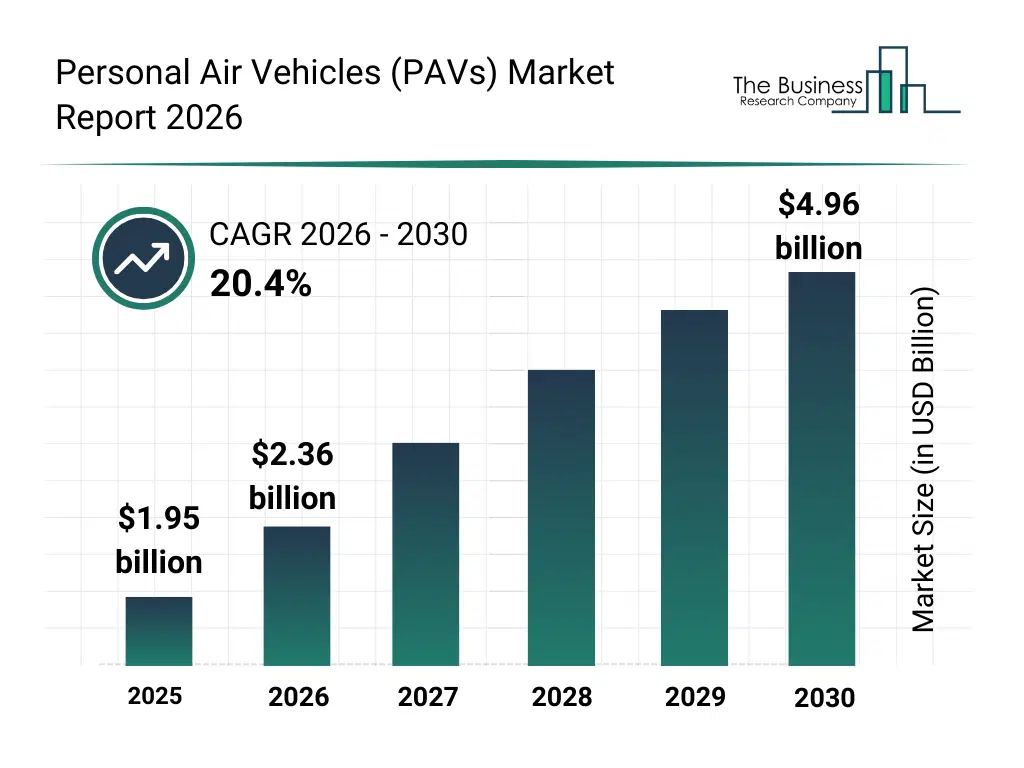
What Is The Personal Air Vehicles (PAVs) Market Size and Share 2026?
The personal air vehicles (pavs) market size has grown exponentially in recent years. It will grow from $1.95 billion in 2025 to $2.36 billion in 2026 at a compound annual growth rate (CAGR) of 21.0%. The growth in the historic period can be attributed to advances in lightweight materials, early electric aircraft prototypes, congestion in urban transport, aviation innovation funding, pilot urban mobility trials.What Is The Personal Air Vehicles (PAVs) Market Growth Forecast?
The personal air vehicles (pavs) market size is expected to see exponential growth in the next few years. It will grow to $4.96 billion in 2030 at a compound annual growth rate (CAGR) of 20.4%. The growth in the forecast period can be attributed to regulatory support for aam, battery energy density improvements, autonomous flight certification, smart city integration, sustainable transport demand. Major trends in the forecast period include development of evtol platforms, growth of urban air mobility services, integration of autonomous flight systems, expansion of hybrid and hydrogen aircraft, demand for on-demand air mobility.
Global Personal Air Vehicles (PAVs) Market Segmentation
1) By Product Type: Electric Vertical Take-Off And Landing (eVTOL) Aircraft, Hybrid-Electric Aircraft, Hydrogen-Powered Aircraft 2) By Technology: Autonomous, Semi-Autonomous, Manual 3) By Distribution Channel: Direct Sales, Distributors, Online Platforms 4) By Application: Urban Air Mobility, Emergency Services, Recreational, Other Applications 5) By End-User: Individual Consumers, Commercial Operators, Government Agencies Subsegments: 1) By Electric Vertical Take-Off And Landing (eVTOL) Aircraft: Multicopper, Lift Plus Cruise, Vectored Thrust 2) By Hybrid-Electric Aircraft: Parallel Hybrid, Series Hybrid, Turboelectric Hybrid 3) By Hydrogen-Powered Aircraft: Hydrogen Combustion Engine, Hydrogen Fuel Cell, Hybrid Hydrogen SystemsWhat Is The Driver Of The Personal Air Vehicles (PAVs) Market?
The growing demand for aerial transportation is expected to propel the growth of the personal air vehicle (PAV) market going forward. Aerial transport refers to the conveyance of passengers or cargo through the air via aircraft or flying vehicles. The aerial transport is growing due to urban congestion, as rising traffic delays and overcrowded roads increase the demand for faster, above-ground travel solutions. Personal air vehicles (PAVs) support aerial transport by offering on-demand, point-to-point travel, making them ideal for urban and regional mobility. They reduce ground traffic congestion and travel time, improving transportation efficiency and convenience. For instance, in December 2024, according to the Eurostat, a Luxembourg-based statistical office of the European Union (EU), the total number of air passengers reached 973 million in 2023, an increase of 19.3% from 816 million in 2022. Therefore, the growing demand for aerial transportation is driving the growth of the personal air vehicles (PAVs) industry.Key Players In The Global Personal Air Vehicles (PAVs) Market
Major companies operating in the personal air vehicles (pavs) market report include Hyundai Motor Company, The Boeing Company, Airbus SE, EmbraerX Inc., Moog Inc., Bell Textron Inc., Hanwha Systems Co. Ltd., Aston Martin Lagonda Global Holdings plc, Lilium GmbH, Archer Aviation Inc., Volocopter GmbH, Vertical Aerospace Ltd., SkyDrive Inc., Eve Air Mobility Inc., Opener Inc., PAL-V International B.V., EHang Holdings Limited, Pivotal Aero Inc., Joby Aviation Inc., Samson Sky LLC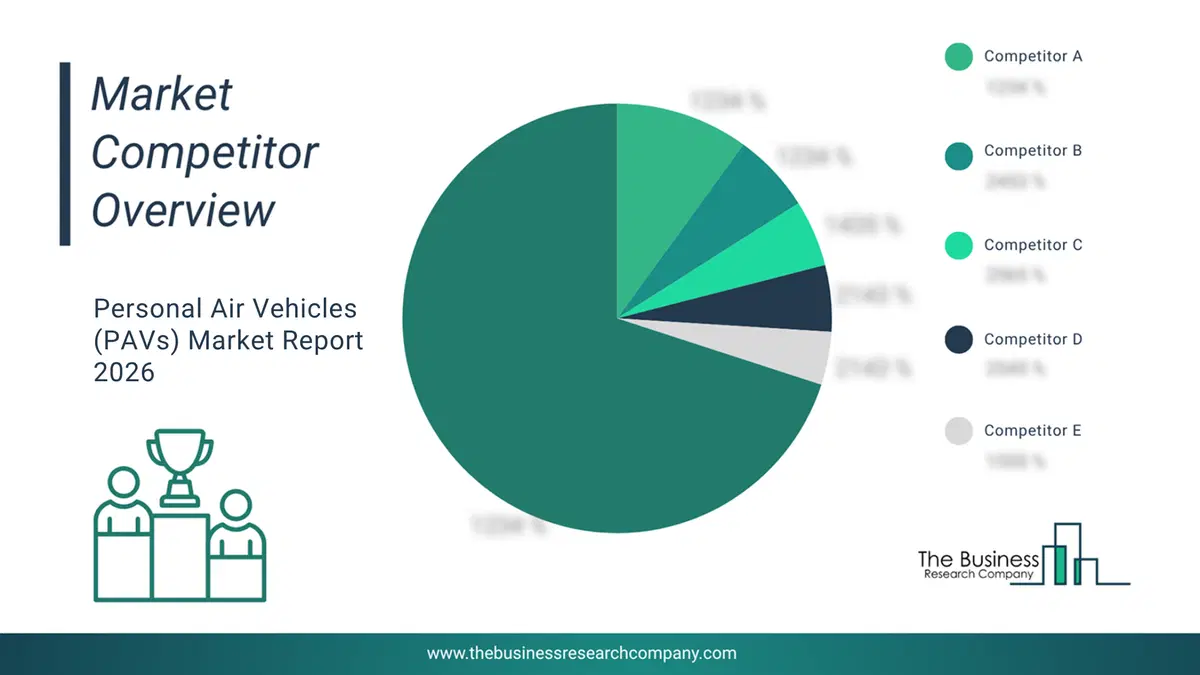
This chart is for illustrative purposes; the full report includes a detailed competitor analysis and comprehensive overview of the top 10 companies in the market.
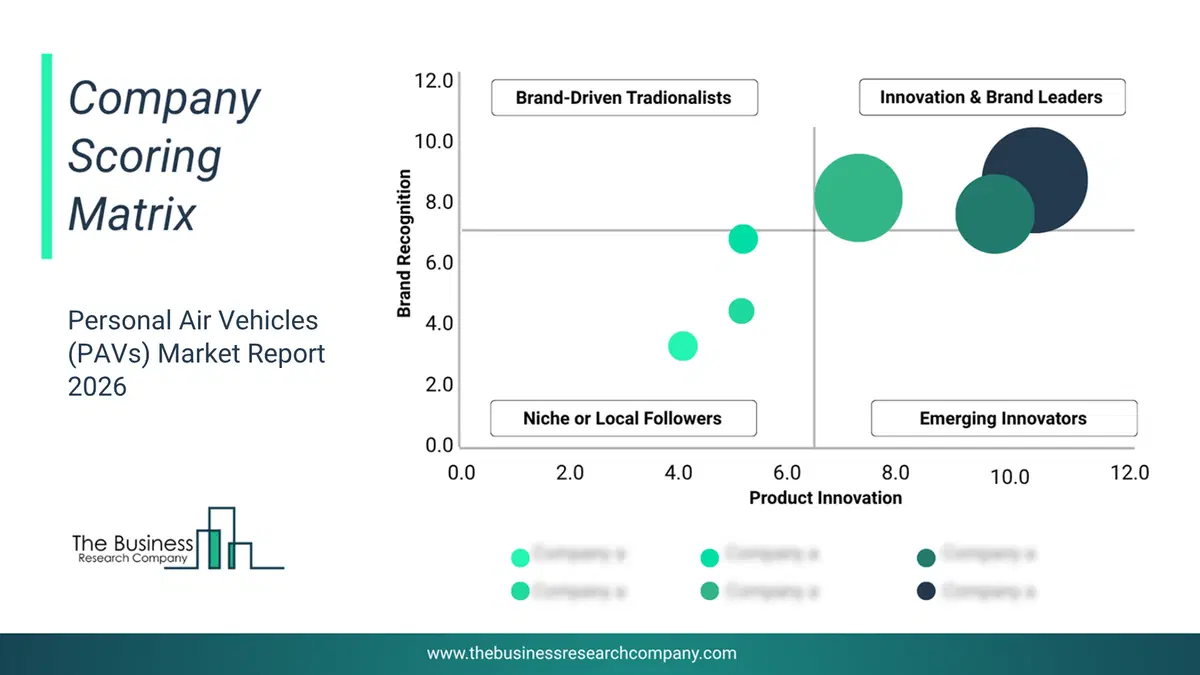
This chart maps companies by product innovation and brand strength, with bubble size indicating relative revenue, helping identify market leaders, challengers, and niche players. This is an illustrative chart; the full report provides a complete and accurate competitive analysis.
Global Personal Air Vehicles (PAVs) Market Trends and Insights
Major companies operating in the personal air vehicles (PAVs) market are focusing on adopting strategic partnerships to expand manufacturing capabilities and enhance next-generation air mobility solutions. Strategic partnerships are alliances between organizations that combine strengths, resources, and expertise to achieve shared objectives, driving long-term value creation, innovation, and competitive advantage rather than short-term gains. For instance, in June 2025, AIR, a US-based aircraft company, partnered with EDAG Group, a Germany-based engineering company, to develop and manufacture the main aircraft structure for its AIR ONE eVTOL production model. The collaboration aims to enable scalable, high-quality manufacturing for both manned and unmanned variants, featuring a modular aluminum frame with innovations such as folding wings and expanded cabin space to serve personal and enterprise needs. This partnership accelerates assembly and commercial ramp-up, with the first structures already delivered for ongoing production and planned customer deliveries.What Are Latest Mergers And Acquisitions In The Personal Air Vehicles (PAVs) Market?
In February 2024, BAE Systems plc, a UK-based aerospace company, acquired Malloy Aeronautics Limited for an undisclosed amount. With this acquisition, BAE Systems aims to integrate Malloy Aeronautics’ unmanned aerial systems (UAS) expertise to strengthen its advanced air mobility solutions and expand its portfolio in next-generation defense technologies. Malloy Aeronautics Limited is a UK-based aerospace company specializing in personal air vehicle (PAV) solutions.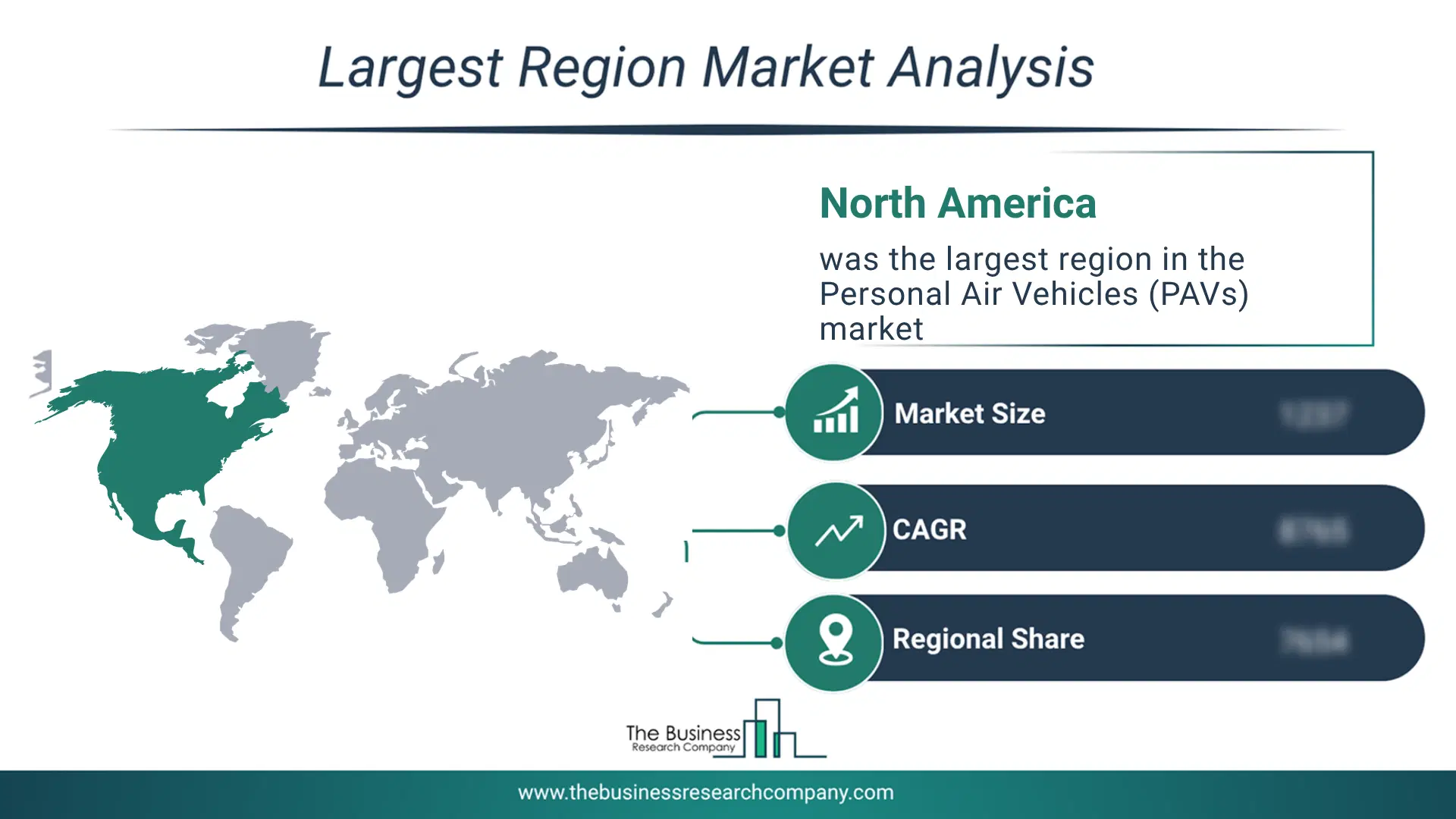
Regional Outlook
North America was the largest region in the personal air vehicles (PAVs) market in 2025. The regions covered in this market report include Asia-Pacific, South East Asia, Western Europe, Eastern Europe, North America, South America, Middle East, Africa. The countries covered in this market report include Australia, Brazil, China, France, Germany, India, Indonesia, Japan, Taiwan, Russia, South Korea, UK, USA, Canada, Italy, SpainWhat Defines the Personal Air Vehicles (PAVs) Market?
The personal air vehicles (PAVs) market consists of revenues earned by entities by providing services such as urban air mobility solutions, autonomous air transportation, air traffic management, and sustainable personal aviation solutions. The market value includes the value of related goods sold by the service provider or included within the service offering. The personal air vehicles (PAVs) market also includes sales of airframes, electric propulsion systems, and autonomous navigation systems. Values in this market are ‘factory gate’ values, that is, the value of goods sold by the manufacturers or creators of the goods, whether to other entities (including downstream manufacturers, wholesalers, distributors, and retailers) or directly to end customers. The value of goods in this market includes related services sold by the creators of the goods.How is Market Value Defined and Measured?
The market value is defined as the revenues that enterprises gain from the sale of goods and/or services within the specified market and geography through sales, grants, or donations in terms of the currency (in USD unless otherwise specified). The revenues for a specified geography are consumption values that are revenues generated by organizations in the specified geography within the market, irrespective of where they are produced. It does not include revenues from resales along the supply chain, either further along the supply chain or as part of other products.
This chart presents market attractiveness based on a quantitative evaluation of growth, competition, strategic alignment, and risk, offering a clear view of opportunity areas for decision-making. This chart is for illustrative purposes; the full report contains the complete analysis.

This chart highlights the Total Addressable Market (TAM) by estimating the maximum revenue opportunity using an assumption-driven approach, supporting strategic planning and opportunity sizing across markets. The chart is illustrative; the full report provides a more comprehensive analysis.
What Key Data and Analysis Are Included in the Personal Air Vehicles (PAVs) Market Report 2026?
The personal air vehicles (pavs) market research report is one of a series of new reports from The Business Research Company that provides market statistics, including industry global market size, regional shares, competitors with the market share, detailed market segments, market trends and opportunities, and any further data you may need to thrive in the personal air vehicles (pavs) industry. The market research report delivers a complete perspective of everything you need, with an in-depth analysis of the current and future state of the industry.Personal Air Vehicles (PAVs) Market Report Forecast Analysis
| Report Attribute | Details |
|---|---|
| Market Size Value In 2026 | $2.36 billion |
| Revenue Forecast In 2030 | $4.96 billion |
| Growth Rate | CAGR of 21.0% from 2026 to 2030 |
| Base Year For Estimation | 2025 |
| Actual Estimates/Historical Data | 2020-2025 |
| Forecast Period | 2026 - 2030 - 2030 |
| Market Representation | Revenue in USD Billion and CAGR from 2026 to 2030 |
| Segments Covered | Product Type, Technology, Distribution Channel, Application, End-User |
| Regional Scope | Asia-Pacific, Western Europe, Eastern Europe, North America, South America, Middle East, Africa |
| Country Scope | The countries covered in the report are Australia, Brazil, China, France, Germany, India, Indonesia, Japan, Taiwan, Russia, South Korea, UK, USA, Canada, Italy, Spain. |
| Key Companies Profiled | Hyundai Motor Company, The Boeing Company, Airbus SE, EmbraerX Inc., Moog Inc., Bell Textron Inc., Hanwha Systems Co. Ltd., Aston Martin Lagonda Global Holdings plc, Lilium GmbH, Archer Aviation Inc., Volocopter GmbH, Vertical Aerospace Ltd., SkyDrive Inc., Eve Air Mobility Inc., Opener Inc., PAL-V International B.V., EHang Holdings Limited, Pivotal Aero Inc., Joby Aviation Inc., Samson Sky LLC |
| Customization Scope | Request for Customization |
| Pricing And Purchase Options | Explore Purchase Options |