
Personal Computer Cards And Modems Market Report 2026
Global Outlook – By Product Type (Memory Cards, Modems, Network Interface Cards, Embedded Communication Modules, Other Product Types), By Form Factor (Internal, External, Removable (PC Card Slot), Integrated (Motherboard-Level)), By Technology (Wired Communication Technology, Wireless Communication Technology, Broadband Technology, Cellular Technology, Other Technologies), By Distribution Channel (Online, Offline), By Application (Residential, Commercial, Industrial, Education, Government) – Market Size, Trends, Strategies, and Forecast to 2030
Personal Computer Cards And Modems Market Overview
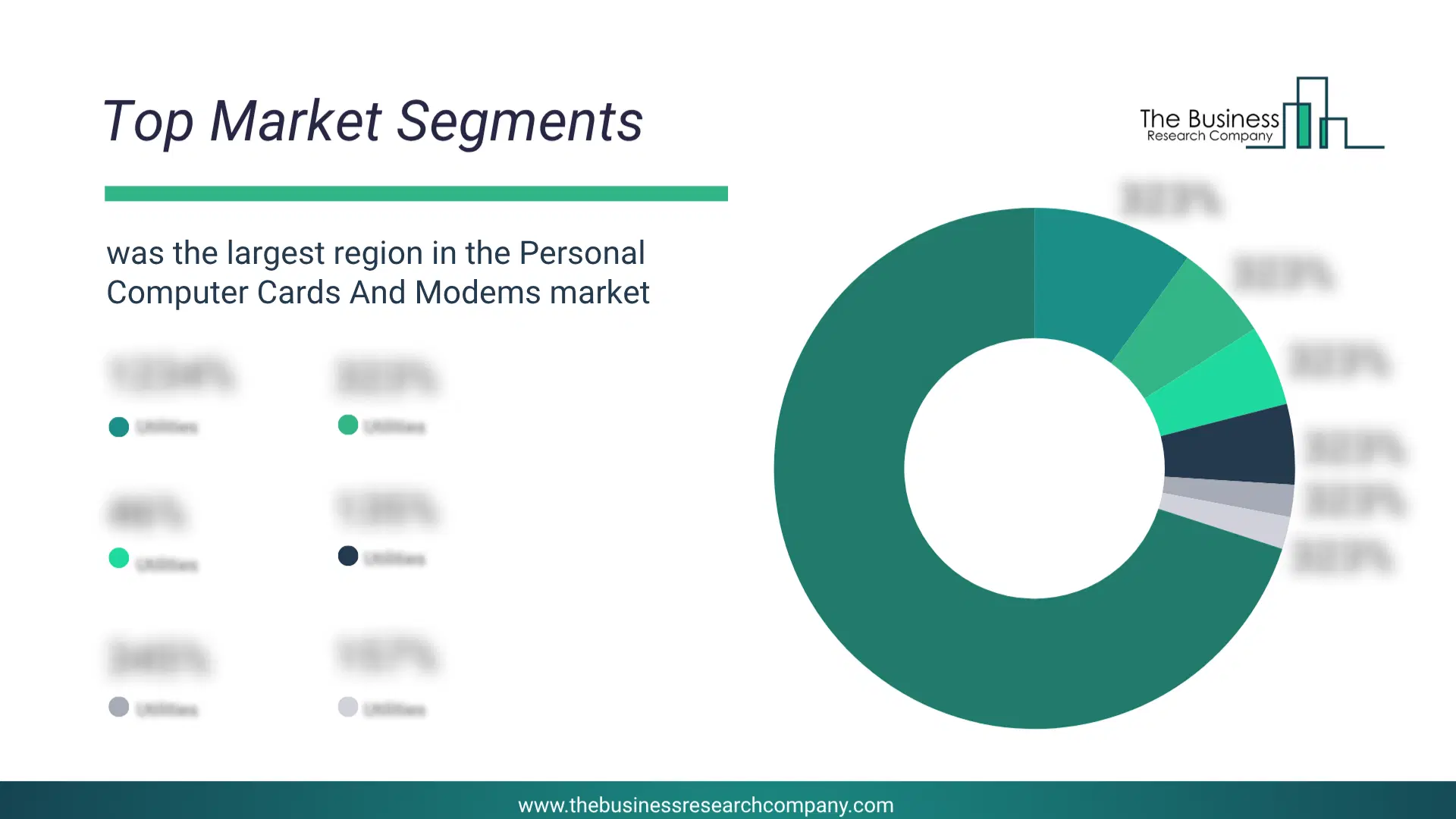
• Personal Computer Cards And Modems market size has reached to $7.09 billion in 2025 • Expected to grow to $7.47 billion in 2030 at a compound annual growth rate (CAGR) of 5.5% • Growth Driver: Increasing Demand For High-speed Internet Connectivity Driving The Growth Of The Market Due To Rising Need For Faster Data Processing And Transmission • Market Trend: Advancements In Power-Efficient High-Speed Memory And Data Transmission Technologies • North America was the largest region in 2025 and Asia-Pacific is the fastest growing region.What Is Covered Under Personal Computer Cards And Modems Market?
Personal computer cards and modems are hardware components used to enable connectivity and communication for computing devices, allowing systems to access wired or wireless networks and transmit data efficiently. PC cards provide expandable interface capabilities for laptops and legacy computing systems, while modems convert digital signals into transmission formats suitable for communication over telecommunication networks. These components support reliable data exchange, network access, and system interoperability in client computing environments. The main product types of the personal computer cards and modems are memory cards, modems, network interface cards, embedded communication modules, and other product types. Memory cards refer to storage devices used to expand data storage capacity in personal computers and enable efficient data transfer. These components are available in various form factors, including internal, external, removable (PC card slot), and integrated (motherboard-level). They are based on different technologies, such as wired communication technology, wireless communication technology, broadband technology, cellular technology, and other technologies, and are distributed through online and offline channels. They are used across multiple applications, including residential, commercial, industrial, education, and government.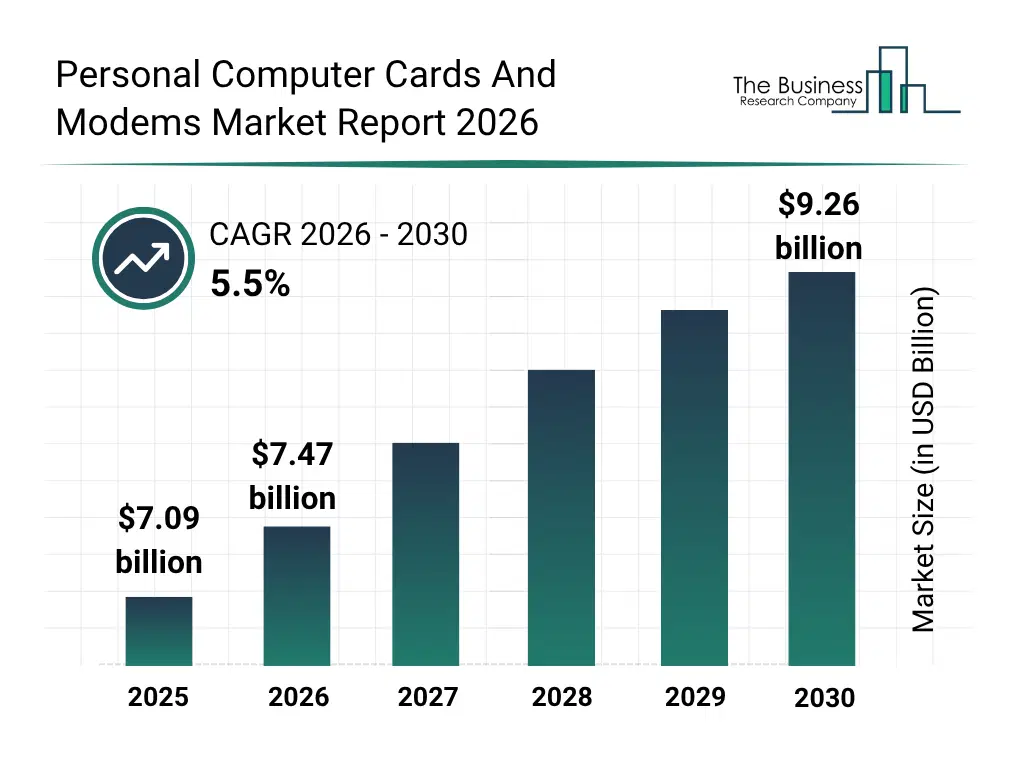
What Is The Personal Computer Cards And Modems Market Size and Share 2026?
The personal computer cards and modems market size has grown strongly in recent years. It will grow from $7.09 billion in 2025 to $7.47 billion in 2026 at a compound annual growth rate (CAGR) of 5.3%. The growth in the historic period can be attributed to rise of broadband internet adoption, expansion of laptop and personal computing usage, need for portable connectivity solutions, growth of enterprise networking requirements, evolution of dial up to broadband transition.What Is The Personal Computer Cards And Modems Market Growth Forecast?
The personal computer cards and modems market size is expected to see strong growth in the next few years. It will grow to $9.26 billion by 2030 at a compound annual growth rate (CAGR) of 5.5%. The growth in the forecast period can be attributed to expansion of iot connected devices ecosystem, increasing demand for high speed wireless connectivity, growth of edge computing enabled devices, rising adoption of hybrid work computing environments, advancement in 5G and private network infrastructure. Major trends in the forecast period include 5G and advanced cellular modem integration, wi fi 6 and wi fi 7 enabled connectivity modules, usb based plug and play networking expansion, embedded ioT communication modules adoption, edge enabled wireless network interface card evolution.
Global Personal Computer Cards And Modems Market Segmentation
1) By Product Type: Memory Cards, Modems, Network Interface Cards, Embedded Communication Modules, Other Product Types 2) By Form Factor: Internal, External, Removable (PC Card Slot), Integrated (Motherboard-Level) 3) By Technology: Wired Communication Technology, Wireless Communication Technology, Broadband Technology, Cellular Technology, Other Technologies 4) By Distribution Channel: Online, Offline 5) By Application: Residential, Commercial, Industrial, Education, Government Subsegments: 1) By Memory Cards: SD Cards, MicroSD Cards, CompactFlash Cards, Memory Stick Cards, SmartMedia Cards 2) By Modems: Dial-Up Modems, Digital Subscriber Line (DSL) Modems, Cable Modems, Cellular Modems, Satellite Modems 3) By Network Interface Cards: Ethernet Network Interface Cards (NICs), Wireless Network Interface Cards (NICs) (Wi-Fi Cards), Fiber Optic Network Interface Cards (NICs), Token Ring Network Interface Cards (NICs) 4) By Embedded Communication Modules: Wi-Fi Modules, Bluetooth Modules, Cellular Modules (LTE/5G), GNSS Modules, Zigbee Modules 5) By Other Product Types: USB Adapters, Dongles, Repeaters And Extenders, Media Converters, Hubs And BridgesWhat Is The Driver Of The Personal Computer Cards And Modems Market?
The increasing demand for high-speed internet connectivity is expected to propel the growth of the personal computer memory cards and modems market going forward. High-speed internet connectivity refers to the availability of fast and reliable internet access that enables efficient data transmission for activities such as streaming, cloud computing, online gaming, and video conferencing. High-speed internet connectivity is increasing due to the rising demand for data-intensive applications such as video streaming, cloud computing, online gaming, and remote work, which require faster and more reliable network performance. Personal computer memory cards and modems support high-speed internet connectivity by enabling efficient data storage, processing, and transmission between devices and networks, ensuring faster access to digital applications and services. For instance, in November 2025, according to a Ofcom, a UK–based regulator for telecommunications, media, and broadcasting, gigabit-capable broadband network coverage across UK residential premises increased to 87%, up from 83% in 2024. Therefore, increasing demand for high-speed internet connectivity is driving the growth of the personal computer memory cards and modems market.Key Players In The Global Personal Computer Cards And Modems Market
Major companies operating in the personal computer cards and modems market are Samsung Electronics Co. Ltd.; Qualcomm Technologies Inc.; ZTE Corporation; Quectel Wireless Solutions Co. Ltd.; Fibocom Wireless Inc.; NETGEAR Inc.; Digi International Inc.; Telit Cinterion Deutschland GmbH; Hitron Technologies Inc.; Inseego Corp.; D-Link Corporation; Lantronix Inc.; TRENDnet Inc.; Option NV; Raveon Technologies Corporation; Radicom Research Inc.; Multi-Tech Systems Inc.; Gateworks Corporation; Bausch Datacom NV; Nimbus Technologies Private Limited
This chart is for illustrative purposes; the full report includes a detailed competitor analysis and comprehensive overview of the top 10 companies in the market.
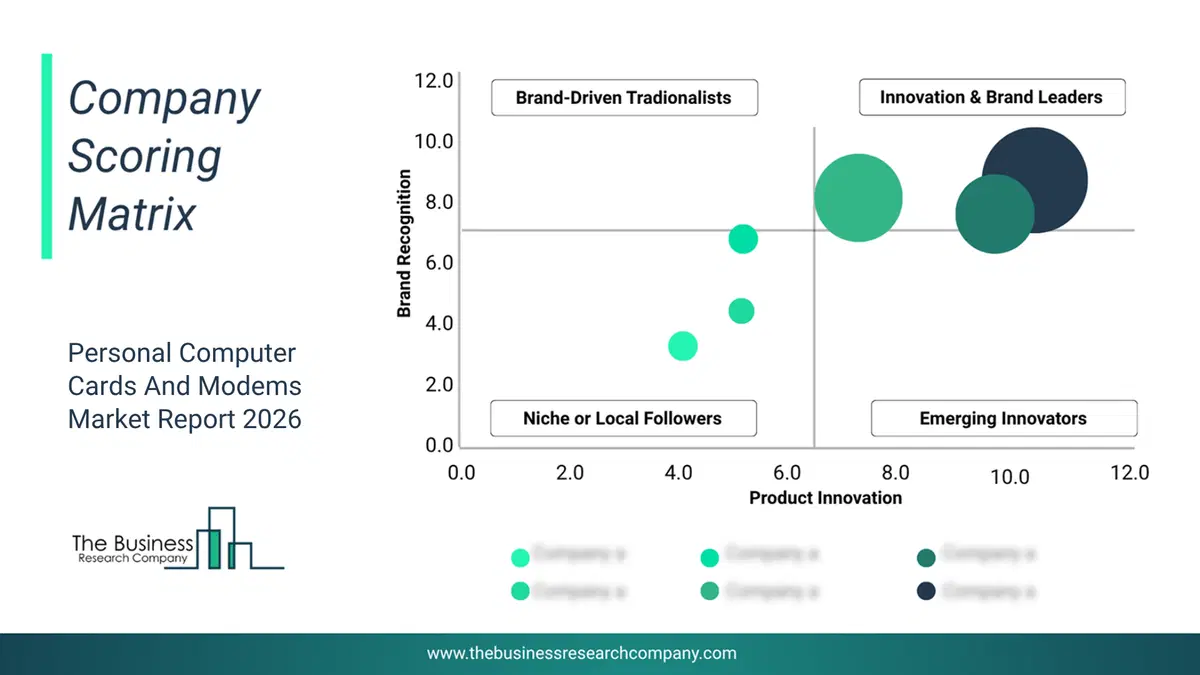
This chart maps companies by product innovation and brand strength, with bubble size indicating relative revenue, helping identify market leaders, challengers, and niche players. This is an illustrative chart; the full report provides a complete and accurate competitive analysis.
Global Personal Computer Cards And Modems Market Trends and Insights
Major companies operating in the personal computer memory cards and modems market are focusing on technological advancements in high-speed data transmission modems, such as power efficiency enhancement, to gain a competitive edge, improve device performance, and meet the growing demand for faster, more reliable connectivity solutions across consumer and enterprise applications. Power efficiency enhancement refers to the improvement of a device’s ability to deliver higher performance while consuming less electrical power. For instance, in January 2024, Micron Technology, a US-based semiconductor company specializing in memory and storage solutions, launched LPCAMM2 (Low Power Compression Attached Memory Module) for laptops, designed to deliver higher performance, improved power efficiency, and a compact form factor. The module is based on LPDDR5X DRAM technology and offers significantly faster data transfer speeds, reduced power consumption, and up to 64% space savings compared to traditional SODIMM modules. Additionally, the solution supports modularity and upgradeability, enabling flexible system design, improved battery life, and enhanced performance for next-generation and AI-enabled laptops.What Are Latest Mergers And Acquisitions In The Personal Computer Cards And Modems Market?
In June 2025, CMS Distribution Limited, a UK-based technology distribution company, entered into a strategic partnership with Lexar Co., Ltd. for an undisclosed amount. With this partnership, CMS Distribution aims to expand its memory and storage portfolio across the UK and Europe, strengthening its presence in the personal computer memory cards and modems market while enhancing product availability through its distribution network. Lexar Co., Ltd. is a US-based technology company that specializes in providing high-performance memory solutions, including memory cards, USB flash drives, SSDs, and storage products for consumer and professional use.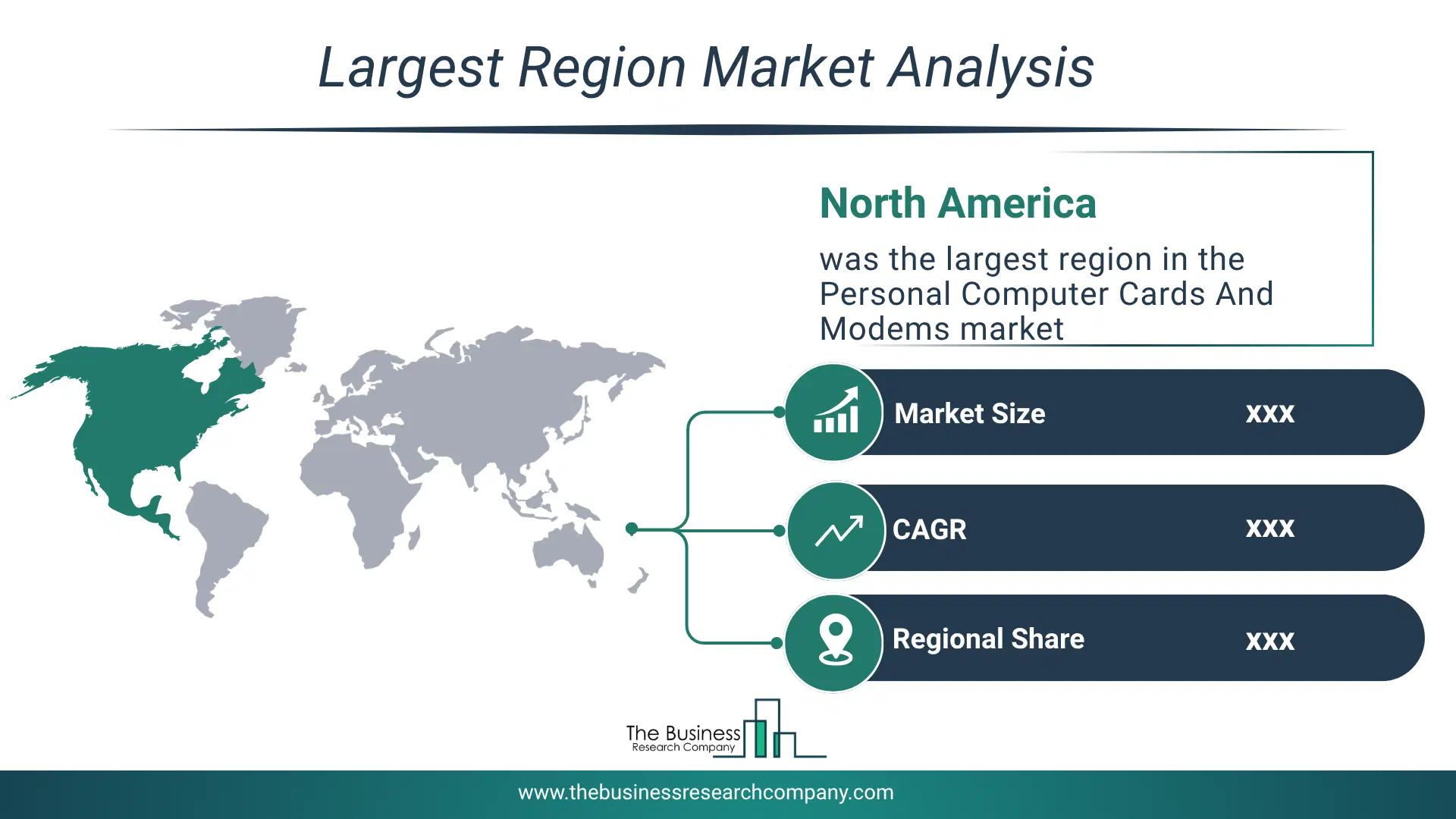
Regional Insights
North America was the largest region in the personal computer memory cards and modems market in 2025. Asia-Pacific is expected to be the fastest-growing region in the forecast period. The regions covered in this market report are Asia-Pacific, South East Asia, Western Europe, Eastern Europe, North America, South America, Middle East, Africa. The countries covered in this market report are Australia, Brazil, China, France, Germany, India, Indonesia, Japan, Taiwan, Russia, South Korea, UK, USA, Canada, Italy, Spain.What Defines the Personal Computer Cards And Modems Market?
The personal computer cards and modems market consists of sales internal and external modems, wireless network interface cards, and embedded communication modules. Values in this market are ‘factory gate’ values, that is the value of goods sold by the manufacturers or creators of the goods, whether to other entities (including downstream manufacturers, wholesalers, distributors and retailers) or directly to end customers. The value of goods in this market includes related services sold by the creators of the goods.How is Market Value Defined and Measured?
The market value is defined as the revenues that enterprises gain from the sale of goods and/or services within the specified market and geography through sales, grants, or donations in terms of the currency (in USD unless otherwise specified). The revenues for a specified geography are consumption values that are revenues generated by organizations in the specified geography within the market, irrespective of where they are produced. It does not include revenues from resales along the supply chain, either further along the supply chain or as part of other products.
This chart presents market attractiveness based on a quantitative evaluation of growth, competition, strategic alignment, and risk, offering a clear view of opportunity areas for decision-making. This chart is for illustrative purposes; the full report contains the complete analysis.

This chart highlights the Total Addressable Market (TAM) by estimating the maximum revenue opportunity using an assumption-driven approach, supporting strategic planning and opportunity sizing across markets. The chart is illustrative; the full report provides a more comprehensive analysis.
What Key Data and Analysis Are Included in the Personal Computer Cards And Modems Market Report 2026?
The personal computer cards and modems market research report is one of a series of new reports from The Business Research Company that provides market statistics, including industry global market size, regional shares, competitors with the market share, detailed market segments, market trends and opportunities, and any further data you may need to thrive in the personal computer cards and modems industry. The market research report delivers a complete perspective of everything you need, with an in-depth analysis of the current and future state of the industry.Personal Computer Cards And Modems Market Report Forecast Analysis
| Report Attribute | Details |
|---|---|
| Market Size Value In 2026 | $7.47 billion |
| Revenue Forecast In 2030 | $9.26 billion |
| Growth Rate | CAGR of 5.50% from 2026 to 2030 |
| Base Year For Estimation | 2025 |
| Actual Estimates/Historical Data | 2020-2025 |
| Forecast Period | 2026 - 2030 |
| Market Representation | Revenue in USD Billion and CAGR from 2026 to 2030 |
| Segments Covered | Product Type, Form Factor, Technology, Distribution Channel, Application |
| Regional Scope | Asia-Pacific, Western Europe, Eastern Europe, North America, South America, Middle East, Africa |
| Country Scope | The countries covered in the report are Australia, Brazil, China, France, Germany, India, Indonesia, Japan, Taiwan, Russia, South Korea, UK, USA, Canada, Italy, Spain. |
| Key Companies Profiled | Samsung Electronics Co. Ltd.; Qualcomm Technologies Inc.; ZTE Corporation; Quectel Wireless Solutions Co. Ltd.; Fibocom Wireless Inc.; NETGEAR Inc.; Digi International Inc.; Telit Cinterion Deutschland GmbH; Hitron Technologies Inc.; Inseego Corp.; D-Link Corporation; Lantronix Inc.; TRENDnet Inc.; Option NV; Raveon Technologies Corporation; Radicom Research Inc.; Multi-Tech Systems Inc.; Gateworks Corporation; Bausch Datacom NV; Nimbus Technologies Private Limited |
| Customization Scope | Request for Customization |
| Pricing And Purchase Options | Explore Purchase Options |