

Personal Computer (PC) Power Policy Management Market Report 2026
Global Outlook – By Component (Software, Hardware, Services), By Deployment Mode (On Premises, Cloud), By Enterprise Size (Small And Medium Enterprises, Large Enterprises), By Application (Energy Management, Security And Compliance, System Optimization, Other Applications), By End User (Banking, Financial Services, And Insurance, Healthcare, Information Technology And Telecommunications, Government, Education, Manufacturing, Other End Users) – Market Size, Trends, Strategies, and Forecast to 2030
Personal Computer (PC) Power Policy Management Market Overview
• Personal Computer (PC) Power Policy Management market size has reached to $1.51 billion in 2025 • Expected to grow to $2.81 billion in 2030 at a compound annual growth rate (CAGR) of 13.2% • Growth Driver: Surge In Remote And Hybrid Work Models Driving The Market Growth Due To Increasing Demand For Centralized Device Management • North America was the largest region in 2025 and Asia-Pacific is the fastest growing region.What Is Covered Under Personal Computer (PC) Power Policy Management Market?
Personal computer (PC) power policy management refers to a set of software-based rules and controls used to regulate energy consumption and power states in personal computers. It enables automated management of functions such as sleep, hibernation, and processor performance based on user behavior or organizational policies. The system integrates power control and monitoring features to reduce energy usage, extend hardware lifespan, and support efficient device operation. The main components of personal computer (PC) power policy management are software, hardware, and services. Software refers to solutions that enable organizations to configure, monitor, and enforce power management policies across PCs to optimize energy usage and ensure compliance. These solutions are deployed through on-premises and cloud deployment modes. They are designed for organizations of different enterprise sizes, including small and medium enterprises and large enterprises, and are applied across applications, such as energy management, security and compliance, system optimization, and other applications. They serve multiple end-users, including banking, financial services, and insurance; healthcare; information technology and telecommunications; government; education; manufacturing; and other end users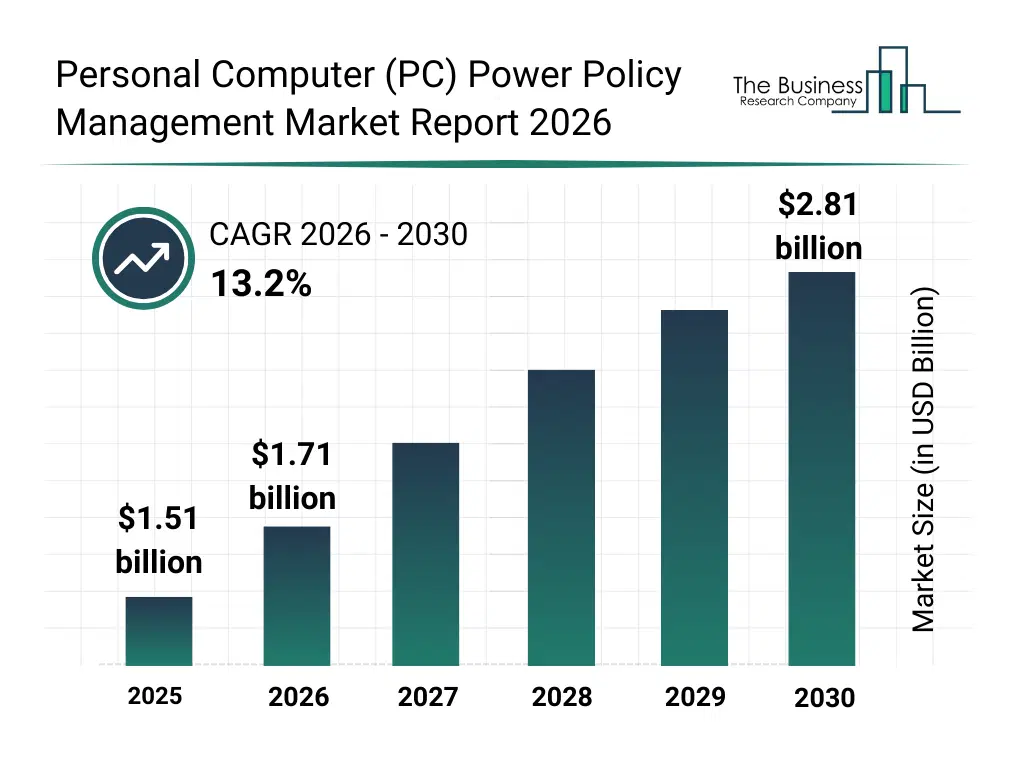
What Is The Personal Computer (PC) Power Policy Management Market Size and Share 2026?
The personal computer (pc) power policy management market size has grown rapidly in recent years. It will grow from $1.51 billion in 2025 to $1.71 billion in 2026 at a compound annual growth rate (CAGR) of 12.9%. The growth in the historic period can be attributed to enterprise energy saving initiatives, growth in endpoint management tools, rising electricity costs, green IT programs, expansion of corporate device fleets.What Is The Personal Computer (PC) Power Policy Management Market Growth Forecast?
The personal computer (pc) power policy management market size is expected to see rapid growth in the next few years. It will grow to $2.81 billion in 2030 at a compound annual growth rate (CAGR) of 13.2%. The growth in the forecast period can be attributed to net zero it targets, stricter enterprise energy audits, growth in remote device management, expansion of smart workplace programs, rising carbon reporting requirements. Major trends in the forecast period include automated endpoint power scheduling, AI based energy optimization policies, centralized device power dashboards, remote pc power governance tools, user behavior based power rules.
Global Personal Computer (PC) Power Policy Management Market Segmentation
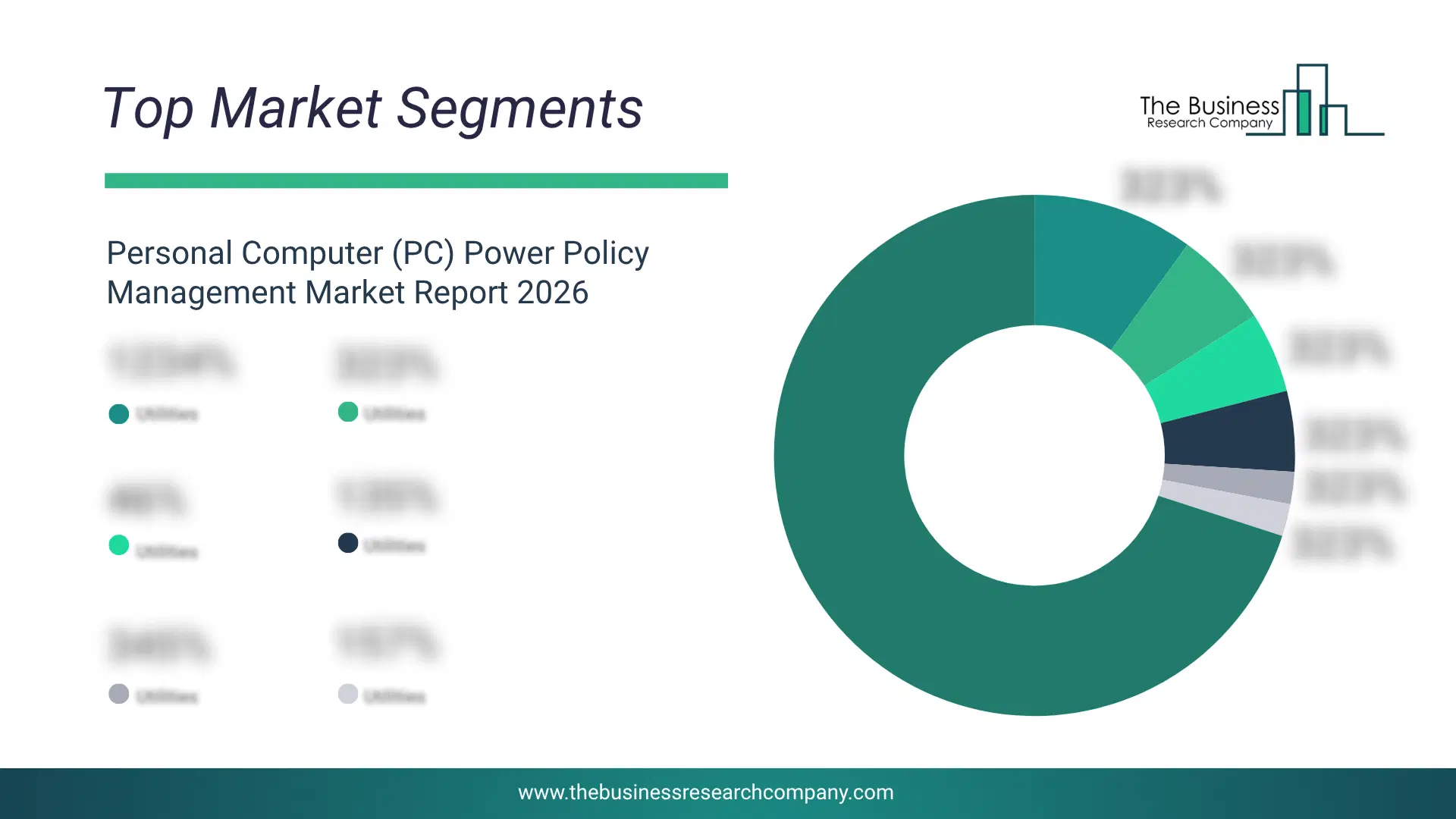
1) By Component: Software; Hardware; Services 2) By Deployment Mode: On Premises; Cloud 3) By Enterprise Size: Small And Medium Enterprises; Large Enterprises 4) By Application: Energy Management; Security And Compliance; System Optimization; Other Applications 5) By End User: Banking, Financial Services, And Insurance; Healthcare; Information Technology And Telecommunications; Government; Education; Manufacturing; Other End Users Subsegments: 1) By Software: Energy Management Software; Power Monitoring Software; Policy Automation Software; Analytics Software; Optimization Software 2) By Hardware: Power Controllers; Energy Meters; Smart Plugs; Sensors; Power Distribution Units 3) By Services: Consulting Services; Implementation Services; Maintenance Services; Training Services; Support ServicesWhat Are The Drivers Of The Personal Computer (PC) Power Policy Management Market?
The surge in remote and hybrid work models is expected to propel the growth of the PC power policy management market going forward. Remote and hybrid work models refer to flexible work arrangements where employees perform their job duties from locations outside traditional office settings, either entirely or on a part-time basis. Remote and hybrid work models are rising due to advancements in digital collaboration tools, growing employee demand for flexible work arrangements, and organizations aiming to reduce office costs while maintaining productivity. PC power policy management supports remote and hybrid work models by enabling IT administrators to centrally monitor, control, and optimize the power usage of distributed endpoints, ensuring energy efficiency, reducing operational costs, and maintaining consistent device performance across employees working from any location. For instance, in March 2025, according to the U.S. Bureau of Labor Statistics, a US-based federal government agency, in the first quarter of 2024, 35.5 million people worked from home or teleworked for pay, an increase of 5.1 million compared with the previous year. These workers made up 22.9% of all employed individuals during the period, up from 19.6% in the same quarter of the prior year. Therefore, the surge in remote and hybrid work models is driving the growth of the PC power policy management market. The escalating emphasis on energy efficiency is expected to propel the growth of the PC power policy management market going forward. Energy efficiency emphasis refers to the increasing organizational and governmental focus on reducing energy consumption and optimizing power usage across facilities, equipment, and operations to minimize costs and environmental impact. Emphasis on energy efficiency is rising due to increasing energy costs, which is pushing organizations to adopt PC power policy management solutions to lower electricity expenses, reduce energy waste, and improve operational efficiency. PC power policy management supports the emphasis on energy efficiency by enabling organizations to automatically control, monitor, and optimize PC power usage through intelligent policies, thereby reducing energy waste, lowering electricity costs, and improving overall operational sustainability. For instance, in March 2024, according to the Department for Energy Security and Net Zero, a UK-based government department, national energy efficiency programs such as the Energy Company Obligation (ECO) continued to expand in 2023, delivering 265,000 efficiency measures, a 61% increase compared to 2022, reflecting the strengthening policy and regulatory focus on energy efficiency across the economy. Therefore, the escalating emphasis on energy efficiency is driving the growth of the PC power policy management market. The rising digital transformation initiatives are expected to propel the growth of the PC power policy management market going forward. Digital transformation initiatives refer to strategic organizational efforts to integrate digital technologies across all business operations to fundamentally change how companies operate and deliver value to customers. Digital transformation initiatives are rising due to organizations need to improve operational efficiency by automating processes, optimizing resource usage, and enabling faster, data-driven decision-making. Digital transformation initiatives support PC power policy management by enabling centralized, automated, and data-driven control over enterprise-wide PC power usage, helping organizations optimize energy consumption, reduce operational costs, ensure policy compliance, and efficiently manage increasingly distributed and digital work environments. For instance, in November 2023, according to the Central Digital and Data Office (CDDO), a UK-based government agency, from April 2022 to April 2023, the Government Digital and Data profession saw a 19% increase in its workforce, strengthening vital digital skills across the civil service, while 32 organisations adopted the common Government Digital and Data pay framework, helping cut reliance on contractors and deliver savings for taxpayers. Therefore, rising digital transformation initiatives are driving the growth of the PC power policy management market.Key Players In The Global Personal Computer (PC) Power Policy Management Market
Major companies operating in the personal computer (pc) power policy management market are Microsoft Corporation, Dell Technologies Inc., Siemens AG, Lenovo Group Limited, IBM Corporation, Cisco Systems Inc., Intel Corporation, Schneider Electric SE, ABB Ltd., Hewlett Packard Enterprise, Fujitsu Limited, Toshiba Corporation, Eaton Corporation plc, ASUSTeK Computer Inc., Delta Electronics Inc., Acer Inc., Panasonic Inc., Sunbird Software Inc., CyberPower Systems Inc., Verismic Software Inc.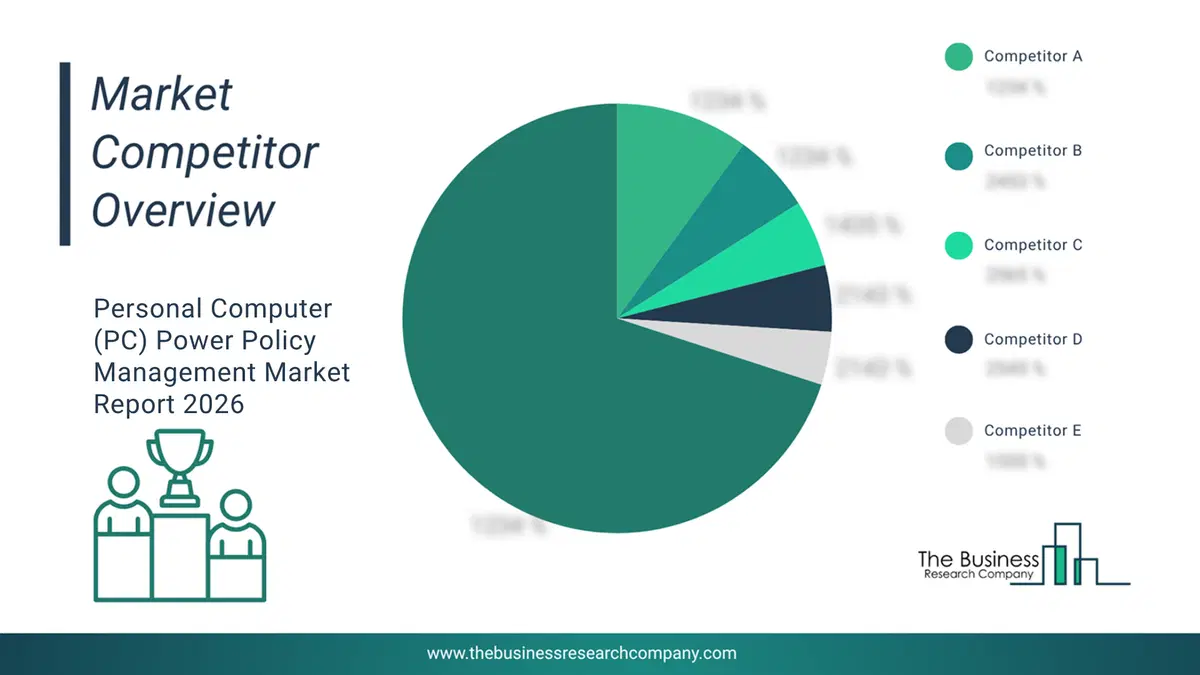
This chart is for illustrative purposes; the full report includes a detailed competitor analysis and comprehensive overview of the top 10 companies in the market.
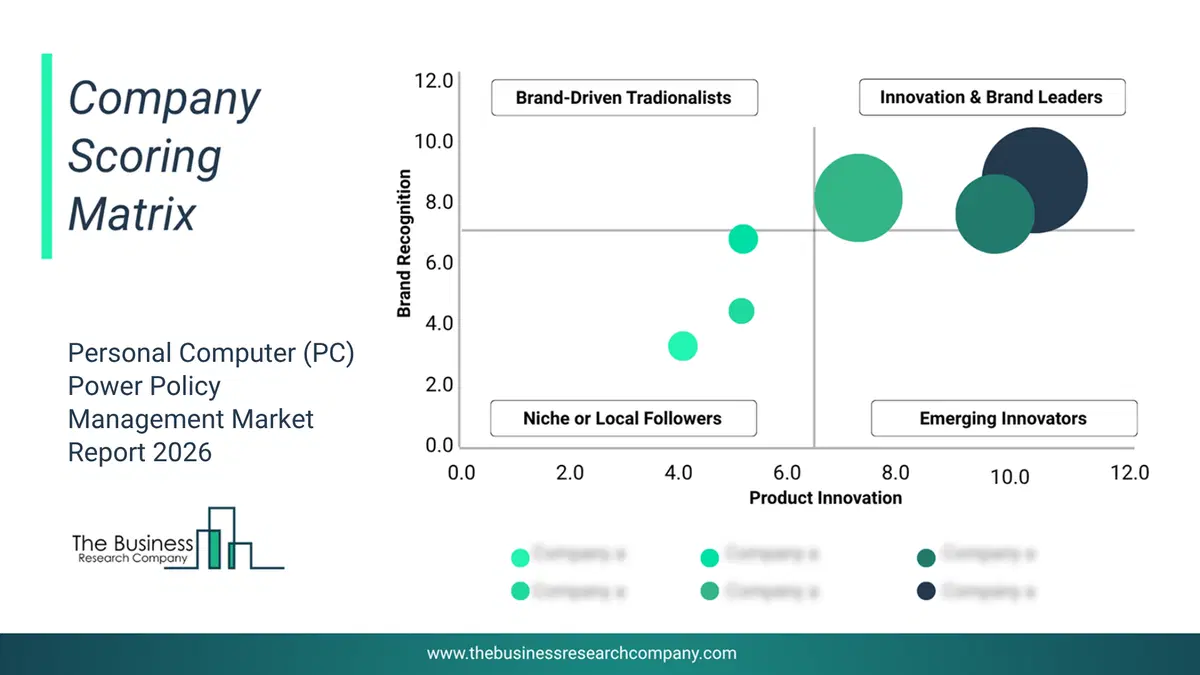
This chart maps companies by product innovation and brand strength, with bubble size indicating relative revenue, helping identify market leaders, challengers, and niche players. This is an illustrative chart; the full report provides a complete and accurate competitive analysis.
Regional Insights
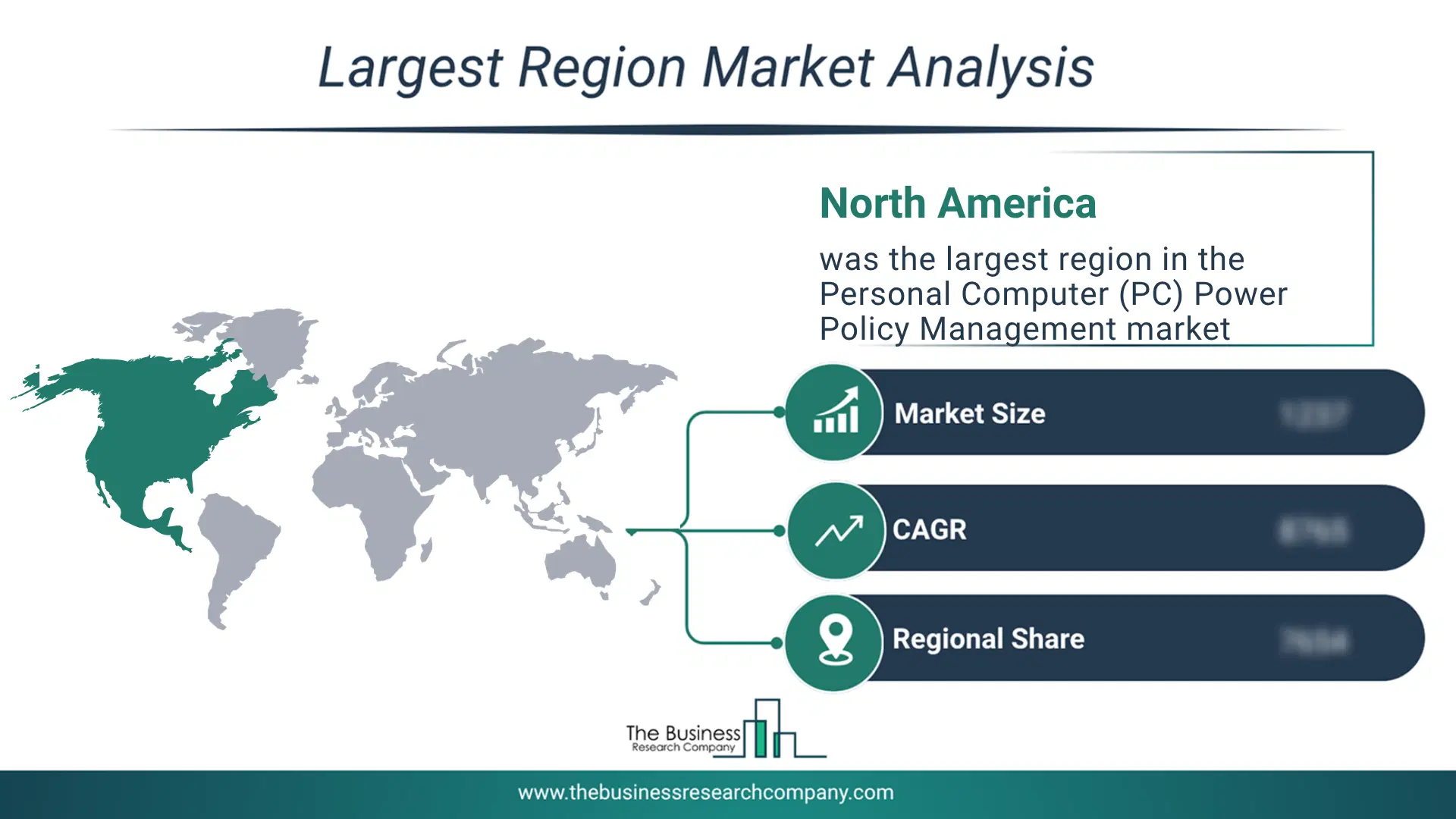
North America was the largest region in the pc power policy management market in 2025. Asia-Pacific is expected to be the fastest-growing region in the forecast period. The regions covered in this market report are Asia-Pacific, South East Asia, Western Europe, Eastern Europe, North America, South America, Middle East, Africa. The countries covered in this market report are Australia, Brazil, China, France, Germany, India, Indonesia, Japan, Taiwan, Russia, South Korea, UK, USA, Canada, Italy, Spain.What Defines the Personal Computer (PC) Power Policy Management Market?
The personal computer (PC) power policy management market consists of revenues earned by entities by providing services such as policy design and configuration services, deployment and integration services, monitoring and reporting services, energy usage analytics services and compliance and audit support services. The market value includes the value of related goods sold by the service provider or included within the service offering. The personal computer (PC) power policy management market includes sales of smart power meters, intelligent power strips, networked power switches, endpoint management appliances and energy monitoring sensors. Values in this market are ‘factory gate’ values, that is, the value of goods sold by the manufacturers or creators of the goods, whether to other entities (including downstream manufacturers, wholesalers, distributors, and retailers) or directly to end customers. The value of goods in this market includes related services sold by the creators of the goods.How is Market Value Defined and Measured?
The market value is defined as the revenues that enterprises gain from the sale of goods and/or services within the specified market and geography through sales, grants, or donations in terms of the currency (in USD unless otherwise specified). The revenues for a specified geography are consumption values that are revenues generated by organizations in the specified geography within the market, irrespective of where they are produced. It does not include revenues from resales along the supply chain, either further along the supply chain or as part of other products.
This chart presents market attractiveness based on a quantitative evaluation of growth, competition, strategic alignment, and risk, offering a clear view of opportunity areas for decision-making. This chart is for illustrative purposes; the full report contains the complete analysis.

This chart highlights the Total Addressable Market (TAM) by estimating the maximum revenue opportunity using an assumption-driven approach, supporting strategic planning and opportunity sizing across markets. The chart is illustrative; the full report provides a more comprehensive analysis.
What Key Data and Analysis Are Included in the Personal Computer (PC) Power Policy Management Market Report 2026?
The personal computer (pc) power policy management market research report is one of a series of new reports from The Business Research Company that provides market statistics, including industry global market size, regional shares, competitors with the market share, detailed market segments, market trends and opportunities, and any further data you may need to thrive in the personal computer (pc) power policy management industry. The market research report delivers a complete perspective of everything you need, with an in-depth analysis of the current and future state of the industry.Personal Computer (PC) Power Policy Management Market Report Forecast Analysis
| Report Attribute | Details |
|---|---|
| Market Size Value In 2026 | $1.71 billion |
| Revenue Forecast In 2030 | $2.81 billion |
| Growth Rate | CAGR of 13.2% from 2026 to 2030 |
| Base Year For Estimation | 2025 |
| Actual Estimates/Historical Data | 2020-2025 |
| Forecast Period | 2026 - 2030 |
| Market Representation | Revenue in USD Billion and CAGR from 2026 to 2030 |
| Segments Covered | Component, Deployment Mode, Enterprise Size, Application, End User |
| Regional Scope | Asia-Pacific, Western Europe, Eastern Europe, North America, South America, Middle East, Africa |
| Country Scope | The Countries Covered In This Market Report Are Australia, Brazil, China, France, Germany, India, Indonesia, Japan, Taiwan, Russia, South Korea, Uk, Usa, Canada, Italy, Spain. |
| Key Companies Profiled | Microsoft Corporation, Dell Technologies Inc., Siemens AG, Lenovo Group Limited, IBM Corporation, Cisco Systems Inc., Intel Corporation, Schneider Electric SE, ABB Ltd., Hewlett Packard Enterprise, Fujitsu Limited, Toshiba Corporation, Eaton Corporation plc, ASUSTeK Computer Inc., Delta Electronics Inc., Acer Inc., Panasonic Inc., Sunbird Software Inc., CyberPower Systems Inc., Verismic Software Inc. |
| Customization Scope | Request for Customization |
| Pricing And Purchase Options | Explore Purchase Options |