
Personal Computer (PC) Processor Market Report 2026
Global Outlook – By Product Type (Desktop Central Processing Units, Mobile Central Processing Units, Client Systems-On-Chip), By Architecture (Intel x86 Instruction Set Architecture, Arm-Based), By Power Class (Ultra-Low-Power, Mobile High-Performance, Desktop Standard, High-Thermal Design Power Unlocked), By Performance Tier (Entry-Level, Mainstream, Performance, Enthusiast Or Workstation), By End User (Consumer, Gaming, Professional, Enterprise) – Market Size, Trends, Strategies, and Forecast to 2030
Personal Computer (PC) Processor Market Overview
• Personal Computer (PC) Processor market size has reached to $101.5 billion in 2025 • Expected to grow to $145.48 billion in 2030 at a compound annual growth rate (CAGR) of 7.4% • Growth Driver: Surge In Hybrid Work, Remote Learning, And Digital Transformation Fueling The Growth Of The Market Due To Increasing Demand For Efficient Computing And Collaboration • Market Trend: Innovations In Artificial Intelligence (AI)-Enabled PC Processors Enhance Computing Performance And Productivity • North America was the largest region in 2025 and Asia-Pacific is the fastest growing region.What Is Covered Under Personal Computer (PC) Processor Market?
A personal computer (PC) processor is the primary computing component of a personal computer that executes instructions and performs calculations required for system operations. It interprets and processes data by following instructions from software programs, enabling the computer to perform tasks efficiently. A personal computer (PC) processor is commonly referred to as the central processing unit and acts as the core unit that manages overall system processing activities. The main product types of personal computer (PC) processor include desktop central processing units, mobile central processing units, and client systems-on-chip. Desktop central processing units refer to processors designed to provide high computational performance for desktop computers, supporting applications ranging from everyday productivity to demanding professional workloads. These processors are based on Intel x86 instruction set architecture and Arm-based architectures and are available across ultra-low-power, mobile high-performance, desktop standard, and high-thermal design power unlocked power classes. They are categorized into entry-level, mainstream, performance, and enthusiast or workstation performance tiers and are utilized by end users including consumer, gaming, professional, and enterprise.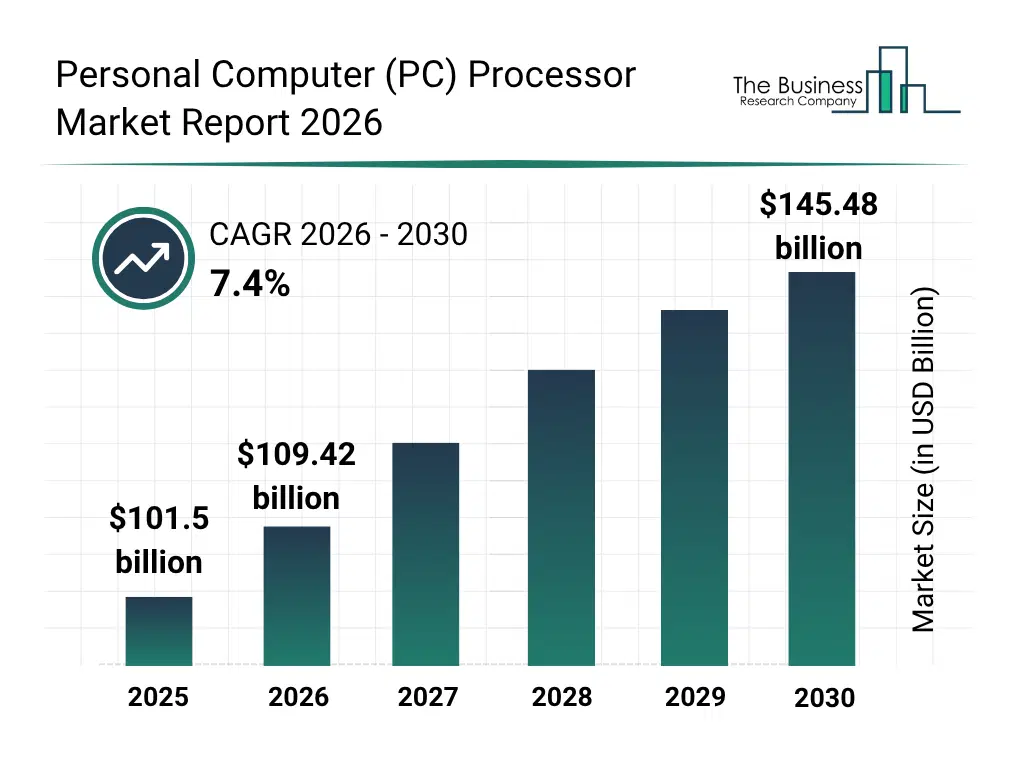
What Is The Personal Computer (PC) Processor Market Size and Share 2026?
The personal computer (pc) processor market size has grown strongly in recent years. It will grow from $101.5 billion in 2025 to $109.42 billion in 2026 at a compound annual growth rate (CAGR) of 7.8%. The growth in the historic period can be attributed to increasing personal computer shipments, rising demand for faster computing performance, growing adoption of laptops and mobile computing devices, increasing consumer demand for gaming PCs, expanding use of PCs for professional workloads.What Is The Personal Computer (PC) Processor Market Growth Forecast?
The personal computer (pc) processor market size is expected to see strong growth in the next few years. It will grow to $145.48 billion in 2030 at a compound annual growth rate (CAGR) of 7.4%. The growth in the forecast period can be attributed to rising demand for AI-enabled PC processors, increasing adoption of high-performance computing capabilities in consumer devices, growing demand for power-efficient mobile processors, increasing preference for advanced processor architectures, rising demand for processors supporting demanding gaming and workstation applications. Major trends in the forecast period include rising demand for higher processor core counts, increasing adoption of heterogeneous computing architectures, growing demand for energy-efficient PC processors, increasing integration of dedicated graphics capabilities, rising demand for advanced processor packaging and thermal management.
Global Personal Computer (PC) Processor Market Segmentation
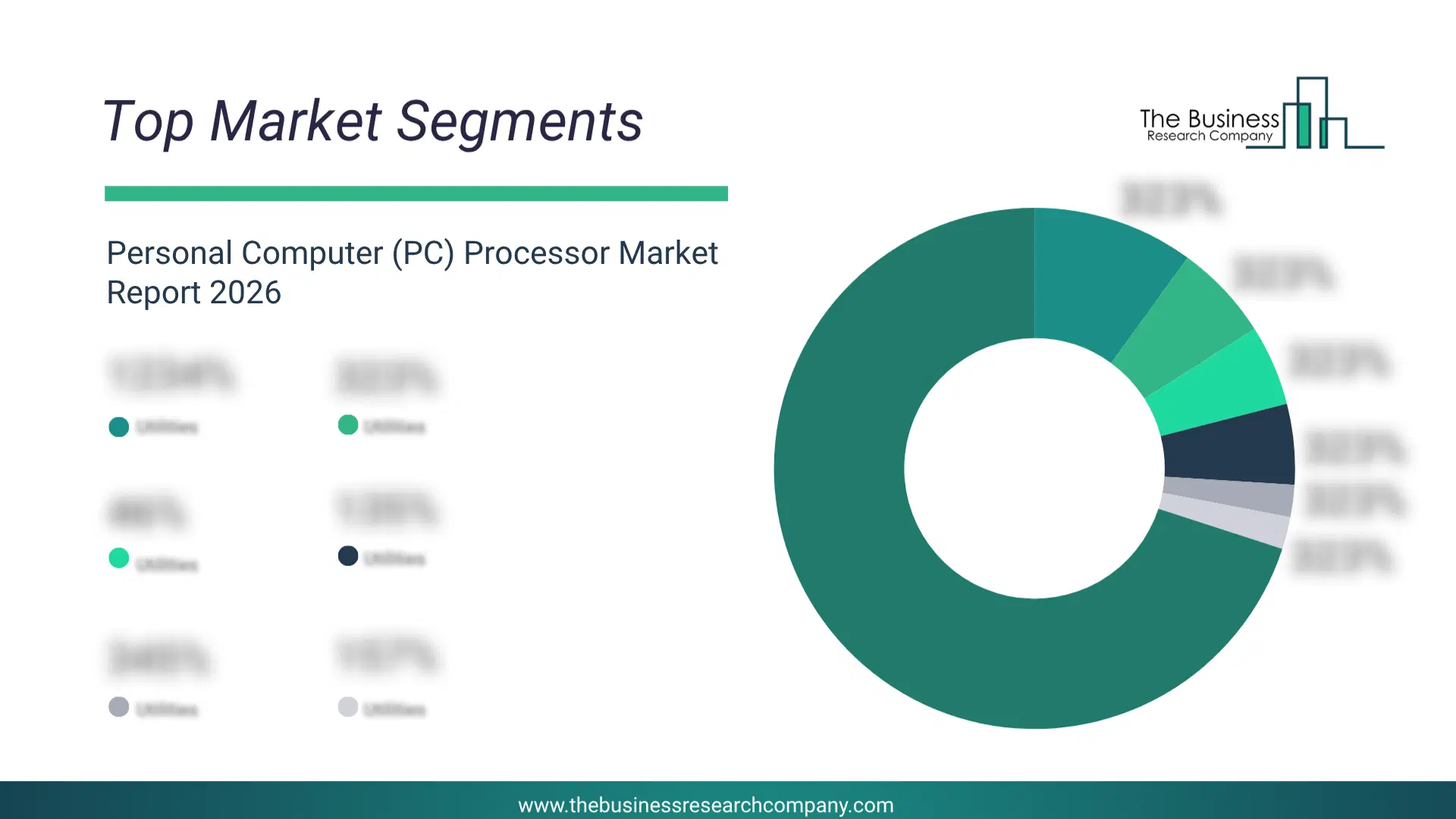
1) By Product Type: Desktop Central Processing Units, Mobile Central Processing Units, Client Systems-On-Chip 2) By Architecture: Intel x86 Instruction Set Architecture, Arm-Based 3) By Power Class: Ultra-Low-Power, Mobile High-Performance, Desktop Standard, High-Thermal Design Power Unlocked 4) By Performance Tier: Entry-Level, Mainstream, Performance, Enthusiast Or Workstation 5) By End User: Consumer, Gaming, Professional, Enterprise Subsegments: 1) By Desktop Central Processing Units: Entry-Level Desktop Processors, Mainstream Desktop Processors, High-Performance Desktop Processors, Workstation Desktop Processors 2) By Mobile Central Processing Units: Entry-Level Mobile Processors, Mainstream Mobile Processors, High-Performance Mobile Processors, Ultra-Low-Power Mobile Processors 3) By Client Systems-On-Chip: Consumer Client Systems-On-Chip, Premium Client Systems-On-Chip, Always Connected Client Systems-On-Chip, Artificial Intelligence Accelerated Client Systems-On-ChipWhat Is The Driver Of The Personal Computer (PC) Processor Market?
The expansion of hybrid work, remote learning, and digital transformation is expected to propel the growth of the personal computer (PC) processor market going forward. Hybrid work, remote learning, and digital transformation refer to the integration of flexible work models, online education, and technology-driven changes that enable digital adoption across organizations and institutions. The expansion of hybrid work, remote learning, and digital transformation is driven by increased accessibility to digital technologies, as they enable seamless communication, collaboration, and learning across remote and distributed environments. PC processors enable hybrid work, remote learning, and digital transformation by delivering high-speed computing performance that supports seamless multitasking, real-time collaboration, and efficient execution of digital applications across distributed environments. For instance, in December 2024, according to the U.S. Office of Personnel Management, a US-based federal government agency, remote work eligibility in the federal government rose from 52% of employees in fiscal year 2022 to 57% in fiscal year 2023. Therefore, the expansion of hybrid work, remote learning, and digital transformation is driving the growth of the personal computer (PC) processor industry.Key Players In The Global Personal Computer (PC) Processor Market
Major companies operating in the personal computer (PC) processor market are Apple Inc., NVIDIA Corporation, Huawei Technologies Co. Ltd., Intel Corporation, Qualcomm Incorporated, Advanced Micro Devices Inc., MediaTek Inc., Arm Holdings plc, Hygon Information Technology Co. Ltd., VeriSilicon Microelectronics (Shanghai) Co. Ltd., SiFive Inc., Rockchip Electronics Co. Ltd., Phytium Technology Co. Ltd., Codasip s.r.o., Loongson Technology Corporation Limited, Shanghai Zhaoxin Semiconductor Co. Ltd.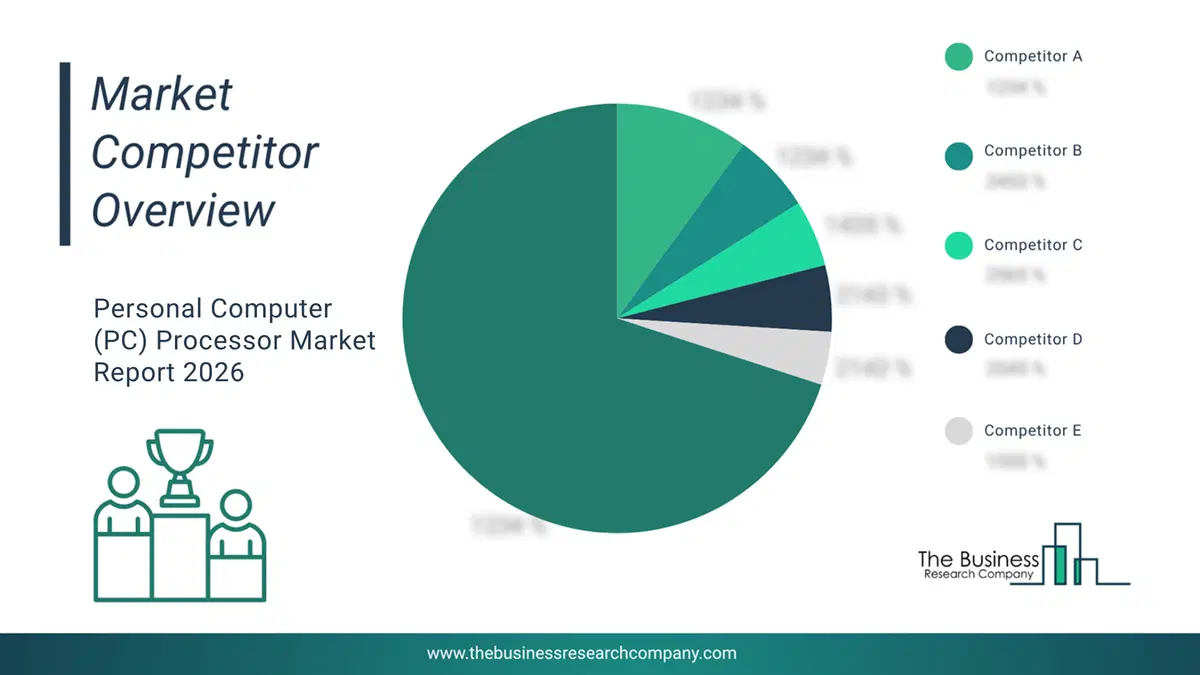
This chart is for illustrative purposes; the full report includes a detailed competitor analysis and comprehensive overview of the top 10 companies in the market.
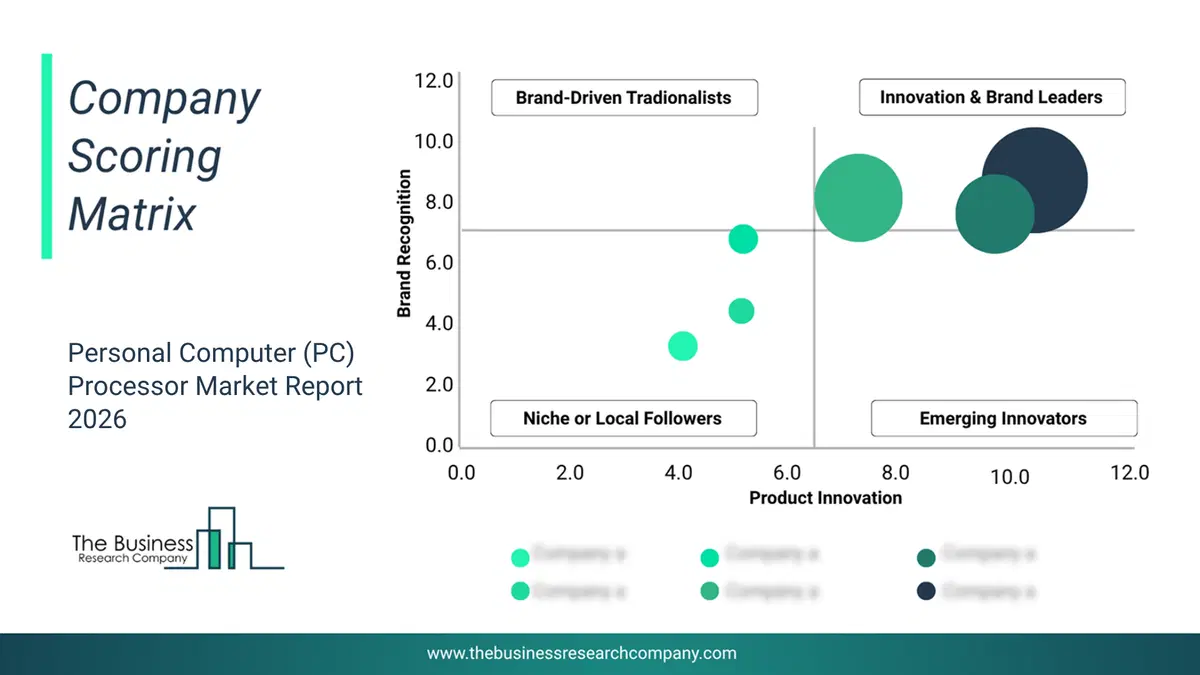
This chart maps companies by product innovation and brand strength, with bubble size indicating relative revenue, helping identify market leaders, challengers, and niche players. This is an illustrative chart; the full report provides a complete and accurate competitive analysis.
Global Personal Computer (PC) Processor Market Trends and Insights
Major companies operating in the personal computer (PC) processor market are focusing on developing advanced solutions, such as artificial intelligence (AI)-enabled processors, to deliver higher computing performance, improved power efficiency, and enhanced on-device AI capabilities. AI-enabled processors integrate dedicated neural processing units (NPUs) with central processing units (CPUs) and graphics processing units (GPUs) to accelerate AI workloads while reducing power consumption. For instance, in June 2024, Advanced Micro Devices (AMD), a US-based semiconductor company, unveiled its next-generation Zen 5 Ryzen AI 300 Series and Ryzen 9000 Series processors. The processors deliver up to 50 TOPS of AI performance with the XDNA 2 Neural Processing Unit (NPU), powered by the advanced Zen 5 architecture for faster and more efficient computing. They enhance gaming, content creation, and on-device AI applications while improving overall performance and power efficiency across desktop and laptop PCs.What Are Latest Mergers And Acquisitions In The Personal Computer (PC) Processor Market?
In May 2026, NVIDIA Corporation, a US-based semiconductor and artificial intelligence technology company, partnered with Microsoft Corporation to develop Windows PCs purpose-built for personal AI agents through NVIDIA RTX Spark. With this partnership, NVIDIA and Microsoft aimed to advance personal computing by combining NVIDIA’s high-performance AI hardware and software ecosystem with Windows-native security and agent capabilities, enabling secure, private, and locally run AI agents on next-generation PCs. Microsoft Corporation is a US-based technology company graphics processing units, CPUs, AI accelerators, and related computing technologies for personal computers, and data centers.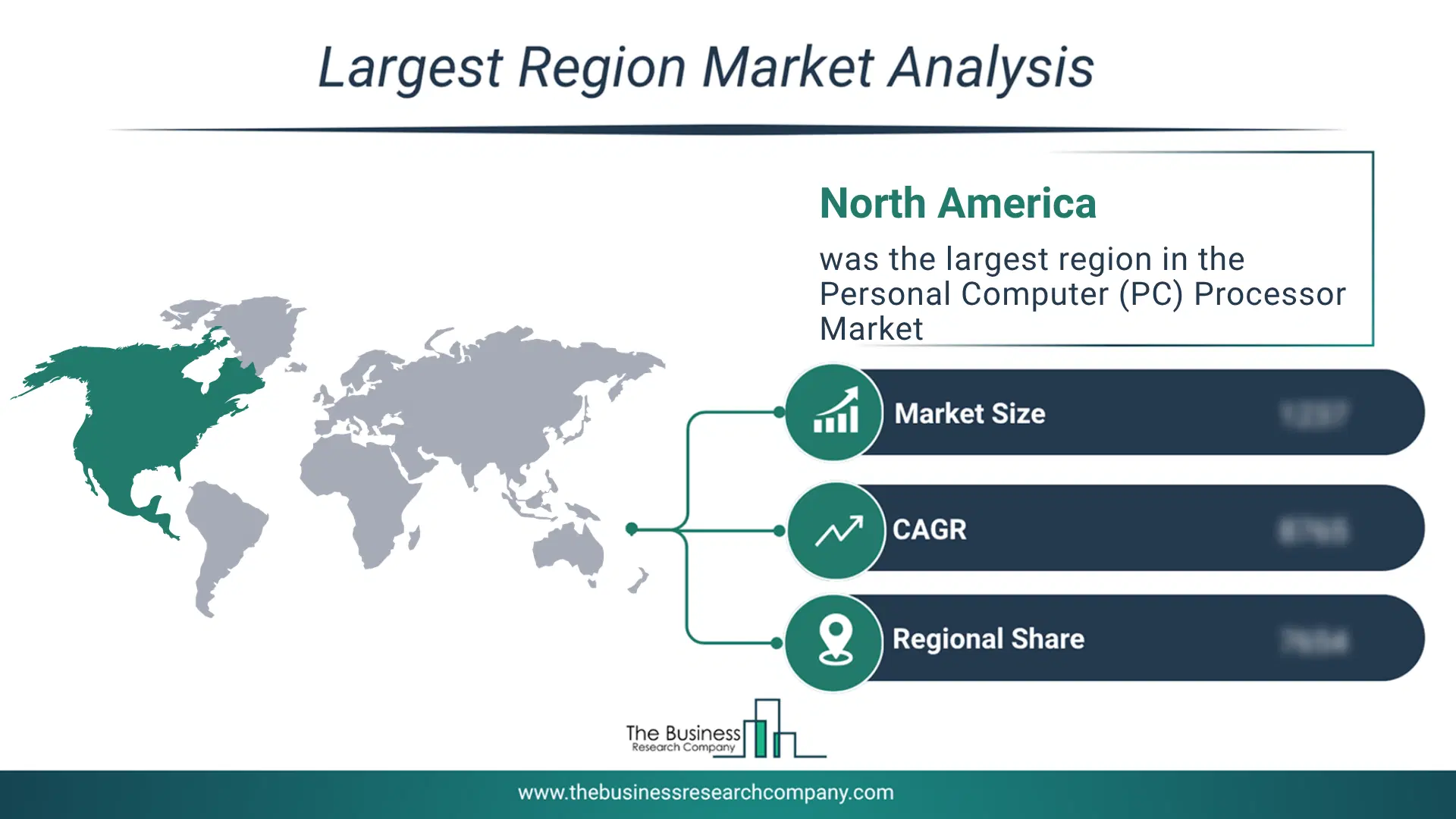
Regional Outlook
North America was the largest region in the personal computer (PC) processor market in 2025. Asia-Pacific is expected to be the fastest-growing region in the forecast period. The regions covered in this market report are Asia-Pacific, South East Asia, Western Europe, Eastern Europe, North America, South America, Middle East, Africa. The countries covered in this market report are Australia, Brazil, China, France, Germany, India, Indonesia, Japan, Taiwan, Russia, South Korea, UK, USA, Canada, Italy, Spain.What Defines the Personal Computer (PC) Processor Market?
The personal computer (PC) processor market consists of sales of chipset controllers, integrated processing units, and embedded processors. Values in this market are ‘factory gate’ values, that is, the value of goods sold by the manufacturers or creators of the goods, whether to other entities (including downstream manufacturers, wholesalers, distributors, and retailers) or directly to end customers. The value of goods in this market includes related services sold by the creators of the goods.How is Market Value Defined and Measured?
The market value is defined as the revenues that enterprises gain from the sale of goods and/or services within the specified market and geography through sales, grants, or donations in terms of the currency (in USD unless otherwise specified). The revenues for a specified geography are consumption values that are revenues generated by organizations in the specified geography within the market, irrespective of where they are produced. It does not include revenues from resales along the supply chain, either further along the supply chain or as part of other products.
This chart presents market attractiveness based on a quantitative evaluation of growth, competition, strategic alignment, and risk, offering a clear view of opportunity areas for decision-making. This chart is for illustrative purposes; the full report contains the complete analysis.

This chart highlights the Total Addressable Market (TAM) by estimating the maximum revenue opportunity using an assumption-driven approach, supporting strategic planning and opportunity sizing across markets. The chart is illustrative; the full report provides a more comprehensive analysis.
What Key Data and Analysis Are Included in the Personal Computer (PC) Processor Market Report 2026?
The personal computer (pc) processor market research report is one of a series of new reports from The Business Research Company that provides market statistics, including industry global market size, regional shares, competitors with the market share, detailed market segments, market trends and opportunities, and any further data you may need to thrive in the personal computer (pc) processor industry. The market research report delivers a complete perspective of everything you need, with an in-depth analysis of the current and future state of the industry.Personal Computer (PC) Processor Market Report Forecast Analysis
| Report Attribute | Details |
|---|---|
| Market Size Value In 2026 | $109.42 billion |
| Revenue Forecast In 2030 | $145.48 billion |
| Growth Rate | CAGR of 7.4% from 2026 to 2030 |
| Base Year For Estimation | 2025 |
| Actual Estimates/Historical Data | 2020-2025 |
| Forecast Period | 2026 - 2030 |
| Market Representation | Revenue in USD Billion and CAGR from 2026 to 2030 |
| Segments Covered | Product Type, Architecture, Power Class, Performance Tier, End User |
| Regional Scope | Asia-Pacific, Western Europe, Eastern Europe, North America, South America, Middle East, Africa |
| Country Scope | The countries covered in the report are Australia, Brazil, China, France, Germany, India, Indonesia, Japan, Taiwan, Russia, South Korea, UK, USA, Canada, Italy, Spain. |
| Key Companies Profiled | Apple Inc., NVIDIA Corporation, Huawei Technologies Co. Ltd., Intel Corporation, Qualcomm Incorporated, Advanced Micro Devices Inc., MediaTek Inc., Arm Holdings plc, Hygon Information Technology Co. Ltd., VeriSilicon Microelectronics (Shanghai) Co. Ltd., SiFive Inc., Rockchip Electronics Co. Ltd., Phytium Technology Co. Ltd., Codasip s.r.o., Loongson Technology Corporation Limited, Shanghai Zhaoxin Semiconductor Co. Ltd. |
| Customization Scope | Request for Customization |
| Pricing And Purchase Options | Explore Purchase Options |