
Personal Extended Reality Hardware Market Report 2026
Global Outlook – By Device Type (Virtual Reality Headsets, Augmented Reality Glasses, Mixed Reality Devices, Haptic Feedback Devices), By Connectivity (Wired, Wireless, Standalone), By Technology (Display Technology, Sensor Technology, Processing Technology, Audio Technology), By Distribution Channel (Online Retail, Offline Electronics Stores, Direct-To-Consumer), By End Use (Gaming, Training And Education, Healthcare, Entertainment) – Market Size, Trends, Strategies, and Forecast to 2030
Personal Extended Reality Hardware Market Overview
• Personal Extended Reality Hardware market size has reached to $16.97 billion in 2025 • Expected to grow to $37.56 billion in 2030 at a compound annual growth rate (CAGR) of 17.3% • Growth Driver: Growing Demand For Remote Work The Growth Of The Market Due To Enhanced Virtual Collaboration And Flexible Work Arrangements • Market Trend: Standalone Virtual Reality Devices Redefine Fully Wireless Immersive Gaming • North America was the largest region in 2025 and Asia-Pacific is the fastest growing region.What Is Covered Under Personal Extended Reality Hardware Market?
Personal extended reality hardware refers to consumer-focused devices that enable individuals to experience virtual, augmented, or mixed reality. This includes head-mounted displays, smart glasses, controllers, and integrated sensors designed for personal use. The hardware supports immersive visualization, interaction, and spatial computing across various applications. The main device types of personal extended reality hardware include virtual reality headsets, augmented reality glasses, mixed reality devices, and haptic feedback devices. Virtual reality headsets refer to wearable devices that immerse users in a fully digital environment through advanced display, sensor, and audio technologies. These devices are available with different connectivity options, including wired, wireless, and standalone. The technologies involved are display technology, sensor technology, processing technology, and audio technology and they are distributed through several channels such as online retail, offline electronics stores, and direct-to-consumer. The end users of personal extended reality hardware include gaming, training and education, healthcare, and entertainment.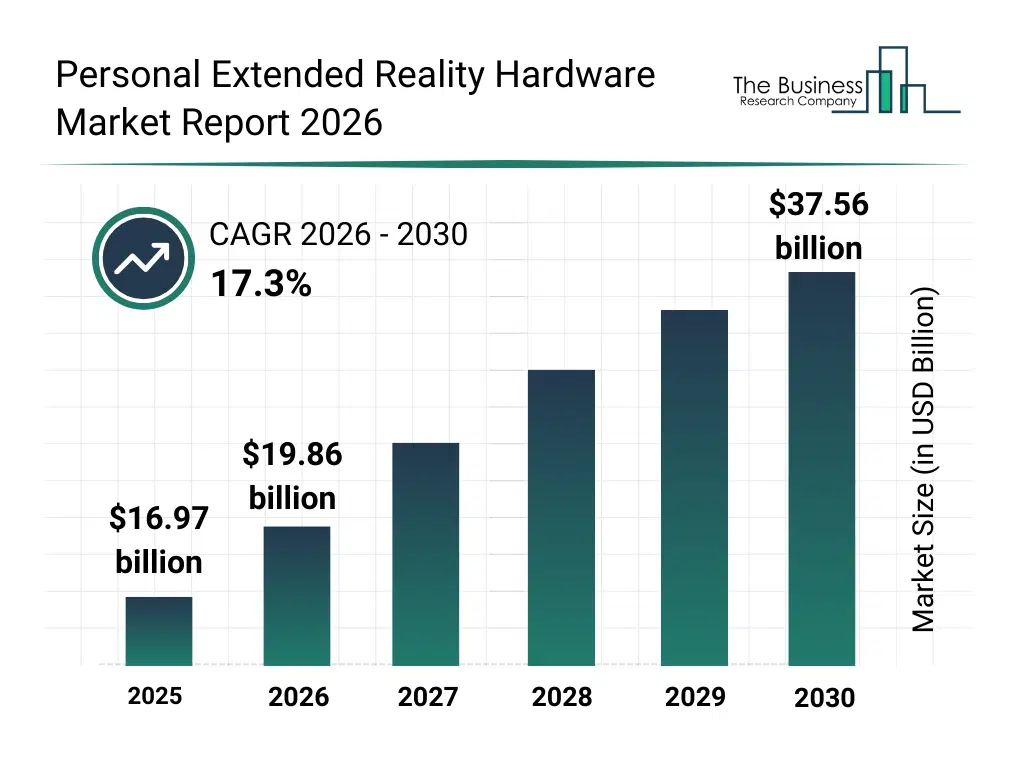
What Is The Personal Extended Reality Hardware Market Size and Share 2026?
The personal extended reality hardware market size has grown rapidly in recent years. It will grow from $16.97 billion in 2025 to $19.86 billion in 2026 at a compound annual growth rate (CAGR) of 17.0%. The growth in the historic period can be attributed to growth of gaming and immersive entertainment, advancements in display and sensor technologies, expansion of consumer electronics market, rise in digital content consumption, early adoption of vr headsets by tech enthusiasts.What Is The Personal Extended Reality Hardware Market Growth Forecast?
The personal extended reality hardware market size is expected to see rapid growth in the next few years. It will grow to $37.56 billion in 2030 at a compound annual growth rate (CAGR) of 17.3%. The growth in the forecast period can be attributed to increasing use of xr in training and education, growth of spatial computing applications, rising demand for mixed reality experiences, advancements in compact processing hardware, expansion of consumer metaverse platforms. Major trends in the forecast period include growing demand for lightweight and ergonomic head mounted displays, increasing integration of motion tracking sensors and spatial computing features, rising popularity of standalone xr devices without external hardware dependency, expansion of haptic feedback accessories for immersive interaction, rising focus on high resolution display and low latency performance.

Global Personal Extended Reality Hardware Market Segmentation
1) By Device Type: Virtual Reality Headsets, Augmented Reality Glasses, Mixed Reality Devices, Haptic Feedback Devices 2) By Connectivity: Wired, Wireless, Standalone 3) By Technology: Display Technology, Sensor Technology, Processing Technology, Audio Technology 4) By Distribution Channel: Online Retail, Offline Electronics Stores, Direct-To-Consumer 5) By End Use: Gaming, Training And Education, Healthcare, Entertainment Subsegments: 1) By Virtual Reality Headsets: Standalone Virtual Reality Headsets, Tethered Virtual Reality Headsets, Mobile Virtual Reality Headsets, Enterprise Virtual Reality Headsets 2) By Augmented Reality Glasses: Monocular Augmented Reality Glasses, Binocular Augmented Reality Glasses, Smart Augmented Reality Glasses, Industrial Augmented Reality Glasses 3) By Mixed Reality Devices: Head-Mounted Mixed Reality Displays, Spatial Computing Devices, Enterprise Mixed Reality Devices, Consumer Mixed Reality Devices 4) By Haptic Feedback Devices: Haptic Gloves, Haptic Vests And Suits, Haptic Controllers, Haptic Footwear And AccessoriesWhat Is The Driver Of The Personal Extended Reality Hardware Market?
The growing demand for remote work is expected to propel the growth of the personal extended reality hardware market going forward. Remote work refers to a working arrangement where employees perform their job duties outside of a traditional office, typically from home or any location with internet access. The growing demand for remote work is primarily driven by employees’ preference for better work-life balance, allowing them to manage personal and professional responsibilities more flexibly. Personal extended reality hardware enhances remote work by creating immersive, interactive virtual environments that enable real-time collaboration, spatial visualization, and hands-on training regardless of physical location. For instance, in February 2023, according to the Office for National Statistics, a UK-based government department, in Great Britain, about 38% of working adults worked from home in 2022, and this percentage increased to around 40% during the period from 2023. Therefore, the growing demand for remote work is driving the growth of the personal extended reality hardware industry.Key Players In The Global Personal Extended Reality Hardware Market
Major companies operating in the personal extended reality hardware market are Apple Inc., Microsoft Corporation, Samsung Electronics Co. Ltd., Meta Platforms Inc., Sony Group Corporation, Acer Inc., Valve Corporation, Magic Leap Inc., XREAL Inc., Pimax Innovation Inc., Varjo Technologies Oy, LLVision Technology Co. Ltd., Shanghai Deepoon Virtual Reality Technology Co. Ltd., RealWear Inc., NoloVR Co. Ltd., Rayneo Co. Ltd., VRgineers sro, Vuzix Corporation, AjnaLens Inc., Somnium Space Inc.
This chart is for illustrative purposes; the full report includes a detailed competitor analysis and comprehensive overview of the top 10 companies in the market.
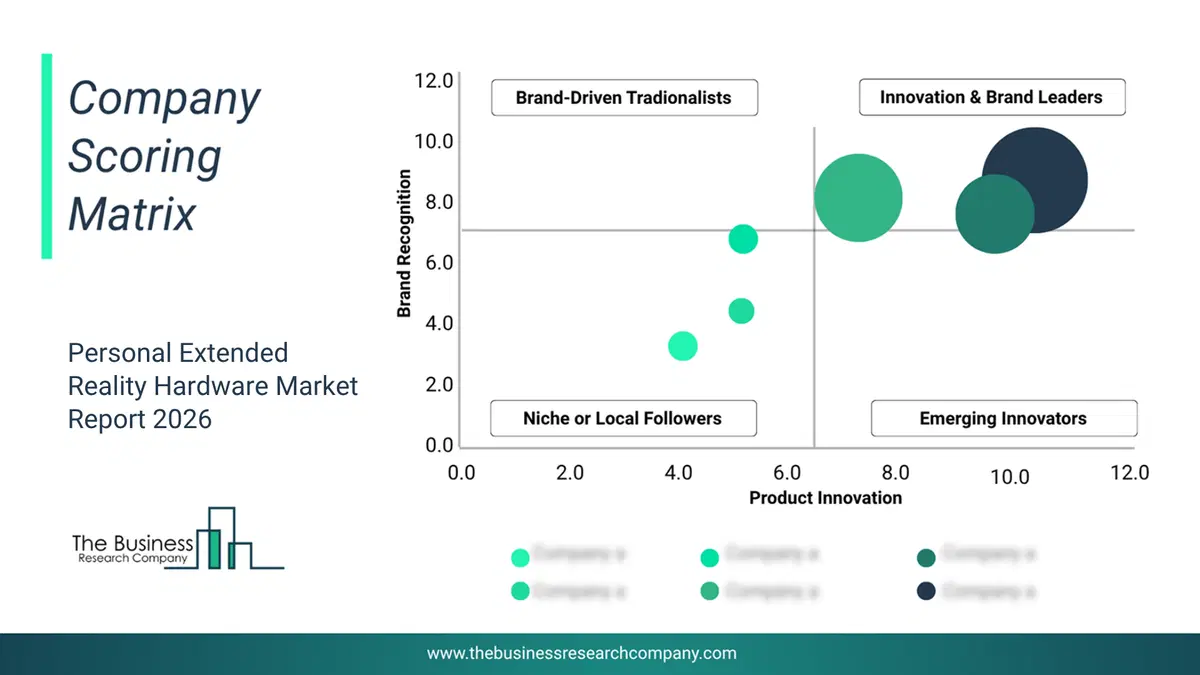
This chart maps companies by product innovation and brand strength, with bubble size indicating relative revenue, helping identify market leaders, challengers, and niche players. This is an illustrative chart; the full report provides a complete and accurate competitive analysis.
Global Personal Extended Reality Hardware Market Trends and Insights
Major companies operating in the personal extended reality hardware market are focusing on developing innovative solutions, such as standalone virtual reality headsets, to deliver immersive experiences without reliance on external PCs or consoles. Standalone virtual reality headsets are self-contained devices that run VR experiences independently, without needing a PC, console, or external sensors. For instance, in November 2025, Valve Corporation, a US-based video game company, launched Steam Frame, a standalone VR headset designed to let users access and play their entire Steam library portably, without needing a tethered PC. The device runs on SteamOS and supports both native gameplay and low-latency wireless streaming, enabling users to play VR and non-VR titles on a large virtual screen within the headset. Equipped with inside-out tracking, high-resolution displays, and advanced connectivity, Steam Frame delivers a fully wireless, immersive gaming experience. This launch reflects Valve’s broader strategy to expand the Steam ecosystem beyond PCs by blending portable computing with next-generation virtual reality.What Are Latest Mergers And Acquisitions In The Personal Extended Reality Hardware Market?
In October 2024, Infinite Reality Inc., a US-based technology company, acquired Zappar for $45 million. With this acquisition, Infinite Reality aimed to expand its immersive technology capabilities and enhance its extended reality (XR) product portfolio to better serve mobile, desktop, and headset-based experiences across global markets. Zappar Limited is a UK-based company that specializes in providing personal extended reality (XR) hardware.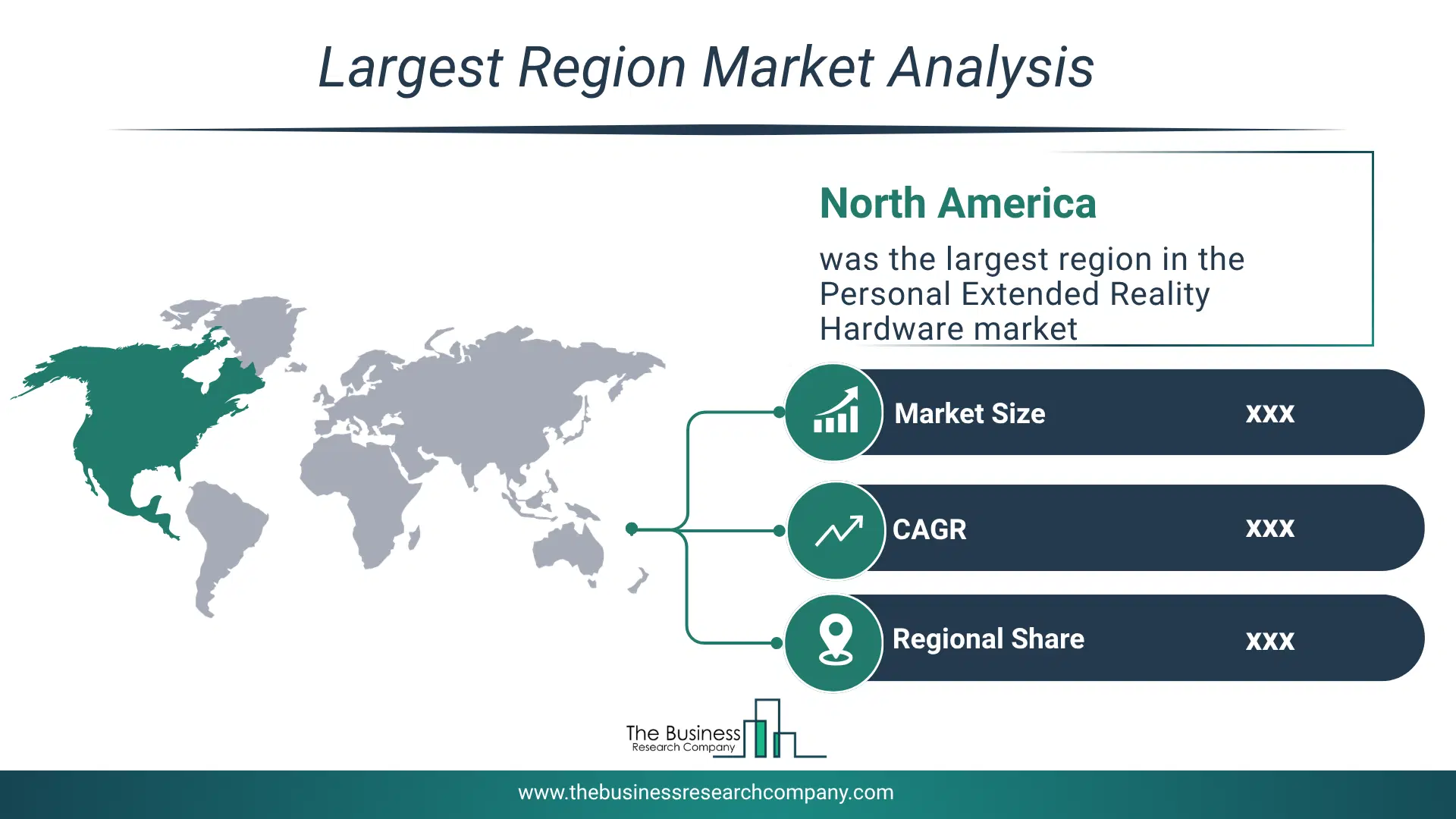
Regional Outlook
North America was the largest region in the personalized genomics market in 2025. Asia-Pacificis expected to be the fastest-growing region in the forecast period. The regions covered in this market report are Asia-Pacific, South East Asia, Western Europe, Eastern Europe, North America, South America, Middle East, Africa. The countries covered in this market report are Australia, Brazil, China, France, Germany, India, Indonesia, Japan, Taiwan, Russia, South Korea, UK, USA, Canada, Italy, Spain.What Defines the Personal Extended Reality Hardware Market?
The personal extended reality hardware market consists of revenues earned by entities by providing services such as developing, manufacturing, and distributing virtual reality headsets, augmented reality glasses, mixed reality devices, and haptic feedback systems, as well as offering support, maintenance, and software integration for these devices. The market value includes the value of related goods sold by the service provider or included within the service offering. The personal extended reality hardware market consists of sales of handheld controllers, motion tracking sensors, integrated cameras and displays, and related accessories. Values in this market are ‘factory gate’ values, that is, the value of goods sold by the manufacturers or creators of the goods, whether to other entities (including downstream manufacturers, wholesalers, distributors, and retailers) or directly to end customers. The value of goods in this market includes related services sold by the creators of the goods.How is Market Value Defined and Measured?
The market value is defined as the revenues that enterprises gain from the sale of goods and/or services within the specified market and geography through sales, grants, or donations in terms of the currency (in USD unless otherwise specified). The revenues for a specified geography are consumption values that are revenues generated by organizations in the specified geography within the market, irrespective of where they are produced. It does not include revenues from resales along the supply chain, either further along the supply chain or as part of other products.
This chart presents market attractiveness based on a quantitative evaluation of growth, competition, strategic alignment, and risk, offering a clear view of opportunity areas for decision-making. This chart is for illustrative purposes; the full report contains the complete analysis.

This chart highlights the Total Addressable Market (TAM) by estimating the maximum revenue opportunity using an assumption-driven approach, supporting strategic planning and opportunity sizing across markets. The chart is illustrative; the full report provides a more comprehensive analysis.
What Key Data and Analysis Are Included in the Personal Extended Reality Hardware Market Report 2026?
The personal extended reality hardware market research report is one of a series of new reports from The Business Research Company that provides market statistics, including industry global market size, regional shares, competitors with the market share, detailed market segments, market trends and opportunities, and any further data you may need to thrive in the personal extended reality hardware industry. The market research report delivers a complete perspective of everything you need, with an in-depth analysis of the current and future state of the industry.Personal Extended Reality Hardware Market Report Forecast Analysis
| Report Attribute | Details |
|---|---|
| Market Size Value In 2026 | $19.86 billion |
| Revenue Forecast In 2030 | $37.56 billion |
| Growth Rate | CAGR of 17.0% from 2026 to 2030 |
| Base Year For Estimation | 2025 |
| Actual Estimates/Historical Data | 2020-2025 |
| Forecast Period | 2026 - 2030 |
| Market Representation | Revenue in USD Billion and CAGR from 2026 to 2030 |
| Segments Covered | Device Type, Connectivity, Technology, Distribution Channel, End Use |
| Regional Scope | Asia-Pacific, Western Europe, Eastern Europe, North America, South America, Middle East, Africa |
| Country Scope | The countries covered in the report are Australia, Brazil, China, France, Germany, India, Indonesia, Japan, Taiwan, Russia, South Korea, UK, USA, Canada, Italy, Spain. |
| Key Companies Profiled | Apple Inc., Microsoft Corporation, Samsung Electronics Co. Ltd., Meta Platforms Inc., Sony Group Corporation, Acer Inc., Valve Corporation, Magic Leap Inc., XREAL Inc., Pimax Innovation Inc., Varjo Technologies Oy, LLVision Technology Co. Ltd., Shanghai Deepoon Virtual Reality Technology Co. Ltd., RealWear Inc., NoloVR Co. Ltd., Rayneo Co. Ltd., VRgineers sro, Vuzix Corporation, AjnaLens Inc., Somnium Space Inc. |
| Customization Scope | Request for Customization |
| Pricing And Purchase Options | Explore Purchase Options |